United Arab Emirates (UAE) Medium Density Fiberboard Market Size, Share & Growth Rate
The United Arab Emirates (UAE) Medium Density Fiberboard Market was estimated at USD 160 Million in 2025 and is projected to reach USD 220 Million by 2032, growing at a CAGR of 4.7% from 2026 to 2032. This promising trajectory is largely attributed to the ongoing construction boom and a robust demand for interior furnishings across various sectors. The shift towards sustainable materials further enhances the markets growth prospects, as stakeholders increasingly prioritize eco-friendly solutions in their projects.
United Arab Emirates (UAE) Medium Density Fiberboard Market Year-wise Growth Rate and Key Drivers
This graph highlights how the United Arab Emirates (UAE) Medium Density Fiberboard Market has steadily grown over the years, supported by major growth factors.
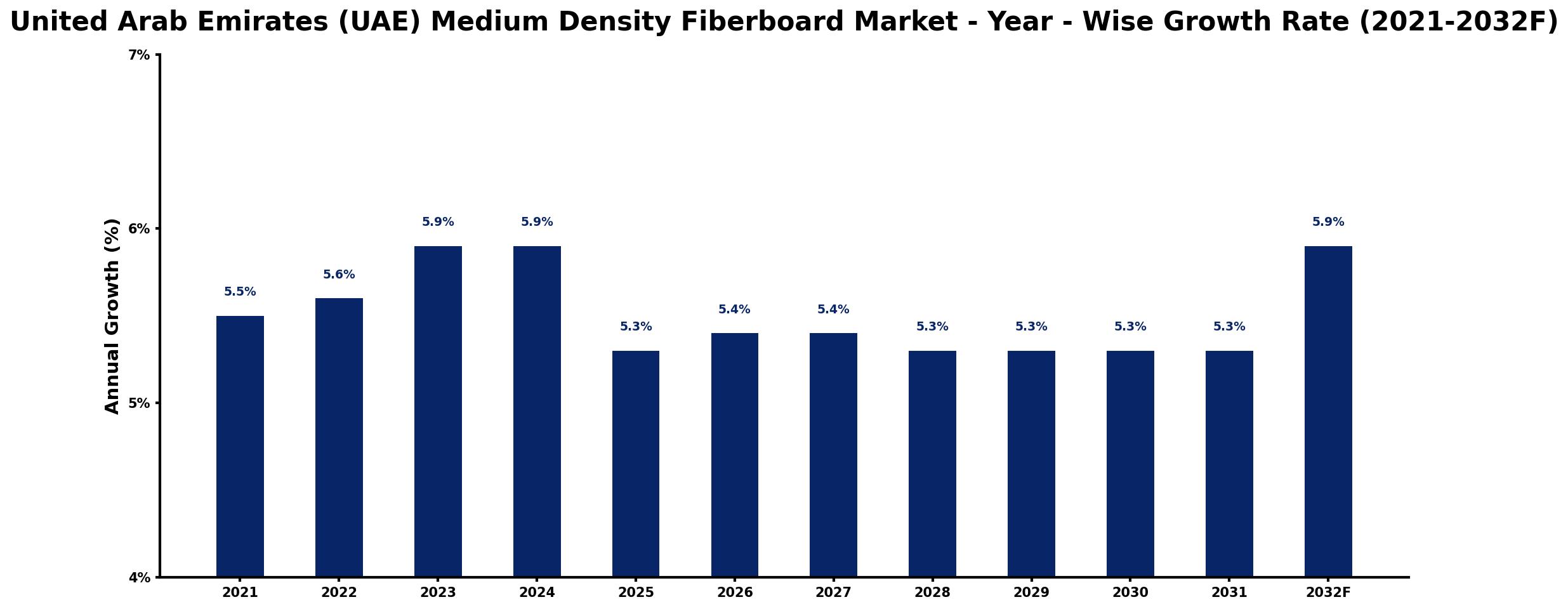
The table below presents the year‑wise growth rates along with the key drivers influencing the market
| Year | Growth Rate | Major Drivers |
| 2021 | 5.5% | Construction sector recovery momentum |
| 2022 | 5.6% | Increased residential building projects |
| 2023 | 5.9% | Growing demand for sustainable materials |
| 2024 | 5.9% | Expansion of furniture manufacturing capacity |
| 2025 | 5.3% | Rise in interior design trends |
| 2026 | 5.4% | Boost in retail fixture installations |
| 2027 | 5.4% | Surge in home renovation activities |
| 2028 | 5.3% | Investments in construction technology |
| 2029 | 5.3% | Emergence of new export markets |
| 2030 | 5.3% | Strengthening of logistics networks |
| 2031 | 5.3% | Increased focus on eco-friendly solutions |
| 2032 | 5.9% | Growth in hospitality sector developments |
Note: Market size estimations and growth projections presented in this report are based on 6Wresearch's proprietary forecasting methodology, utilizing the latest available industry data, government publications, and primary research inputs.
United Arab Emirates (UAE) Medium Density Fiberboard Market Synopsis
In recent years, the UAE Medium Density Fiberboard (MDF) market has shown significant momentum, driven by a resurgence in the construction and furniture sectors. However, as the industry heads towards 2032, it faces both opportunities and challenges, particularly in terms of sustainability and raw material sourcing.
Looking forward, the demand for MDF is expected to remain strong as urbanization and population growth fuel the need for innovative interior solutions. While the market continues to adapt to fluctuations in supply chains and evolving consumer preferences, its alignment with sustainable construction practices positions it well for future growth.
United Arab Emirates (UAE) Medium Density Fiberboard Market Key Takeaways
- Robust growth projected due to increasing demand for sustainable building materials.
- Urbanization and population growth are significant drivers behind the MDF market expansion.
- Rising DIY projects and home renovations have influenced consumer behavior positively.
- Challenges from imported raw materials necessitate strategic sourcing solutions.
- Competitive dynamics among manufacturers may impact profitability and innovation.
Evaluation of Restraints in United Arab Emirates (UAE) Medium Density Fiberboard Market
The UAE Medium Density Fiberboard market is constrained by several key factors that need consideration. A primary challenge is the heavy dependence on imported raw materials, which exposes manufacturers to price volatility and supply chain uncertainties. Additionally, the push for greener production methods introduces complexities and higher costs, potentially hindering profitability. Furthermore, competition from alternative materials, such as engineered wood and plastic options, presents a challenge to market share, necessitating innovation to retain consumer interest. These restraints underline the importance of strategic planning and adaptability for stakeholders in this market.
United Arab Emirates (UAE) Medium Density Fiberboard Market Trends
The current landscape of the UAE Medium Density Fiberboard market is shaped by several emerging trends. The increasing popularity of eco-friendly products aligns with global sustainability initiatives, pushing manufacturers to innovate with greener materials. Furthermore, the rise of smart homes and advanced interior design solutions emphasizes the demand for versatile MDF applications. Digitalization within the supply chain, including automated manufacturing processes, is also gaining traction, enhancing operational efficiencies. These trends collectively mark a pivotal shift toward a more sustainable and technologically advanced MDF market in the UAE.
United Arab Emirates (UAE) Medium Density Fiberboard Market Opportunities
The UAE Medium Density Fiberboard market presents various growth opportunities that savvy investors and manufacturers can capitalize on. As the construction sector continues to expand, the need for innovative MDF solutions tailored to specific applications—such as cabinetry and furniture—is becoming increasingly pronounced. There is also a significant market gap for affordable, eco-friendly MDF products, particularly among environmentally conscious consumers and businesses. By focusing on sustainable production methods and value-added services, companies can differentiate themselves in a competitive market and tap into this burgeoning demand.
Government Initiatives in the United Arab Emirates (UAE) Medium Density Fiberboard Market
The UAE government has initiated several programs to promote sustainable construction practices and support the medium density fiberboard market. Policies focused on environmental sustainability encourage manufacturers to adopt greener production processes and improve efficiency. Additionally, public spending on infrastructure and residential development is aimed at boosting the construction sector, indirectly benefiting the MDF market. These government initiatives play a crucial role in driving investment and fostering an environment conducive to growth in the medium density fiberboard sector.
Future Insights of the United Arab Emirates (UAE) Medium Density Fiberboard Market
Between 2026 and 2032, the UAE Medium Density Fiberboard market is expected to evolve significantly. As consumer preferences shift towards sustainability, manufacturers who innovate their product offerings will likely lead the way. The ongoing urbanization trend will continue to spur demand for MDF products in construction and furniture applications. Moreover, advancements in technology, coupled with strategic collaborations among industry players, will enhance product quality and operational efficiency. As the market matures, understanding these dynamics will be critical for stakeholders aiming to leverage emerging opportunities.
United Arab Emirates (UAE) Medium Density Fiberboard Market Latest Developments (2025 - 2026)
Recent developments in the UAE Medium Density Fiberboard market indicate a shift towards more sustainable practices, with increasing investments in research and development for eco-friendly MDF products. Notably, several manufacturers are exploring partnerships to enhance their supply chain resilience and reduce dependency on imported raw materials. Additionally, consumer-driven trends highlighting DIY projects are influencing product innovation, leading to a broader range of designs and applications being introduced to the market. These developments signal a proactive approach within the industry to adapt to changing consumer behaviors and market conditions.
United Arab Emirates (UAE) Medium Density Fiberboard Market - Key Attractiveness of the Report
- 10 Years of Market Numbers
- Historical Data Starting from 2022 to 2025
- Base Year: 2025
- Forecast Data until 2032
- Key Performance Indicators Impacting the Market
- Major Upcoming Developments and Projects
Key Highlights of the Report:
- United Arab Emirates (UAE) Medium Density Fiberboard Market Outlook
- Market Size of United Arab Emirates (UAE) Medium Density Fiberboard Market, 2025
- Forecast of United Arab Emirates (UAE) Medium Density Fiberboard Market, 2032
- Historical Data and Forecast of United Arab Emirates (UAE) Medium Density Fiberboard Revenues & Volume for the Period 2022-2032F
- United Arab Emirates (UAE) Medium Density Fiberboard Market Trend Evolution
- United Arab Emirates (UAE) Medium Density Fiberboard Market Drivers and Challenges
- United Arab Emirates (UAE) Medium Density Fiberboard Price Trends
- United Arab Emirates (UAE) Medium Density Fiberboard Porter's Five Forces
- United Arab Emirates (UAE) Medium Density Fiberboard Industry Life Cycle
- Historical Data and Forecast of United Arab Emirates (UAE) Medium Density Fiberboard Market Revenues & Volume By Type for the Period 2022-2032F
- Historical Data and Forecast of United Arab Emirates (UAE) Medium Density Fiberboard Market Revenues & Volume By Standard for the Period 2022-2032F
- Historical Data and Forecast of United Arab Emirates (UAE) Medium Density Fiberboard Market Revenues & Volume By Moisture Resistant for the Period 2022-2032F
- Historical Data and Forecast of United Arab Emirates (UAE) Medium Density Fiberboard Market Revenues & Volume By Fire-Rated for the Period 2022-2032F
- Historical Data and Forecast of United Arab Emirates (UAE) Medium Density Fiberboard Market Revenues & Volume By Application for the Period 2022-2032F
- Historical Data and Forecast of United Arab Emirates (UAE) Medium Density Fiberboard Market Revenues & Volume By Furniture for the Period 2022-2032F
- Historical Data and Forecast of United Arab Emirates (UAE) Medium Density Fiberboard Market Revenues & Volume By Construction & Flooring for the Period 2022-2032F
- Historical Data and Forecast of United Arab Emirates (UAE) Medium Density Fiberboard Market Revenues & Volume By Interior Designing for the Period 2022-2032F
- Historical Data and Forecast of United Arab Emirates (UAE) Medium Density Fiberboard Market Revenues & Volume By Packaging Systems for the Period 2022-2032F
- Historical Data and Forecast of United Arab Emirates (UAE) Medium Density Fiberboard Market Revenues & Volume By Others for the Period 2022-2032F
- United Arab Emirates (UAE) Medium Density Fiberboard Import Export Trade Statistics
- Market Opportunity Assessment By Type
- Market Opportunity Assessment By Application
- United Arab Emirates (UAE) Medium Density Fiberboard Top Companies Market Share
- United Arab Emirates (UAE) Medium Density Fiberboard Competitive Benchmarking By Technical and Operational Parameters
- United Arab Emirates (UAE) Medium Density Fiberboard Company Profiles
- United Arab Emirates (UAE) Medium Density Fiberboard Key Strategic Recommendations






































