United Arab Emirates (UAE) Metal Shredder Machine Market Size, Share & Growth Rate
The United Arab Emirates (UAE) Metal Shredder Machine Market was estimated at USD 488 Million in 2025 and is projected to reach USD 670 Million by 2032, growing at a CAGR of 4.6% from 2026 to 2032. This upward trajectory is driven primarily by the increasing emphasis on sustainable waste management and recycling practices within the region. As industries strive for more efficient waste processing solutions, the demand for advanced metal shredder technologies continues to rise, solidifying the market's growth potential.
United Arab Emirates (UAE) Metal Shredder Machine Market Year-wise Growth Rate and Key Drivers
This graph highlights how the United Arab Emirates (UAE) Metal Shredder Machine Market has steadily grown over the years, supported by major growth factors.
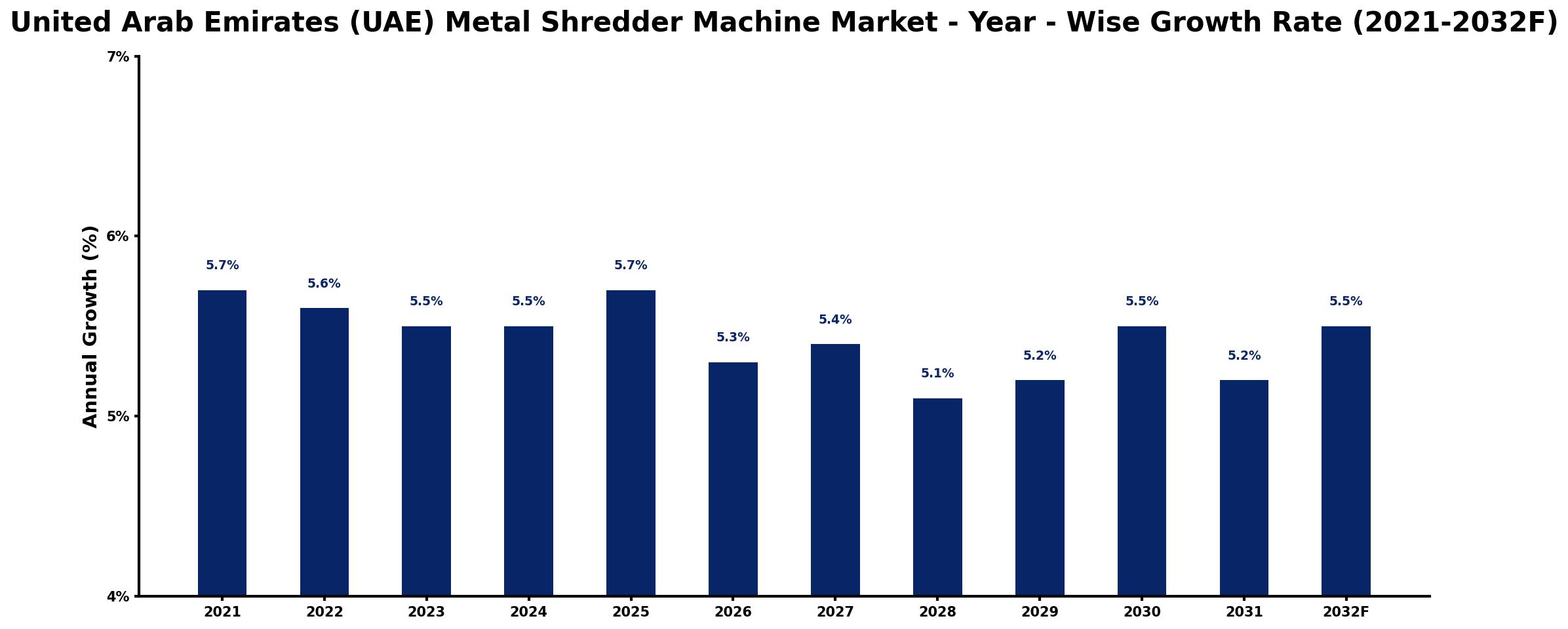
The table below presents the year‑wise growth rates along with the key drivers influencing the market
| Year | Growth Rate | Major Drivers |
| 2021 | 5.7% | Rising recycling industry investments |
| 2022 | 5.6% | Growing demand for sustainable practices |
| 2023 | 5.5% | Expansion of construction activities |
| 2024 | 5.5% | Increased focus on waste management |
| 2025 | 5.7% | Surge in automotive sector recycling |
| 2026 | 5.3% | Boost in industrial production rates |
| 2027 | 5.4% | Emerging technologies in recycling |
| 2028 | 5.1% | Regulatory support for recycling initiatives |
| 2029 | 5.2% | Enhanced consumer awareness programs |
| 2030 | 5.5% | Growth in renewable energy projects |
| 2031 | 5.2% | Strengthening circular economy initiatives |
| 2032 | 5.5% | Investments in infrastructure upgrades |
Note: Market size estimations and growth projections presented in this report are based on 6Wresearch's proprietary forecasting methodology, utilizing the latest available industry data, government publications, and primary research inputs.
United Arab Emirates (UAE) Metal Shredder Machine Market Synopsis
The UAE Metal Shredder Machine Market is witnessing dynamic developments, attributed largely to heightened environmental awareness and stringent recycling regulations. Organizations are increasingly adopting shredding technologies to manage metal scrap effectively, facilitating the recycling process and supporting national sustainability goals.
Innovative advancements in shredder technologies are streamlining operations, enhancing efficiency, and minimizing operational costs. With a growing focus on the circular economy, the role of metal shredders in resource recovery and waste reduction is becoming increasingly vital in the UAE's industrial landscape.
United Arab Emirates (UAE) Metal Shredder Machine Market Key Takeaways
- The market is poised for substantial growth due to increasing regulations on recycling and waste management.
- Innovative shredding technologies are enhancing operational efficiency in processing metal scrap.
- Key drivers include the demand for sustainable waste management solutions and secure disposal of sensitive materials.
- Operational challenges arise from the need for skilled technicians and fluctuating raw material prices.
- The COVID-19 pandemic initially disrupted operations but has led to renewed interest in advanced shredding technologies.
Evaluation of Restraints in United Arab Emirates (UAE) Metal Shredder Machine Market
The UAE Metal Shredder Machine Market is currently navigating several significant restraints. One of the most pressing challenges stems from stringent regulatory frameworks surrounding environmental emissions and waste disposal. Compliance with these regulations often requires substantial investments in technology upgrades, which can strain manufacturer resources. Furthermore, a shortage of skilled technicians familiar with advanced shredding systems is creating operational inefficiencies, leading to increased downtime and maintenance costs. This operational friction can stifle profitability and slow the overall growth of the market. Additionally, the volatility of raw material prices, particularly steel, poses a threat to the financial viability of shredding operations.
United Arab Emirates (UAE) Metal Shredder Machine Market Trends
A pivotal trend in the UAE Metal Shredder Machine Market is the integration of automation and digital technologies into shredding operations. This shift not only enhances operational efficiency but also allows for better tracking and management of recycling processes. Moreover, an increasing number of companies are focusing on environmentally-friendly shredding solutions that comply with local regulations. The push towards a circular economy is also compelling businesses to invest in advanced shredding technologies, which can convert metal waste into reusable resources.
United Arab Emirates (UAE) Metal Shredder Machine Market Opportunities
Emerging opportunities within the UAE Metal Shredder Machine Market are substantial, particularly as businesses increasingly embrace sustainability initiatives. The growth of the construction sector, with its significant metal waste generation, represents a lucrative target for shredding technologies. Furthermore, partnerships between public and private sectors to improve recycling infrastructure create avenues for investment and expansion. The potential for developing advanced, efficient shredding technologies that cater to specific industry needs further enhances the scope for growth in this market.
Government Initiatives in the United Arab Emirates (UAE) Metal Shredder Machine Market
The UAE government is actively promoting sustainability through various initiatives aimed at enhancing waste management and recycling practices. Policies encouraging recycling and stricter regulations on waste disposal drive demand for metal shredding solutions. Additionally, public spending on infrastructure improvements and recycling facilities signals strong governmental support for the growth of the shredding industry. Programs aimed at fostering technological advancements in waste processing further underline the commitment to sustainability and resource recovery in the UAE.
Future Insights of the United Arab Emirates (UAE) Metal Shredder Machine Market
Looking ahead to the period between 2026 and 2032, the UAE Metal Shredder Machine Market is expected to undergo significant transformations. The continued push towards sustainability, coupled with advancements in shredding technologies, will likely drive innovation in this space. As industries increasingly prioritize efficiency in waste management, there will be a heightened focus on developing shredders that not only meet regulatory requirements but also contribute positively to the circular economy. This future outlook presents exciting possibilities for stakeholders as the market evolves in response to both environmental imperatives and technological advancements.
United Arab Emirates (UAE) Metal Shredder Machine Market Latest Developments (2025 - 2026)
In the most recent months, the UAE Metal Shredder Machine Market has seen a surge in interest towards innovative technologies that enhance metal recycling processes. Companies are increasingly exploring collaborative efforts aimed at improving shredding efficiency and compliance with environmental standards. Moreover, as the region's economy recovers from the impacts of the COVID-19 pandemic, more stakeholders are investing in advanced shredding solutions to meet the growing demands of the recycling sector.
United Arab Emirates (UAE) Metal Shredder Machine Market - Key Attractiveness of the Report
- 10 Years of Market Numbers
- Historical Data Starting from 2022 to 2025
- Base Year: 2025
- Forecast Data until 2032
- Key Performance Indicators Impacting the Market
- Major Upcoming Developments and Projects
Key Highlights of the Report:
- United Arab Emirates (UAE) Metal Shredder Machine Market Outlook
- Market Size of United Arab Emirates (UAE) Metal Shredder Machine Market, 2025
- Forecast of United Arab Emirates (UAE) Metal Shredder Machine Market, 2032
- Historical Data and Forecast of United Arab Emirates (UAE) Metal Shredder Machine Revenues & Volume for the Period 2022-2032F
- United Arab Emirates (UAE) Metal Shredder Machine Market Trend Evolution
- United Arab Emirates (UAE) Metal Shredder Machine Market Drivers and Challenges
- United Arab Emirates (UAE) Metal Shredder Machine Price Trends
- United Arab Emirates (UAE) Metal Shredder Machine Porter's Five Forces
- United Arab Emirates (UAE) Metal Shredder Machine Industry Life Cycle
- Historical Data and Forecast of United Arab Emirates (UAE) Metal Shredder Machine Market Revenues & Volume By Type for the Period 2022-2032F
- Historical Data and Forecast of United Arab Emirates (UAE) Metal Shredder Machine Market Revenues & Volume By Mechanical Shredder Machine for the Period 2022-2032F
- Historical Data and Forecast of United Arab Emirates (UAE) Metal Shredder Machine Market Revenues & Volume By Shock Wave Shredder Machine for the Period 2022-2032F
- Historical Data and Forecast of United Arab Emirates (UAE) Metal Shredder Machine Market Revenues & Volume By Application for the Period 2022-2032F
- Historical Data and Forecast of United Arab Emirates (UAE) Metal Shredder Machine Market Revenues & Volume By Iron and Steel for the Period 2022-2032F
- Historical Data and Forecast of United Arab Emirates (UAE) Metal Shredder Machine Market Revenues & Volume By Aluminum and Copper for the Period 2022-2032F
- Historical Data and Forecast of United Arab Emirates (UAE) Metal Shredder Machine Market Revenues & Volume By Non-Ferrous Metals for the Period 2022-2032F
- United Arab Emirates (UAE) Metal Shredder Machine Import Export Trade Statistics
- Market Opportunity Assessment By Type
- Market Opportunity Assessment By Application
- United Arab Emirates (UAE) Metal Shredder Machine Top Companies Market Share
- United Arab Emirates (UAE) Metal Shredder Machine Competitive Benchmarking By Technical and Operational Parameters
- United Arab Emirates (UAE) Metal Shredder Machine Company Profiles
- United Arab Emirates (UAE) Metal Shredder Machine Key Strategic Recommendations






































