United Arab Emirates (UAE) Mortar Market Summary
The united arab emirates (uae) mortar market was estimated at USD 462 Million in 2025 and is projected to reach USD 638 Million by 2032, growing at a CAGR of 5.2% from 2026 to 2032.
United Arab Emirates (UAE) Mortar Market Year-wise Growth Rate and Key Drivers
This graph highlights how the United Arab Emirates (UAE) Mortar Market has steadily grown over the past five years, supported by major growth factors.
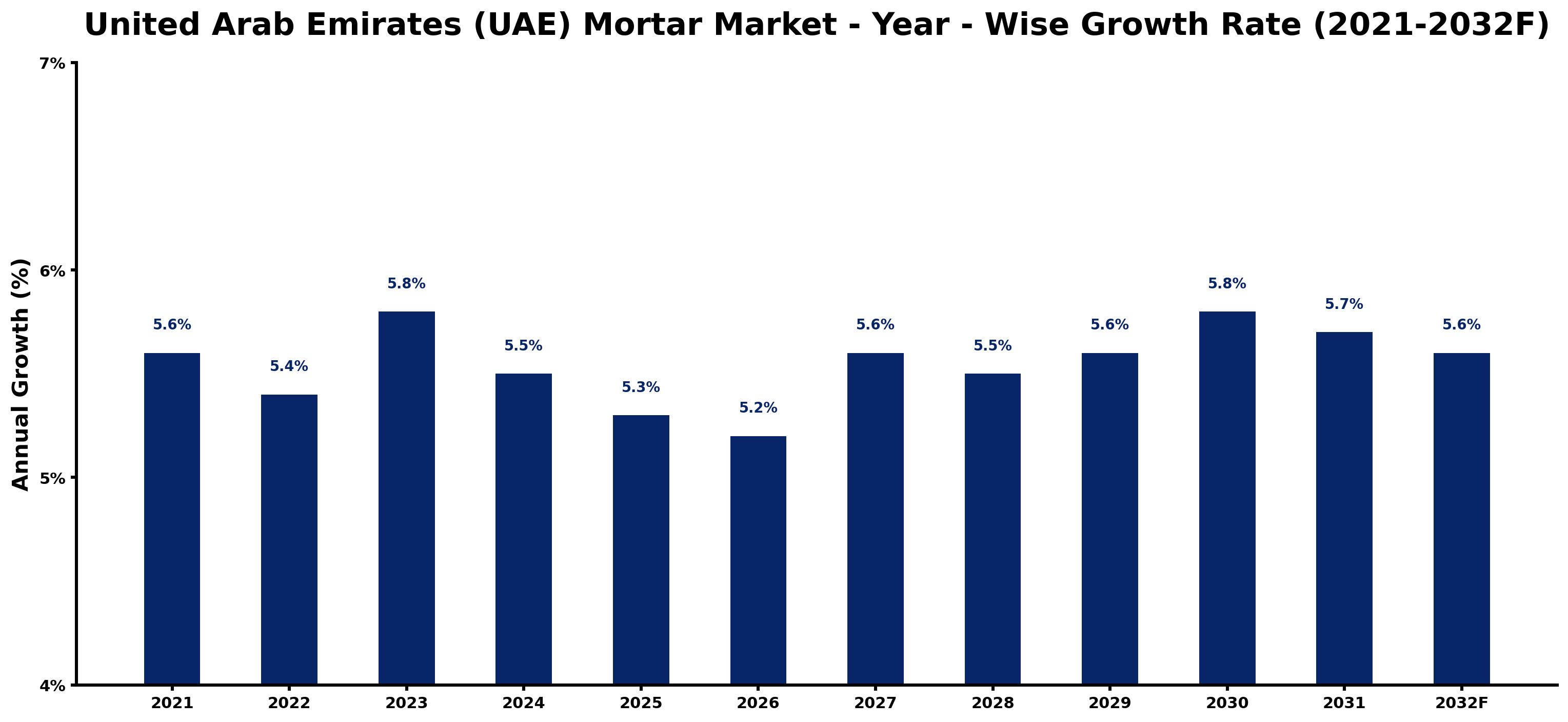
The table below presents the year wise growth rates along with the key drivers influencing the market
| Year | Growth Rate | Major Drivers |
| 2021 | 5.6% | Post-lockdown retail projects increased infrastructure spending across the UAE construction sector. |
| 2022 | 5.4% | The country's ambitious Expo 2020 showcased significant investment in urban development projects. |
| 2023 | 5.8% | Emerging luxury real estate developments highlighted a need for high-quality mortar solutions. |
| 2024 | 5.5% | Ongoing demand for eco-friendly construction materials influences supplier offerings in the market. |
| 2025 | 5.3% | Expansion of the UAE's tourism sector drives the construction of new hospitality properties. |
| 2026 | 5.2% | Local manufacturing initiatives support more resilient supply chains for mortar products. |
| 2027 | 5.6% | Integration of smart building technologies impacts the specifications for mortar applications. |
| 2028 | 5.5% | UAE's commitment to sustainability aligns with increased demand for green construction materials. |
| 2029 | 5.6% | Major infrastructure projects for public transport enhance the mortar market's growth potential. |
| 2030 | 5.8% | Investment in renewable energy projects necessitates advanced materials for construction durability. |
| 2031 | 5.7% | Urbanization trends push for innovative solutions in high-density residential projects. |
| 2032 | 5.6% | The foresight of mega projects like Neom ensures consistent demand for construction materials. |
Note - Market size estimations and growth projections presented in this report are based on 6Wresearch's advanced forecasting approach, validated with industry datasets as of June 2026.
United Arab Emirates (UAE) Mortar Market Synopsis
The United Arab Emirates (UAE) Mortar Market is projected to reach 5.2% and witness significant growth during the forecast period (2026-2032). This market encompasses the production, distribution, and sale of mortar, a composite material of sand, cement, and water utilized primarily as a binding agent in construction and masonry. Mortar's vital role in the UAE's thriving construction sector is underscored by its use in numerous infrastructure projects, residential complexes, and commercial edifices. The expected expansion of the market is driven by rapid urbanization, increased construction activities, and the rising demand for high-quality, durable construction materials.
United Arab Emirates (UAE) Mortar Market Growth Drivers
The primary growth drivers of the UAE mortar market include:
- The rapid urbanization within the UAE, leading to the continuous development of new cities, roads, and buildings, inevitably creates a consistent demand for mortar as a fundamental construction material.
- Increased public and private sector investment in infrastructure projects, which necessitates the use of advanced mortar solutions for improved durability and sustainability.
- The growing trend of modern architectural designs that require specialized mortar products tailored for specific applications, such as high-temperature resistance or water-proofing.
- The influx of expatriates and the subsequent rise in residential construction, leading to a heightened need for high-quality mortar products to ensure structural integrity and longevity.
- Government initiatives aimed at enhancing the construction sector, including incentives for using sustainable materials, driving the demand for innovative mortar solutions.
United Arab Emirates (UAE) Mortar Market Challenges and Restraints
Despite the positive growth trajectory, the UAE mortar market contends with several challenges that could impact its sustainability:
- Fluctuating raw material costs pose a significant challenge, as variations in the prices of essential components like cement and sand directly affect the overall production cost of mortar.
- Supply chain disruptions, exacerbated by global economic fluctuations, can hinder timely delivery and availability of raw materials needed for mortar production.
- Environmental regulations and sustainability concerns necessitate a shift towards eco-friendly manufacturing practices, which can require substantial investment and adaptation by producers.
- Intense competition within the market may lead to price wars, impacting profitability and discouraging investment in research and development for new mortar formulations.
- The impact of external economic factors, including geopolitical tensions and global market instability, can affect investment inflows and demand for construction materials in the UAE.
United Arab Emirates (UAE) Mortar Market Government Investment and Initiatives
The UAE government plays a pivotal role in promoting growth within the mortar market through various investments and initiatives:
- Substantial public spending on infrastructure projects, including road expansions, public transport systems, and urban development plans, stimulates demand for mortar.
- Strategic development plans, such as Vision 2040, emphasize sustainable urban development and infrastructure improvement, creating opportunities for mortar suppliers.
- Government incentives aimed at adopting advanced construction techniques and materials have been introduced to enhance the quality and sustainability of construction practices.
- Public-private partnerships have been initiated to enhance collaboration in large-scale infrastructure projects, encouraging the use of innovative mortar solutions.
- Regulatory measures promoting the use of environmentally sustainable building materials provide a platform for the introduction of green mortar alternatives in the market.
United Arab Emirates (UAE) Mortar Market Latest Developments (May 2025 - June 2026)
Recent developments within the UAE mortar market have indicated a shift towards innovative and sustainable solutions:
- Manufacturers have increasingly integrated advanced technologies in their production processes, enhancing the performance and durability of mortar products.
- There has been a marked rise in the application of environmentally friendly materials in the production of mortar, aligned with global sustainability trends and local regulations.
- A focus on research and development has led to the introduction of specialty mortars that cater to specific construction needs, such as improved thermal insulation and moisture control.
- Collaboration between industry stakeholders and government entities has increased, fostering initiatives aimed at developing resilient and sustainable construction practices.
- The impact of the Covid-19 pandemic was notably diminishing, with construction activities rebounding and a renewed focus on essential infrastructure and residential projects.
United Arab Emirates (UAE) Mortar Market - Key Attractiveness of the Report
- 10 Years of Market Numbers
- Historical Data Starting from 2022 to 2025
- Base Year: 2025
- Forecast Data until 2032
- Key Performance Indicators Impacting the Market
- Major Upcoming Developments and Projects
Key Highlights of the Report:
- United Arab Emirates (UAE) Mortar Market Outlook
- Market Size of United Arab Emirates (UAE) Mortar Market, 2025
- Forecast of United Arab Emirates (UAE) Mortar Market, 2032
- Historical Data and Forecast of United Arab Emirates (UAE) Mortar Revenues & Volume for the Period 2022-2032F
- United Arab Emirates (UAE) Mortar Market Trend Evolution
- United Arab Emirates (UAE) Mortar Market Drivers and Challenges
- United Arab Emirates (UAE) Mortar Price Trends
- United Arab Emirates (UAE) Mortar Porter's Five Forces
- United Arab Emirates (UAE) Mortar Industry Life Cycle
- Historical Data and Forecast of United Arab Emirates (UAE) Mortar Market Revenues & Volume By Type for the Period 2022-2032F
- Historical Data and Forecast of United Arab Emirates (UAE) Mortar Market Revenues & Volume By Wet Mixed Mortar for the Period 2022-2032F
- Historical Data and Forecast of United Arab Emirates (UAE) Mortar Market Revenues & Volume By Dry Mortar for the Period 2022-2032F
- Historical Data and Forecast of United Arab Emirates (UAE) Mortar Market Revenues & Volume By Application for the Period 2022-2032F
- Historical Data and Forecast of United Arab Emirates (UAE) Mortar Market Revenues & Volume By Construction Industry for the Period 2022-2032F
- Historical Data and Forecast of United Arab Emirates (UAE) Mortar Market Revenues & Volume By Home Decoration Industry for the Period 2022-2032F
- Historical Data and Forecast of United Arab Emirates (UAE) Mortar Market Revenues & Volume By Others for the Period 2022-2032F
- United Arab Emirates (UAE) Mortar Import Export Trade Statistics
- Market Opportunity Assessment By Type
- Market Opportunity Assessment By Application
- United Arab Emirates (UAE) Mortar Top Companies Market Share
- United Arab Emirates (UAE) Mortar Competitive Benchmarking By Technical and Operational Parameters
- United Arab Emirates (UAE) Mortar Company Profiles
- United Arab Emirates (UAE) Mortar Key Strategic Recommendations






































