United Arab Emirates (UAE) Narrow Woven Fabrics Market Summary
The united arab emirates (uae) narrow woven fabrics market was estimated at USD 177 Million in 2025 and is projected to reach USD 235 Million by 2032, growing at a CAGR of 4.6% from 2026 to 2032.
United Arab Emirates (UAE) Narrow Woven Fabrics Market Year-wise Growth Rate and Key Drivers
This graph highlights how the United Arab Emirates (UAE) Narrow Woven Fabrics Market has steadily grown over the past five years, supported by major growth factors.
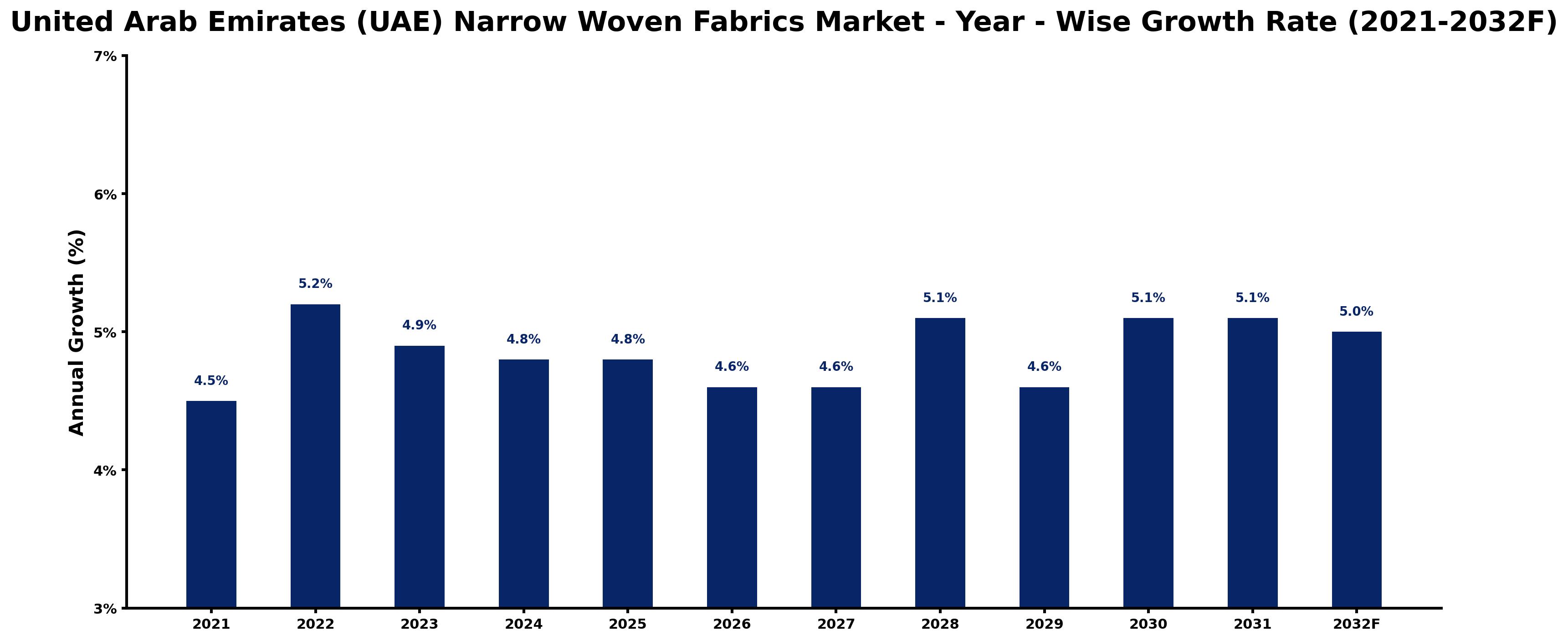
The table below presents the year wise growth rates along with the key drivers influencing the market
| Year | Growth Rate | Major Drivers |
| 2021 | 4.5% | Post-lockdown retail projects in UAE enhance demand for narrow woven fabrics significantly. |
| 2022 | 5.2% | Construction sector expansion leads to increased usage of specialized woven products. |
| 2023 | 4.9% | Local manufacturers innovate for unique textile applications, boosting market presence rapidly. |
| 2024 | 4.8% | Trade agreements within GCC facilitate wider distribution of woven fabrics across borders. |
| 2025 | 4.8% | Sustainable practices in production attract eco-conscious consumers and industry players alike. |
| 2026 | 4.6% | Technological advancements in textile machinery enhance fabric quality and production efficiency. |
| 2027 | 4.6% | Growing fashion retail sector seeks unique woven fabrics for bespoke designs and collections. |
| 2028 | 5.1% | Rising tourism demands specialized fabrics for hospitality and luxury retail environments. |
| 2029 | 4.6% | Manufacturing diversification encourages growth of niche markets within the UAE fabric sector. |
| 2030 | 5.1% | Climate considerations prompt the introduction of lightweight, durable woven fabrics for outdoor use. |
| 2031 | 5.1% | E-commerce expansion enhances accessibility to narrow woven fabrics for small businesses and consumers. |
| 2032 | 5.0% | Collaborations between designers and manufacturers innovate the market with fresh fabric concepts. |
Note - Market size estimations and growth projections presented in this report are based on 6Wresearch's advanced forecasting approach, validated with industry datasets as of June 2026.
United Arab Emirates (UAE) Narrow Woven Fabrics Market Synopsis
The United Arab Emirates (UAE) Narrow Woven Fabrics Market is projected to reach 4.6% and witness significant growth during the forecast period (2026-2032). This burgeoning market encompasses the production, distribution, and sales of narrow woven fabrics, which are defined by their narrow width as well as their diverse patterns and designs. These textiles find extensive applications across industries including apparel, accessories, furniture, automotive, and more, driven by the rising demand for innovative fabric solutions and the growth of the UAE's textile and fashion sectors.
United Arab Emirates (UAE) Narrow Woven Fabrics Market Growth Drivers
The growth of the UAE narrow woven fabrics market can be fundamentally attributed to several key drivers:
- The UAE's booming textile and fashion industry serves as a primary catalyst for the demand for narrow woven fabrics. As the region solidifies its position as a fashion hub, the need for high-quality, bespoke textiles increases.
- Innovation in fabric designs has led to heightened interest among designers and manufacturers in utilizing narrow woven fabrics, enabling unique applications across various product lines.
- The rise of e-commerce platforms has bolstered market accessibility and consumer awareness, driving up demand for diverse fabric types and styles.
- Increased collaboration between textile manufacturers and fashion designers fosters creativity and results in the introduction of exclusive fabric collections tailored to evolving market trends.
- The ongoing urbanization and lifestyle changes in the UAE contribute to the growth in demand for customized, stylish narrow woven fabrics to be used in home decor, apparel, and automotive interiors.
United Arab Emirates (UAE) Narrow Woven Fabrics Market Challenges and Restraints
Despite the promising growth trajectory, the United Arab Emirates (UAE) narrow woven fabrics market encounters several challenges:
- The influx of low-cost imports from international markets poses a significant threat to local manufacturers, compelling them to rethink pricing strategies and product offerings.
- Quality control emerges as a critical issue, as manufacturers must ensure their products meet the high standards expected by consumers and businesses alike.
- Rapid changes in consumer preferences necessitate constant innovation and adaptation, which can strain production processes and supply chains.
- Fluctuations in raw material prices further complicate profit margins, influencing the overall market dynamics of narrow woven fabrics.
- The Covid-19 pandemic significantly disrupted supply chains, revealing vulnerabilities in the industry that need to be addressed to ensure resilience against future shocks.
United Arab Emirates (UAE) Narrow Woven Fabrics Market Covid-19 Impact
The Covid-19 pandemic has had a profound impact on the United Arab Emirates (UAE) narrow woven fabrics market, as it did across numerous sectors. During the height of the pandemic, global supply chain disruptions led to fluctuations in the demand for fabrics, particularly from industries such as retail and fashion that faced shutdowns. However, a silver lining emerged as sectors like medical and personal protective equipment continued to operate, keeping interest in certain types of fabrics, including narrow woven variants, steady during tumultuous times.
United Arab Emirates (UAE) Narrow Woven Fabrics Market Government Investment and Initiatives
The government of the United Arab Emirates has actively invested in initiatives that positively influence the narrow woven fabrics market. Major policies focus on promoting local manufacturing capabilities and fostering a conducive environment for innovation. This includes incentives for businesses to enhance their production facilities and invest in sustainable practices. Furthermore, initiatives aimed at promoting tourism and fashion events in the UAE provide platforms for local designers and textile manufacturers to showcase their capabilities, thereby enhancing market visibility and growth opportunities. Government programs that facilitate trade partnerships also aid in capturing a more extensive international audience for UAE-made narrow woven fabrics.
United Arab Emirates (UAE) Narrow Woven Fabrics Market Latest Developments (May 2025 - June 2026)
Recent developments within the United Arab Emirates (UAE) narrow woven fabrics market from May 2025 to June 2026 have shown a shift towards sustainability and innovation. Many manufacturers are increasingly focusing on eco-friendly textile production methods and materials, responding to a growing consumer demand for sustainable fashion. Events such as trade shows and exhibitions in the region are providing opportunities for companies to network and showcase their latest fabric innovations. Additionally, collaboration between local textile manufacturers and fashion designers is leading to unique product offerings that reflect cultural influences and modern design trends. As the economy continues to rebound from the pandemic, investment in advanced manufacturing technologies is becoming more prevalent, streamlining production processes and enhancing quality control measures.
United Arab Emirates (UAE) Narrow Woven Fabrics Market - Key Attractiveness of the Report
- 10 Years of Market Numbers
- Historical Data Starting from 2022 to 2025
- Base Year: 2025
- Forecast Data until 2032
- Key Performance Indicators Impacting the Market
- Major Upcoming Developments and Projects
Key Highlights of the Report:
- United Arab Emirates (UAE) Narrow Woven Fabrics Market Outlook
- Market Size of United Arab Emirates (UAE) Narrow Woven Fabrics Market, 2025
- Forecast of United Arab Emirates (UAE) Narrow Woven Fabrics Market, 2032
- Historical Data and Forecast of United Arab Emirates (UAE) Narrow Woven Fabrics Revenues & Volume for the Period 2022-2032F
- United Arab Emirates (UAE) Narrow Woven Fabrics Market Trend Evolution
- United Arab Emirates (UAE) Narrow Woven Fabrics Market Drivers and Challenges
- United Arab Emirates (UAE) Narrow Woven Fabrics Price Trends
- United Arab Emirates (UAE) Narrow Woven Fabrics Porter's Five Forces
- United Arab Emirates (UAE) Narrow Woven Fabrics Industry Life Cycle
- Historical Data and Forecast of United Arab Emirates (UAE) Narrow Woven Fabrics Market Revenues & Volume By Type for the Period 2022-2032F
- Historical Data and Forecast of United Arab Emirates (UAE) Narrow Woven Fabrics Market Revenues & Volume By Polyester for the Period 2022-2032F
- Historical Data and Forecast of United Arab Emirates (UAE) Narrow Woven Fabrics Market Revenues & Volume By Nylon for the Period 2022-2032F
- Historical Data and Forecast of United Arab Emirates (UAE) Narrow Woven Fabrics Market Revenues & Volume By PP for the Period 2022-2032F
- Historical Data and Forecast of United Arab Emirates (UAE) Narrow Woven Fabrics Market Revenues & Volume By Applications for the Period 2022-2032F
- Historical Data and Forecast of United Arab Emirates (UAE) Narrow Woven Fabrics Market Revenues & Volume By Garments for the Period 2022-2032F
- Historical Data and Forecast of United Arab Emirates (UAE) Narrow Woven Fabrics Market Revenues & Volume By Home Furnishing for the Period 2022-2032F
- Historical Data and Forecast of United Arab Emirates (UAE) Narrow Woven Fabrics Market Revenues & Volume By Other for the Period 2022-2032F
- United Arab Emirates (UAE) Narrow Woven Fabrics Import Export Trade Statistics
- Market Opportunity Assessment By Type
- Market Opportunity Assessment By Applications
- United Arab Emirates (UAE) Narrow Woven Fabrics Top Companies Market Share
- United Arab Emirates (UAE) Narrow Woven Fabrics Competitive Benchmarking By Technical and Operational Parameters
- United Arab Emirates (UAE) Narrow Woven Fabrics Company Profiles
- United Arab Emirates (UAE) Narrow Woven Fabrics Key Strategic Recommendations






































