United Arab Emirates (UAE) Nickel-copper Market Size, Share & Growth Rate
The United Arab Emirates (UAE) Nickel-copper Market was estimated at USD 370 Million in 2025 and is projected to reach USD 503 Million by 2032, growing at a CAGR of 4.5% from 2026 to 2032. This upward trajectory is primarily driven by robust industrialization efforts within the UAE, particularly in sectors such as electronics, automotive, and renewable energy. As these industries expand, the need for high-quality nickel-copper alloys, which offer superior conductivity and corrosion resistance, is becoming increasingly critical.
United Arab Emirates (UAE) Nickel-copper Market Year-wise Growth Rate and Key Drivers
This graph highlights how the United Arab Emirates (UAE) Nickel-copper Market has steadily grown over the years, supported by major growth factors.
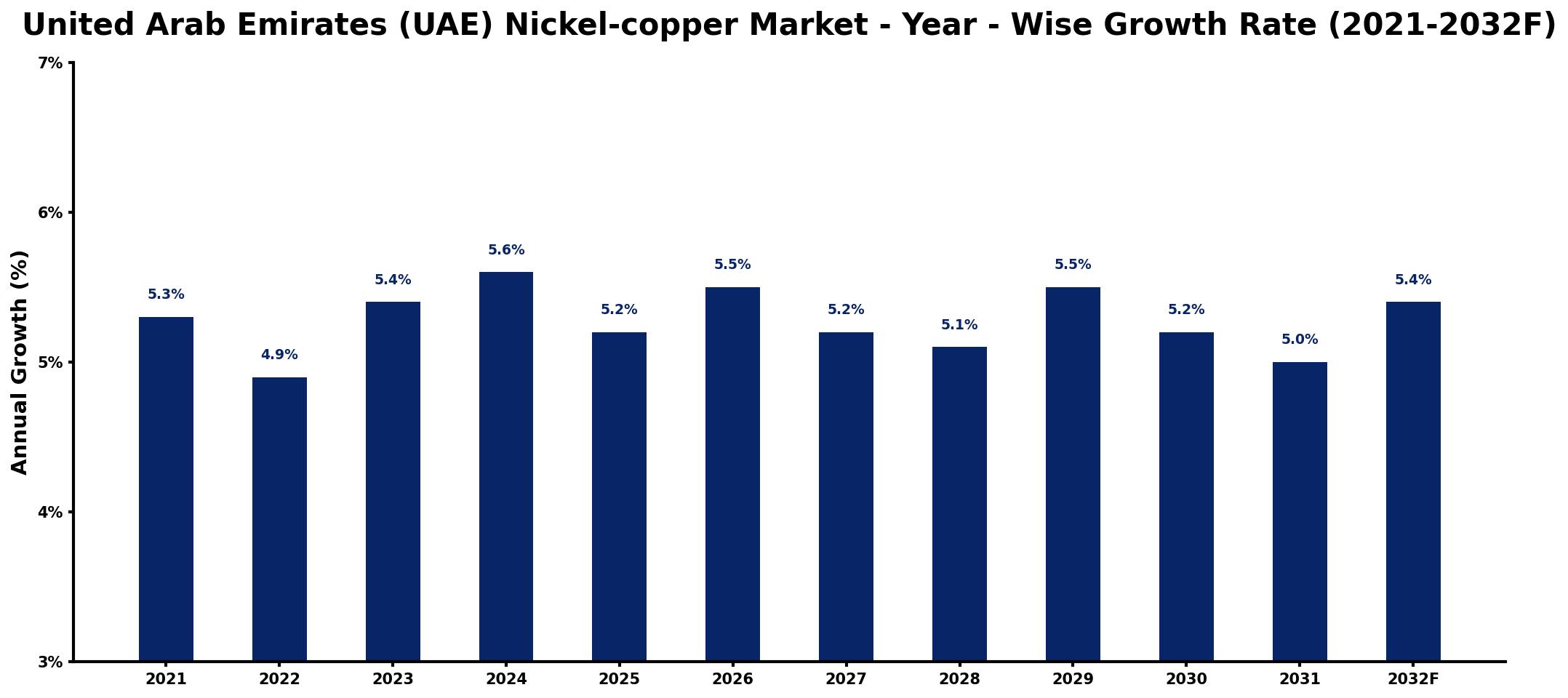
The table below presents the year‑wise growth rates along with the key drivers influencing the market
| Year | Growth Rate | Major Drivers |
| 2021 | 5.3% | Increased demand from construction sector |
| 2022 | 4.9% | Expansion of renewable energy projects |
| 2023 | 5.4% | Growth in electric vehicle production |
| 2024 | 5.6% | Rising investment in infrastructure development |
| 2025 | 5.2% | Surge in technology manufacturing needs |
| 2026 | 5.5% | Boost in aerospace industry activities |
| 2027 | 5.2% | Advancements in battery technology adoption |
| 2028 | 5.1% | Heightened focus on sustainable mining |
| 2029 | 5.5% | Growing interest in green technologies |
| 2030 | 5.2% | Increased governmental support initiatives |
| 2031 | 5.0% | expanding healthcare application demand |
| 2032 | 5.4% | Rising urbanization and housing projects |
Note: Market size estimations and growth projections presented in this report are based on 6Wresearch's proprietary forecasting methodology, utilizing the latest available industry data, government publications, and primary research inputs.
United Arab Emirates (UAE) Nickel-copper Market Synopsis
The UAE Nickel-copper market is witnessing a surge in demand driven by the burgeoning electronics sector, where nickel-copper alloys play an essential role in electrical components and wiring. This growth is complemented by the countrys strategic initiatives to enhance manufacturing capabilities, bolstered by a growing appetite for reliable electrical systems.
In addition to manufacturing, the construction industry in the UAE is increasingly utilizing nickel-copper materials for their durability and resistance to harsh environmental conditions. This cross-sector utilization enhances the market's relevance, positioning it as a backbone for sustainable industrial growth in the region.
United Arab Emirates (UAE) Nickel-copper Market Key Takeaways
- The market is driven by significant demand from the electronics and automotive industries.
- Renewable energy sector growth is enhancing the need for nickel-copper alloys in batteries and conductors.
- Environmental regulations are pushing for sustainable mining practices in metal extraction.
- Geopolitical tensions and competition from alternative materials could impact market stability.
- Key companies are vital to the UAEs economic diversification strategy in the global metals industry.
Evaluation of Restraints in United Arab Emirates (UAE) Nickel-copper Market
Despite its promising growth, the UAE Nickel-copper market faces notable restraints that could hinder its full potential. Fluctuating global prices for nickel and copper create a volatile environment, affecting profitability and investment stability. Furthermore, the increasing emphasis on environmental sustainability may compel companies to adopt more costly mining practices to comply with regulations, thus impacting margins. In addition, the market contends with competition from alternative materials that can potentially replace nickel-copper alloys, thereby threatening market share. Lastly, geopolitical challenges and trade restrictions could disrupt supply chains, influencing the availability of these essential metals.
United Arab Emirates (UAE) Nickel-copper Market Trends
Several trends are currently shaping the UAE Nickel-copper market landscape. The advancement of technology in battery manufacturing is fueling the demand for high-performance nickel-copper alloys that provide enhanced conductivity. Additionally, there's a growing focus on circular economy initiatives within the UAE, encouraging recycling and sustainable practices in metals production. As industries adapt to these trends, innovations in alloy compositions are anticipated to evolve, further driving market expansion.
United Arab Emirates (UAE) Nickel-copper Market Opportunities
The UAE Nickel-copper market presents substantial growth and investment opportunities, particularly in sectors emphasizing sustainability and efficiency. The renewable energy transition is a key area for growth, as the demand for nickel-copper alloys in solar energy components and energy storage solutions rises. Moreover, initiatives aimed at boosting domestic manufacturing capabilities provide an avenue for local companies to leverage the growing demand for high-quality materials. Collaborations with international firms can also enhance technological advancements and improve production methodologies.
Government Initiatives in the United Arab Emirates (UAE) Nickel-copper Market
The UAE government is actively fostering an environment conducive to the growth of the nickel-copper market through various initiatives. Policies aimed at industrial diversification encourage investments in manufacturing and technology. Public spending is increasingly directed towards enhancing infrastructure, which benefits sectors relying on nickel-copper materials. Furthermore, the government is promoting research and development in sustainable mining practices, thereby aligning with global environmental standards while ensuring resource availability.
Future Insights of the United Arab Emirates (UAE) Nickel-copper Market
Looking ahead to 2026-2032, the UAE Nickel-copper market is expected to thrive, bolstered by the ongoing industrial diversification and infrastructural investments. The shift towards renewable energy will catalyze the demand for nickel-copper alloys, as industries seek efficient and sustainable solutions. Additionally, advancements in alloy technology and increased recycling efforts will likely play pivotal roles in shaping the market. Ultimately, the UAE is positioning itself to become a significant player in the global nickel-copper landscape.
United Arab Emirates (UAE) Nickel-copper Market Latest Developments (2025 - 2026)
In recent months, the UAE Nickel-copper market has seen a notable shift towards sustainable practices, with industry leaders investing in technologies aimed at reducing carbon footprints. New partnerships have been formed to enhance research in innovative alloy compositions, promising improvements in performance metrics for electrical and industrial applications. Furthermore, the government has initiated public-private partnerships to expedite the development of infrastructure projects, which will further increase the demand for nickel-copper materials.
United Arab Emirates (UAE) Nickel-copper Market - Key Attractiveness of the Report
- 10 Years of Market Numbers
- Historical Data Starting from 2022 to 2025
- Base Year: 2025
- Forecast Data until 2032
- Key Performance Indicators Impacting the Market
- Major Upcoming Developments and Projects
Key Highlights of the Report:
- United Arab Emirates (UAE) Nickel-copper Market Outlook
- Market Size of United Arab Emirates (UAE) Nickel-copper Market, 2025
- Forecast of United Arab Emirates (UAE) Nickel-copper Market, 2032
- Historical Data and Forecast of United Arab Emirates (UAE) Nickel-copper Revenues & Volume for the Period 2022-2032F
- United Arab Emirates (UAE) Nickel-copper Market Trend Evolution
- United Arab Emirates (UAE) Nickel-copper Market Drivers and Challenges
- United Arab Emirates (UAE) Nickel-copper Price Trends
- United Arab Emirates (UAE) Nickel-copper Porter's Five Forces
- United Arab Emirates (UAE) Nickel-copper Industry Life Cycle
- Historical Data and Forecast of United Arab Emirates (UAE) Nickel-copper Market Revenues & Volume By Product Type for the Period 2022-2032F
- Historical Data and Forecast of United Arab Emirates (UAE) Nickel-copper Market Revenues & Volume By Round Wire for the Period 2022-2032F
- Historical Data and Forecast of United Arab Emirates (UAE) Nickel-copper Market Revenues & Volume By Flat Wire for the Period 2022-2032F
- Historical Data and Forecast of United Arab Emirates (UAE) Nickel-copper Market Revenues & Volume By Square Wire for the Period 2022-2032F
- Historical Data and Forecast of United Arab Emirates (UAE) Nickel-copper Market Revenues & Volume By Bars for the Period 2022-2032F
- Historical Data and Forecast of United Arab Emirates (UAE) Nickel-copper Market Revenues & Volume By Shaped Profiles for the Period 2022-2032F
- Historical Data and Forecast of United Arab Emirates (UAE) Nickel-copper Market Revenues & Volume By Applications for the Period 2022-2032F
- Historical Data and Forecast of United Arab Emirates (UAE) Nickel-copper Market Revenues & Volume By Resistors for the Period 2022-2032F
- Historical Data and Forecast of United Arab Emirates (UAE) Nickel-copper Market Revenues & Volume By Home Appliances for the Period 2022-2032F
- Historical Data and Forecast of United Arab Emirates (UAE) Nickel-copper Market Revenues & Volume By Industrial for the Period 2022-2032F
- United Arab Emirates (UAE) Nickel-copper Import Export Trade Statistics
- Market Opportunity Assessment By Product Type
- Market Opportunity Assessment By Applications
- United Arab Emirates (UAE) Nickel-copper Top Companies Market Share
- United Arab Emirates (UAE) Nickel-copper Competitive Benchmarking By Technical and Operational Parameters
- United Arab Emirates (UAE) Nickel-copper Company Profiles
- United Arab Emirates (UAE) Nickel-copper Key Strategic Recommendations






































