United Arab Emirates (UAE) Organic Poultry Market Size, Share & Growth Rate
The United Arab Emirates (UAE) Organic Poultry Market was estimated at USD 316 Million in 2025 and is projected to reach USD 421 Million by 2032, growing at a CAGR of 4.2% from 2026 to 2032. This promising trajectory is fueled by an increasing consumer shift towards health-conscious dietary choices, further enhanced by a growing commitment to sustainability and local sourcing. As consumers become more informed about food sources, the demand for organic, hormone-free, and antibiotic-free poultry products continues to rise across both retail and food service sectors.
United Arab Emirates (UAE) Organic Poultry Market Year-wise Growth Rate and Key Drivers
This graph highlights how the United Arab Emirates (UAE) Organic Poultry Market has steadily grown over the years, supported by major growth factors.
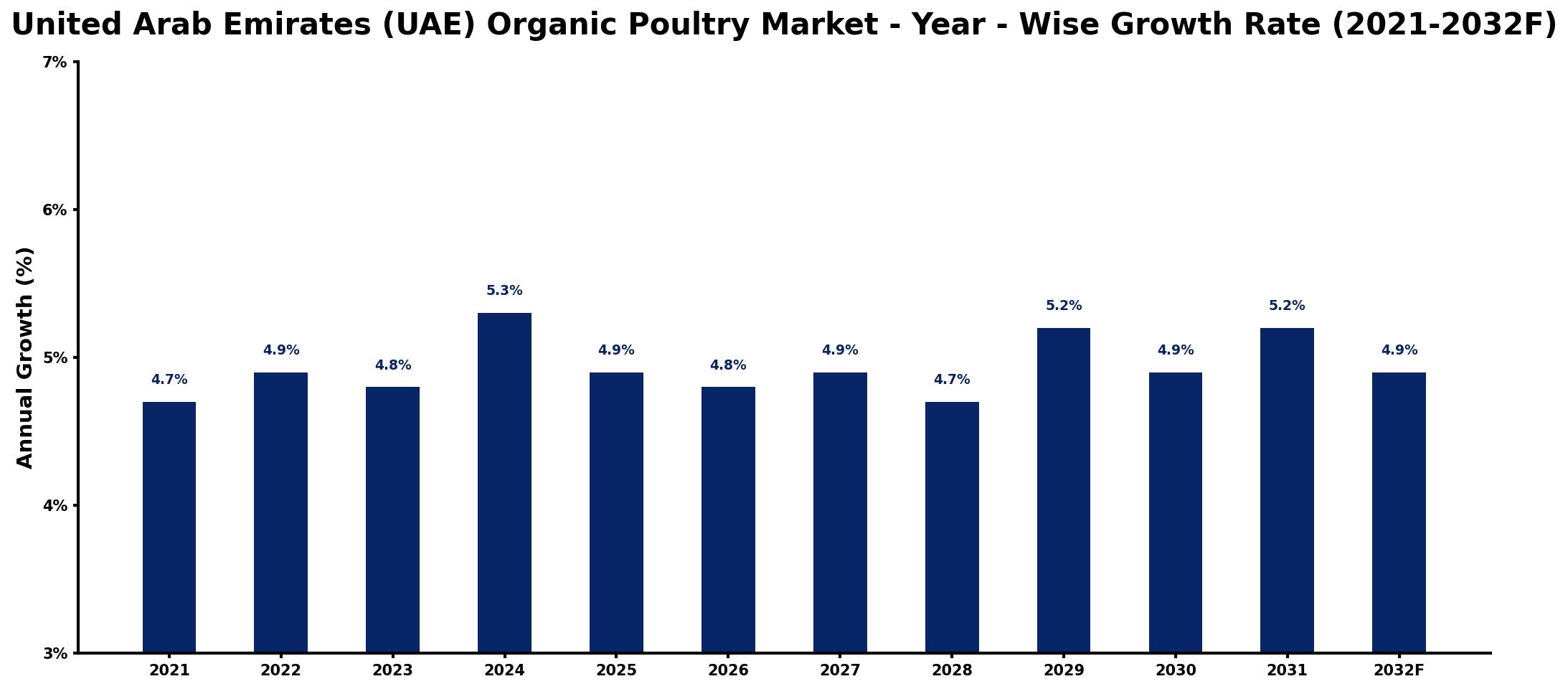
The table below presents the year‑wise growth rates along with the key drivers influencing the market
| Year | Growth Rate | Major Drivers |
| 2021 | 4.7% | Rising health consciousness among consumers |
| 2022 | 4.9% | Increased availability of local farms |
| 2023 | 4.8% | Growing demand for sustainable practices |
| 2024 | 5.3% | Expansion of distribution channels |
| 2025 | 4.9% | Investment in eco-friendly technologies |
| 2026 | 4.8% | Enhanced marketing strategies adopted |
| 2027 | 4.9% | Collaborations with health organizations |
| 2028 | 4.7% | Emerging trends in dietary preferences |
| 2029 | 5.2% | Government support for local producers |
| 2030 | 4.9% | Focus on animal welfare standards |
| 2031 | 5.2% | Adoption of innovative farming practices |
| 2032 | 4.9% | Strengthening consumer education initiatives |
Note: Market size estimations and growth projections presented in this report are based on 6Wresearch's proprietary forecasting methodology, utilizing the latest available industry data, government publications, and primary research inputs.
United Arab Emirates (UAE) Organic Poultry Market Synopsis
In recent years, the organic poultry market in the UAE has demonstrated remarkable growth, similar to the expansion seen in the organic lamb segment. Consumers are increasingly prioritizing organic options, driven by health benefits and environmental awareness. This trend is reflected not only in grocery aisles but also in restaurant menus, as chefs and food establishments strive to meet the rising demand for ethically raised poultry.
Emerging local organic poultry farms have played a crucial role in this market's evolution. With stringent quality standards and a commitment to sustainable farming practices, these farms have made it easier for consumers to access organic products. The focus on locally sourced poultry also resonates with UAE residents, who are keen to support domestic agriculture and ensure the freshness of their food.
United Arab Emirates (UAE) Organic Poultry Market Key Takeaways
- Significant consumer demand for hormone-free and antibiotic-free poultry products.
- Growth driven by increased health awareness and a push for sustainable farming practices.
- Emergence of local organic poultry farms enhancing product availability and quality.
- COVID-19 pandemic underscored the need for strengthening local production capabilities.
- Market poised for steady growth with a projected CAGR of 4.2% from 2026 to 2032.
Evaluation of Restraints in United Arab Emirates (UAE) Organic Poultry Market
Despite the promising growth in the UAE's organic poultry market, several restraints hinder its full potential. One significant challenge is the sourcing and cost of organic feed, which can significantly impact production costs. Additionally, maintaining stringent organic certification standards while scaling operations proves to be a complex task for local farmers. As the market demand continues to rise, these operational hurdles may pose challenges in fulfilling consumer expectations for organic poultry supply.
United Arab Emirates (UAE) Organic Poultry Market Trends
Several notable trends are currently shaping the UAE organic poultry landscape. Firstly, a marked rise in awareness regarding animal welfare is pushing consumers to seek out poultry products from farms with humane practices. Alongside this, technology in farming, such as improved feeding techniques and genetic management, is enhancing the production quality of organic poultry. Furthermore, a growing inclination towards farm-to-table dining experiences indicates an increasing preference for locally sourced organic poultry, which is likely to persist in the foreseeable future.
United Arab Emirates (UAE) Organic Poultry Market Opportunities
As the demand for organic poultry continues to rise, several lucrative opportunities are emerging in the UAE market. The establishment of new local organic farms presents an avenue for investment and innovation. Additionally, aligning with international certification bodies could enhance export potentials for UAE organic poultry products. Furthermore, collaborating with restaurants and food service providers to develop bespoke organic offerings can create new revenue streams while meeting consumer preferences for healthier dining options.
Government Initiatives in the United Arab Emirates (UAE) Organic Poultry Market
The UAE government has been actively promoting the organic farming sector, implementing policies aimed at supporting sustainable agricultural practices. Various public spending initiatives and programs focus on enhancing local food security and reducing dependence on imports. By encouraging the establishment of organic farms and ensuring compliance with rigorous quality standards, these initiatives are pivotal in fostering growth within the organic poultry market.
Future Insights of the United Arab Emirates (UAE) Organic Poultry Market
Looking ahead to the period from 2026 to 2032, the UAE organic poultry market is expected to evolve with a dual focus on meeting consumer demand and addressing sustainability challenges. Enhanced agricultural technologies and a growing network of local organic producers will likely streamline supply chains and improve the freshness of products. Furthermore, increasing consumer advocacy for sustainable food sources will drive continuous innovation within the sector, further embedding organic poultry as a staple in the UAEs food culture.
United Arab Emirates (UAE) Organic Poultry Market Latest Developments (2025 - 2026)
Recent developments in the UAE organic poultry market indicate a strong shift toward localized production. Numerous organic farms are implementing advanced technologies to enhance production efficiency while maintaining organic standards. Additionally, collaborations between local farmers and restaurants are blossoming, with chefs increasingly featuring organic poultry on their menus. This period also sees a rise in consumer education campaigns aimed at highlighting the benefits of organic poultry, further bolstering market growth.
United Arab Emirates (UAE) Organic Poultry Market - Key Attractiveness of the Report
- 10 Years of Market Numbers
- Historical Data Starting from 2022 to 2025
- Base Year: 2025
- Forecast Data until 2032
- Key Performance Indicators Impacting the Market
- Major Upcoming Developments and Projects
Key Highlights of the Report:
- United Arab Emirates (UAE) Organic Poultry Market Outlook
- Market Size of United Arab Emirates (UAE) Organic Poultry Market, 2025
- Forecast of United Arab Emirates (UAE) Organic Poultry Market, 2032
- Historical Data and Forecast of United Arab Emirates (UAE) Organic Poultry Revenues & Volume for the Period 2022-2032F
- United Arab Emirates (UAE) Organic Poultry Market Trend Evolution
- United Arab Emirates (UAE) Organic Poultry Market Drivers and Challenges
- United Arab Emirates (UAE) Organic Poultry Price Trends
- United Arab Emirates (UAE) Organic Poultry Porter's Five Forces
- United Arab Emirates (UAE) Organic Poultry Industry Life Cycle
- Historical Data and Forecast of United Arab Emirates (UAE) Organic Poultry Market Revenues & Volume By Type for the Period 2022-2032F
- Historical Data and Forecast of United Arab Emirates (UAE) Organic Poultry Market Revenues & Volume By Organic Eggs for the Period 2022-2032F
- Historical Data and Forecast of United Arab Emirates (UAE) Organic Poultry Market Revenues & Volume By Organic Meat for the Period 2022-2032F
- Historical Data and Forecast of United Arab Emirates (UAE) Organic Poultry Market Revenues & Volume By Sales Channel for the Period 2022-2032F
- Historical Data and Forecast of United Arab Emirates (UAE) Organic Poultry Market Revenues & Volume By Business To Business for the Period 2022-2032F
- Historical Data and Forecast of United Arab Emirates (UAE) Organic Poultry Market Revenues & Volume By Business To Consumer for the Period 2022-2032F
- United Arab Emirates (UAE) Organic Poultry Import Export Trade Statistics
- Market Opportunity Assessment By Type
- Market Opportunity Assessment By Sales Channel
- United Arab Emirates (UAE) Organic Poultry Top Companies Market Share
- United Arab Emirates (UAE) Organic Poultry Competitive Benchmarking By Technical and Operational Parameters
- United Arab Emirates (UAE) Organic Poultry Company Profiles
- United Arab Emirates (UAE) Organic Poultry Key Strategic Recommendations






































