United Arab Emirates (UAE) Parking Meter Market Size, Share & Growth Rate
The United Arab Emirates (UAE) Parking Meter Market was estimated at USD 1070 Million in 2025 and is projected to reach USD 1542 Million by 2032, growing at a CAGR of 5.4% from 2026 to 2032. This growth trajectory is driven by an escalating urban population and the increasing emphasis on smart city initiatives. The demand for efficient parking management solutions is becoming more critical as city planners seek to minimize congestion and maximize space utilization.
United Arab Emirates (UAE) Parking Meter Market Year-wise Growth Rate and Key Drivers
This graph highlights how the United Arab Emirates (UAE) Parking Meter Market has steadily grown over the years, supported by major growth factors.
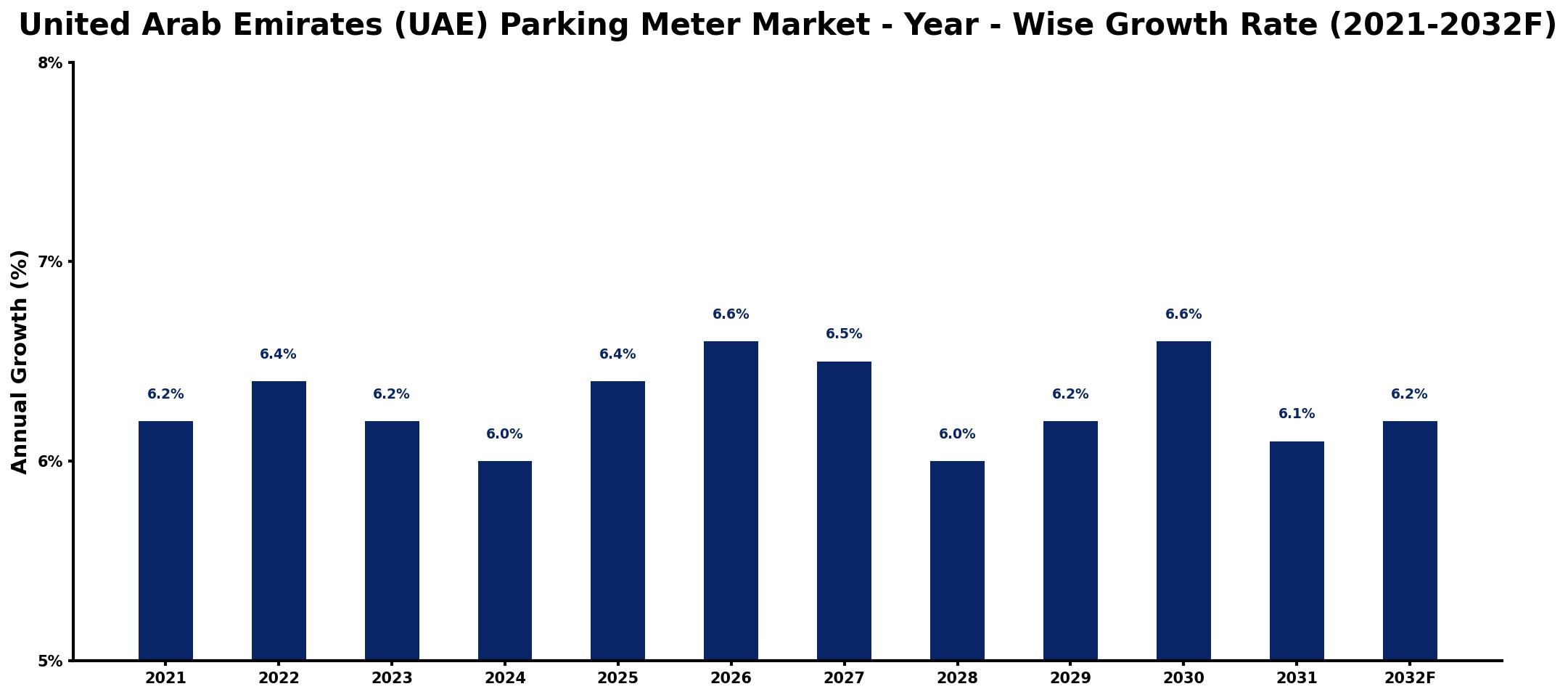
The table below presents the year‑wise growth rates along with the key drivers influencing the market
| Year | Growth Rate | Major Drivers |
| 2021 | 6.2% | Urban development projects increase demand |
| 2022 | 6.4% | Government investments in infrastructure |
| 2023 | 6.2% | Rise in smart city initiatives |
| 2024 | 6.0% | Growing need for efficient management |
| 2025 | 6.4% | Expansion of commercial zones continues |
| 2026 | 6.6% | Increased focus on sustainability efforts |
| 2027 | 6.5% | Technological advancements drive adoption |
| 2028 | 6.0% | Tourism sector recovery boosts usage |
| 2029 | 6.2% | Rising population fuels demand growth |
| 2030 | 6.6% | Enhanced urban mobility solutions emerge |
| 2031 | 6.1% | Public-private partnerships expand services |
| 2032 | 6.2% | Evolving consumer preferences drive innovation |
Note: Market size estimations and growth projections presented in this report are based on 6Wresearch's proprietary forecasting methodology, utilizing the latest available industry data, government publications, and primary research inputs.
United Arab Emirates (UAE) Parking Meter Market Synopsis
The UAE parking meter market is currently positioned at a crossroads of innovation and urban necessity. With its rapidly developing urban centers, the need for sophisticated parking solutions is intensifying. As municipalities strive to enhance revenue generation and manage growing vehicle numbers, parking meters are evolving into essential infrastructure.
The integration of smart technologies is reshaping how parking systems operate. Modern parking meters are now equipped with features that allow for cashless payments and real-time monitoring, ensuring a more user-friendly experience. This trend toward technological enhancement is crucial for meeting the needs of a tech-savvy population and addressing urban congestion effectively.
United Arab Emirates (UAE) Parking Meter Market Key Takeaways
- The market is projected to grow significantly, reaching USD 1542 Million by 2032.
- Smart technology integration is a driving force behind the modernization of parking systems.
- Municipalities are increasingly recognizing parking meters as vital tools for managing urban congestion.
- Cashless transaction options are becoming standard, improving user convenience.
- Regulatory frameworks are evolving to support innovative parking solutions and sustainable urban planning.
Evaluation of Restraints in United Arab Emirates (UAE) Parking Meter Market
Despite its growth potential, the UAE parking meter market faces several challenges that could impede its trajectory. One of the primary concerns is the need for robust cybersecurity measures to safeguard cashless transactions. As cities adopt more sophisticated payment systems, ensuring the security of these platforms is crucial to building user trust. Additionally, the integration of new technologies often requires significant infrastructural investment, which may deter some municipalities from fully upgrading their parking management systems.
United Arab Emirates (UAE) Parking Meter Market Trends
Several key trends are shaping the future of the UAE parking meter market. The shift towards smart, connected parking solutions is at the forefront, with innovations such as mobile payment options and real-time occupancy tracking becoming increasingly common. Moreover, the emphasis on sustainability is influencing municipalities to explore eco-friendly parking solutions, including solar-powered parking meters. As urbanization continues, the demand for these advanced parking systems will likely grow, further enhancing their role in traffic management.
United Arab Emirates (UAE) Parking Meter Market Opportunities
There is substantial opportunity for growth within the UAE parking meter market, especially in the realm of technological advancements. Companies that focus on developing user-friendly apps for payment and parking space navigation will likely find a receptive audience. Additionally, municipalities are increasingly open to partnerships with tech firms to deploy pilot programs for smart parking solutions, which can serve as an entry point for innovative startups in the region. Enhanced data analytics capabilities also present opportunities for municipalities to optimize parking management strategies.
Government Initiatives in the United Arab Emirates (UAE) Parking Meter Market
The UAE government is actively promoting initiatives aimed at improving urban infrastructure, including parking management systems. Policies are being enacted to support smart city projects that leverage technology to enhance efficiency. Public funding is increasingly directed towards developing intelligent transportation systems that integrate with parking solutions, further illustrating the commitment to efficient urban mobility. Programs encouraging the adoption of cashless payment systems are also gaining traction, reflecting a shift towards modernization in public services.
Future Insights of the United Arab Emirates (UAE) Parking Meter Market
Looking ahead to 2026-2032, the UAE parking meter market is poised for transformative growth. The ongoing integration of advanced technologies, coupled with governmental support for smart urban initiatives, will likely enhance operational efficiencies. The focus will increasingly shift towards creating seamless user experiences, encompassing mobile applications and real-time data access. As urban areas continue to develop, the parking meter market will play an essential role in shaping how cities manage their transportation ecosystems.
United Arab Emirates (UAE) Parking Meter Market Latest Developments (2025 - 2026)
In recent months, significant advancements have been made in the UAE parking meter sector, focusing on enhancing user experience through technology. New pilot projects have been launched that aim to streamline payment processes, incorporating features such as contactless payment methods and improved mobile app functionalities. Furthermore, municipalities are collaborating with tech firms to expand real-time monitoring capabilities, addressing both efficiency and user satisfaction. There is a noticeable push towards adopting more sustainable practices, reflecting broader environmental objectives.
United Arab Emirates (UAE) Parking Meter Market - Key Attractiveness of the Report
- 10 Years of Market Numbers
- Historical Data Starting from 2022 to 2025
- Base Year: 2025
- Forecast Data until 2032
- Key Performance Indicators Impacting the Market
- Major Upcoming Developments and Projects
Key Highlights of the Report:
- United Arab Emirates (UAE) Parking Meter Market Outlook
- Market Size of United Arab Emirates (UAE) Parking Meter Market, 2025
- Forecast of United Arab Emirates (UAE) Parking Meter Market, 2032
- Historical Data and Forecast of United Arab Emirates (UAE) Parking Meter Revenues & Volume for the Period 2022-2032F
- United Arab Emirates (UAE) Parking Meter Market Trend Evolution
- United Arab Emirates (UAE) Parking Meter Market Drivers and Challenges
- United Arab Emirates (UAE) Parking Meter Price Trends
- United Arab Emirates (UAE) Parking Meter Porter's Five Forces
- United Arab Emirates (UAE) Parking Meter Industry Life Cycle
- Historical Data and Forecast of United Arab Emirates (UAE) Parking Meter Market Revenues & Volume By Technology for the Period 2022-2032F
- Historical Data and Forecast of United Arab Emirates (UAE) Parking Meter Market Revenues & Volume By Parking Meter (Single Space) for the Period 2022-2032F
- Historical Data and Forecast of United Arab Emirates (UAE) Parking Meter Market Revenues & Volume By Parking Kiosks (Multi Space) for the Period 2022-2032F
- Historical Data and Forecast of United Arab Emirates (UAE) Parking Meter Market Revenues & Volume By Government Institutions for the Period 2022-2032F
- Historical Data and Forecast of United Arab Emirates (UAE) Parking Meter Market Revenues & Volume By Application for the Period 2022-2032F
- Historical Data and Forecast of United Arab Emirates (UAE) Parking Meter Market Revenues & Volume By Hospitals for the Period 2022-2032F
- Historical Data and Forecast of United Arab Emirates (UAE) Parking Meter Market Revenues & Volume By Parks for the Period 2022-2032F
- Historical Data and Forecast of United Arab Emirates (UAE) Parking Meter Market Revenues & Volume By Transit Systems for the Period 2022-2032F
- Historical Data and Forecast of United Arab Emirates (UAE) Parking Meter Market Revenues & Volume By Malls & Stadiums for the Period 2022-2032F
- Historical Data and Forecast of United Arab Emirates (UAE) Parking Meter Market Revenues & Volume By Others for the Period 2022-2032F
- Historical Data and Forecast of United Arab Emirates (UAE) Parking Meter Market Revenues & Volume By Parking Mode for the Period 2022-2032F
- Historical Data and Forecast of United Arab Emirates (UAE) Parking Meter Market Revenues & Volume By Pay & Display for the Period 2022-2032F
- Historical Data and Forecast of United Arab Emirates (UAE) Parking Meter Market Revenues & Volume By Plate for the Period 2022-2032F
- Historical Data and Forecast of United Arab Emirates (UAE) Parking Meter Market Revenues & Volume By Space for the Period 2022-2032F
- Historical Data and Forecast of United Arab Emirates (UAE) Parking Meter Market Revenues & Volume By Others for the Period 2022-2032F
- United Arab Emirates (UAE) Parking Meter Import Export Trade Statistics
- Market Opportunity Assessment By Technology
- Market Opportunity Assessment By Application
- Market Opportunity Assessment By Parking Mode
- United Arab Emirates (UAE) Parking Meter Top Companies Market Share
- United Arab Emirates (UAE) Parking Meter Competitive Benchmarking By Technical and Operational Parameters
- United Arab Emirates (UAE) Parking Meter Company Profiles
- United Arab Emirates (UAE) Parking Meter Key Strategic Recommendations






































