United Arab Emirates (UAE) Paving Blocks Market Summary
The united arab emirates (uae) paving blocks market was estimated at USD 1289 Million in 2025 and is projected to reach USD 1855 Million by 2032, growing at a CAGR of 6.2% from 2026 to 2032.
United Arab Emirates (UAE) Paving Blocks Market Year-wise Growth Rate and Key Drivers
This graph highlights how the United Arab Emirates (UAE) Paving Blocks Market has steadily grown over the past five years, supported by major growth factors.
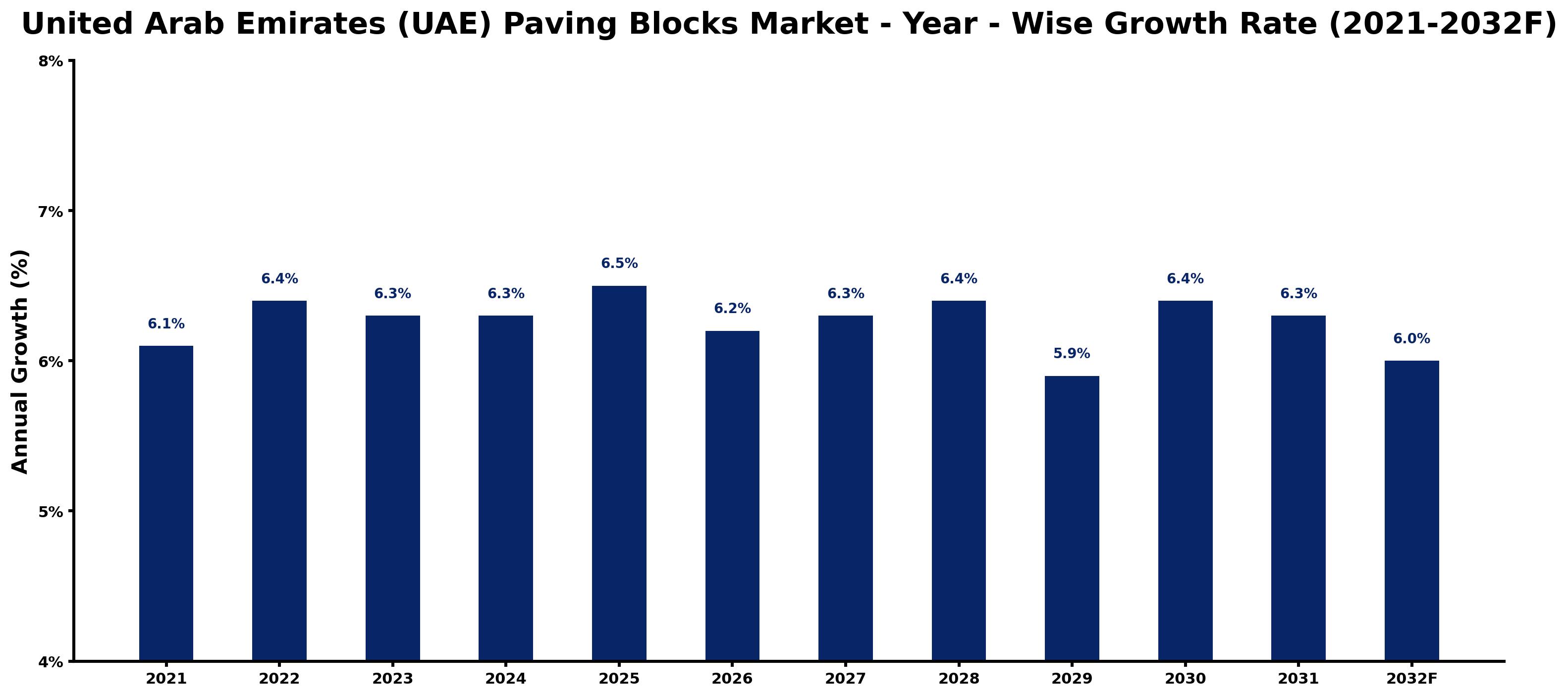
The table below presents the year wise growth rates along with the key drivers influencing the market
| Year | Growth Rate | Major Drivers |
| 2021 | 6.1% | Investment in infrastructure projects lays groundwork for enhanced market opportunities. |
| 2022 | 6.4% | Emerging trends highlight sustainability, pushing demand for eco-friendly paving solutions. |
| 2023 | 6.3% | Increasing tourism developments prompt a rise in high-quality paving block installations. |
| 2024 | 6.3% | Urbanization continues to escalate, leading to more urban paving requirements across cities. |
| 2025 | 6.5% | Technological innovations drive improvements in manufacturing processes and product quality. |
| 2026 | 6.2% | The construction sector expands, necessitating durable paving solutions for various applications. |
| 2027 | 6.3% | Local manufacturers enhance capacity, fostering competitive pricing and product diversity. |
| 2028 | 6.4% | Architectural trends emphasize aesthetics, increasing interest in designer paving options. |
| 2029 | 5.9% | Environmental considerations encourage the integration of recycled materials in paving blocks. |
| 2030 | 6.4% | Smart city initiatives promote advanced infrastructure, elevating paving block specifications. |
| 2031 | 6.3% | Rising commercial developments correlate with heightened demand for versatile paving solutions. |
| 2032 | 6.0% | Future urban planning outlines expansive projects, ensuring sustained market growth momentum. |
Note - Market size estimations and growth projections presented in this report are based on 6Wresearch's advanced forecasting approach, validated with industry datasets as of June 2026.
United Arab Emirates (UAE) Paving Blocks Market Synopsis
The United Arab Emirates (UAE) Paving Blocks Market is projected to reach 6.2% and witness significant growth during the forecast period (2026-2032). The ongoing urbanization and infrastructure initiatives in the UAE are contributing to this upward trajectory, as paving blocks are increasingly favored for their durability and aesthetic versatility. Used extensively in landscaping, road construction, and outdoor areas, paving blocks are becoming a preferred choice for both commercial and residential projects, reflecting a broader shift towards sustainable construction practices.
United Arab Emirates (UAE) Paving Blocks Market Growth Drivers
The expansion of the United Arab Emirates (UAE) Paving Blocks Market is driven by several key factors.
- First, the UAE's ambitious infrastructure development projects, including the construction of new roads, highways, and public spaces, are perpetuating demand for paving blocks, which are essential for ensuring durability and structural stability.
- Secondly, the increasing focus on sustainability has propelled the adoption of permeable paving solutions, which not only enhance water management but also meet the growing public and governmental demand for eco-friendly materials.
- Furthermore, the aesthetic qualities of paving blocks, which come in various designs and colors, are making them a popular choice in landscaping and urban design.
- Additionally, with the UAE's commitment to improving public spaces, paving blocks are being utilized in parks, walkways, and recreational areas, showcasing their multifunctionality.
- Lastly, the ease of installation and maintenance associated with interlocking pavers further strengthens their appeal, facilitating quick project execution and long-term cost savings for developers.
United Arab Emirates (UAE) Paving Blocks Market Challenges and Restraints
Despite the promising growth of the United Arab Emirates (UAE) Paving Blocks Market, several challenges could hinder its progress.
- Competition from established traditional materials such as asphalt and concrete presents a significant hurdle, as these alternatives are often more cost-effective and readily available in the market.
- The need for industry players to effectively communicate the benefits of paving blocks in terms of durability, visual appeal, and environmental sustainability is crucial for maintaining market share.
- Moreover, external factors such as fluctuations in raw material costs and supply chain disruptions can adversely impact the manufacturing and pricing of paving blocks.
- Economic uncertainties stemming from global events, including the impact of the Covid-19 pandemic, have also led to reduced consumer spending, which could affect construction projects within the UAE.
- Lastly, changing regulations and standards regarding construction materials may require manufacturers to adapt quickly, possibly resulting in increased operational costs.
United Arab Emirates (UAE) Paving Blocks Market Government Investment and Initiatives
The role of government investment and initiatives is pivotal in shaping the United Arab Emirates (UAE) Paving Blocks Market. The UAE government has made significant commitments to infrastructure development as part of its vision for sustainable urban growth. This includes investments in public spaces and transportation systems, which leverage paving blocks for their durability and aesthetic charm.
Additionally, the government promotes the use of eco-friendly materials through initiatives that advocate for sustainable construction practices. Public-private partnerships are increasingly fostered to support large-scale infrastructure projects, providing a conducive environment for paving blocks to be incorporated into future developments.
Furthermore, the UAE's commitment to enhancing its public areas aligns with global sustainability goals, helping to drive regulations that favor the use of permeable paving solutions, thereby creating a market that is responsive to environmental considerations.
United Arab Emirates (UAE) Paving Blocks Market Latest Developments (May 2025 - June 2026)
Recent developments in the United Arab Emirates (UAE) Paving Blocks Market from May 2025 to June 2026 have showcased a trend towards increased innovation and investment in paving solutions. The market is witnessing advancements in manufacturing technologies that enhance the quality and sustainability of paving blocks, allowing for improved durability and aesthetic customizability.
Moreover, the ongoing recovery from the effects of the Covid-19 pandemic has sparked renewed interest in outdoor renovation projects, positing paving blocks as an ideal option for homeowners and businesses looking to enhance their exterior spaces. The integration of smart technology into paving solutions is also gaining traction, providing opportunities for the market to modernize and meet changing consumer preferences.
Concurrently, a growing number of collaborations between construction companies and local governments have emerged to facilitate urban regeneration initiatives, further supporting the demand for paving blocks in large-scale projects.
United Arab Emirates (UAE) Paving Blocks Market - Key Attractiveness of the Report
- 10 Years of Market Numbers
- Historical Data Starting from 2022 to 2025
- Base Year: 2025
- Forecast Data until 2032
- Key Performance Indicators Impacting the Market
- Major Upcoming Developments and Projects
Key Highlights of the Report:
- United Arab Emirates (UAE) Paving Blocks Market Outlook
- Market Size of United Arab Emirates (UAE) Paving Blocks Market, 2025
- Forecast of United Arab Emirates (UAE) Paving Blocks Market, 2032
- Historical Data and Forecast of United Arab Emirates (UAE) Paving Blocks Revenues & Volume for the Period 2022-2032F
- United Arab Emirates (UAE) Paving Blocks Market Trend Evolution
- United Arab Emirates (UAE) Paving Blocks Market Drivers and Challenges
- United Arab Emirates (UAE) Paving Blocks Price Trends
- United Arab Emirates (UAE) Paving Blocks Porter's Five Forces
- United Arab Emirates (UAE) Paving Blocks Industry Life Cycle
- Historical Data and Forecast of United Arab Emirates (UAE) Paving Blocks Market Revenues & Volume By Product for the Period 2022-2032F
- Historical Data and Forecast of United Arab Emirates (UAE) Paving Blocks Market Revenues & Volume By Pavers for the Period 2022-2032F
- Historical Data and Forecast of United Arab Emirates (UAE) Paving Blocks Market Revenues & Volume By Glazed Clay Bricks for the Period 2022-2032F
- Historical Data and Forecast of United Arab Emirates (UAE) Paving Blocks Market Revenues & Volume By Wall Block for the Period 2022-2032F
- Historical Data and Forecast of United Arab Emirates (UAE) Paving Blocks Market Revenues & Volume By Material for the Period 2022-2032F
- Historical Data and Forecast of United Arab Emirates (UAE) Paving Blocks Market Revenues & Volume By Clay for the Period 2022-2032F
- Historical Data and Forecast of United Arab Emirates (UAE) Paving Blocks Market Revenues & Volume By Building Bricks for the Period 2022-2032F
- Historical Data and Forecast of United Arab Emirates (UAE) Paving Blocks Market Revenues & Volume By Concrete for the Period 2022-2032F
- Historical Data and Forecast of United Arab Emirates (UAE) Paving Blocks Market Revenues & Volume By End-users for the Period 2022-2032F
- Historical Data and Forecast of United Arab Emirates (UAE) Paving Blocks Market Revenues & Volume By General for the Period 2022-2032F
- Historical Data and Forecast of United Arab Emirates (UAE) Paving Blocks Market Revenues & Volume By Structural for the Period 2022-2032F
- Historical Data and Forecast of United Arab Emirates (UAE) Paving Blocks Market Revenues & Volume By Hardscaping for the Period 2022-2032F
- Historical Data and Forecast of United Arab Emirates (UAE) Paving Blocks Market Revenues & Volume By Siding for the Period 2022-2032F
- Historical Data and Forecast of United Arab Emirates (UAE) Paving Blocks Market Revenues & Volume By Fireplace for the Period 2022-2032F
- Historical Data and Forecast of United Arab Emirates (UAE) Paving Blocks Market Revenues & Volume By Other for the Period 2022-2032F
- United Arab Emirates (UAE) Paving Blocks Import Export Trade Statistics
- Market Opportunity Assessment By Product
- Market Opportunity Assessment By Material
- Market Opportunity Assessment By End-users
- United Arab Emirates (UAE) Paving Blocks Top Companies Market Share
- United Arab Emirates (UAE) Paving Blocks Competitive Benchmarking By Technical and Operational Parameters
- United Arab Emirates (UAE) Paving Blocks Company Profiles
- United Arab Emirates (UAE) Paving Blocks Key Strategic Recommendations






































