United Arab Emirates (UAE) Petroleum Refining Products Market Summary
The united arab emirates (uae) petroleum refining products market was estimated at USD 476 Million in 2025 and is projected to reach USD 659 Million by 2032, growing at a CAGR of 5.8% from 2026 to 2032.
United Arab Emirates (UAE) Petroleum Refining Products Market Year-wise Growth Rate and Key Drivers
This graph highlights how the United Arab Emirates (UAE) Petroleum Refining Products Market has steadily grown over the past five years, supported by major growth factors.
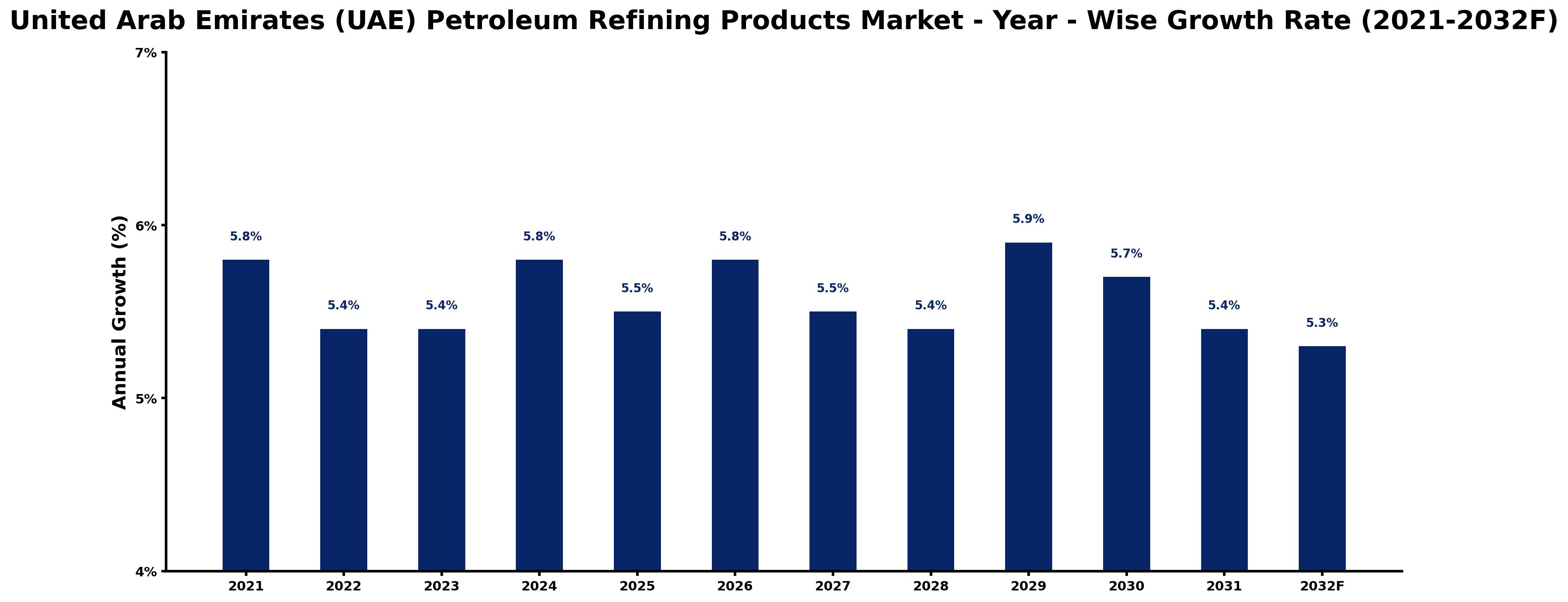
The table below presents the year wise growth rates along with the key drivers influencing the market
| Year | Growth Rate | Major Drivers |
| 2021 | 5.8% | Industry recovery post-pandemic spurred a revitalization in refining capacity and investments. |
| 2022 | 5.4% | Investors focused on upgrading facilities to meet evolving global petroleum standards. |
| 2023 | 5.4% | Continued emphasis on diversification saw increased funding for petrochemical expansions and innovation. |
| 2024 | 5.8% | Local demand for refined products intensified due to UAE's economic rebound and construction projects. |
| 2025 | 5.5% | Emerging markets in Asia presented new export opportunities for UAE refinery outputs. |
| 2026 | 5.8% | Technological advancements in refining processes enhanced efficiency and reduced operational costs. |
| 2027 | 5.5% | Partnerships with international firms facilitated knowledge transfer and upgraded refining technologies. |
| 2028 | 5.4% | Increased focus on sustainability prompted investment in cleaner refining technologies and practices. |
| 2029 | 5.9% | UAE's geopolitical stability attracted foreign investments in energy sector development and infrastructure. |
| 2030 | 5.7% | Refinery capacity expansion projects aligned with UAE's long-term economic diversification strategy. |
| 2031 | 5.4% | Digital transformation initiatives streamlined operational efficiencies within the petroleum refining sector. |
| 2032 | 5.3% | Growing global energy transition pressures reshaped market dynamics and prompted innovation in refining. |
Note - Market size estimations and growth projections presented in this report are based on 6Wresearch's advanced forecasting approach, validated with industry datasets as of June 2026.
United Arab Emirates (UAE) Petroleum Refining Products Market Synopsis
The United Arab Emirates (UAE) Petroleum Refining Products Market is projected to reach 5.8% and witness significant growth during the forecast period (2026-2032). The petroleum refining products market plays an integral role in the UAE's economy, given its status as a leading oil producer and exporter. This industry is essential for transforming crude oil into various refined products such as gasoline, diesel, jet fuel, and an array of petrochemicals, which are vital both for domestic consumption and international export.
United Arab Emirates (UAE) Petroleum Refining Products Market Growth Drivers
Several factors contribute to the growth of the United Arab Emirates (UAE) Petroleum Refining Products Market. The country's vast crude oil reserves and high production capacity provide a reliable feedstock for local refineries. Additionally, the strategic geographic positioning of the UAE ensures easy access to major international shipping routes, allowing for efficient distribution of refined products across global markets. Moreover, the domestic demand for energy is consistently growing, fueled by population increases and economic development projects. Various governmental initiatives aimed at enhancing refining capabilities and sustainability practices are further propelling market growth.
- The significant increase in urbanisation and industrial activities within the UAE translates into rising energy demands.
- Continued investments in upgrading refinery technologies are improving efficiency and output capacities.
- The UAE's vision for economic diversification encourages more investments in the petrochemical sector.
- The development of renewable energy initiatives within the UAE also indirectly supports the petroleum refining sector through hybrid models.
- Growing export opportunities owing to the UAE's reputation as a reliable supplier of refined products attract international partnerships.
United Arab Emirates (UAE) Petroleum Refining Products Market Challenges and Restraints
Despite its advantages, the United Arab Emirates (UAE) Petroleum Refining Products Market faces significant challenges that can impede growth. The volatility of global oil prices poses a risk to profitability, as fluctuating prices can impact operational margins for refineries. Additionally, the industry is under increasing pressure from the global shift towards renewable energy sources, raising concerns about the long-term viability of petroleum-focused operations. Environmental regulatory frameworks are becoming stricter, necessitating compliance that can burden refineries with high operational costs.
- Fluctuations in oil prices can lead to inconsistent profit margins, impacting investment decisions.
- The global shift to renewable energy raises concerns about the sustainability of the petroleum market.
- Increased environmental regulations require refineries to invest in cleaner technologies, raising operational costs.
- COVID-19 resulted in significant disruptions, highlighting vulnerabilities in the supply chain that need addressing.
- Competition from emerging oil-producing regions could challenge the UAE's market share in international exports.
United Arab Emirates (UAE) Petroleum Refining Products Market Government Investment and Initiatives
The government of the United Arab Emirates (UAE) is actively engaged in enhancing the petroleum refining products market through strategic investments and policies. Initiatives aimed at diversifying the economy include substantial public spending on refining infrastructure and technology upgrades. The UAE government has introduced incentives to promote innovation and sustainability within the refining sector, encouraging companies to adopt environmentally friendly practices. Furthermore, development plans encompass expanding refining capacities, as well as integrating petrochemical production with refining processes to maximize output and revenue.
- The government is focused on creating a conducive environment for private sector investments in refining technologies.
- Public funds are allocated towards research and development initiatives to enhance refining efficiencies.
- Partnerships with international firms are encouraged to incorporate global best practices in refinery operations.
- Regulatory frameworks are being refined to facilitate smoother operations while ensuring environmental compliance.
- Long-term national strategies aim to position the UAE as a leader in advanced petroleum refining solutions.
United Arab Emirates (UAE) Petroleum Refining Products Market Latest Developments (May 2025 - June 2026)
During the period from May 2025 to June 2026, the United Arab Emirates (UAE) Petroleum Refining Products Market has seen significant advancements. The focus has been on modernising existing refineries to enhance operational efficiency and reduce emissions. Several initiatives emphasizing the integration of digital technologies in refining processes have surfaced, enabling real-time monitoring and optimization. Efforts to strengthen international trade relationships have also been evident, as the UAE seeks to bolster export capabilities while navigating fluctuating global oil market conditions.
- Refinery upgrades have been initiated to meet both domestic and international regulatory standards for emissions.
- Digitalization projects are being rolled out within refineries to improve efficiency and decision-making processes.
- Strategic alliances with foreign companies for technology transfer and expertise development have been pursued.
- Increased focus on environmental sustainability has led to research initiatives on cleaner refining processes.
- Market dynamics have prompted refiners to explore new export markets in Asia and Europe.
United Arab Emirates (UAE) Petroleum Refining Products Market - Key Attractiveness of the Report
- 10 Years of Market Numbers
- Historical Data Starting from 2022 to 2025
- Base Year: 2025
- Forecast Data until 2032
- Key Performance Indicators Impacting the Market
- Major Upcoming Developments and Projects
Key Highlights of the Report:
- United Arab Emirates (UAE) Petroleum Refining Products Market Outlook
- Market Size of United Arab Emirates (UAE) Petroleum Refining Products Market, 2025
- Forecast of United Arab Emirates (UAE) Petroleum Refining Products Market, 2032
- Historical Data and Forecast of United Arab Emirates (UAE) Petroleum Refining Products Revenues & Volume for the Period 2022-2032F
- United Arab Emirates (UAE) Petroleum Refining Products Market Trend Evolution
- United Arab Emirates (UAE) Petroleum Refining Products Market Drivers and Challenges
- United Arab Emirates (UAE) Petroleum Refining Products Price Trends
- United Arab Emirates (UAE) Petroleum Refining Products Porter's Five Forces
- United Arab Emirates (UAE) Petroleum Refining Products Industry Life Cycle
- Historical Data and Forecast of United Arab Emirates (UAE) Petroleum Refining Products Market Revenues & Volume By Type for the Period 2022-2032F
- Historical Data and Forecast of United Arab Emirates (UAE) Petroleum Refining Products Market Revenues & Volume By Ethane & LPG for the Period 2022-2032F
- Historical Data and Forecast of United Arab Emirates (UAE) Petroleum Refining Products Market Revenues & Volume By Gasoline for the Period 2022-2032F
- Historical Data and Forecast of United Arab Emirates (UAE) Petroleum Refining Products Market Revenues & Volume By Diesel/Gasoil for the Period 2022-2032F
- Historical Data and Forecast of United Arab Emirates (UAE) Petroleum Refining Products Market Revenues & Volume By Jet/Kerosene for the Period 2022-2032F
- Historical Data and Forecast of United Arab Emirates (UAE) Petroleum Refining Products Market Revenues & Volume By Naphtha for the Period 2022-2032F
- Historical Data and Forecast of United Arab Emirates (UAE) Petroleum Refining Products Market Revenues & Volume By Fuel Oil for the Period 2022-2032F
- Historical Data and Forecast of United Arab Emirates (UAE) Petroleum Refining Products Market Revenues & Volume By Others for the Period 2022-2032F
- Historical Data and Forecast of United Arab Emirates (UAE) Petroleum Refining Products Market Revenues & Volume By End-users for the Period 2022-2032F
- Historical Data and Forecast of United Arab Emirates (UAE) Petroleum Refining Products Market Revenues & Volume By Transportation for the Period 2022-2032F
- Historical Data and Forecast of United Arab Emirates (UAE) Petroleum Refining Products Market Revenues & Volume By Others for the Period 2022-2032F
- United Arab Emirates (UAE) Petroleum Refining Products Import Export Trade Statistics
- Market Opportunity Assessment By Type
- Market Opportunity Assessment By End-users
- United Arab Emirates (UAE) Petroleum Refining Products Top Companies Market Share
- United Arab Emirates (UAE) Petroleum Refining Products Competitive Benchmarking By Technical and Operational Parameters
- United Arab Emirates (UAE) Petroleum Refining Products Company Profiles
- United Arab Emirates (UAE) Petroleum Refining Products Key Strategic Recommendations






































