United Arab Emirates (UAE) Plastic Building Materials Market Summary
The united arab emirates (uae) plastic building materials market was estimated at USD 379 Million in 2025 and is projected to reach USD 512 Million by 2032, growing at a CAGR of 5.0% from 2026 to 2032.
United Arab Emirates (UAE) Plastic Building Materials Market Year-wise Growth Rate and Key Drivers
This graph highlights how the United Arab Emirates (UAE) Plastic Building Materials Market has steadily grown over the past five years, supported by major growth factors.
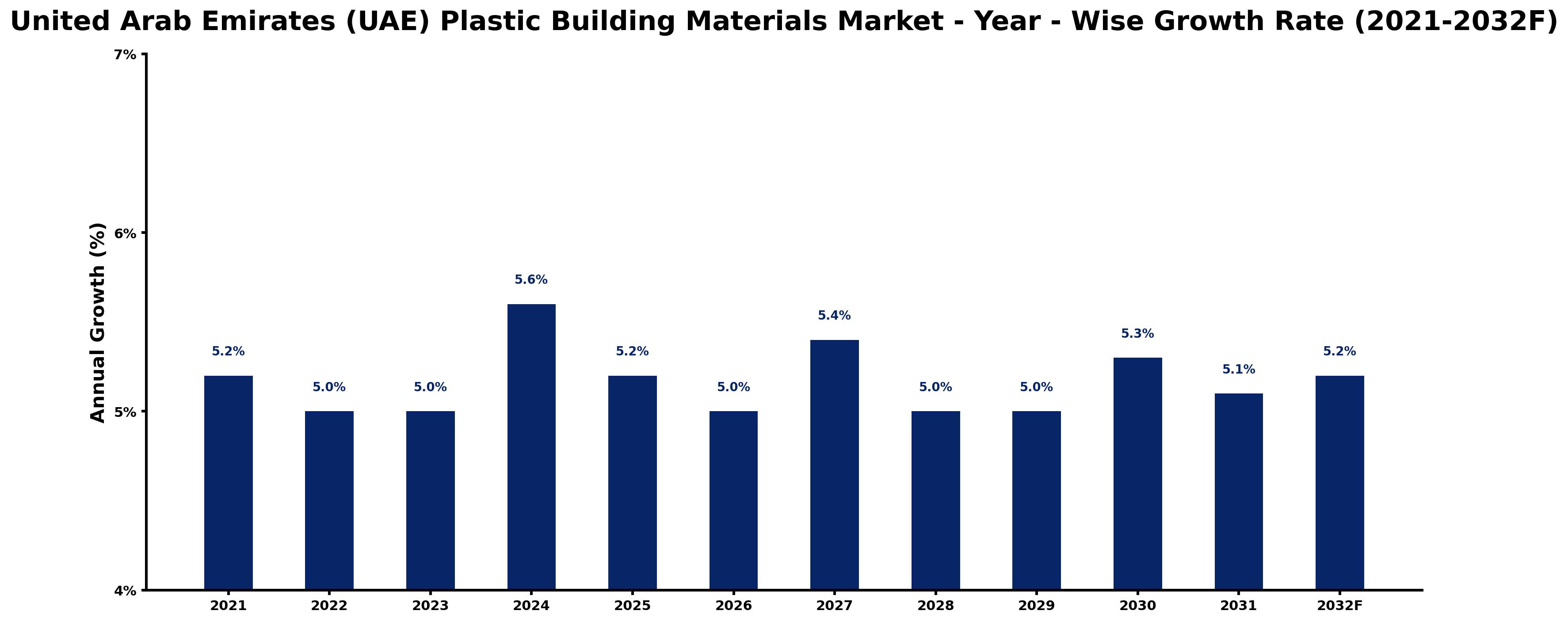
The table below presents the year wise growth rates along with the key drivers influencing the market
| Year | Growth Rate | Major Drivers |
| 2021 | 5.2% | Post-lockdown construction activities prompted a surge in building material needs. |
| 2022 | 5.0% | Local manufacturers adapted to meet the UAE's evolving sustainability standards effectively. |
| 2023 | 5.0% | Urbanization trends pushed demand for lightweight, durable plastic building materials significantly. |
| 2024 | 5.6% | Real estate developments in cities like Dubai and Abu Dhabi expanded material consumption. |
| 2025 | 5.2% | Technological innovations improved production efficiency, reducing costs for builders nationwide. |
| 2026 | 5.0% | Construction projects aligned with Expo 2020 showcased advanced plastic material capabilities. |
| 2027 | 5.4% | Environmental awareness among consumers began influencing material choices in construction. |
| 2028 | 5.0% | Collaborations between local firms and international manufacturers enhanced product offerings broadly. |
| 2029 | 5.0% | Smart city initiatives integrated advanced building materials into urban infrastructure designs. |
| 2030 | 5.3% | Architectural firms favored sustainable materials, driving demand for eco-friendly building products. |
| 2031 | 5.1% | Regional economic diversification strategies included enhancing construction material manufacturing locally. |
| 2032 | 5.2% | Investment in green technologies positioned plastic building materials as a preferred choice. |
Note - Market size estimations and growth projections presented in this report are based on 6Wresearch's advanced forecasting approach, validated with industry datasets as of June 2026.
United Arab Emirates (UAE) Plastic Building Materials Market Synopsis
The United Arab Emirates (UAE) Plastic Building Materials Market is projected to reach 5.0% and witness significant growth during the forecast period (2026-2032). This growth is primarily driven by robust demand stemming from both commercial and residential construction initiatives in the region. With the UAE's continuous push for modern infrastructure and sustainable building practices, the plastic building materials sector is well-positioned to capitalize on these trends.
United Arab Emirates (UAE) Plastic Building Materials Market Growth Drivers
The expansion of the United Arab Emirates (UAE) Plastic Building Materials Market can be attributed to several key factors:
- Increased investments in the construction sector have led to a surge in demand for plastic building materials, which are favored for their durability and versatility in various applications.
- The government's focus on green building materials to enhance energy efficiency and sustainability has driven the adoption of plastic-based solutions within the construction industry.
- Technological advancements, including the rise of 3D printing technologies, enable cost-effective and efficient production of plastic building materials, further stimulating market growth.
- Urbanization in the UAE is a critical driver, as the growing population demands more housing and infrastructure development, thereby increasing the need for innovative building materials.
- The increasing awareness of the environmental benefits associated with plastic materials, such as lower carbon footprints compared to traditional materials, is propelling their use in construction projects.
United Arab Emirates (UAE) Plastic Building Materials Market Challenges and Restraints
Despite the positive growth trajectory, the United Arab Emirates (UAE) Plastic Building Materials Market faces several challenges:
- Fluctuations in raw material prices can significantly impact manufacturing costs and profit margins for companies in the plastic building materials sector.
- There are ongoing concerns about the environmental impact of plastic waste, leading to scrutiny from both consumers and regulatory bodies, which can affect market perceptions.
- Competition from alternative materials such as wood, metal, and concrete may limit the market share of plastic building materials in certain applications.
- Regulatory hurdles and compliance with environmental standards can create challenges for manufacturers aiming to introduce new products into the market.
- The need for continuous innovation and adaptation to changing consumer preferences adds pressure on manufacturers to stay competitive.
United Arab Emirates (UAE) Plastic Building Materials Market Investment Opportunities
The United Arab Emirates (UAE) Plastic Building Materials Market presents notable investment opportunities, including:
- Capitalizing on the green building trend by developing eco-friendly plastic building materials that meet stringent sustainability standards.
- Investing in R&D to explore advanced manufacturing techniques that enhance product efficiency and reduce costs.
- Establishing partnerships with construction firms to provide tailored solutions and meet the specific needs of diverse projects.
- Leveraging government initiatives aimed at developing smart cities and sustainable urban environments, which can boost demand for innovative building materials.
- Exploring export opportunities to neighboring markets that are experiencing similar construction booms and may require advanced plastic building solutions.
United Arab Emirates (UAE) Plastic Building Materials Market Government Investment and Initiatives
The government of the United Arab Emirates has proactively supported the growth of the plastic building materials sector through various policies and initiatives:
- The UAE Vision 2021 aims to enhance the nation's infrastructure and promote sustainability, directing public spending towards innovative construction solutions, including plastic materials.
- Incentives for the construction industry have encouraged the adoption of sustainable building practices, fostering demand for eco-friendly plastic building materials.
- Public-Private Partnerships (PPPs) are increasingly being utilized to leverage private investment in sustainable construction projects, which could significantly utilize plastic materials.
- Investment in research and technology parks emphasizes the importance of innovation in construction materials, which benefits the plastic building materials industry.
- Regulatory frameworks supporting green building certifications provide a conducive environment for the growth and adoption of plastic building materials in construction projects.
United Arab Emirates (UAE) Plastic Building Materials Market Latest Developments (May 2025 - June 2026)
Recent developments in the United Arab Emirates (UAE) Plastic Building Materials Market from May 2025 to June 2026 reflect a dynamic industry:
- There has been a notable increase in collaborations between construction firms and materials suppliers, aimed at enhancing the efficiency and sustainability of building projects.
- The introduction of new regulations promoting sustainable practices within the construction sector has spurred investments in plastic building materials.
- Technological innovations, particularly in manufacturing processes, have led to the development of new, more efficient plastic materials tailored specifically for construction applications.
- Exhibitions and trade shows have highlighted advancements in plastic building technologies, leading to increased visibility and interest in the industry.
- Market players have intensified their focus on consumer education regarding the benefits of plastic building materials, which is influencing purchasing decisions among contractors and developers.
United Arab Emirates (UAE) Plastic Building Materials Market - Key Attractiveness of the Report
- 10 Years of Market Numbers
- Historical Data Starting from 2022 to 2025
- Base Year: 2025
- Forecast Data until 2032
- Key Performance Indicators Impacting the Market
- Major Upcoming Developments and Projects
Key Highlights of the Report:
- United Arab Emirates (UAE) Plastic Building Materials Market Outlook
- Market Size of United Arab Emirates (UAE) Plastic Building Materials Market, 2025
- Forecast of United Arab Emirates (UAE) Plastic Building Materials Market, 2032F
- Historical Data and Forecast of United Arab Emirates (UAE) Plastic Building Materials Revenues & Volume for the Period 2022-2032F
- United Arab Emirates (UAE) Plastic Building Materials Market Trend Evolution
- United Arab Emirates (UAE) Plastic Building Materials Market Drivers and Challenges
- United Arab Emirates (UAE) Plastic Building Materials Price Trends
- United Arab Emirates (UAE) Plastic Building Materials Porter's Five Forces
- United Arab Emirates (UAE) Plastic Building Materials Industry Life Cycle
- Historical Data and Forecast of United Arab Emirates (UAE) Plastic Building Materials Market Revenues & Volume By Product Type for the Period 2022-2032F
- Historical Data and Forecast of United Arab Emirates (UAE) Plastic Building Materials Market Revenues & Volume By Thermoplastic for the Period 2022-2032F
- Historical Data and Forecast of United Arab Emirates (UAE) Plastic Building Materials Market Revenues & Volume By Thermosetting Plastic for the Period 2022-2032F
- Historical Data and Forecast of United Arab Emirates (UAE) Plastic Building Materials Market Revenues & Volume By Applications for the Period 2022-2032F
- Historical Data and Forecast of United Arab Emirates (UAE) Plastic Building Materials Market Revenues & Volume By Flooring for the Period 2022-2032F
- Historical Data and Forecast of United Arab Emirates (UAE) Plastic Building Materials Market Revenues & Volume By Window and Door Panel for the Period 2022-2032F
- Historical Data and Forecast of United Arab Emirates (UAE) Plastic Building Materials Market Revenues & Volume By Siding for the Period 2022-2032F
- Historical Data and Forecast of United Arab Emirates (UAE) Plastic Building Materials Market Revenues & Volume By Piping for the Period 2022-2032F
- Historical Data and Forecast of United Arab Emirates (UAE) Plastic Building Materials Market Revenues & Volume By Roofing for the Period 2022-2032F
- Historical Data and Forecast of United Arab Emirates (UAE) Plastic Building Materials Market Revenues & Volume By Insulation for the Period 2022-2032F
- Historical Data and Forecast of United Arab Emirates (UAE) Plastic Building Materials Market Revenues & Volume By Others for the Period 2022-2032F
- United Arab Emirates (UAE) Plastic Building Materials Import Export Trade Statistics
- Market Opportunity Assessment By Product Type
- Market Opportunity Assessment By Applications
- United Arab Emirates (UAE) Plastic Building Materials Top Companies Market Share
- United Arab Emirates (UAE) Plastic Building Materials Competitive Benchmarking By Technical and Operational Parameters
- United Arab Emirates (UAE) Plastic Building Materials Company Profiles
- United Arab Emirates (UAE) Plastic Building Materials Key Strategic Recommendations






































