United Arab Emirates (UAE) Platform as a Service (PaaS) Market Size & Growth Rate (2026-2032)
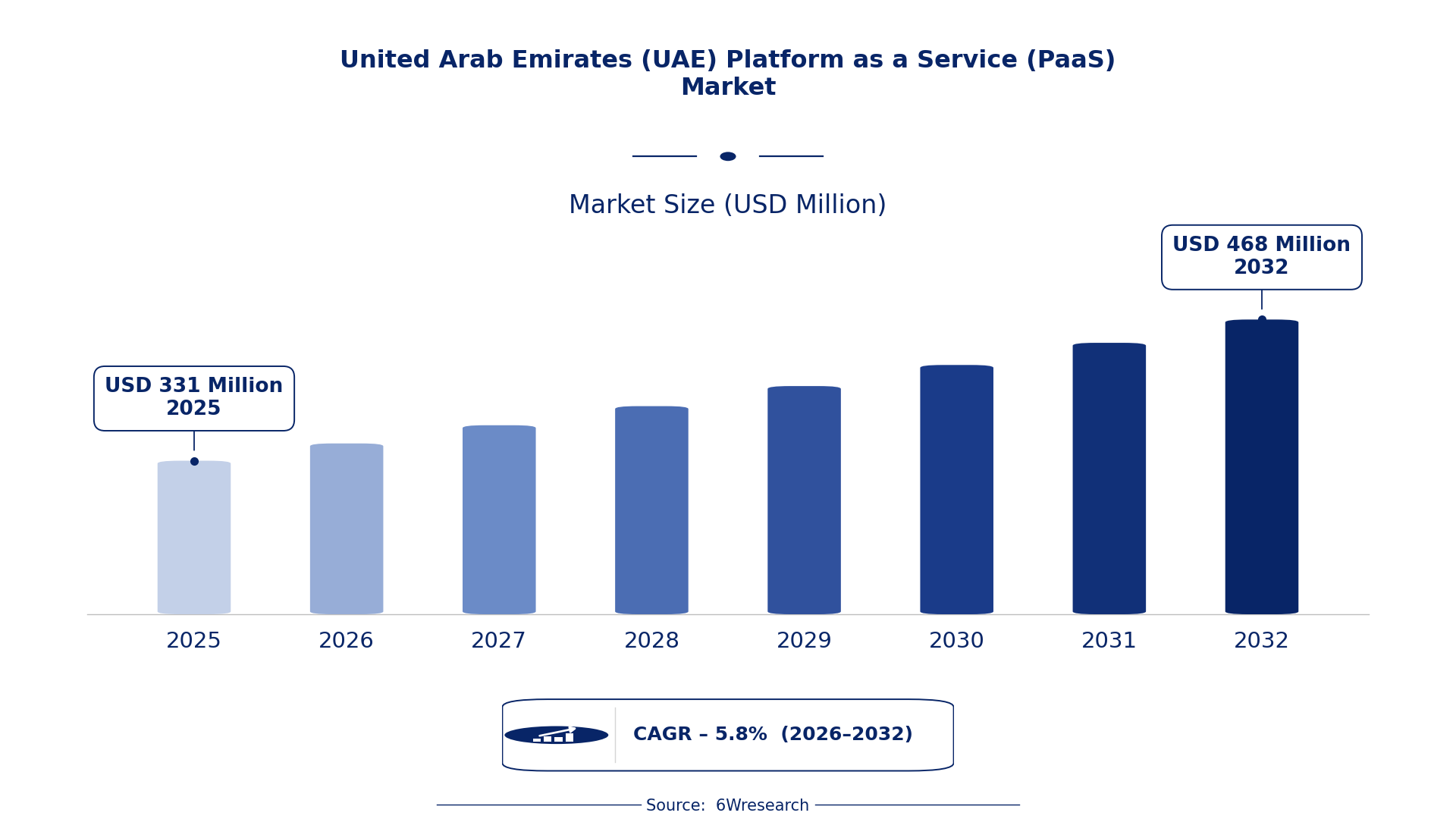
The United Arab Emirates (UAE) Platform as a Service (PaaS) Market was estimated at USD 331 Million in 2025 and is projected to reach USD 468 Million by 2032, growing at a CAGR of 5.8% from 2026 to 2032.
United Arab Emirates (UAE) Platform as a Service (PaaS) Market Synopsis
The surge in demand for agile development solutions is the primary force propelling the UAE Platform as a Service (PaaS) market forward. Businesses are increasingly turning to PaaS to streamline application development and deployment, enabling them to focus on innovation rather than the complexities of infrastructure management.
With the government's strong push towards smart cities and digital transformation, PaaS solutions have gained traction across various sectors. This dynamic environment fosters competition among both local and international providers, who are eager to deliver diverse tools and services tailored to the unique needs of businesses operating in the UAE.
United Arab Emirates (UAE) Platform as a Service (PaaS) Market Year-wise Growth Rate and Key Drivers
This graph illustrates the annual growth rates of the United Arab Emirates (UAE) Platform as a Service (PaaS) Market from 2021 to 2032, highlighting a steady upward trajectory and projected expansion over the forecast period.
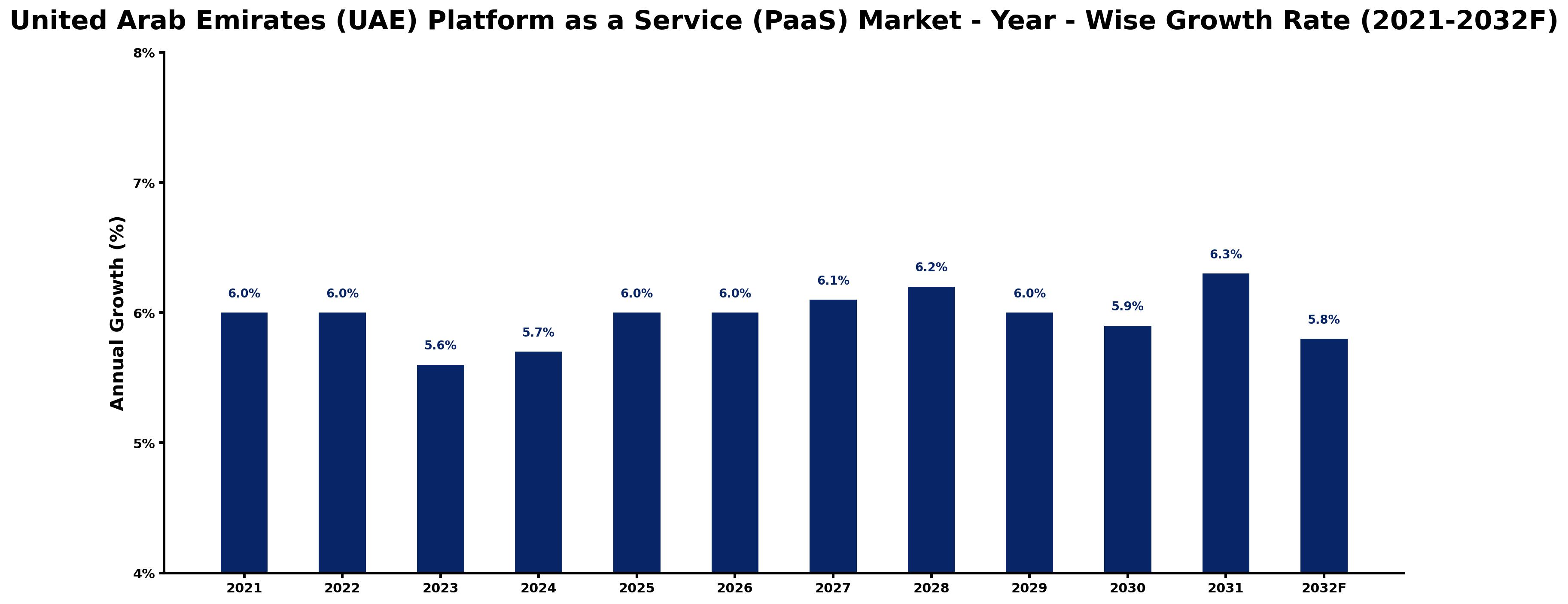
The table below presents the year‑wise growth rates along with the key drivers influencing the market
| Year | Growth Rate | Major Drivers |
| 2021 | 6.0% | ADX digital transformation strategy enhances cloud adoption. |
| 2022 | 6.0% | UAE Vision 2021 promotes innovation in digital services. |
| 2023 | 5.6% | Growing tech startup ecosystem increases PaaS platform usage. |
| 2024 | 5.7% | Smart Dubai initiative accelerates cloud solution integration. |
| 2025 | 6.0% | National AI Strategy encourages PaaS for intelligent applications. |
| 2026 | 6.0% | Rising local demand for SaaS boosts PaaS platforms. |
| 2027 | 6.1% | Government cloud policy fosters PaaS investments and growth. |
| 2028 | 6.2% | Youth-led digital initiatives expand PaaS market potential. |
| 2029 | 6.0% | Local enterprises shifting to cloud-driven models increase uptake. |
| 2030 | 5.9% | E-Government services adoption boosts PaaS utilization rates. |
| 2031 | 6.3% | Increased cybersecurity regulations drive secure PaaS solutions. |
| 2032 | 5.8% | Regional tech events highlight PaaS innovation opportunities. |
Note: Market size estimations and growth projections presented in this report are based on 6Wresearch's proprietary forecasting methodology, utilizing the latest available industry data, government publications, and primary research inputs.
United Arab Emirates (UAE) Platform as a Service (PaaS) Market Key Takeaways
Below are some of the specific key takeaways from the market, including:
- The UAE PaaS market is experiencing robust growth driven by increased cloud adoption.
- Innovation and digital transformation initiatives are key priorities for local businesses.
- Competition among PaaS providers enhances service offerings for end-users.
- Government initiatives focusing on digital infrastructure significantly support market growth.
- Data security and compliance remain critical considerations for PaaS adoption.
Evaluation of Restraints in United Arab Emirates (UAE) Platform as a Service (PaaS) Market
While the UAE PaaS market shows promising growth, several restraints hinder its full potential. One major limitation is the challenge of customization versus standardization. Many businesses desire tailored solutions, but providers must also offer standardized platforms for broader appeal and ease of use. This balancing act can lead to tensions in service delivery. on top of that, concerns regarding data security and regulatory compliance add layers of complexity to the adoption of PaaS solutions, making organizations cautious. As the market continues to evolve, navigating these constraints will be vital for both providers and users alike.
United Arab Emirates (UAE) Platform as a Service (PaaS) Market Trends
Several trends are emerging in the UAE PaaS market that will shape its future. The rise of low-code and no-code platforms is making application development accessible to a broader range of users, reducing the dependency on traditional coding skills. Additionally, integration of advanced technologies like AI and machine learning within PaaS offerings is enhancing the capabilities of these platforms, enabling businesses to create more intelligent applications. on top of that, as businesses continue to prioritize sustainability, there is an increasing demand for green cloud solutions that minimize environmental impact.
United Arab Emirates (UAE) Platform as a Service (PaaS) Market Opportunities
The PaaS market in the UAE presents numerous opportunities for growth and investment. As sectors like finance, healthcare, and logistics ramp up their digital transformation efforts, there is a pressing need for tailored PaaS solutions. Companies that can develop platforms catering to specific industry requirements are likely to capture significant market share. on top of that, the ongoing government initiatives to enhance digital infrastructure create a favorable environment for PaaS providers to collaborate on innovative projects, further driving market expansion.
Government Initiatives in the United Arab Emirates (UAE) Platform as a Service (PaaS) Market
The UAE government is actively shaping the PaaS market through various initiatives focused on digital innovation and infrastructure enhancement. By prioritizing smart city projects and digital transformation, public policy plays a crucial role in fostering an environment conducive to PaaS adoption. These initiatives not only support local businesses but also attract international players, contributing to a competitive market.
- A national digital infrastructure upgrade programme, recently launched, aims to bolster connectivity and cloud adoption across sectors.
- Ongoing initiatives focus on developing a regulatory framework to ensure data protection and compliance for PaaS solutions.
- A planned public-private partnership is expected to enhance support for innovative PaaS applications in the healthcare sector by 2026.
- In 2025, the government introduced a programme that incentivizes businesses to adopt cloud technologies, including PaaS solutions.
- Upcoming initiatives include a national campaign designed to promote awareness of PaaS benefits among SMEs, scheduled for 2027.
Future Insights of the United Arab Emirates (UAE) Platform as a Service (PaaS) Market
From 2026 to 2032, the UAE PaaS market is expected to continue its upward trajectory, driven by ongoing digital transformation across various industries. As organizations seek to enhance their operational efficiency, the demand for PaaS solutions will intensify. The integration of emerging technologies like AI, IoT, and blockchain will further expand the capabilities of PaaS platforms, making them indispensable for businesses. With the government's unwavering support for digital initiatives, the market is well-positioned for sustained growth, attracting both local and international investments.
United Arab Emirates (UAE) Platform as a Service (PaaS) Market Latest Developments
In the past year, the UAE PaaS market has seen a flurry of activity as businesses increasingly embrace cloud technologies. This trend has spurred numerous developments aimed at enhancing service offerings and expanding market reach. Companies are focusing on collaboration and innovation to meet the evolving needs of their customers.
- A leading regional operator announced the launch of a new PaaS offering designed for small and medium-sized enterprises, initiated in early 2025 and completed by late 2025.
- Currently ongoing, a major technology vendor is enhancing its PaaS platform with advanced AI features aimed at improving application development efficiency.
- An initiative focused on integrating PaaS solutions with IoT technologies began in mid-2025 and remains underway, targeting the logistics sector.
- Upcoming plans include a rollout of a multi-cloud PaaS solution expected to begin in the second half of 2026, aimed at increasing flexibility for developers.
- A recent partnership between key stakeholders aims to create a centralized PaaS marketplace, with completion anticipated by early 2026.
United Arab Emirates (UAE) Platform as a Service (PaaS) Market - Key Attractiveness of the Report
- 10 Years of Market Numbers
- Historical Data Starting from 2022 to 2025
- Base Year: 2025
- Forecast Data until 2032
- Key Performance Indicators Impacting the Market
- Major Upcoming Developments and Projects
Key Highlights of the Report:
- United Arab Emirates (UAE) Platform as a Service (PaaS) Market Outlook
- Market Size of United Arab Emirates (UAE) Platform as a Service (PaaS) Market, 2025
- Forecast of United Arab Emirates (UAE) Platform as a Service (PaaS) Market, 2032
- Historical Data and Forecast of United Arab Emirates (UAE) Platform as a Service (PaaS) Revenues & Volume for the Period 2022-2032F
- United Arab Emirates (UAE) Platform as a Service (PaaS) Market Trend Evolution
- United Arab Emirates (UAE) Platform as a Service (PaaS) Market Drivers and Challenges
- United Arab Emirates (UAE) Platform as a Service (PaaS) Price Trends
- United Arab Emirates (UAE) Platform as a Service (PaaS) Porter's Five Forces
- United Arab Emirates (UAE) Platform as a Service (PaaS) Industry Life Cycle
- Historical Data and Forecast of United Arab Emirates (UAE) Platform as a Service (PaaS) Market Revenues & Volume By Type for the Period 2022-2032F
- Historical Data and Forecast of United Arab Emirates (UAE) Platform as a Service (PaaS) Market Revenues & Volume By Application PaaS (aPaaS) for the Period 2022-2032F
- Historical Data and Forecast of United Arab Emirates (UAE) Platform as a Service (PaaS) Market Revenues & Volume By Integration PaaS (iPaaS) for the Period 2022-2032F
- Historical Data and Forecast of United Arab Emirates (UAE) Platform as a Service (PaaS) Market Revenues & Volume By Database PaaS (dbPaaS) for the Period 2022-2032F
- Historical Data and Forecast of United Arab Emirates (UAE) Platform as a Service (PaaS) Market Revenues & Volume By Others for the Period 2022-2032F
- Historical Data and Forecast of United Arab Emirates (UAE) Platform as a Service (PaaS) Market Revenues & Volume By Deployment for the Period 2022-2032F
- Historical Data and Forecast of United Arab Emirates (UAE) Platform as a Service (PaaS) Market Revenues & Volume By Public for the Period 2022-2032F
- Historical Data and Forecast of United Arab Emirates (UAE) Platform as a Service (PaaS) Market Revenues & Volume By Private for the Period 2022-2032F
- Historical Data and Forecast of United Arab Emirates (UAE) Platform as a Service (PaaS) Market Revenues & Volume By Market Type for the Period 2022-2032F
- Historical Data and Forecast of United Arab Emirates (UAE) Platform as a Service (PaaS) Market Revenues & Volume By APaaS for the Period 2022-2032F
- Historical Data and Forecast of United Arab Emirates (UAE) Platform as a Service (PaaS) Market Revenues & Volume By IPaaS for the Period 2022-2032F
- Historical Data and Forecast of United Arab Emirates (UAE) Platform as a Service (PaaS) Market Revenues & Volume By DBPaaS for the Period 2022-2032F
- Historical Data and Forecast of United Arab Emirates (UAE) Platform as a Service (PaaS) Market Revenues & Volume By Organization Size for the Period 2022-2032F
- Historical Data and Forecast of United Arab Emirates (UAE) Platform as a Service (PaaS) Market Revenues & Volume By Large Enterprises for the Period 2022-2032F
- Historical Data and Forecast of United Arab Emirates (UAE) Platform as a Service (PaaS) Market Revenues & Volume By SMEs for the Period 2022-2032F
- Historical Data and Forecast of United Arab Emirates (UAE) Platform as a Service (PaaS) Market Revenues & Volume By Vertical for the Period 2022-2032F
- Historical Data and Forecast of United Arab Emirates (UAE) Platform as a Service (PaaS) Market Revenues & Volume By BFSI for the Period 2022-2032F
- Historical Data and Forecast of United Arab Emirates (UAE) Platform as a Service (PaaS) Market Revenues & Volume By Consumer goods and retail for the Period 2022-2032F
- Historical Data and Forecast of United Arab Emirates (UAE) Platform as a Service (PaaS) Market Revenues & Volume By Telecommunication for the Period 2022-2032F
- Historical Data and Forecast of United Arab Emirates (UAE) Platform as a Service (PaaS) Market Revenues & Volume By IT and ITeS for the Period 2022-2032F
- Historical Data and Forecast of United Arab Emirates (UAE) Platform as a Service (PaaS) Market Revenues & Volume By Manufacturing for the Period 2022-2032F
- Historical Data and Forecast of United Arab Emirates (UAE) Platform as a Service (PaaS) Market Revenues & Volume By Healthcare and life sciences for the Period 2022-2032F
- Historical Data and Forecast of United Arab Emirates (UAE) Platform as a Service (PaaS) Market Revenues & Volume By Energy and utility for the Period 2022-2032F
- Historical Data and Forecast of United Arab Emirates (UAE) Platform as a Service (PaaS) Market Revenues & Volume By Others for the Period 2022-2032F
- United Arab Emirates (UAE) Platform as a Service (PaaS) Import Export Trade Statistics
- Market Opportunity Assessment By Type
- Market Opportunity Assessment By Deployment
- Market Opportunity Assessment By Market Type
- Market Opportunity Assessment By Organization Size
- Market Opportunity Assessment By Vertical
- United Arab Emirates (UAE) Platform as a Service (PaaS) Top Companies Market Share
- United Arab Emirates (UAE) Platform as a Service (PaaS) Competitive Benchmarking By Technical and Operational Parameters
- United Arab Emirates (UAE) Platform as a Service (PaaS) Company Profiles
- United Arab Emirates (UAE) Platform as a Service (PaaS) Key Strategic Recommendations






































