United Arab Emirates (UAE) Polyester Spun Yarn Market Size, Share & Growth Rate
The United Arab Emirates (UAE) Polyester Spun Yarn Market was estimated at USD 1455 Million in 2025 and is projected to reach USD 2100 Million by 2032, growing at a CAGR of 5.4% from 2026 to 2032. This growth trajectory is largely fueled by a burgeoning textile and apparel sector, underscoring the fabric's durability and cost-effectiveness in various applications. The UAE's strategic position as a global trade hub also amplifies its role in the polyester spun yarn market, driving both domestic manufacturing and international trade.
United Arab Emirates (UAE) Polyester Spun Yarn Market Year-wise Growth Rate and Key Drivers
This graph highlights how the United Arab Emirates (UAE) Polyester Spun Yarn Market has steadily grown over the years, supported by major growth factors.
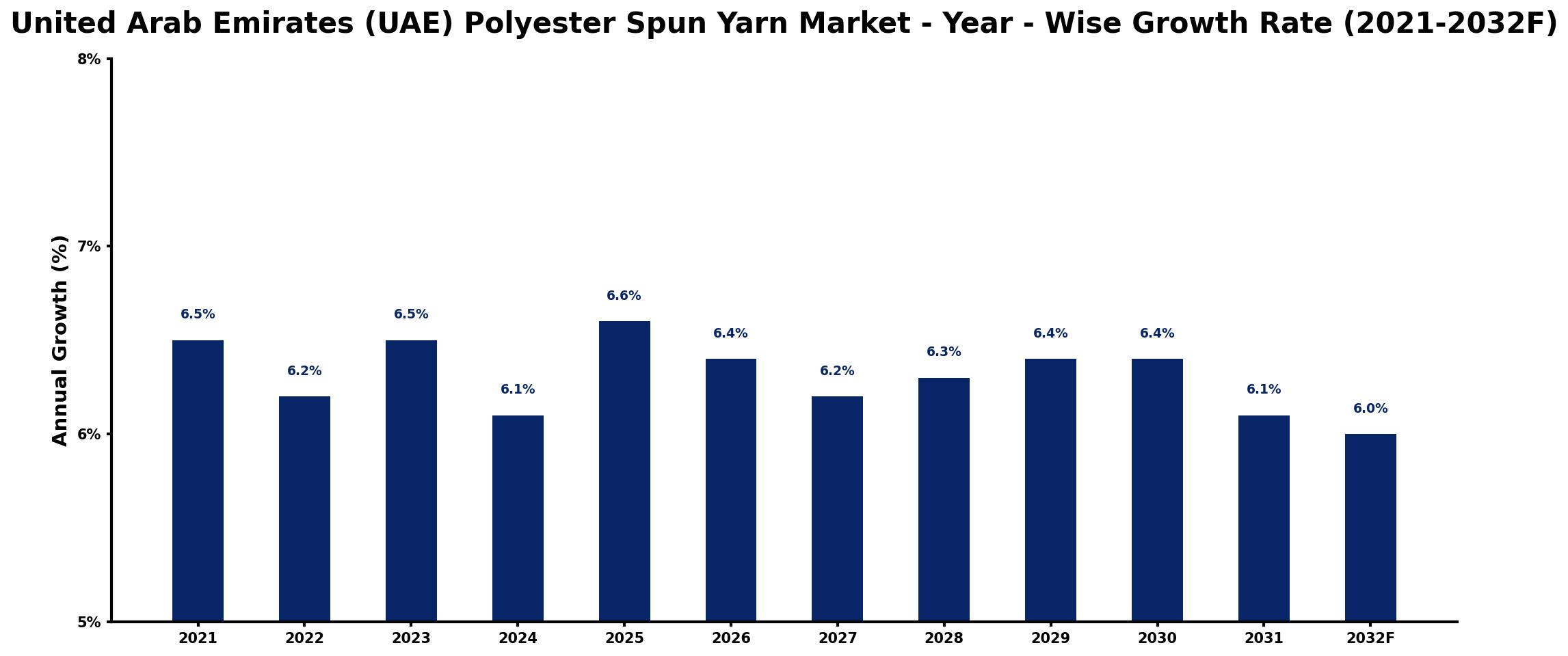
The table below presents the year‑wise growth rates along with the key drivers influencing the market
| Year | Growth Rate | Major Drivers |
| 2021 | 6.5% | Rising demand from textile industry |
| 2022 | 6.2% | Increased investment in manufacturing |
| 2023 | 6.5% | Growth in retail market segments |
| 2024 | 6.1% | Expansion of e-commerce platforms |
| 2025 | 6.6% | Surge in fashion industry trends |
| 2026 | 6.4% | Higher consumer spending on apparel |
| 2027 | 6.2% | Development of sustainable production methods |
| 2028 | 6.3% | Boost in home textile applications |
| 2029 | 6.4% | Innovations in textile technology |
| 2030 | 6.4% | Strengthening of export markets |
| 2031 | 6.1% | Growing interest in activewear segments |
| 2032 | 6.0% | Rising focus on eco-friendly textiles |
Note: Market size estimations and growth projections presented in this report are based on 6Wresearch's proprietary forecasting methodology, utilizing the latest available industry data, government publications, and primary research inputs.
United Arab Emirates (UAE) Polyester Spun Yarn Market Synopsis
The primary force shaping the UAE Polyester Spun Yarn market is the continuous growth of the textile and apparel industry, which has a strong consumer base and high demand for versatile, high-quality materials. This market is also bolstered by the region's commitment to enhancing its manufacturing capabilities, which ensures that polyester spun yarn remains at the forefront of textile innovation.
Moreover, the increasing adoption of polyester spun yarn in home textiles and industrial applications reflects its expanding utility beyond traditional garments. As local manufacturers strive to meet both domestic and international standards, there is a notable trend toward high-performance yarns that cater to evolving consumer preferences, sustaining the market's positive momentum.
United Arab Emirates (UAE) Polyester Spun Yarn Market Key Takeaways
- Significant growth projected from USD 1455 Million in 2025 to USD 2100 Million by 2032.
- Durability and versatility of polyester spun yarn driving its adoption across various textile applications.
- Dependence on raw material imports poses risks related to supply chain stability and pricing.
- Innovations in textile manufacturing are enhancing the performance and applications of polyester spun yarn.
- Government initiatives are likely to support the local production and overall growth of the market.
Evaluation of Restraints in United Arab Emirates (UAE) Polyester Spun Yarn Market
The UAE Polyester Spun Yarn market faces significant restraints primarily due to its reliance on imported raw materials. This dependency creates vulnerabilities to international supply chain disruptions and price volatility, complicating the ability of local manufacturers to stabilize costs. Additionally, competition from lower-priced foreign yarn producers can limit the growth potential of domestic companies. These factors necessitate strategic approaches to enhance local production capabilities and diversify supply sources to mitigate risks.
United Arab Emirates (UAE) Polyester Spun Yarn Market Trends
A notable trend in the UAE Polyester Spun Yarn market is the increasing focus on sustainability, pushing manufacturers to explore eco-friendly production processes and materials. As consumers grow more environmentally conscious, the demand for recycled polyester and sustainable sourcing practices is rising. Furthermore, technological advancements in manufacturing processes are leading to higher-quality yarns that meet specific industrial requirements, paving the way for new applications in non-textile sectors.
United Arab Emirates (UAE) Polyester Spun Yarn Market Opportunities
There are substantial opportunities for growth in the UAE Polyester Spun Yarn market as manufacturers seek to innovate and expand their product offerings. With rising investments in textile technology and infrastructure, companies can capitalize on the increasing demand for specialized yarns tailored for niche applications, including sportswear and technical textiles. Furthermore, leveraging the UAE's strategic location can facilitate export opportunities to neighboring markets, enhancing the region's role in global textile trade.
Government Initiatives in the United Arab Emirates (UAE) Polyester Spun Yarn Market
The UAE government has implemented various initiatives aimed at bolstering the local textile industry, including financial incentives for manufacturers and investment in research and development. Programs designed to enhance skill development and innovation in textile production are fostering a more competitive landscape. Such efforts not only support local businesses but also aim to attract foreign investment, ultimately contributing to the sustainable growth of the polyester spun yarn market.
Future Insights of the United Arab Emirates (UAE) Polyester Spun Yarn Market
Looking ahead to the period from 2026 to 2032, the UAE Polyester Spun Yarn market is poised for significant advancements. The integration of technology and sustainability in manufacturing will likely reshape product offerings, catering to an increasingly discerning customer base. The market's growth will be driven by continuous investments in infrastructure and innovations that align with global trends, ensuring that the UAE remains competitive on the world stage.
United Arab Emirates (UAE) Polyester Spun Yarn Market Latest Developments (2025 - 2026)
In recent months, there has been a pronounced shift towards sustainability within the UAE Polyester Spun Yarn market, with multiple manufacturers exploring eco-friendly alternatives and production techniques. New collaborations aimed at enhancing technology in textile manufacturing have emerged, reflecting a unified industry response to consumer demand for high-quality, sustainable products. Furthermore, trade initiatives have been undertaken to strengthen export channels for UAE-made yarn products.
United Arab Emirates (UAE) Polyester Spun Yarn Market - Key Attractiveness of the Report
- 10 Years of Market Numbers
- Historical Data Starting from 2022 to 2025
- Base Year: 2025
- Forecast Data until 2032
- Key Performance Indicators Impacting the Market
- Major Upcoming Developments and Projects
Key Highlights of the Report:
- United Arab Emirates (UAE) Polyester Spun Yarn Market Outlook
- Market Size of United Arab Emirates (UAE) Polyester Spun Yarn Market, 2025
- Forecast of United Arab Emirates (UAE) Polyester Spun Yarn Market, 2032
- Historical Data and Forecast of United Arab Emirates (UAE) Polyester Spun Yarn Revenues & Volume for the Period 2022-2032F
- United Arab Emirates (UAE) Polyester Spun Yarn Market Trend Evolution
- United Arab Emirates (UAE) Polyester Spun Yarn Market Drivers and Challenges
- United Arab Emirates (UAE) Polyester Spun Yarn Price Trends
- United Arab Emirates (UAE) Polyester Spun Yarn Porter's Five Forces
- United Arab Emirates (UAE) Polyester Spun Yarn Industry Life Cycle
- Historical Data and Forecast of United Arab Emirates (UAE) Polyester Spun Yarn Market Revenues & Volume By Types for the Period 2022-2032F
- Historical Data and Forecast of United Arab Emirates (UAE) Polyester Spun Yarn Market Revenues & Volume By Recycled Spun Yarn for the Period 2022-2032F
- Historical Data and Forecast of United Arab Emirates (UAE) Polyester Spun Yarn Market Revenues & Volume By Non-recycled Spun Yarn for the Period 2022-2032F
- Historical Data and Forecast of United Arab Emirates (UAE) Polyester Spun Yarn Market Revenues & Volume By Fields for the Period 2022-2032F
- Historical Data and Forecast of United Arab Emirates (UAE) Polyester Spun Yarn Market Revenues & Volume By Apparel for the Period 2022-2032F
- Historical Data and Forecast of United Arab Emirates (UAE) Polyester Spun Yarn Market Revenues & Volume By Household Textiles for the Period 2022-2032F
- Historical Data and Forecast of United Arab Emirates (UAE) Polyester Spun Yarn Market Revenues & Volume By Others for the Period 2022-2032F
- United Arab Emirates (UAE) Polyester Spun Yarn Import Export Trade Statistics
- Market Opportunity Assessment By Types
- Market Opportunity Assessment By Fields
- United Arab Emirates (UAE) Polyester Spun Yarn Top Companies Market Share
- United Arab Emirates (UAE) Polyester Spun Yarn Competitive Benchmarking By Technical and Operational Parameters
- United Arab Emirates (UAE) Polyester Spun Yarn Company Profiles
- United Arab Emirates (UAE) Polyester Spun Yarn Key Strategic Recommendations






































