United Arab Emirates (UAE) Polyethylene (PE) Pipes and Tubes Market Summary
The united arab emirates (uae) polyethylene (pe) pipes and tubes market was estimated at USD 282 Million in 2025 and is projected to reach USD 394 Million by 2032, growing at a CAGR of 5.5% from 2026 to 2032.
United Arab Emirates (UAE) Polyethylene (PE) Pipes and Tubes Market Year-wise Growth Rate and Key Drivers
This graph highlights how the United Arab Emirates (UAE) Polyethylene (PE) Pipes and Tubes Market has steadily grown over the past five years, supported by major growth factors.
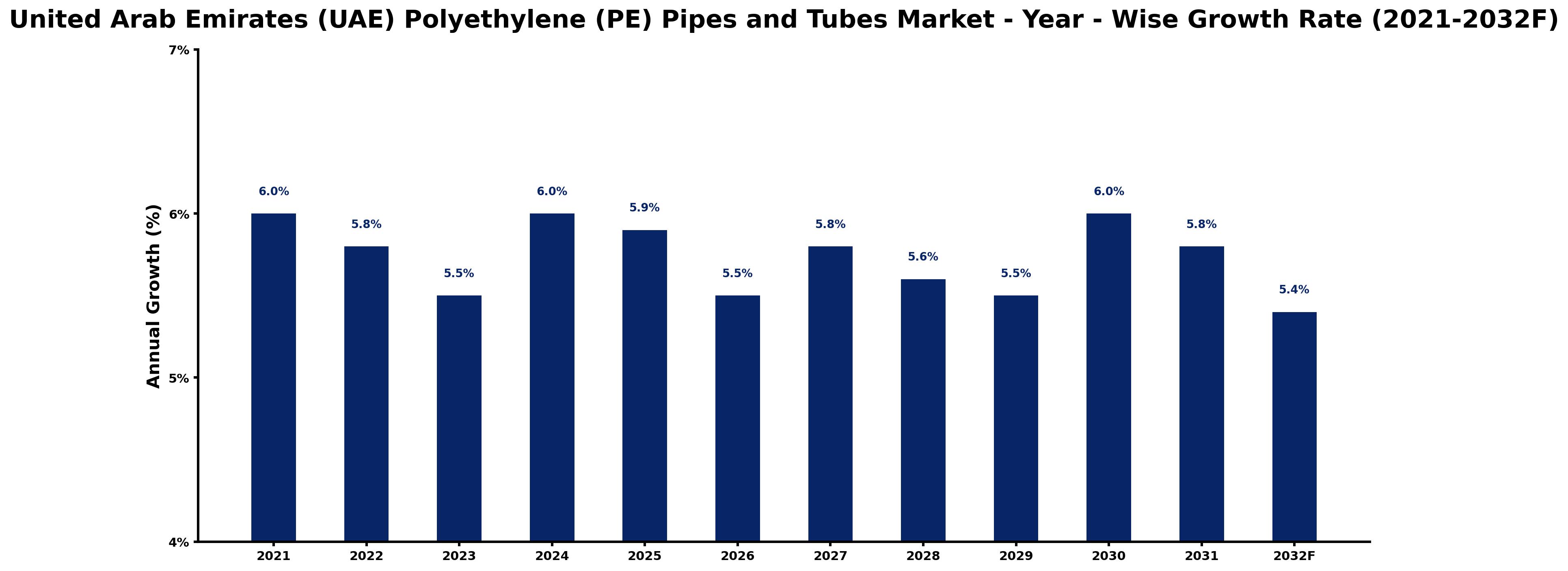
The table below presents the year wise growth rates along with the key drivers influencing the market
| Year | Growth Rate | Major Drivers |
| 2021 | 6.0% | Post-lockdown retail projects triggered a surge in construction activities across the UAE. |
| 2022 | 5.8% | Real estate developments in Dubai attracted significant foreign investments and construction funding. |
| 2023 | 5.5% | Climate resilience mandates accelerated the adoption of PE pipes for water management. |
| 2024 | 6.0% | Smart city initiatives in Abu Dhabi incorporated advanced water distribution systems using PE. |
| 2025 | 5.9% | Oil and gas sector expansion created opportunities for durable piping solutions in pipelines. |
| 2026 | 5.5% | Innovation in manufacturing processes improved the cost efficiency of producing PE pipes. |
| 2027 | 5.8% | Increased awareness about environmental sustainability encouraged the use of recyclable PE materials. |
| 2028 | 5.6% | Integration of IoT in urban infrastructure led to smarter water management solutions using PE. |
| 2029 | 5.5% | Rural electrification projects relied on PE pipes for improved power distribution networks. |
| 2030 | 6.0% | Emerging construction standards mandated the use of lightweight, flexible PE piping solutions. |
| 2031 | 5.8% | Collaboration between local manufacturers and global suppliers enhanced product quality and availability. |
| 2032 | 5.4% | Urbanization trends necessitated extensive PE piping networks for efficient waste management systems. |
Note - Market size estimations and growth projections presented in this report are based on 6Wresearch's advanced forecasting approach, validated with industry datasets as of June 2026.
United Arab Emirates (UAE) Polyethylene (PE) Pipes and Tubes Market Synopsis
The United Arab Emirates (UAE) Polyethylene (PE) Pipes and Tubes Market is projected to reach 5.5% and witness significant growth during the forecast period (2026-2032). The increasing applications of polyethylene pipes in various sectors, including water supply, irrigation, and gas distribution, have fueled this expansion. The unique properties of PE pipes, such as their durability, flexibility, and corrosion resistance, make them an optimal choice for modern infrastructure projects, reflecting their critical role in the UAE's ongoing development.
United Arab Emirates (UAE) Polyethylene (PE) Pipes and Tubes Market Growth Drivers
Several factors are propelling the growth of the UAE polyethylene pipes and tubes market. Firstly, the UAE's rapid population growth and urbanization lead to an increased need for water supply systems. This demand necessitates the deployment of versatile and effective PE pipes. Secondly, the country's investment in agricultural development has heightened the focus on irrigation solutions, which effectively utilize PE pipes for optimal water management. Furthermore, with an emphasis on sustainable construction practices, the adoption of lightweight and reusable materials like polyethylene is becoming increasingly favorable.
- The demand for efficient water distribution systems is rising, driven by population growth.
- Investment in agriculture has spurred the need for advanced irrigation technology utilizing polyethylene pipes.
- The construction sector's expansion creates opportunities for PE pipes due to their cost-effectiveness.
- The push for environmentally sustainable building materials enhances the appeal of polyethylene solutions.
- Technological advancements in PE pipe manufacturing are improving performance and reducing production costs.
United Arab Emirates (UAE) Polyethylene (PE) Pipes and Tubes Market Challenges and Restraints
While the market is poised for growth, several challenges need to be addressed. Competition from alternative materials, such as PVC and steel pipes, poses a significant threat, as these materials are often favored for certain applications. Understanding the distinct benefits of polyethylene pipes, such as chemical resistance and lightweight characteristics, is essential for market players. Additionally, raw material price fluctuations can affect production costs, and strict adherence to regulatory standards adds complexity to the manufacturing process.
- Competition from PVC and steel pipes can limit market share and growth potential for PE pipes.
- Raw material price volatility may lead to fluctuating profit margins for manufacturers.
- Increased regulatory standards require continuous adaptation and investment in compliance measures.
- Market education regarding the advantages of polyethylene over traditional materials is crucial.
- Supply chain disruptions can impact the availability and timely delivery of polyethylene products.
United Arab Emirates (UAE) Polyethylene (PE) Pipes and Tubes Market Government Investment and Initiatives
The UAE government has been actively fostering an environment conducive to the growth of the polyethylene pipes and tubes market. Various initiatives and investments focus on enhancing infrastructure and sustainability within the country. Public spending on infrastructure projects, including water supply and irrigation systems, supports the demand for polyethylene products. Moreover, government policies promoting green building practices encourage the use of environmentally friendly materials, further bolstering the market for PE pipes. The commitment to diversifying the economy away from oil dependency also highlights the significance of innovative building solutions.
United Arab Emirates (UAE) Polyethylene (PE) Pipes and Tubes Market Latest Developments (May 2025 - June 2026)
Recent developments in the UAE polyethylene pipes and tubes market reflect a growing trend toward innovation and sustainability. The period from May 2025 to June 2026 saw increased project announcements related to water management and irrigation systems across the UAE, reinforcing the demand for polyethylene solutions. Companies have been exploring advancements in manufacturing technologies to enhance the durability and efficiency of PE pipes. Additionally, partnerships between agencies and manufacturers are emerging, aimed at promoting comprehensive solutions for water distribution and gas transit, aligning with the UAE's strategic vision for sustainable development.
United Arab Emirates (UAE) Polyethylene (PE) Pipes and Tubes Market - Key Attractiveness of the Report
- 10 Years of Market Numbers
- Historical Data Starting from 2022 to 2025
- Base Year: 2025
- Forecast Data until 2032
- Key Performance Indicators Impacting the Market
- Major Upcoming Developments and Projects
Key Highlights of the Report:
- United Arab Emirates (UAE) Polyethylene (PE) Pipes and Tubes Market Outlook
- Market Size of United Arab Emirates (UAE) Polyethylene (PE) Pipes and Tubes Market, 2025
- Forecast of United Arab Emirates (UAE) Polyethylene (PE) Pipes and Tubes Market, 2032
- Historical Data and Forecast of United Arab Emirates (UAE) Polyethylene (PE) Pipes and Tubes Revenues & Volume for the Period 2022-2032F
- United Arab Emirates (UAE) Polyethylene (PE) Pipes and Tubes Market Trend Evolution
- United Arab Emirates (UAE) Polyethylene (PE) Pipes and Tubes Market Drivers and Challenges
- United Arab Emirates (UAE) Polyethylene (PE) Pipes and Tubes Price Trends
- United Arab Emirates (UAE) Polyethylene (PE) Pipes and Tubes Porter's Five Forces
- United Arab Emirates (UAE) Polyethylene (PE) Pipes and Tubes Industry Life Cycle
- Historical Data and Forecast of United Arab Emirates (UAE) Polyethylene (PE) Pipes and Tubes Market Revenues & Volume By Type for the Period 2022-2032F
- Historical Data and Forecast of United Arab Emirates (UAE) Polyethylene (PE) Pipes and Tubes Market Revenues & Volume By High Density Polythene (HDPE) for the Period 2022-2032F
- Historical Data and Forecast of United Arab Emirates (UAE) Polyethylene (PE) Pipes and Tubes Market Revenues & Volume By Low Density Polythene (LDPE) for the Period 2022-2032F
- Historical Data and Forecast of United Arab Emirates (UAE) Polyethylene (PE) Pipes and Tubes Market Revenues & Volume By Linear Low Density Polythene (LLDPE) for the Period 2022-2032F
- Historical Data and Forecast of United Arab Emirates (UAE) Polyethylene (PE) Pipes and Tubes Market Revenues & Volume By Cross Link Polythene (PEX/XLPE) for the Period 2022-2032F
- Historical Data and Forecast of United Arab Emirates (UAE) Polyethylene (PE) Pipes and Tubes Market Revenues & Volume By Application for the Period 2022-2032F
- Historical Data and Forecast of United Arab Emirates (UAE) Polyethylene (PE) Pipes and Tubes Market Revenues & Volume By Industrial for the Period 2022-2032F
- Historical Data and Forecast of United Arab Emirates (UAE) Polyethylene (PE) Pipes and Tubes Market Revenues & Volume By Agriculture for the Period 2022-2032F
- Historical Data and Forecast of United Arab Emirates (UAE) Polyethylene (PE) Pipes and Tubes Market Revenues & Volume By Underwater And Municipal for the Period 2022-2032F
- Historical Data and Forecast of United Arab Emirates (UAE) Polyethylene (PE) Pipes and Tubes Market Revenues & Volume By Construction for the Period 2022-2032F
- Historical Data and Forecast of United Arab Emirates (UAE) Polyethylene (PE) Pipes and Tubes Market Revenues & Volume By Gas Extraction for the Period 2022-2032F
- Historical Data and Forecast of United Arab Emirates (UAE) Polyethylene (PE) Pipes and Tubes Market Revenues & Volume By Others for the Period 2022-2032F
- United Arab Emirates (UAE) Polyethylene (PE) Pipes and Tubes Import Export Trade Statistics
- Market Opportunity Assessment By Type
- Market Opportunity Assessment By Application
- United Arab Emirates (UAE) Polyethylene (PE) Pipes and Tubes Top Companies Market Share
- United Arab Emirates (UAE) Polyethylene (PE) Pipes and Tubes Competitive Benchmarking By Technical and Operational Parameters
- United Arab Emirates (UAE) Polyethylene (PE) Pipes and Tubes Company Profiles
- United Arab Emirates (UAE) Polyethylene (PE) Pipes and Tubes Key Strategic Recommendations






































