United Arab Emirates (UAE) Polymer Clay Market Size, Share & Growth Rate
The United Arab Emirates (UAE) Polymer Clay Market was estimated at USD 476 Million in 2025 and is projected to reach USD 633 Million by 2032, growing at a CAGR of 4.2% from 2026 to 2032. This growth trajectory is primarily fueled by the flourishing crafts and hobby industry within the region, which continues to seek versatile and accessible materials for artistic expression. Additionally, the rising popularity of DIY culture among the UAE population is significantly contributing to the demand for polymer clay.
United Arab Emirates (UAE) Polymer Clay Market Year-wise Growth Rate and Key Drivers
This graph highlights how the United Arab Emirates (UAE) Polymer Clay Market has steadily grown over the years, supported by major growth factors.
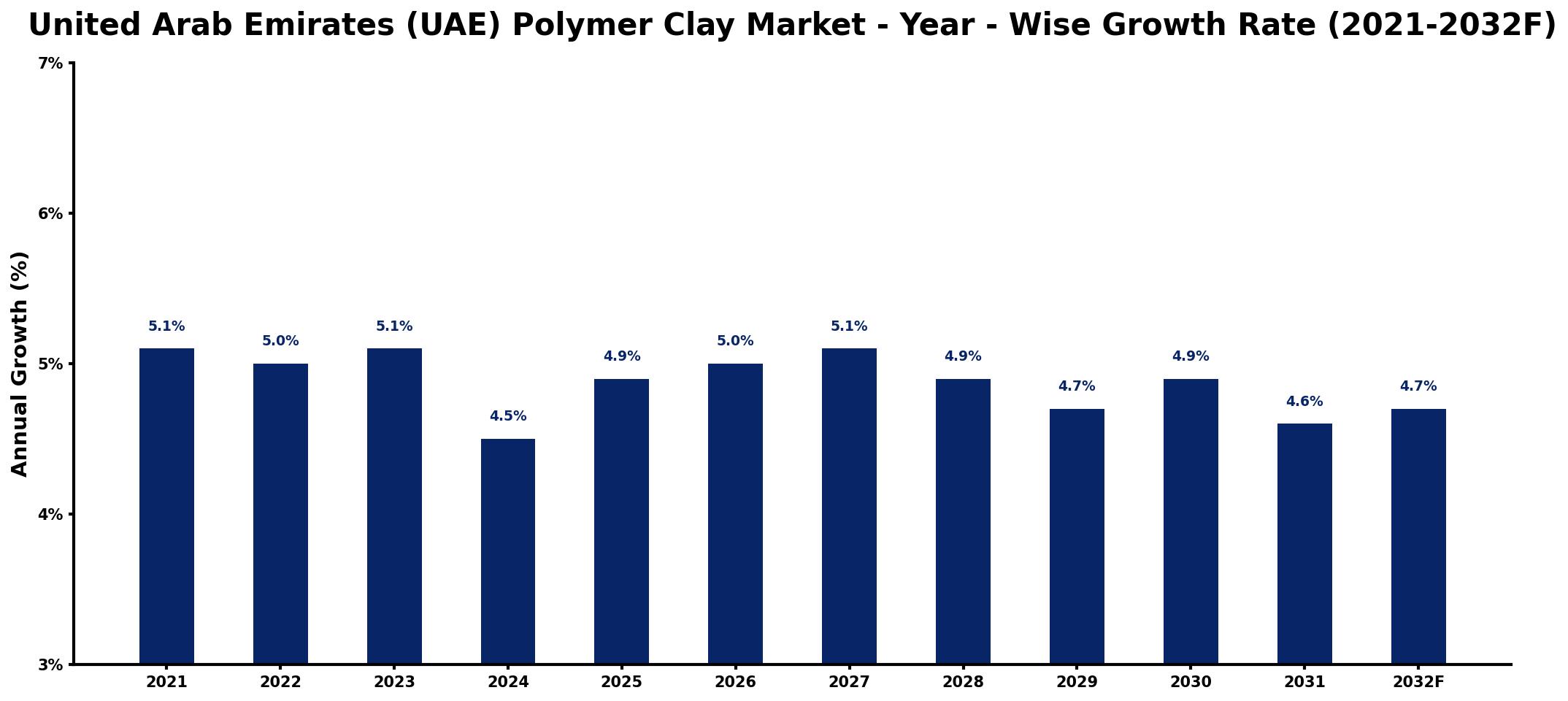
The table below presents the year‑wise growth rates along with the key drivers influencing the market
| Year | Growth Rate | Major Drivers |
| 2021 | 5.1% | Increased consumer crafting interest |
| 2022 | 5.0% | Expansion of DIY market segment |
| 2023 | 5.1% | Rising popularity of art supplies |
| 2024 | 4.5% | Growth in educational workshops |
| 2025 | 4.9% | Investment in creative industries |
| 2026 | 5.0% | Surge in online crafting communities |
| 2027 | 5.1% | Emergence of eco-friendly materials |
| 2028 | 4.9% | Increase in home-based businesses |
| 2029 | 4.7% | Demand for unique handmade products |
| 2030 | 4.9% | growing commercial sector adoption |
| 2031 | 4.6% | rising export shipment volumes |
| 2032 | 4.7% | Rise in artistic collaboration projects |
Note: Market size estimations and growth projections presented in this report are based on 6Wresearch's proprietary forecasting methodology, utilizing the latest available industry data, government publications, and primary research inputs.
United Arab Emirates (UAE) Polymer Clay Market Synopsis
The most influential factor currently shaping the UAE polymer clay market is the ongoing expansion of the creative arts sector. This includes a vibrant community of artists, hobbyists, and educators who are increasingly adopting polymer clay due to its user-friendly properties and wide variety of colors and finishes. The emphasis on innovation has led to the development of new formulations that enhance the usability and appeal of polymer clay products.
Educational institutions in the UAE are also playing a crucial role by incorporating polymer clay into their art curricula, fostering creative skills among students. Furthermore, the surge in creative workshops and community classes has not only popularized polymer clay but also built a supportive ecosystem that encourages artistic exploration and craftsmanship.
United Arab Emirates (UAE) Polymer Clay Market Key Takeaways
- The market is driven by a vibrant arts and crafts community eager for versatile materials.
- Educational initiatives are integrating polymer clay into creative learning, enhancing its visibility.
- Emerging trends in DIY projects are significantly boosting consumer interest and sales.
- Innovative formulations and product diversification are essential for market competitiveness.
- COVID-19 effects led to temporary demand declines, but recovery trends are evident.
Evaluation of Restraints in United Arab Emirates (UAE) Polymer Clay Market
Despite its growth potential, the UAE polymer clay market faces significant restraints that could impede progress. Market saturation has become a pressing issue, with a growing number of suppliers competing for market share. This heightened competition is leading to price pressure and necessitating constant innovation to differentiate offerings. Furthermore, fluctuating consumer preferences and the ever-evolving nature of trends in the arts and crafts domain require businesses to remain agile and responsive to maintain relevance. A thorough understanding of these dynamics is crucial for players in this space to navigate the challenges effectively.
United Arab Emirates (UAE) Polymer Clay Market Trends
Current trends in the UAE polymer clay market indicate a strong inclination toward customization and personalization. Artists and hobbyists are increasingly seeking unique color blends and textures, which encourages suppliers to innovate further. Additionally, eco-friendly formulations are gaining traction as consumers become more environmentally conscious, leading to a demand for sustainable products. Workshops and online tutorials have also surged, providing creative outlets and further driving polymer clay adoption among new users.
United Arab Emirates (UAE) Polymer Clay Market Opportunities
The future of the UAE polymer clay market holds significant opportunities for growth and investment. The ongoing expansion of the DIY community presents a fertile ground for new product offerings tailored to different skill levels and artistic pursuits. Furthermore, collaborations with local artists and influencers could enhance brand visibility and attract a wider consumer base. The rise of e-commerce platforms also offers a chance to reach a more extensive audience, allowing suppliers to cater to the burgeoning online craft market.
Government Initiatives in the United Arab Emirates (UAE) Polymer Clay Market
The UAE government has been actively promoting creative industries through various initiatives, emphasizing innovation and sustainability in arts and crafts. Public spending on education and arts programs has increased, encouraging greater participation in creative endeavors. Additionally, policies supporting local artisans and small businesses are fostering a favorable environment for the growth of the polymer clay market. These initiatives are essential in building a robust foundation for the creative arts sector in the UAE.
Future Insights of the United Arab Emirates (UAE) Polymer Clay Market
Looking ahead to 2026-2032, the UAE polymer clay market is poised for steady growth driven by ongoing developments in consumer preferences and creative technologies. As educational institutions continue to emphasize arts and crafts, the market is likely to expand its reach. Furthermore, the increasing integration of digital platforms for craft sales and tutorials suggests a transformation in how polymer clay products are marketed and consumed, paving the way for innovative approaches in the years to come.
United Arab Emirates (UAE) Polymer Clay Market Latest Developments (2025 - 2026)
In the past year, the UAE polymer clay market has witnessed a revitalization as art stores reopen and community workshops resume post-pandemic. There has been a notable increase in online sales channels, with suppliers expanding their digital presence to meet evolving consumer needs. Additionally, local craft fairs and exhibitions have started to feature polymer clay prominently, providing a platform for artists to showcase their work and connect with enthusiasts. This renewed focus on community engagement is expected to bolster market growth significantly.
United Arab Emirates (UAE) Polymer Clay Market - Key Attractiveness of the Report
- 10 Years of Market Numbers
- Historical Data Starting from 2022 to 2025
- Base Year: 2025
- Forecast Data until 2032
- Key Performance Indicators Impacting the Market
- Major Upcoming Developments and Projects
Key Highlights of the Report:
- United Arab Emirates (UAE) Polymer Clay Market Outlook
- Market Size of United Arab Emirates (UAE) Polymer Clay Market, 2025
- Forecast of United Arab Emirates (UAE) Polymer Clay Market, 2032
- Historical Data and Forecast of United Arab Emirates (UAE) Polymer Clay Revenues & Volume for the Period 2022-2032F
- United Arab Emirates (UAE) Polymer Clay Market Trend Evolution
- United Arab Emirates (UAE) Polymer Clay Market Drivers and Challenges
- United Arab Emirates (UAE) Polymer Clay Price Trends
- United Arab Emirates (UAE) Polymer Clay Porter's Five Forces
- United Arab Emirates (UAE) Polymer Clay Industry Life Cycle
- Historical Data and Forecast of United Arab Emirates (UAE) Polymer Clay Market Revenues & Volume By Product Form for the Period 2022-2032F
- Historical Data and Forecast of United Arab Emirates (UAE) Polymer Clay Market Revenues & Volume By Solid for the Period 2022-2032F
- Historical Data and Forecast of United Arab Emirates (UAE) Polymer Clay Market Revenues & Volume By Liquid for the Period 2022-2032F
- Historical Data and Forecast of United Arab Emirates (UAE) Polymer Clay Market Revenues & Volume By Application for the Period 2022-2032F
- Historical Data and Forecast of United Arab Emirates (UAE) Polymer Clay Market Revenues & Volume By Jewelry Making for the Period 2022-2032F
- Historical Data and Forecast of United Arab Emirates (UAE) Polymer Clay Market Revenues & Volume By Manufacturing of Toys and Novelty Items for the Period 2022-2032F
- Historical Data and Forecast of United Arab Emirates (UAE) Polymer Clay Market Revenues & Volume By Arts and Sculpture Making for the Period 2022-2032F
- Historical Data and Forecast of United Arab Emirates (UAE) Polymer Clay Market Revenues & Volume By Crockery and Ceramic Products for the Period 2022-2032F
- Historical Data and Forecast of United Arab Emirates (UAE) Polymer Clay Market Revenues & Volume By Others for the Period 2022-2032F
- Historical Data and Forecast of United Arab Emirates (UAE) Polymer Clay Market Revenues & Volume By End Use for the Period 2022-2032F
- Historical Data and Forecast of United Arab Emirates (UAE) Polymer Clay Market Revenues & Volume By Residential for the Period 2022-2032F
- Historical Data and Forecast of United Arab Emirates (UAE) Polymer Clay Market Revenues & Volume By Commercial for the Period 2022-2032F
- Historical Data and Forecast of United Arab Emirates (UAE) Polymer Clay Market Revenues & Volume By Industrial for the Period 2022-2032F
- United Arab Emirates (UAE) Polymer Clay Import Export Trade Statistics
- Market Opportunity Assessment By Product Form
- Market Opportunity Assessment By Application
- Market Opportunity Assessment By End Use
- United Arab Emirates (UAE) Polymer Clay Top Companies Market Share
- United Arab Emirates (UAE) Polymer Clay Competitive Benchmarking By Technical and Operational Parameters
- United Arab Emirates (UAE) Polymer Clay Company Profiles
- United Arab Emirates (UAE) Polymer Clay Key Strategic Recommendations






































