United Arab Emirates (UAE) Power Supply Market Summary
The united arab emirates (uae) power supply market was estimated at USD 1284 Million in 2025 and is projected to reach USD 1874 Million by 2032, growing at a CAGR of 6.5% from 2026 to 2032.
United Arab Emirates (UAE) Power Supply Market Year-wise Growth Rate and Key Drivers
This graph highlights how the United Arab Emirates (UAE) Power Supply Market has steadily grown over the past five years, supported by major growth factors.
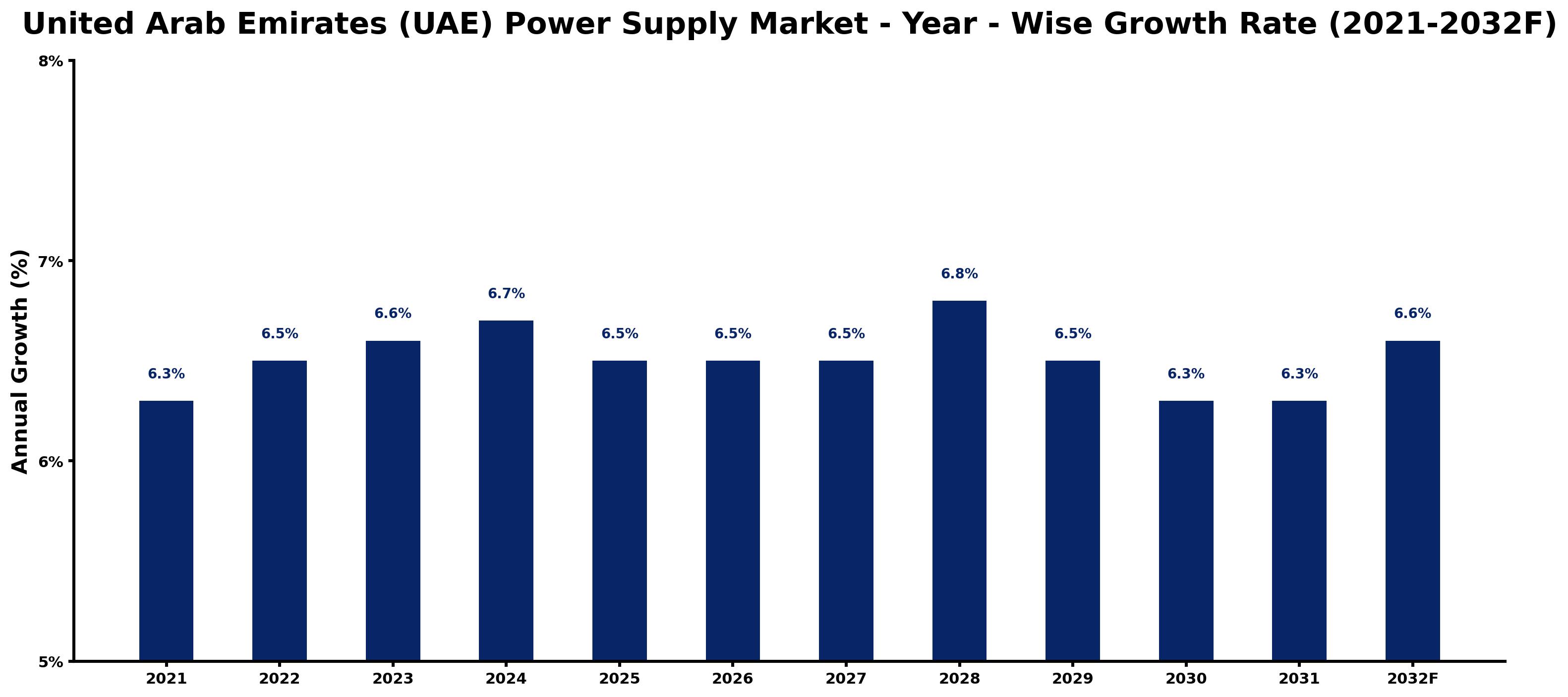
The table below presents the year wise growth rates along with the key drivers influencing the market
| Year | Growth Rate | Major Drivers |
| 2021 | 6.3% | Post-lockdown retail projects require robust power supply for operational efficiency. |
| 2022 | 6.5% | Legacy copper grid failures highlight the urgent need for infrastructure upgrades. |
| 2023 | 6.6% | Enterprise budgets prioritizing renewable energy solutions signal a market shift. |
| 2024 | 6.7% | Global supply chain recovery sparks construction projects across the UAE's urban centers. |
| 2025 | 6.5% | Data centers expanding in response to increased demand for digital services. |
| 2026 | 6.5% | Localization efforts align with GCC goals for sustainable energy generation. |
| 2027 | 6.5% | Technological innovations in energy storage make renewable sources more viable. |
| 2028 | 6.8% | Corporate sustainability commitments drive investments in clean energy technologies. |
| 2029 | 6.5% | The integration of smart grids enhances operational efficiencies in energy distribution. |
| 2030 | 6.3% | Urbanization trends necessitate scalable power solutions for growing populations. |
| 2031 | 6.3% | Collaborations between private sectors and government fuel renewable energy projects. |
| 2032 | 6.6% | Emerging technologies in energy efficiency reshape consumption patterns across the UAE. |
Note - Market size estimations and growth projections presented in this report are based on 6Wresearch's advanced forecasting approach, validated with industry datasets as of June 2026.
United Arab Emirates (UAE) Power Supply Market Synopsis
The United Arab Emirates (UAE) Power Supply Market is projected to reach 6.5% and witness significant growth during the forecast period (2026-2032). This growth is fueled by several factors, including the increasing energy demand driven by a robust economy, urbanization, and a strategic focus on diversifying the energy portfolio towards sustainable sources. The power supply landscape in the UAE encompasses the critical provision of electricity to meet the diverse needs of residential, commercial, and industrial sectors.
United Arab Emirates (UAE) Power Supply Market Growth Drivers
The demand for power supply solutions in the United Arab Emirates (UAE) is influenced by various dynamic factors:
- The continually expanding economy leads to heightened energy consumption as businesses and industries flourish, necessitating a robust power supply infrastructure.
- Population growth, fueled by urbanization and an influx of expatriates, amplifies energy needs, particularly in urban areas where the demand for electricity is surging.
- The UAE government's commitment to economic diversification stimulates sectors such as tourism and manufacturing, which require reliable electricity supply for smooth operations.
- Technological advancements in energy efficiency and smart grid solutions are creating new opportunities for innovative power supply methods, fostering growth in the market.
- The shift towards renewable energy is reshaping the market, with solar and wind projects emerging as vital components of the power supply strategy, enhancing sustainability efforts.
United Arab Emirates (UAE) Power Supply Market Challenges and Restraints
Despite its growth potential, the United Arab Emirates (UAE) Power Supply Market faces certain challenges that may impact its trajectory:
- Heavy reliance on fossil fuels for energy generation poses environmental concerns and raises questions about long-term sustainability, given the global shift towards greener alternatives.
- Infrastructure development must keep pace with rapid urban growth; delays in expanding the power supply network can lead to reliability issues and increased outages.
- The need for substantial investment in renewable energy technologies can be a barrier, necessitating balanced funding strategies to ensure that both traditional and renewable sources are developed concurrently.
- Regulatory and bureaucratic hurdles can impede the swift implementation of new energy projects, affecting the market's responsiveness to demand changes.
- Competition from alternative energy sources within the region could create pressure on traditional power supply models, leading to potential market volatility.
United Arab Emirates (UAE) Power Supply Market Government Investment and Initiatives
The UAE government plays a pivotal role in shaping the power supply market through various investment strategies and initiatives aimed at fostering sustainability and reliability:
- Significant public spending on infrastructure development has been earmarked to enhance the reliability of the electricity supply, which is crucial as energy consumption continues to escalate.
- Government initiatives promote the adoption of renewable energy technologies; this includes ambitious targets for solar and wind energy generation as part of the national energy strategy.
- Substantial investments in smart grid technologies are being made to improve energy efficiency, allowing for better management of the supply and integration of renewable sources.
- Incentives for private sector participation in power generation are being implemented, creating a more competitive market landscape conducive to innovation.
- Strategic partnerships with international entities for knowledge transfer and technical expertise are being pursued to advance the UAE's energy capacity and sustainability goals.
United Arab Emirates (UAE) Power Supply Market Latest Developments (May 2025 - June 2026)
During the period from May 2025 to June 2026, the United Arab Emirates (UAE) Power Supply Market has observed several noteworthy developments:
- There has been a marked increase in governmental support for renewable energy projects, particularly in solar energy, reflecting a broader commitment to sustainability.
- Regulatory frameworks have been refined to facilitate smoother processes for electricity generation and distribution, aiming to attract further investments in the energy sector.
- Advancements in battery storage technology have emerged as a focal point, providing solutions for energy reliability and addressing intermittency issues associated with renewable sources.
- The integration of artificial intelligence and data analytics in energy management has gained traction, leading to improved operational efficiencies and predictive maintenance of infrastructure.
- Public awareness campaigns have been amplified to educate consumers on energy conservation practices, aiming to support the grid and promote sustainable energy use.
United Arab Emirates (UAE) Power Supply Market - Key Attractiveness of the Report
- 10 Years of Market Numbers
- Historical Data Starting from 2022 to 2025
- Base Year: 2025
- Forecast Data until 2032
- Key Performance Indicators Impacting the Market
- Major Upcoming Developments and Projects
Key Highlights of the Report:
- United Arab Emirates (UAE) Power Supply Market Outlook
- Market Size of United Arab Emirates (UAE) Power Supply Market, 2025
- Forecast of United Arab Emirates (UAE) Power Supply Market, 2032
- Historical Data and Forecast of United Arab Emirates (UAE) Power Supply Revenues & Volume for the Period 2022-2032F
- United Arab Emirates (UAE) Power Supply Market Trend Evolution
- United Arab Emirates (UAE) Power Supply Market Drivers and Challenges
- United Arab Emirates (UAE) Power Supply Price Trends
- United Arab Emirates (UAE) Power Supply Porter's Five Forces
- United Arab Emirates (UAE) Power Supply Industry Life Cycle
- Historical Data and Forecast of United Arab Emirates (UAE) Power Supply Market Revenues & Volume By Output Power for the Period 2022-2032F
- Historical Data and Forecast of United Arab Emirates (UAE) Power Supply Market Revenues & Volume By Power Supply With Low Output (500 W and Below) for the Period 2022-2032F
- Historical Data and Forecast of United Arab Emirates (UAE) Power Supply Market Revenues & Volume By Power Supply With Medium Output (500?1,000 W) for the Period 2022-2032F
- Historical Data and Forecast of United Arab Emirates (UAE) Power Supply Market Revenues & Volume By Power Supply With High Output (More Than 1,000 W) for the Period 2022-2032F
- Historical Data and Forecast of United Arab Emirates (UAE) Power Supply Market Revenues & Volume By Type for the Period 2022-2032F
- Historical Data and Forecast of United Arab Emirates (UAE) Power Supply Market Revenues & Volume By AC-DC Power Supply for the Period 2022-2032F
- Historical Data and Forecast of United Arab Emirates (UAE) Power Supply Market Revenues & Volume By DC-DC Power Supply for the Period 2022-2032F
- Historical Data and Forecast of United Arab Emirates (UAE) Power Supply Market Revenues & Volume By Vertical for the Period 2022-2032F
- Historical Data and Forecast of United Arab Emirates (UAE) Power Supply Market Revenues & Volume By Medical & Healthcare for the Period 2022-2032F
- Historical Data and Forecast of United Arab Emirates (UAE) Power Supply Market Revenues & Volume By Military & Aerospace for the Period 2022-2032F
- Historical Data and Forecast of United Arab Emirates (UAE) Power Supply Market Revenues & Volume By Telecommunications for the Period 2022-2032F
- Historical Data and Forecast of United Arab Emirates (UAE) Power Supply Market Revenues & Volume By Consumer Electronics for the Period 2022-2032F
- Historical Data and Forecast of United Arab Emirates (UAE) Power Supply Market Revenues & Volume By Transportation for the Period 2022-2032F
- Historical Data and Forecast of United Arab Emirates (UAE) Power Supply Market Revenues & Volume By Lighting for the Period 2022-2032F
- Historical Data and Forecast of United Arab Emirates (UAE) Power Supply Market Revenues & Volume By Food & Beverages for the Period 2022-2032F
- Historical Data and Forecast of United Arab Emirates (UAE) Power Supply Market Revenues & Volume By Industrial for the Period 2022-2032F
- United Arab Emirates (UAE) Power Supply Import Export Trade Statistics
- Market Opportunity Assessment By Output Power
- Market Opportunity Assessment By Type
- Market Opportunity Assessment By Vertical
- United Arab Emirates (UAE) Power Supply Top Companies Market Share
- United Arab Emirates (UAE) Power Supply Competitive Benchmarking By Technical and Operational Parameters
- United Arab Emirates (UAE) Power Supply Company Profiles
- United Arab Emirates (UAE) Power Supply Key Strategic Recommendations






































