United Arab Emirates (UAE) Radio Broadcast Receivers Market Size, Share & Growth Rate
The United Arab Emirates (UAE) Radio Broadcast Receivers Market was estimated at USD 1173 Million in 2025 and is projected to reach USD 1675 Million by 2032, growing at a CAGR of 5.2% from 2026 to 2032. This robust growth trajectory is propelled by the sustained enthusiasm for radio as a trusted source of news and entertainment. With technological advances in digital broadcasting and an expanding array of radio stations, consumers are increasingly investing in superior audio equipment to enhance their listening experiences.
United Arab Emirates (UAE) Radio Broadcast Receivers Market Year-wise Growth Rate and Key Drivers
This graph highlights how the United Arab Emirates (UAE) Radio Broadcast Receivers Market has steadily grown over the years, supported by major growth factors.
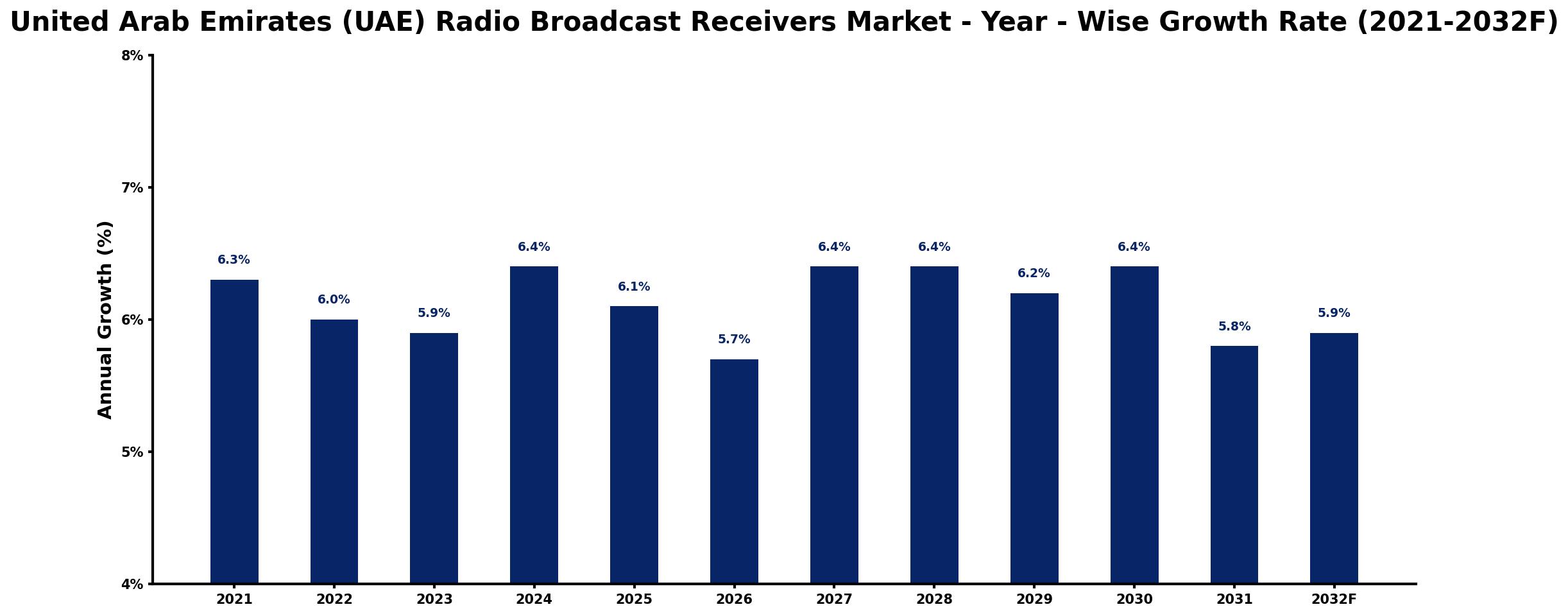
The table below presents the year‑wise growth rates along with the key drivers influencing the market
| Year | Growth Rate | Major Drivers |
| 2021 | 6.3% | Increase in consumer electronics demand |
| 2022 | 6.0% | Growth in digital content consumption |
| 2023 | 5.9% | Rise in home entertainment systems |
| 2024 | 6.4% | Expansion of smart home technologies |
| 2025 | 6.1% | Higher disposable income levels |
| 2026 | 5.7% | Investments in local manufacturing facilities |
| 2027 | 6.4% | Emergence of new entertainment platforms |
| 2028 | 6.4% | Enhanced connectivity solutions available |
| 2029 | 6.2% | Popularity of smart lifestyle products |
| 2030 | 6.4% | Increased focus on sustainability initiatives |
| 2031 | 5.8% | Adoption of innovative audio technologies |
| 2032 | 5.9% | growing regional consumption patterns |
Note: Market size estimations and growth projections presented in this report are based on 6Wresearch's proprietary forecasting methodology, utilizing the latest available industry data, government publications, and primary research inputs.
United Arab Emirates (UAE) Radio Broadcast Receivers Market Synopsis
The UAE Radio Broadcast Receivers market has experienced a notable resurgence in recent years, particularly as the COVID-19 pandemic underscored the importance of reliable communication channels. While traditional radio receivers faced challenges from digital streaming, the move towards high-quality audio technology has rejuvenated consumer interest. Looking ahead, the landscape is shifting as the market adapts to integrate innovative features that cater to a tech-savvy audience.
As the transition to digital broadcasting continues, the market is seeing an increase in demand for radio receivers that offer superior sound quality, user-friendly interfaces, and connectivity options. This evolution is essential for radio to maintain its place in the hearts of UAE listeners amidst the fast-paced growth of online media.
United Arab Emirates (UAE) Radio Broadcast Receivers Market Key Takeaways
- The market is experiencing solid growth due to the enduring popularity of radio as an entertainment medium.
- Technological advancements in digital broadcasting are reshaping consumer expectations for audio quality.
- COVID-19 has temporarily boosted radio consumption, increasing the demand for reliable receivers.
- Future innovations will need to focus on enhancing user experience and connectivity features.
- Competitive pressures from streaming services will continue to drive radio receiver technology forward.
Evaluation of Restraints in United Arab Emirates (UAE) Radio Broadcast Receivers Market
Despite the positive outlook, the UAE Radio Broadcast Receivers market faces several limitations. One significant restraint is the rapid growth of digital streaming platforms that challenge the traditional radio receiver market. As consumer preferences shift towards on-demand audio content, traditional receivers must innovate to remain relevant. Moreover, ensuring robust signal quality and extensive coverage in varied urban landscapes presents additional technical challenges that can hinder market growth. This environment necessitates that manufacturers and stakeholders strategize effectively to counter these pressures.
United Arab Emirates (UAE) Radio Broadcast Receivers Market Trends
Emerging trends in the UAE Radio Broadcast Receivers market include a rise in demand for smart receivers equipped with Wi-Fi and Bluetooth connectivity, allowing seamless integration with personal devices. Moreover, there is an increasing consumer inclination toward eco-friendly and energy-efficient products, pushing manufacturers to adopt sustainable practices. The convergence of radio with digital content is also fostering collaboration between traditional broadcasters and tech companies to create hybrid listening experiences.
United Arab Emirates (UAE) Radio Broadcast Receivers Market Opportunities
Opportunities for growth abound in the UAE Radio Broadcast Receivers market, particularly in catering to niche audiences with specialized content. As radio stations continue to diversify their programming, there is potential for receivers designed for specific demographic segments or interests. Additionally, advancements in internet-of-things (IoT) technologies open avenues for developing smart home audio solutions that can integrate radio broadcasting with broader digital ecosystems. This is a promising space for investment and innovation.
Government Initiatives in the United Arab Emirates (UAE) Radio Broadcast Receivers Market
The UAE government has been proactive in promoting digital broadcasting initiatives, aiming to enhance media consumption in the region. Various policies have been introduced to encourage technological advancements and support local content creation. Investments in broadcasting infrastructure and initiatives to foster public-private partnerships are part of the strategy to boost the radio sector. These government efforts are crucial for fostering an environment where innovation in radio broadcasting and receivers can thrive.
Future Insights of the United Arab Emirates (UAE) Radio Broadcast Receivers Market
Looking ahead to the years 2026-2032, the UAE Radio Broadcast Receivers market is likely to continue its upward trajectory. Factors such as the increasing penetration of internet services and advancements in digital broadcasting technologies will play pivotal roles. Moreover, the integration of artificial intelligence and personalized content delivery into radio services will enhance user engagement, thereby reinforcing radio's position as a key media platform. As the market evolves, companies must remain agile to respond to changing consumer behaviors and technological landscapes.
United Arab Emirates (UAE) Radio Broadcast Receivers Market Latest Developments (2025 - 2026)
In recent months, the UAE Radio Broadcast Receivers market has seen significant developments focused on enhancing consumer experience. Many manufacturers are launching receivers equipped with multi-functional capabilities, integrating features such as podcast streaming and voice assistance. Additionally, collaborations between radio broadcasters and tech firms have gained momentum, aiming to enrich content delivery and improve audio quality. As the market adapts to technological shifts, ongoing innovations are expected to reshape how consumers engage with radio.
United Arab Emirates (UAE) Radio Broadcast Receivers Market - Key Attractiveness of the Report
- 10 Years of Market Numbers
- Historical Data Starting from 2022 to 2025
- Base Year: 2025
- Forecast Data until 2032
- Key Performance Indicators Impacting the Market
- Major Upcoming Developments and Projects
Key Highlights of the Report:
- United Arab Emirates (UAE) Radio Broadcast Receivers Market Outlook
- Market Size of United Arab Emirates (UAE) Radio Broadcast Receivers Market, 2025
- Forecast of United Arab Emirates (UAE) Radio Broadcast Receivers Market, 2032
- Historical Data and Forecast of United Arab Emirates (UAE) Radio Broadcast Receivers Revenues & Volume for the Period 2022-2032F
- United Arab Emirates (UAE) Radio Broadcast Receivers Market Trend Evolution
- United Arab Emirates (UAE) Radio Broadcast Receivers Market Drivers and Challenges
- United Arab Emirates (UAE) Radio Broadcast Receivers Price Trends
- United Arab Emirates (UAE) Radio Broadcast Receivers Porter's Five Forces
- United Arab Emirates (UAE) Radio Broadcast Receivers Industry Life Cycle
- Historical Data and Forecast of United Arab Emirates (UAE) Radio Broadcast Receivers Market Revenues & Volume By Equipment for the Period 2022-2032F
- Historical Data and Forecast of United Arab Emirates (UAE) Radio Broadcast Receivers Market Revenues & Volume By Modulators for the Period 2022-2032F
- Historical Data and Forecast of United Arab Emirates (UAE) Radio Broadcast Receivers Market Revenues & Volume By Transmitters And Receivers for the Period 2022-2032F
- Historical Data and Forecast of United Arab Emirates (UAE) Radio Broadcast Receivers Market Revenues & Volume By Encoders for the Period 2022-2032F
- Historical Data and Forecast of United Arab Emirates (UAE) Radio Broadcast Receivers Market Revenues & Volume By Switches for the Period 2022-2032F
- Historical Data and Forecast of United Arab Emirates (UAE) Radio Broadcast Receivers Market Revenues & Volume By Filters for the Period 2022-2032F
- Historical Data and Forecast of United Arab Emirates (UAE) Radio Broadcast Receivers Market Revenues & Volume By Amplifiers for the Period 2022-2032F
- Historical Data and Forecast of United Arab Emirates (UAE) Radio Broadcast Receivers Market Revenues & Volume By Frequency for the Period 2022-2032F
- Historical Data and Forecast of United Arab Emirates (UAE) Radio Broadcast Receivers Market Revenues & Volume By Low Frequency for the Period 2022-2032F
- Historical Data and Forecast of United Arab Emirates (UAE) Radio Broadcast Receivers Market Revenues & Volume By Medium Frequency for the Period 2022-2032F
- Historical Data and Forecast of United Arab Emirates (UAE) Radio Broadcast Receivers Market Revenues & Volume By High Frequency for the Period 2022-2032F
- United Arab Emirates (UAE) Radio Broadcast Receivers Import Export Trade Statistics
- Market Opportunity Assessment By Equipment
- Market Opportunity Assessment By Frequency
- United Arab Emirates (UAE) Radio Broadcast Receivers Top Companies Market Share
- United Arab Emirates (UAE) Radio Broadcast Receivers Competitive Benchmarking By Technical and Operational Parameters
- United Arab Emirates (UAE) Radio Broadcast Receivers Company Profiles
- United Arab Emirates (UAE) Radio Broadcast Receivers Key Strategic Recommendations






































