United Arab Emirates (UAE) Radioactive Waste Management Market Size, Share & Growth Rate
The United Arab Emirates (UAE) Radioactive Waste Management Market was estimated at USD 336 Million in 2025 and is projected to reach USD 461 Million by 2032, growing at a CAGR of 4.6% from 2026 to 2032. This robust growth trajectory is driven by the nations expanding nuclear energy sector and an increasing commitment to sustainable practices in waste management. As the UAE continues to strengthen its nuclear capabilities, the demand for effective waste management solutions becomes critical, ensuring environmental safety and regulatory compliance.
United Arab Emirates (UAE) Radioactive Waste Management Market Year-wise Growth Rate and Key Drivers
This graph highlights how the United Arab Emirates (UAE) Radioactive Waste Management Market has steadily grown over the years, supported by major growth factors.
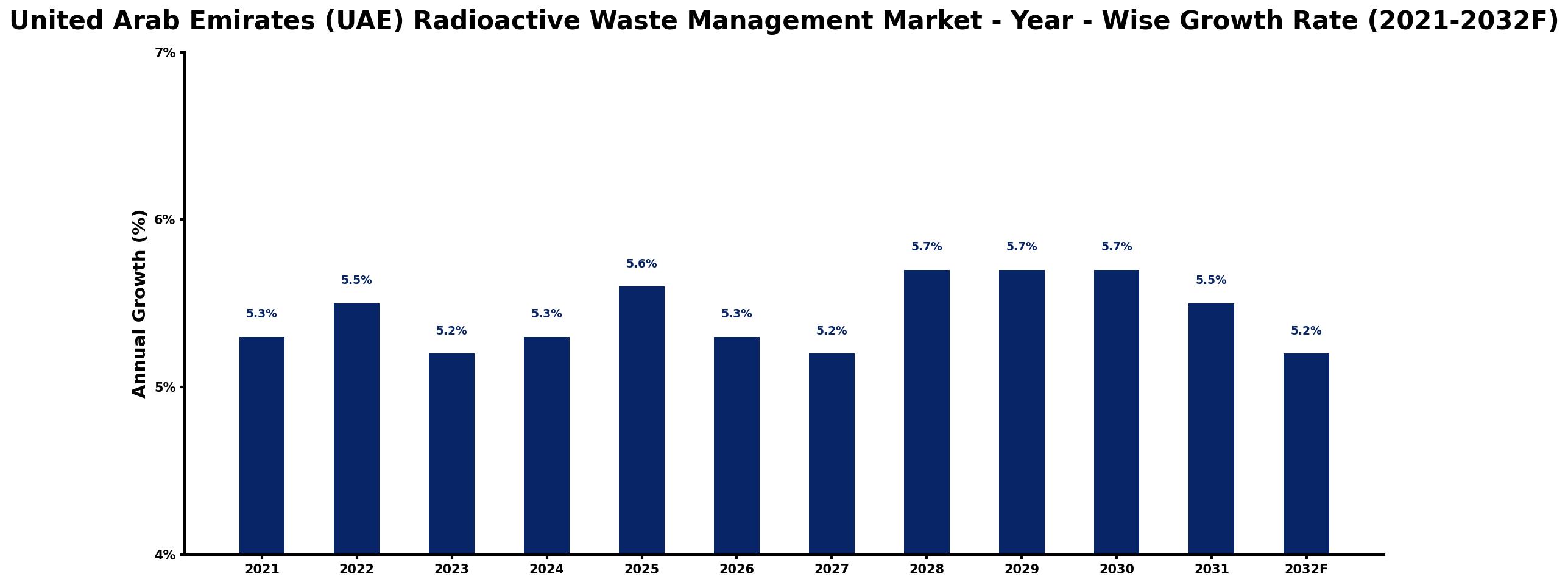
The table below presents the year‑wise growth rates along with the key drivers influencing the market
| Year | Growth Rate | Major Drivers |
| 2021 | 5.3% | Increased regulatory compliance requirements |
| 2022 | 5.5% | Growing energy sector investments |
| 2023 | 5.2% | Rising public health awareness |
| 2024 | 5.3% | Expansion of renewable energy initiatives |
| 2025 | 5.6% | Technological advancements in disposal |
| 2026 | 5.3% | Strengthened international partnerships formed |
| 2027 | 5.2% | Emerging sustainability initiatives launched |
| 2028 | 5.7% | Higher demand for clean technologies |
| 2029 | 5.7% | Significant infrastructure development planned |
| 2030 | 5.7% | Enhanced safety protocols adopted widely |
| 2031 | 5.5% | Growing corporate responsibility commitments |
| 2032 | 5.2% | Increased funding for research projects |
Note: Market size estimations and growth projections presented in this report are based on 6Wresearch's proprietary forecasting methodology, utilizing the latest available industry data, government publications, and primary research inputs.
United Arab Emirates (UAE) Radioactive Waste Management Market Synopsis
As the UAE progresses with its nuclear energy initiatives, the need for effective radioactive waste management solutions is becoming increasingly urgent. The establishment of advanced facilities dedicated to the safe disposal and containment of radioactive materials reflects the nations commitment to sustainability and the protection of public health.
Moreover, the UAE's proactive approach in implementing stringent regulatory frameworks lays a strong foundation for the market. By utilizing innovative technologies, stakeholders are striving to achieve a comprehensive and secure radioactive waste management system, which is essential for fostering public trust and ensuring the long-term viability of nuclear energy.
United Arab Emirates (UAE) Radioactive Waste Management Market Key Takeaways
- The market is poised for steady growth as nuclear energy expands within the UAE.
- Investment in advanced waste management technologies is critical for success.
- Robust regulatory frameworks are essential to ensure safe handling and disposal.
- Public trust and education on waste management practices are vital for market acceptance.
- The demand for sustainable practices is driving innovation in waste management solutions.
Evaluation of Restraints in United Arab Emirates (UAE) Radioactive Waste Management Market
Despite promising growth prospects, the UAE radioactive waste management market faces several restraints that may hinder its progress. A significant challenge is the identification of suitable disposal sites that meet stringent safety standards, which can complicate operational planning and execution. Furthermore, public perception remains a crucial factor; educating communities about safety measures and waste management practices is necessary to alleviate concerns surrounding radioactive materials. Ongoing compliance with evolving international guidelines also necessitates a continuous investment in technological upgrades, placing financial pressure on stakeholders.
United Arab Emirates (UAE) Radioactive Waste Management Market Trends
Current trends indicate a shift towards greater investment in high-tech waste management solutions that ensure safety and environmental sustainability. Innovations such as automated waste sorting systems and advanced containment technologies are gaining traction. Additionally, there is a growing emphasis on international collaboration to share best practices and enhance regulatory compliance, further strengthening the framework for radioactive waste management in the UAE.
United Arab Emirates (UAE) Radioactive Waste Management Market Opportunities
The UAE presents numerous investment opportunities in the radioactive waste management sector. With the nations ongoing commitment to nuclear energy, there is potential for developing cutting-edge waste processing facilities that incorporate the latest technologies. Additionally, initiatives aimed at training and developing local expertise in waste management can significantly enhance operational efficiency and safety. The intersection of public-private partnerships could also lead to innovative funding mechanisms that support infrastructure development.
Government Initiatives in the United Arab Emirates (UAE) Radioactive Waste Management Market
The UAE government is actively investing in initiatives to strengthen radioactive waste management frameworks. This includes the establishment of regulatory bodies dedicated to overseeing waste management practices, ensuring compliance with international safety standards. Public spending has been directed towards the development of state-of-the-art disposal and containment facilities, further highlighting the governments commitment to sustainable nuclear energy. Various programs aimed at public education and outreach are also in place to build trust and transparency in radioactive waste handling.
Future Insights of the United Arab Emirates (UAE) Radioactive Waste Management Market
Looking ahead to 2026-2032, the UAE radioactive waste management market is expected to evolve significantly, driven by advancements in technology and an unwavering commitment to regulatory compliance. Stakeholders are likely to focus on developing innovative waste management solutions that ensure long-term safety and sustainability. Enhanced international cooperation will also play a pivotal role in aligning local practices with global standards, which can further solidify the UAE's position as a leader in responsible nuclear energy production.
United Arab Emirates (UAE) Radioactive Waste Management Market Latest Developments (2025 - 2026)
Recent developments in the UAE's radioactive waste management market reflect a growing emphasis on innovative solutions and regulatory alignment. There has been increased investment in facility upgrades to enhance storage capabilities and meet international safety standards. Furthermore, ongoing collaboration with global waste management experts is fostering the exchange of best practices, helping local stakeholders adapt to evolving challenges within the sector.
United Arab Emirates (UAE) Radioactive Waste Management Market - Key Attractiveness of the Report
- 10 Years of Market Numbers
- Historical Data Starting from 2022 to 2025
- Base Year: 2025
- Forecast Data until 2032
- Key Performance Indicators Impacting the Market
- Major Upcoming Developments and Projects
Key Highlights of the Report:
- United Arab Emirates (UAE) Radioactive Waste Management Market Outlook
- Market Size of United Arab Emirates (UAE) Radioactive Waste Management Market, 2025
- Forecast of United Arab Emirates (UAE) Radioactive Waste Management Market, 2032
- Historical Data and Forecast of United Arab Emirates (UAE) Radioactive Waste Management Revenues & Volume for the Period 2022-2032F
- United Arab Emirates (UAE) Radioactive Waste Management Market Trend Evolution
- United Arab Emirates (UAE) Radioactive Waste Management Market Drivers and Challenges
- United Arab Emirates (UAE) Radioactive Waste Management Price Trends
- United Arab Emirates (UAE) Radioactive Waste Management Porter's Five Forces
- United Arab Emirates (UAE) Radioactive Waste Management Industry Life Cycle
- Historical Data and Forecast of United Arab Emirates (UAE) Radioactive Waste Management Market Revenues & Volume By Type for the Period 2022-2032F
- Historical Data and Forecast of United Arab Emirates (UAE) Radioactive Waste Management Market Revenues & Volume By Exempt Waste and Very Low-Level Waste(VLLW) for the Period 2022-2032F
- Historical Data and Forecast of United Arab Emirates (UAE) Radioactive Waste Management Market Revenues & Volume By Low-Level Waste(LLW) for the Period 2022-2032F
- Historical Data and Forecast of United Arab Emirates (UAE) Radioactive Waste Management Market Revenues & Volume By Intermediate-Level Waste(ILW) for the Period 2022-2032F
- Historical Data and Forecast of United Arab Emirates (UAE) Radioactive Waste Management Market Revenues & Volume By High-Level Waste(HLW) for the Period 2022-2032F
- Historical Data and Forecast of United Arab Emirates (UAE) Radioactive Waste Management Market Revenues & Volume By Application for the Period 2022-2032F
- Historical Data and Forecast of United Arab Emirates (UAE) Radioactive Waste Management Market Revenues & Volume By Industrial for the Period 2022-2032F
- Historical Data and Forecast of United Arab Emirates (UAE) Radioactive Waste Management Market Revenues & Volume By Utility for the Period 2022-2032F
- United Arab Emirates (UAE) Radioactive Waste Management Import Export Trade Statistics
- Market Opportunity Assessment By Type
- Market Opportunity Assessment By Application
- United Arab Emirates (UAE) Radioactive Waste Management Top Companies Market Share
- United Arab Emirates (UAE) Radioactive Waste Management Competitive Benchmarking By Technical and Operational Parameters
- United Arab Emirates (UAE) Radioactive Waste Management Company Profiles
- United Arab Emirates (UAE) Radioactive Waste Management Key Strategic Recommendations






































