United Arab Emirates (UAE) Scissors and Shears Market Summary
The united arab emirates (uae) scissors and shears market was estimated at USD 394 Million in 2025 and is projected to reach USD 529 Million by 2032, growing at a CAGR of 5.4% from 2026 to 2032.
United Arab Emirates (UAE) Scissors and Shears Market Year-wise Growth Rate and Key Drivers
This graph highlights how the United Arab Emirates (UAE) Scissors and Shears Market has steadily grown over the past five years, supported by major growth factors.
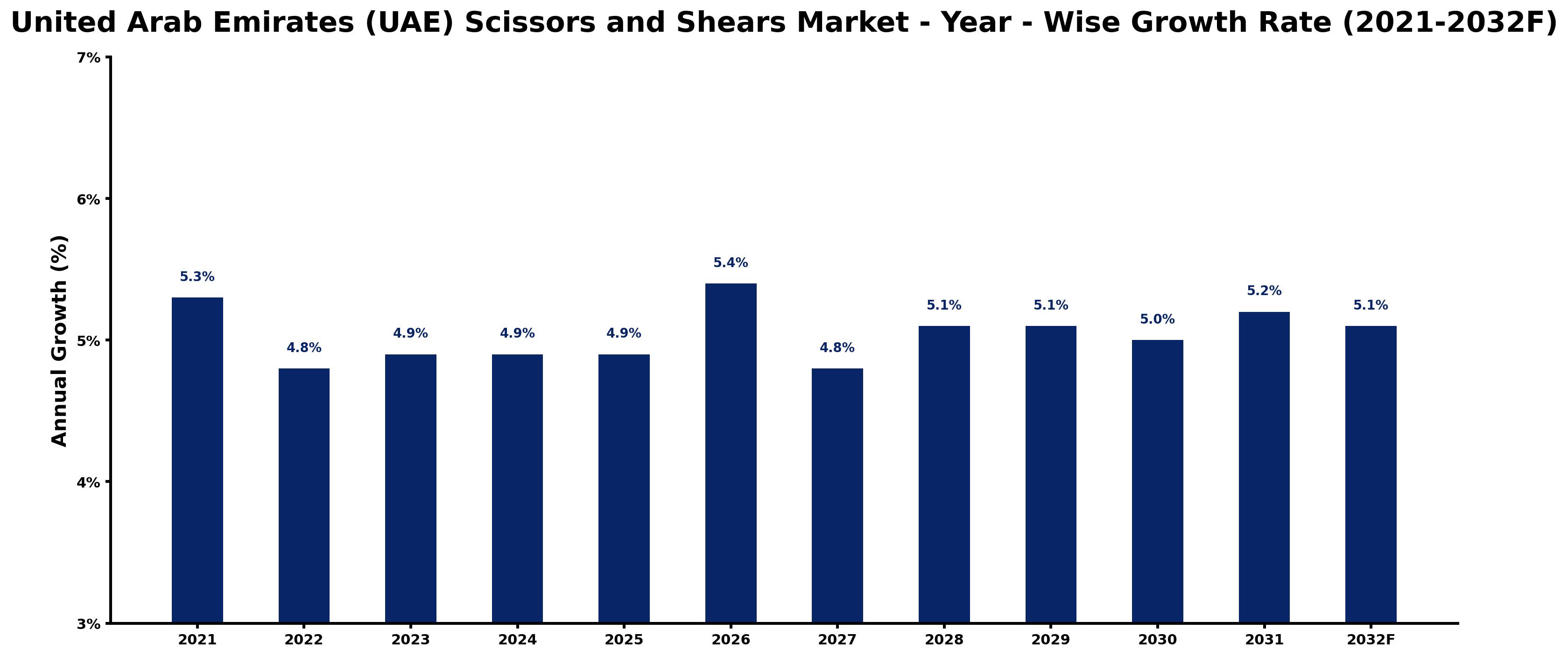
The table below presents the year wise growth rates along with the key drivers influencing the market
| Year | Growth Rate | Major Drivers |
| 2021 | 5.3% | Post-pandemic recovery in consumer spending boosted demand for home improvement products. |
| 2022 | 4.8% | Regional construction projects outpacing others in the GCC fueled demand for quality tools. |
| 2023 | 4.9% | Increased focus on local craftsmanship spurred interest in high-quality scissors and shears. |
| 2024 | 4.9% | E-commerce platforms expanded reach, making these tools more accessible to consumers. |
| 2025 | 4.9% | The beauty and grooming industry in UAE intensified competition among tool manufacturers. |
| 2026 | 5.4% | Cultural shifts towards DIY home projects ignited a surge in household tool purchases. |
| 2027 | 4.8% | Technical innovations in material science enhanced the durability of scissors and shears. |
| 2028 | 5.1% | Emerging startups in the region introduced sustainable and eco-friendly product lines. |
| 2029 | 5.1% | Global supply chain optimization improved availability of premium scissors in local markets. |
| 2030 | 5.0% | Increased trade activities with Asia diversified the sourcing of unique cutting tools. |
| 2031 | 5.2% | A booming expatriate population created diverse preferences for various cutting tools. |
| 2032 | 5.1% | Investment in local manufacturing capacities decreased reliance on imported scissors and shears. |
Note - Market size estimations and growth projections presented in this report are based on 6Wresearch's advanced forecasting approach, validated with industry datasets as of June 2026.
United Arab Emirates (UAE) Scissors and Shears Market Synopsis
The United Arab Emirates (UAE) Scissors and Shears Market is projected to reach 5.4% and witness significant growth during the forecast period (2026-2032). Scissors and shears are pivotal cutting tools that find application across multiple sectors including textiles, automotive, medical, and household, providing essential capabilities for precise cutting. The market is expected to expand owing to the robust growth of industrial and consumer segments in the UAE, along with an increasing demand for superior quality cutting implements.
United Arab Emirates (UAE) Scissors and Shears Market Growth Drivers
Several factors are propelling the growth of the scissors and shears market in the UAE. The primary driver is the flourishing textile and apparel manufacturing sector, which consistently necessitates high-quality scissors and shears for fabric manipulation. Additionally, the automotive and medical sectors are witnessing significant development, resulting in a rising demand for specialized cutting tools tailored to these industries. The growing trend of DIY projects and crafting among consumers has further accentuated the need for household scissors and shears.
- The expansion of the textile industry creates continuous demand for fabric cutting tools, contributing to market growth.
- Growth in the automotive sector is boosting the requirement for specialized scissors and shears designed for precision cutting.
- The medical domain is increasingly utilizing scissors and shears for surgical and clinical applications, elevating market demand.
- Consumer interest in DIY and crafting activities is driving household demand for a variety of cutting tools.
- Advancements in ergonomic and innovative designs are attracting consumers to high-quality products, further stimulating market growth.
United Arab Emirates (UAE) Scissors and Shears Market Challenges and Restraints
Despite the positive growth trajectory, the UAE scissors and shears market faces several challenges. A notable concern is the influx of low-cost imported scissors and shears from various regions, which exerts pricing pressures on local manufacturers and distributors. In order to maintain competitiveness, it is crucial for market players to focus on the quality and durability of their products. Furthermore, the ramifications of the Covid-19 pandemic continue to pose challenges, as fluctuations in consumer spending affect overall market dynamics.
- Low-cost imports challenge domestic manufacturers, creating a competitive pricing environment.
- Quality differentiation becomes essential for local players to combat price competition from imports.
- Ongoing impacts of the Covid-19 pandemic may lead to inconsistent consumer spending patterns.
- The economic uncertainty may deter investments in the market and disrupt supply chains.
- The need for enhanced marketing strategies to communicate product quality to consumers has increased.
United Arab Emirates (UAE) Scissors and Shears Market Covid-19 Impact
The Covid-19 pandemic, which emerged in 2025, had a complex impact on the UAE scissors and shears market. Initially, it caused substantial disruptions in industrial activities and retail operations, resulting in a short-term decrease in demand for cutting tools. However, as restrictions began to ease and consumer focus shifted towards home-based activities, the market demonstrated signs of recovery. The pandemic also underscored the importance of hygiene, particularly in the context of medical and household scissors, thereby influencing consumer preferences.
United Arab Emirates (UAE) Scissors and Shears Market Government Investment and Initiatives
The UAE government has been instrumental in fostering a conducive environment for market growth through various initiatives and investments. Public spending has been directed towards enhancing industrial capabilities, thereby benefiting manufacturing sectors including scissors and shears. Development plans highlight the focus on promoting local production and innovation in cutting tools, with initiatives aimed at supporting startups and SMEs within the sector. By facilitating trade agreements and partnerships, the government is also working to ensure that domestic players can compete effectively on an international scale.
- The government is actively investing in initiatives that bolster manufacturing capabilities and innovation.
- Public policies are geared towards supporting local production to reduce dependency on imports.
- Investment in research and development is prioritized to improve product quality and meet consumer demands.
- The establishment of trade agreements is intended to enhance market access for local manufacturers.
- Government programs aimed at startup support are creating opportunities for new entrants in the scissors and shears market.
United Arab Emirates (UAE) Scissors and Shears Market Latest Developments (May 2025 - June 2026)
The period from May 2025 to June 2026 has seen pivotal developments in the UAE scissors and shears market. The gradual recovery following the Covid-19 pandemic has led to increased investments in the manufacturing sector, focusing on enhancing production technologies. Companies are now more inclined to adopt innovative designs that cater to the ergonomic needs of consumers. Additionally, there has been a notable shift towards sustainability, with industry players exploring eco-friendly materials for scissors and shears. The market is also experiencing a growing emphasis on online retail channels, allowing for broader consumer access.
United Arab Emirates (UAE) Scissors and Shears Market - Key Attractiveness of the Report
- 10 Years of Market Numbers
- Historical Data Starting from 2022 to 2025
- Base Year: 2025
- Forecast Data until 2032
- Key Performance Indicators Impacting the Market
- Major Upcoming Developments and Projects
Key Highlights of the Report:
- United Arab Emirates (UAE) Scissors and Shears Market Outlook
- Market Size of United Arab Emirates (UAE) Scissors and Shears Market, 2025
- Forecast of United Arab Emirates (UAE) Scissors and Shears Market, 2032
- Historical Data and Forecast of United Arab Emirates (UAE) Scissors and Shears Revenues & Volume for the Period 2022-2032F
- United Arab Emirates (UAE) Scissors and Shears Market Trend Evolution
- United Arab Emirates (UAE) Scissors and Shears Market Drivers and Challenges
- United Arab Emirates (UAE) Scissors and Shears Price Trends
- United Arab Emirates (UAE) Scissors and Shears Porter's Five Forces
- United Arab Emirates (UAE) Scissors and Shears Industry Life Cycle
- Historical Data and Forecast of United Arab Emirates (UAE) Scissors and Shears Market Revenues & Volume By Type for the Period 2022-2032F
- Historical Data and Forecast of United Arab Emirates (UAE) Scissors and Shears Market Revenues & Volume By Scissors for the Period 2022-2032F
- Historical Data and Forecast of United Arab Emirates (UAE) Scissors and Shears Market Revenues & Volume By Shears for the Period 2022-2032F
- Historical Data and Forecast of United Arab Emirates (UAE) Scissors and Shears Market Revenues & Volume By Application for the Period 2022-2032F
- Historical Data and Forecast of United Arab Emirates (UAE) Scissors and Shears Market Revenues & Volume By Residential for the Period 2022-2032F
- Historical Data and Forecast of United Arab Emirates (UAE) Scissors and Shears Market Revenues & Volume By Non-Residential for the Period 2022-2032F
- United Arab Emirates (UAE) Scissors and Shears Import Export Trade Statistics
- Market Opportunity Assessment By Type
- Market Opportunity Assessment By Application
- United Arab Emirates (UAE) Scissors and Shears Top Companies Market Share
- United Arab Emirates (UAE) Scissors and Shears Competitive Benchmarking By Technical and Operational Parameters
- United Arab Emirates (UAE) Scissors and Shears Company Profiles
- United Arab Emirates (UAE) Scissors and Shears Key Strategic Recommendations






































