United Arab Emirates (UAE) Secondhand Apparel Market Size, Share & Growth Rate
The United Arab Emirates (UAE) Secondhand Apparel Market was estimated at USD 827 Million in 2025 and is projected to reach USD 1195 Million by 2032, growing at a CAGR of 5.4% from 2026 to 2032. This growth trajectory is largely propelled by a shift in consumer attitudes towards sustainability and a rising demand for affordable fashion. As economic conditions evolve, consumers are increasingly seeking unique and stylish options that align with their values of environmental responsibility.
United Arab Emirates (UAE) Secondhand Apparel Market Growth Rate Analysis (2021-2032)
The secondhand apparel market in the United Arab Emirates has shown a stable growth pattern, reflecting a compound annual growth rate of approximately 6.2% from 2021 through 2024. This consistent increase can be attributed to surging consumer demand for sustainable fashion choices, alongside heightened awareness of environmental issues. Significant investments in digital platforms have facilitated easier access to secondhand options, further fueling this trend. Notably, growth is projected to slightly accelerate to 6.5% by 2027, as the market increasingly embraces e-commerce and mobile technologies. However, fluctuations, such as the slight dip to 6.1% in 2022, underscore the market's sensitivity to economic variables and consumer sentiment shifts, yet it quickly rebounded in subsequent years.
United Arab Emirates (UAE) Secondhand Apparel Market Year-wise Growth Rate and Key Drivers
This graph highlights how the United Arab Emirates (UAE) Secondhand Apparel Market has steadily grown over the past five years, supported by major growth factors.
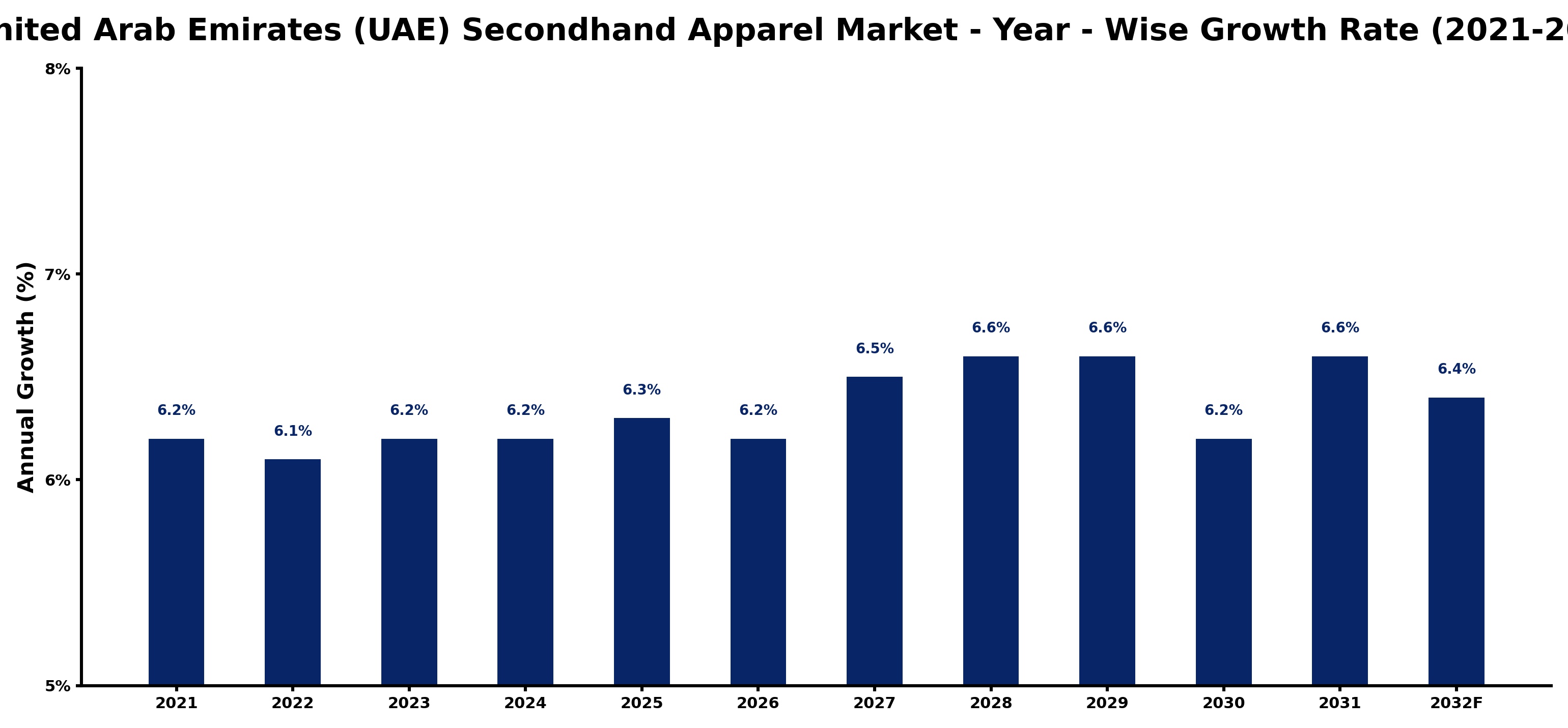
The table below presents the year‑wise growth rates along with the key drivers influencing the market
| Year | Growth Rate | Major Drivers |
| 2021 | 6.2% | Expansion of transportation and logistics networks |
| 2022 | 6.1% | Rapid growth in telecom and data center sectors |
| 2023 | 6.2% | Increasing industrial automation investments |
| 2024 | 6.2% | Increasing adoption of advanced technologies |
| 2025 | 6.3% | Increasing smart city development projects |
| 2026 | 6.2% | Rising electricity demand across industries |
| 2027 | 6.5% | Growing urbanization and commercial development |
| 2028 | 6.6% | Increasing industrial automation investments |
| 2029 | 6.6% | Increasing smart city development projects |
| 2030 | 6.2% | Increasing smart city development projects |
| 2031 | 6.6% | Rapid growth in telecom and data center sectors |
| 2032 | 6.4% | Government infrastructure modernization initiatives |
Note - Market size estimations and growth projections presented in this report are based on 6Wresearch’s advanced forecasting approach, validated with industry datasets as of June 2026.
United Arab Emirates (UAE) Secondhand Apparel Market Synopsis
In recent years, the UAE has witnessed a burgeoning interest in secondhand apparel as sustainability becomes more mainstream. The market is flourishing as consumers embrace thrifting not only for its affordability but also for its unique offerings that defy mass-market trends. This shift represents a significant cultural transformation within a diverse and fashion-forward population.
Moreover, the secondhand apparel market aligns with global movements towards conscious consumerism. Shoppers are now more informed and concerned about the environmental impact of fast fashion, propelling a greater acceptance of pre-loved clothing. This evolving consumer mindset marks a pivotal change in the UAE retail landscape.
United Arab Emirates (UAE) Secondhand Apparel Market Key Takeaways
- The market is driven by increasing consumer awareness of environmental issues related to the fashion industry.
- Affordability and the uniqueness of secondhand clothing attract a diverse range of buyers.
- Social media platforms are vital in popularizing the secondhand apparel trend, particularly among younger demographics.
- The market is characterized by a mix of brick-and-mortar thrift stores and thriving online platforms.
- As consumers shift towards sustainable choices, secondhand apparel is emerging as a viable fashion alternative.
Evaluation of Restraints in United Arab Emirates (UAE) Secondhand Apparel Market
While the UAE secondhand apparel market is experiencing growth, it faces certain limitations. The enduring stigma around secondhand clothing can deter some consumers, who may associate it with lower quality or outdated styles. To bridge this perception gap, education and awareness campaigns are essential, highlighting the benefits of sustainable fashion choices. Additionally, the proliferation of counterfeit items poses risks, as ensuring authenticity and quality is vital to maintain consumer trust. The fierce competition from fast fashion brands also challenges the secondhand market, necessitating a strategic approach to differentiate offerings and emphasize value.
United Arab Emirates (UAE) Secondhand Apparel Market Trends
Emerging trends in the UAE secondhand apparel market include a growing inclination towards online shopping and the rise of digital thrift stores, which cater to tech-savvy consumers. Social media influencers are playing an increasingly prominent role in shaping fashion preferences, showcasing curated secondhand finds. Additionally, there is a notable demand for vintage pieces, reflecting a broader trend where individuality and personal style are prioritized over mass-produced items. Collaborative efforts between brands and local artists to design exclusive lines from upcycled materials are also gaining traction.
United Arab Emirates (UAE) Secondhand Apparel Market Opportunities
The future of the UAE secondhand apparel market presents substantial opportunities for growth and innovation. As sustainability takes center stage, businesses that effectively communicate their environmental impact stand to gain a loyal customer base. There is also potential for partnerships with sustainability-focused organizations to enhance brand credibility. Investment in technology for improved inventory management and online shopping experiences can further capitalize on the growing demand for secondhand apparel. Expanding physical locations in high-footfall areas and enhancing online platforms can also create more touchpoints for consumers.
Government Initiatives in the United Arab Emirates (UAE) Secondhand Apparel Market
The UAE government is increasingly focusing on sustainability initiatives, encouraging businesses to adopt eco-friendly practices. Policies aimed at promoting recycling and waste reduction directly impact the secondhand apparel sector. Programs aimed at raising awareness around sustainable consumption among citizens are becoming more prevalent, fostering a culture that values secondhand goods. This aligns with broader national visions aimed at diversification and economic sustainability, creating a conducive environment for the growth of the secondhand market.
Future Insights of the United Arab Emirates (UAE) Secondhand Apparel Market
Looking ahead to 2026-2032, the UAE secondhand apparel market is expected to continue its upward trajectory driven by evolving consumer preferences and increased digital engagement. As sustainability remains a key focus area for consumers, businesses that adapt to these changing dynamics will thrive. The integration of advanced technologies for an enhanced shopping experience, paired with innovative marketing strategies, will further drive market expansion. The emphasis on unique fashion choices will also ensure that secondhand apparel remains a significant segment in the broader fashion landscape.
United Arab Emirates (UAE) Secondhand Apparel Market Latest Developments (May 2025 - June 2026)
Recent developments indicate a continued rise in online platforms offering secondhand apparel, making it easier for consumers to access diverse options. Collaborative campaigns between thrift stores and local designers are gaining popularity, showcasing curated collections that appeal to environmentally-conscious consumers. Additionally, community-driven initiatives aimed at promoting clothing swaps and local thrift events are fostering a sense of connection among shoppers, enhancing the overall market appeal.
United Arab Emirates (UAE) Secondhand Apparel Market - Key Attractiveness of the Report
- 10 Years of Market Numbers
- Historical Data Starting from 2022 to 2025
- Base Year: 2025
- Forecast Data until 2032
- Key Performance Indicators Impacting the Market
- Major Upcoming Developments and Projects
Key Highlights of the Report:
- United Arab Emirates (UAE) Secondhand Apparel Market Outlook
- Market Size of United Arab Emirates (UAE) Secondhand Apparel Market, 2025
- Forecast of United Arab Emirates (UAE) Secondhand Apparel Market, 2032F
- Historical Data and Forecast of United Arab Emirates (UAE) Secondhand Apparel Revenues & Volume for the Period 2022-2032F
- United Arab Emirates (UAE) Secondhand Apparel Market Trend Evolution
- United Arab Emirates (UAE) Secondhand Apparel Market Drivers and Challenges
- United Arab Emirates (UAE) Secondhand Apparel Price Trends
- United Arab Emirates (UAE) Secondhand Apparel Porter's Five Forces
- United Arab Emirates (UAE) Secondhand Apparel Industry Life Cycle
- Historical Data and Forecast of United Arab Emirates (UAE) Secondhand Apparel Market Revenues & Volume By Sector for the Period 2022-2032F
- Historical Data and Forecast of United Arab Emirates (UAE) Secondhand Apparel Market Revenues & Volume By Resale for the Period 2022-2032F
- Historical Data and Forecast of United Arab Emirates (UAE) Secondhand Apparel Market Revenues & Volume By Traditional Thrift Stores and Donations for the Period 2022-2032F
- Historical Data and Forecast of United Arab Emirates (UAE) Secondhand Apparel Market Revenues & Volume By Product Type for the Period 2022-2032F
- Historical Data and Forecast of United Arab Emirates (UAE) Secondhand Apparel Market Revenues & Volume By Dresses & Tops for the Period 2022-2032F
- Historical Data and Forecast of United Arab Emirates (UAE) Secondhand Apparel Market Revenues & Volume By Shirts & T-shirts for the Period 2022-2032F
- Historical Data and Forecast of United Arab Emirates (UAE) Secondhand Apparel Market Revenues & Volume By Sweaters, Coats & Jackets for the Period 2022-2032F
- Historical Data and Forecast of United Arab Emirates (UAE) Secondhand Apparel Market Revenues & Volume By Jeans & Pants for the Period 2022-2032F
- Historical Data and Forecast of United Arab Emirates (UAE) Secondhand Apparel Market Revenues & Volume By Others for the Period 2022-2032F
- Historical Data and Forecast of United Arab Emirates (UAE) Secondhand Apparel Market Revenues & Volume By Target Population for the Period 2022-2032F
- Historical Data and Forecast of United Arab Emirates (UAE) Secondhand Apparel Market Revenues & Volume By Men for the Period 2022-2032F
- Historical Data and Forecast of United Arab Emirates (UAE) Secondhand Apparel Market Revenues & Volume By Women for the Period 2022-2032F
- Historical Data and Forecast of United Arab Emirates (UAE) Secondhand Apparel Market Revenues & Volume By Kids for the Period 2022-2032F
- Historical Data and Forecast of United Arab Emirates (UAE) Secondhand Apparel Market Revenues & Volume By Sales Channel for the Period 2022-2032F
- Historical Data and Forecast of United Arab Emirates (UAE) Secondhand Apparel Market Revenues & Volume By Wholesalers/Distributors for the Period 2022-2032F
- Historical Data and Forecast of United Arab Emirates (UAE) Secondhand Apparel Market Revenues & Volume By Hypermarkets/Supermarkets for the Period 2022-2032F
- Historical Data and Forecast of United Arab Emirates (UAE) Secondhand Apparel Market Revenues & Volume By Multi-brand Stores for the Period 2022-2032F
- Historical Data and Forecast of United Arab Emirates (UAE) Secondhand Apparel Market Revenues & Volume By Independent Small Stores for the Period 2022-2032F
- Historical Data and Forecast of United Arab Emirates (UAE) Secondhand Apparel Market Revenues & Volume By Departmental Stores for the Period 2022-2032F
- Historical Data and Forecast of United Arab Emirates (UAE) Secondhand Apparel Market Revenues & Volume By Online Retailers for the Period 2022-2032F
- Historical Data and Forecast of United Arab Emirates (UAE) Secondhand Apparel Market Revenues & Volume By Others for the Period 2022-2032F
- United Arab Emirates (UAE) Secondhand Apparel Import Export Trade Statistics
- Market Opportunity Assessment By Sector
- Market Opportunity Assessment By Product Type
- Market Opportunity Assessment By Target Population
- Market Opportunity Assessment By Sales Channel
- United Arab Emirates (UAE) Secondhand Apparel Top Companies Market Share
- United Arab Emirates (UAE) Secondhand Apparel Competitive Benchmarking By Technical and Operational Parameters
- United Arab Emirates (UAE) Secondhand Apparel Company Profiles
- United Arab Emirates (UAE) Secondhand Apparel Key Strategic Recommendations






































