United Arab Emirates (UAE) Small Wind Turbine Market Size, Share & Growth Rate
The United Arab Emirates (UAE) Small Wind Turbine Market was estimated at USD 163 Million in 2025 and is projected to reach USD 223 Million by 2032, growing at a CAGR of 4.6% from 2026 to 2032. This growth is largely fueled by the UAE's strategic commitment to diversifying its energy portfolio and advancing renewable energy sources. Increasing investments in decentralized power generation and heightened awareness regarding environmental sustainability are also pivotal in shaping this market's positive trajectory.
United Arab Emirates (UAE) Small Wind Turbine Market Year-wise Growth Rate and Key Drivers
This graph highlights how the United Arab Emirates (UAE) Small Wind Turbine Market has steadily grown over the years, supported by major growth factors.
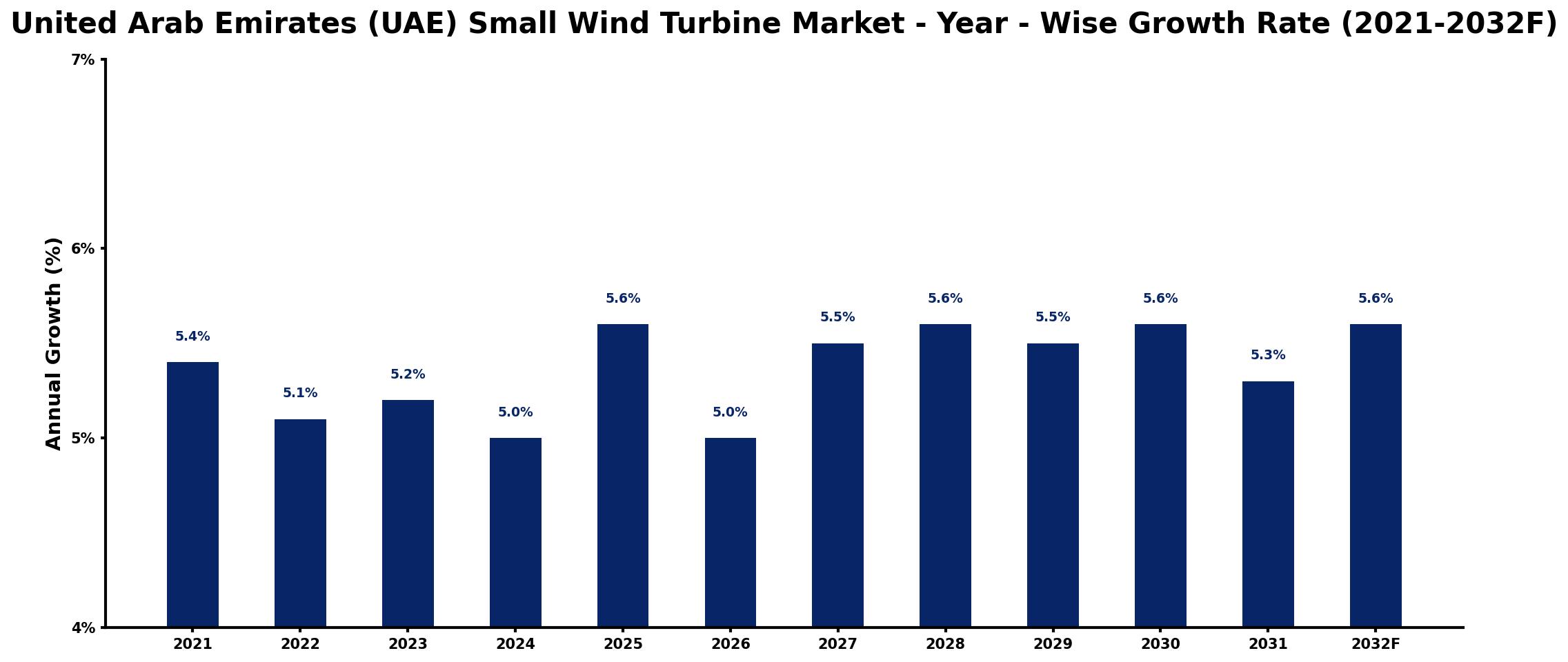
The table below presents the year‑wise growth rates along with the key drivers influencing the market
| Year | Growth Rate | Major Drivers |
| 2021 | 5.4% | Rising interest in renewable energy |
| 2022 | 5.1% | Government incentives for clean technology |
| 2023 | 5.2% | Increased residential energy independence |
| 2024 | 5.0% | Growing awareness of sustainability benefits |
| 2025 | 5.6% | Expansion of green financing options |
| 2026 | 5.0% | Technological advancements in energy efficiency |
| 2027 | 5.5% | Corporate sustainability commitments increasing |
| 2028 | 5.6% | Emerging markets for energy solutions |
| 2029 | 5.5% | Integration with smart grid technology |
| 2030 | 5.6% | Enhanced energy security initiatives |
| 2031 | 5.3% | Public-private partnerships in energy |
| 2032 | 5.6% | Rising demand for decentralized energy |
Note: Market size estimations and growth projections presented in this report are based on 6Wresearch's proprietary forecasting methodology, utilizing the latest available industry data, government publications, and primary research inputs.
United Arab Emirates (UAE) Small Wind Turbine Market Synopsis
The UAE Small Wind Turbine market is currently experiencing a notable surge as initiatives for sustainable energy gain traction across the nation. As the demand for clean energy solutions intensifies, small wind turbines are emerging as a viable option, particularly in off-grid and remote areas where traditional energy sources fall short.
Looking ahead, the market is set to capitalize on the governments push towards renewable energy, highlighting its potential in contributing to national energy goals. With a collaborative focus on innovative technologies and infrastructural improvements, the outlook for the UAE Small Wind Turbine market remains bright and promising.
United Arab Emirates (UAE) Small Wind Turbine Market Key Takeaways
- The UAE is rapidly diversifying its energy mix, focusing on small wind turbines for sustainable power generation.
- Government support through policies and incentives is pivotal in driving market growth.
- Rising awareness of environmental concerns is increasing demand for clean energy solutions.
- Challenges such as extreme weather conditions require innovative engineering approaches.
- Investment in technology and infrastructure is critical to integrate wind energy into the existing grid.
Evaluation of Restraints in United Arab Emirates (UAE) Small Wind Turbine Market
The small wind turbine market in the UAE faces several restraints that may impede its growth. The region's unique climatic conditions, characterized by high temperatures and frequent sandstorms, pose significant challenges to the efficiency and longevity of wind turbines. Moreover, navigating the regulatory landscape can be complicated, with stringent permitting processes that may deter potential investors. Effective integration of wind energy into the existing energy grid presents further hurdles, necessitating substantial investments in both technology and infrastructure to accommodate new renewable sources.
United Arab Emirates (UAE) Small Wind Turbine Market Trends
Current trends in the UAE Small Wind Turbine market reflect a growing inclination towards decentralized energy systems. Notably, businesses and households are increasingly considering small wind turbines as a dependable source of clean energy. The adoption of smart technologies and IoT integration is also transforming the landscape, enhancing efficiency and performance monitoring. Furthermore, partnerships with international firms are paving the way for technological advancements and innovations tailored specifically to address local conditions.
United Arab Emirates (UAE) Small Wind Turbine Market Opportunities
Opportunities in the UAE Small Wind Turbine market are abundant as both public and private sectors look to invest in renewable energy solutions. There is significant potential for project development in remote and off-grid areas, where conventional energy infrastructure is lacking. Moreover, the increasing focus on energy self-sufficiency among businesses and communities presents fertile ground for market expansion. Collaborations with technology developers for improved wind turbine designs also signal a promising avenue for future growth.
Government Initiatives in the United Arab Emirates (UAE) Small Wind Turbine Market
The UAE government has established various initiatives aimed at promoting renewable energy, including small wind turbine projects. Policies designed to facilitate clean energy adoption, such as financial incentives and grants for renewable energy investments, are actively encouraging businesses and consumers to explore small wind technologies. Additionally, national programs focused on sustainability and reducing carbon emissions further illustrate the government's commitment to integrating wind energy solutions into the country's overall energy strategy.
Future Insights of the United Arab Emirates (UAE) Small Wind Turbine Market
Between 2026 and 2032, the UAE Small Wind Turbine market is poised for significant growth driven by increasing awareness of renewable energy benefits and supportive government policies. Advancements in wind turbine technology will likely enhance operational efficiencies and durability, ultimately making small wind systems more attractive to a broader range of users. As the nation continues its drive toward sustainability, the market will increasingly play a crucial role in meeting energy needs while contributing to environmental goals.
United Arab Emirates (UAE) Small Wind Turbine Market Latest Developments (2025 - 2026)
Recent developments in the UAE Small Wind Turbine market indicate a strong pivot towards innovative solutions and partnerships. Companies are focusing on enhancing turbine designs to better withstand local climatic challenges. Furthermore, new projects aimed at integrating small wind technology into existing energy frameworks are being proposed, reflecting a commitment to harnessing local resources effectively. This evolving landscape points to a vibrant market, ripe with potential for both investment and sustainable growth.
United Arab Emirates (UAE) Small Wind Turbine Market - Key Attractiveness of the Report
- 10 Years of Market Numbers
- Historical Data Starting from 2022 to 2025
- Base Year: 2025
- Forecast Data until 2032
- Key Performance Indicators Impacting the Market
- Major Upcoming Developments and Projects
Key Highlights of the Report:
- United Arab Emirates (UAE) Small Wind Turbine Market Outlook
- Market Size of United Arab Emirates (UAE) Small Wind Turbine Market, 2025
- Forecast of United Arab Emirates (UAE) Small Wind Turbine Market, 2032
- Historical Data and Forecast of United Arab Emirates (UAE) Small Wind Turbine Revenues & Volume for the Period 2022-2032F
- United Arab Emirates (UAE) Small Wind Turbine Market Trend Evolution
- United Arab Emirates (UAE) Small Wind Turbine Market Drivers and Challenges
- United Arab Emirates (UAE) Small Wind Turbine Price Trends
- United Arab Emirates (UAE) Small Wind Turbine Porter's Five Forces
- United Arab Emirates (UAE) Small Wind Turbine Industry Life Cycle
- Historical Data and Forecast of United Arab Emirates (UAE) Small Wind Turbine Market Revenues & Volume By Axis Type for the Period 2022-2032F
- Historical Data and Forecast of United Arab Emirates (UAE) Small Wind Turbine Market Revenues & Volume By Horizontal Axis Wind Turbine for the Period 2022-2032F
- Historical Data and Forecast of United Arab Emirates (UAE) Small Wind Turbine Market Revenues & Volume By Vertical Axis Wind Turbine for the Period 2022-2032F
- Historical Data and Forecast of United Arab Emirates (UAE) Small Wind Turbine Market Revenues & Volume By Application for the Period 2022-2032F
- Historical Data and Forecast of United Arab Emirates (UAE) Small Wind Turbine Market Revenues & Volume By On-grid for the Period 2022-2032F
- Historical Data and Forecast of United Arab Emirates (UAE) Small Wind Turbine Market Revenues & Volume By Off-grid for the Period 2022-2032F
- United Arab Emirates (UAE) Small Wind Turbine Import Export Trade Statistics
- Market Opportunity Assessment By Axis Type
- Market Opportunity Assessment By Application
- United Arab Emirates (UAE) Small Wind Turbine Top Companies Market Share
- United Arab Emirates (UAE) Small Wind Turbine Competitive Benchmarking By Technical and Operational Parameters
- United Arab Emirates (UAE) Small Wind Turbine Company Profiles
- United Arab Emirates (UAE) Small Wind Turbine Key Strategic Recommendations






































