United Arab Emirates (UAE) Smart Retail Market Size, Share & Growth Rate
The United Arab Emirates (UAE) Smart Retail Market was estimated at USD 1293 Million in 2025 and is projected to reach USD 2392 Million by 2032, growing at a CAGR of 9.2% from 2026 to 2032. This robust growth trajectory is primarily driven by the UAE's status as a premier global shopping destination, coupled with the increasing consumer demand for high-tech, personalized shopping experiences. As retailers in the UAE embrace innovations such as IoT, AI, and augmented reality, they are not only enhancing customer engagement but also streamlining their operational efficiencies.
United Arab Emirates (UAE) Smart Retail Market Year-wise Growth Rate and Key Drivers
This graph highlights how the United Arab Emirates (UAE) Smart Retail Market has steadily grown over the years, supported by major growth factors.
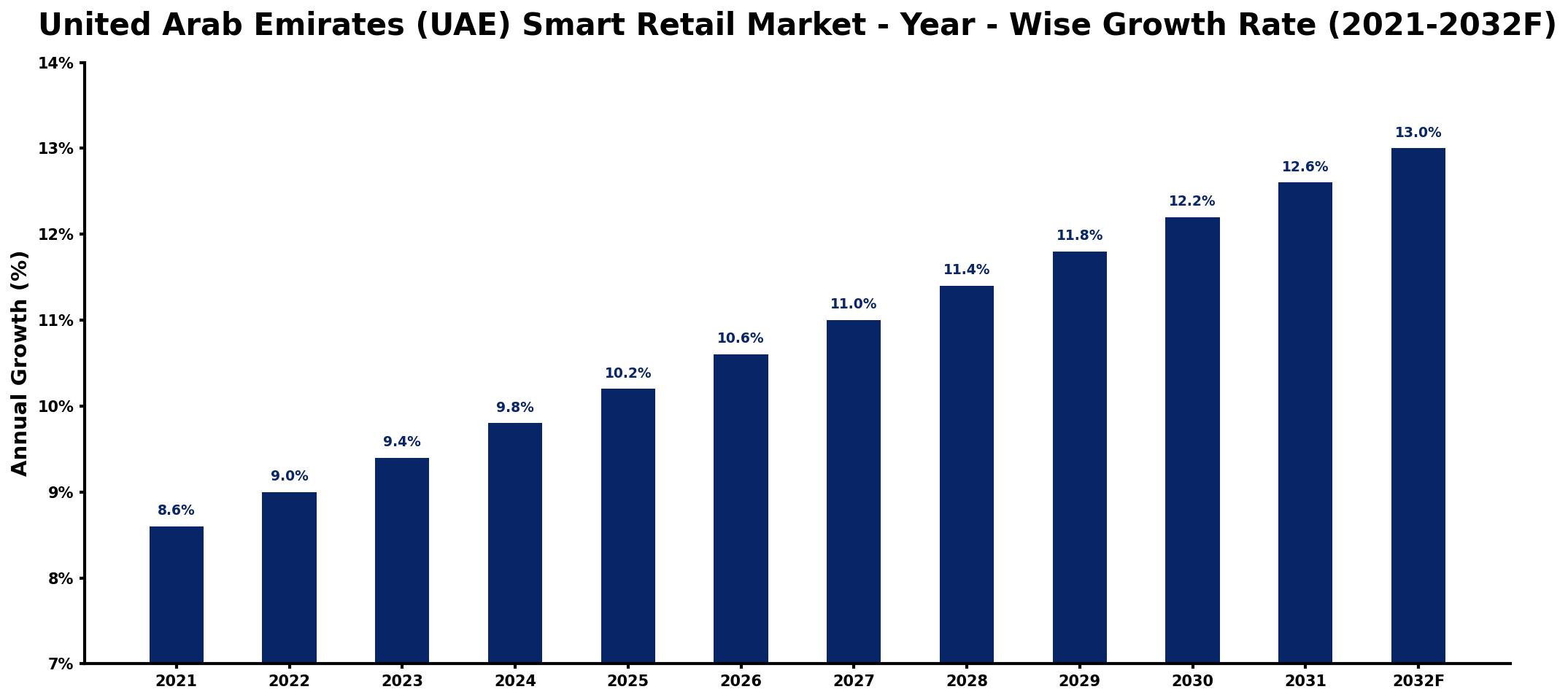
The table below presents the year‑wise growth rates along with the key drivers influencing the market
| Year | Growth Rate | Major Drivers |
| 2021 | 8.6% | Rising demand for digital solutions |
| 2022 | 9.0% | Increase in consumer technology adoption |
| 2023 | 9.4% | Expansion of e-commerce platforms |
| 2024 | 9.8% | Growth in mobile payment systems |
| 2025 | 10.2% | Investments in infrastructure development |
| 2026 | 10.6% | Adoption of AI analytics tools |
| 2027 | 11.0% | Emergence of omnichannel strategies |
| 2028 | 11.4% | Enhancement of customer experience technologies |
| 2029 | 11.8% | Focus on sustainability initiatives |
| 2030 | 12.2% | expanding manufacturing base activity |
| 2031 | 12.6% | Increased collaboration with startups |
| 2032 | 13.0% | Development of advanced analytics solutions |
Note: Market size estimations and growth projections presented in this report are based on 6Wresearch's proprietary forecasting methodology, utilizing the latest available industry data, government publications, and primary research inputs.
United Arab Emirates (UAE) Smart Retail Market Synopsis
In the UAE, the smart retail market is rapidly evolving, marked by a surge in demand for seamless omnichannel shopping experiences. Retailers are harnessing advanced technologies to bridge the digital and physical shopping realms, meeting the expectations of a tech-savvy consumer base that prioritizes convenience and personalization.
Additionally, the integration of IoT-enabled inventory management solutions is revolutionizing supply chain efficiencies. This shift is underpinned by a proactive approach among retailers to optimize operations and enhance customer service, driven in part by governmental support for innovation in the retail sector.
United Arab Emirates (UAE) Smart Retail Market Key Takeaways
- The UAE's luxury retail landscape is propelling investments in smart technologies.
- Consumer preferences are shifting towards personalized and immersive shopping experiences.
- Government initiatives are fostering a culture of innovation in retail.
- Smart technologies are crucial for enhancing operational efficiencies and customer satisfaction.
- The COVID-19 pandemic has accelerated the adoption of contactless and automated retail solutions.
Evaluation of Restraints in United Arab Emirates (UAE) Smart Retail Market
While the smart retail market in the UAE is on a growth path, several restraints hinder its potential. Firstly, the integration of diverse smart solutions—ranging from automated checkout to personalized marketing—demands substantial investments and strategic planning. Additionally, as retailers strive to create intuitive user experiences, the need for deep insights into consumer behavior becomes imperative. Challenges regarding data privacy and security also persist, necessitating robust measures to protect customer information. Finally, balancing the rapid adoption of technology with maintaining personalized human interactions will be vital as the market evolves.
United Arab Emirates (UAE) Smart Retail Market Trends
The smart retail landscape in the UAE is characterized by several emerging trends. Notably, the use of AI for customer analytics is becoming integral, enabling retailers to tailor experiences uniquely to individual preferences. Additionally, the advent of cashier-less shopping environments is reshaping the in-store experience, providing convenience and speed. Furthermore, mobile apps and beacons are enhancing customer engagement, allowing for seamless transitions between digital and physical shopping. Sustainability initiatives are also gaining traction, driving the demand for energy-efficient retail solutions.
United Arab Emirates (UAE) Smart Retail Market Opportunities
The UAE smart retail market presents ample opportunities for growth and investment. Retailers who prioritize the development of omnichannel strategies stand to benefit significantly, as consumers increasingly expect seamless experiences across platforms. Additionally, the focus on sustainability opens doors for technologies that enhance energy efficiency and reduce waste. Moreover, collaborations with tech innovators can spur the development of next-generation retail solutions, positioning businesses at the forefront of the smart retail revolution.
Government Initiatives in the United Arab Emirates (UAE) Smart Retail Market
The UAE government has been proactive in fostering a conducive environment for smart retail innovations. With initiatives aimed at promoting entrepreneurship and technological advancement, various programs and incentives have been established to support retailers in adopting new technologies. Moreover, the emphasis on sustainability and energy efficiency aligns with the global push towards greener retail practices, reinforcing the UAEs commitment to innovation in the retail sector.
Future Insights of the United Arab Emirates (UAE) Smart Retail Market
Looking ahead to 2026-2032, the UAE smart retail market is poised for transformative growth. As retailers continue to integrate cutting-edge technologies, the consumer experience will evolve towards increased personalization and engagement. The market will likely see a greater emphasis on data-driven strategies, enhancing customer loyalty and operational efficiency. The convergence of e-commerce and traditional retail through omnichannel solutions will define the next phase of growth, as retailers strive to create an agile and responsive shopping environment.
United Arab Emirates (UAE) Smart Retail Market Latest Developments (2025 - 2026)
Recent trends in the UAE smart retail market indicate a significant uptick in the adoption of automated checkout systems and contactless payment solutions as retailers seek to enhance safety and convenience. Additionally, personalized marketing efforts powered by AI analytics are gaining traction, allowing retailers to tailor experiences more effectively. Collaborative initiatives with tech firms are also emerging, focusing on creating innovative solutions that bridge the gap between online and physical shopping experiences.
United Arab Emirates (UAE) Smart Retail Market - Key Attractiveness of the Report
- 10 Years of Market Numbers
- Historical Data Starting from 2022 to 2025
- Base Year: 2025
- Forecast Data until 2032
- Key Performance Indicators Impacting the Market
- Major Upcoming Developments and Projects
Key Highlights of the Report:
- United Arab Emirates (UAE) Smart Retail Market Outlook
- Market Size of United Arab Emirates (UAE) Smart Retail Market, 2025
- Forecast of United Arab Emirates (UAE) Smart Retail Market, 2032
- Historical Data and Forecast of United Arab Emirates (UAE) Smart Retail Revenues & Volume for the Period 2022-2032F
- United Arab Emirates (UAE) Smart Retail Market Trend Evolution
- United Arab Emirates (UAE) Smart Retail Market Drivers and Challenges
- United Arab Emirates (UAE) Smart Retail Price Trends
- United Arab Emirates (UAE) Smart Retail Porter's Five Forces
- United Arab Emirates (UAE) Smart Retail Industry Life Cycle
- Historical Data and Forecast of United Arab Emirates (UAE) Smart Retail Market Revenues & Volume By System for the Period 2022-2032F
- Historical Data and Forecast of United Arab Emirates (UAE) Smart Retail Market Revenues & Volume By Digital Signage Solutions for the Period 2022-2032F
- Historical Data and Forecast of United Arab Emirates (UAE) Smart Retail Market Revenues & Volume By Smart Labels for the Period 2022-2032F
- Historical Data and Forecast of United Arab Emirates (UAE) Smart Retail Market Revenues & Volume By Smart Payment Systems for the Period 2022-2032F
- Historical Data and Forecast of United Arab Emirates (UAE) Smart Retail Market Revenues & Volume By Intelligent Vending Machines for the Period 2022-2032F
- Historical Data and Forecast of United Arab Emirates (UAE) Smart Retail Market Revenues & Volume By Augmented Reality Solutions for the Period 2022-2032F
- Historical Data and Forecast of United Arab Emirates (UAE) Smart Retail Market Revenues & Volume By Virtual Reality Solutions for the Period 2022-2032F
- Historical Data and Forecast of United Arab Emirates (UAE) Smart Retail Market Revenues & Volume By POS Solutions for the Period 2022-2032F
- Historical Data and Forecast of United Arab Emirates (UAE) Digital Signage Solutions Smart Retail Market Revenues & Volume By Smart Carts for the Period 2022-2032F
- Historical Data and Forecast of United Arab Emirates (UAE) Smart Retail Market Revenues & Volume By Application for the Period 2022-2032F
- Historical Data and Forecast of United Arab Emirates (UAE) Smart Retail Market Revenues & Volume By Foot-traffic Monitoring for the Period 2022-2032F
- Historical Data and Forecast of United Arab Emirates (UAE) Smart Retail Market Revenues & Volume By Inventory Management for the Period 2022-2032F
- Historical Data and Forecast of United Arab Emirates (UAE) Smart Retail Market Revenues & Volume By Loyalty Management and Payment for the Period 2022-2032F
- Historical Data and Forecast of United Arab Emirates (UAE) Smart Retail Market Revenues & Volume By Predictive Equipment Maintenance for the Period 2022-2032F
- Historical Data and Forecast of United Arab Emirates (UAE) Smart Retail Market Revenues & Volume By Brand Protection for the Period 2022-2032F
- Historical Data and Forecast of United Arab Emirates (UAE) Smart Retail Market Revenues & Volume By Smart Fitting Rooms for the Period 2022-2032F
- Historical Data and Forecast of United Arab Emirates (UAE) Smart Retail Market Revenues & Volume By Retail Offering for the Period 2022-2032F
- Historical Data and Forecast of United Arab Emirates (UAE) Smart Retail Market Revenues & Volume By Apparel and Accessories for the Period 2022-2032F
- Historical Data and Forecast of United Arab Emirates (UAE) Smart Retail Market Revenues & Volume By Fast-moving Consumer Goods for the Period 2022-2032F
- Historical Data and Forecast of United Arab Emirates (UAE) Smart Retail Market Revenues & Volume By Hardlines and Leisure Goods for the Period 2022-2032F
- Historical Data and Forecast of United Arab Emirates (UAE) Smart Retail Market Revenues & Volume By Others for the Period 2022-2032F
- United Arab Emirates (UAE) Smart Retail Import Export Trade Statistics
- Market Opportunity Assessment By System
- Market Opportunity Assessment By Application
- Market Opportunity Assessment By Retail Offering
- United Arab Emirates (UAE) Smart Retail Top Companies Market Share
- United Arab Emirates (UAE) Smart Retail Competitive Benchmarking By Technical and Operational Parameters
- United Arab Emirates (UAE) Smart Retail Company Profiles
- United Arab Emirates (UAE) Smart Retail Key Strategic Recommendations






































