United Arab Emirates (UAE) Soy Grits Market Size, Share & Growth Rate
The United Arab Emirates (UAE) Soy Grits Market was estimated at USD 293 Million in 2025 and is projected to reach USD 398 Million by 2032, growing at a CAGR of 4.5% from 2026 to 2032. This growth trajectory is fueled by a shift in consumer preferences toward plant-based proteins and an increasing health consciousness among the UAE population. The rising availability of soy-based products in retail outlets and restaurants is further propelling the demand for soy grits, marking a notable evolution in the local dietary landscape.
United Arab Emirates (UAE) Soy Grits Market Year-wise Growth Rate and Key Drivers
This graph highlights how the United Arab Emirates (UAE) Soy Grits Market has steadily grown over the years, supported by major growth factors.
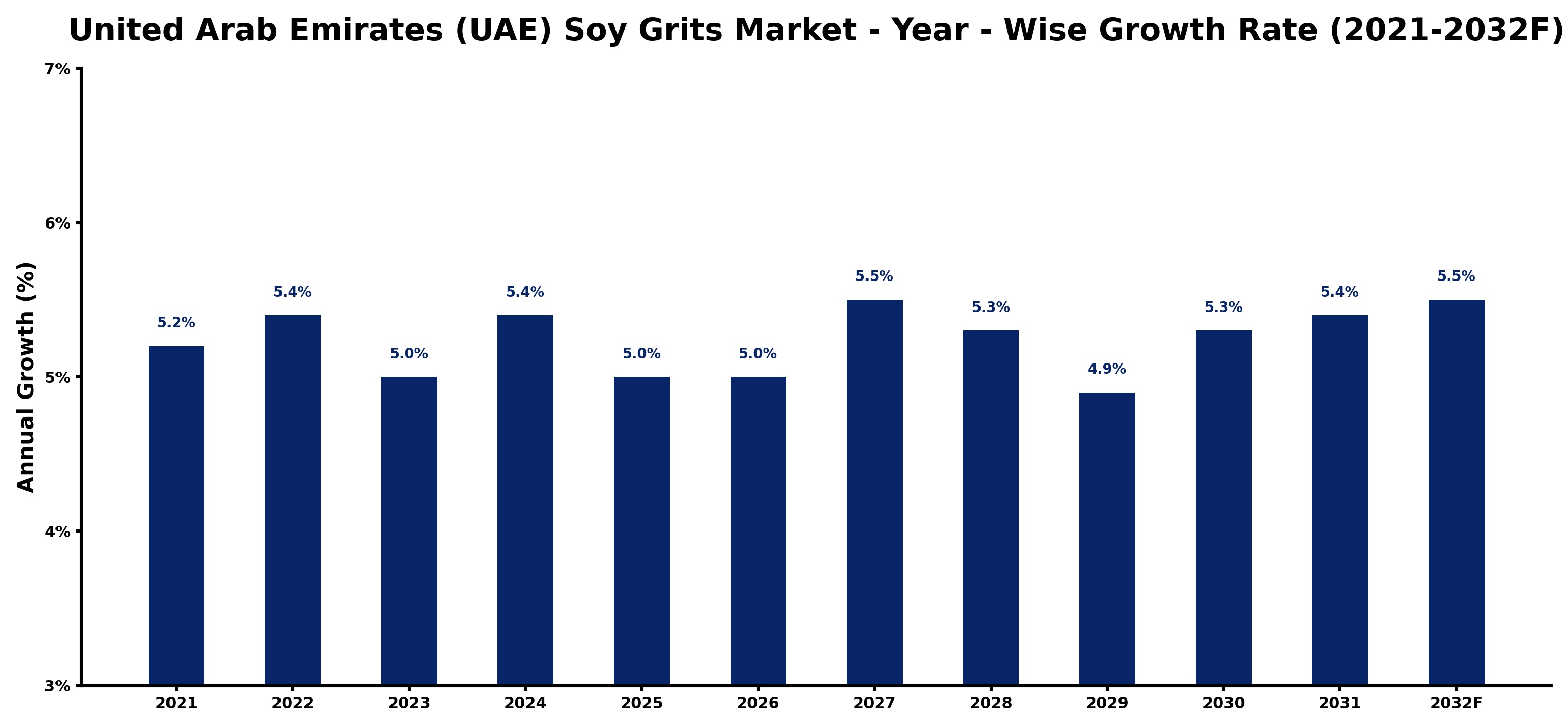
The table below presents the year‑wise growth rates along with the key drivers influencing the market
| Year | Growth Rate | Major Drivers |
| 2021 | 5.2% | Expansion of commercial construction activities |
| 2022 | 5.4% | Growing urbanization and commercial development |
| 2023 | 5.0% | Expansion of commercial construction activities |
| 2024 | 5.4% | Government infrastructure modernization initiatives |
| 2025 | 5.0% | Growing renewable energy integration projects |
| 2026 | 5.0% | Increasing adoption of advanced technologies |
| 2027 | 5.5% | Growing urbanization and commercial development |
| 2028 | 5.3% | Rapid growth in telecom and data center sectors |
| 2029 | 4.9% | Expansion of transportation and logistics networks |
| 2030 | 5.3% | Growing urbanization and commercial development |
| 2031 | 5.4% | Increasing industrial infrastructure investments |
| 2032 | 5.5% | Expansion of transportation and logistics networks |
Note - Market size estimations and growth projections presented in this report are based on 6Wresearch's advanced forecasting approach, validated with industry datasets as of June 2026.
United Arab Emirates (UAE) Soy Grits Market Synopsis
The primary force shaping the UAE soy grits market is the growing health awareness among consumers. As more people adopt vegetarian and vegan lifestyles, soy grits are recognized as a nutrient-dense ingredient, offering substantial protein and fiber content that resonates with health-focused individuals. The increasing versatility of soy grits in various culinary applications also enhances their appeal across different demographic segments.
Additionally, the impact of the Covid-19 pandemic cannot be overlooked. The heightened focus on health and wellness during the crisis led many consumers to explore nutritious food options, including soy-based products. As a result, soy grits have found a more prominent place in both home-cooked meals and commercially prepared foods, indicating a shift in consumption patterns that is likely to persist in the coming years.
United Arab Emirates (UAE) Soy Grits Market Key Takeaways
- The market is projected to grow steadily, reflecting increasing consumer preferences for healthier food options.
- There is a notable rise in plant-based diets, particularly among younger demographics in the UAE.
- Health benefits associated with soy consumption are becoming more recognized, contributing to higher demand for soy grits.
- The pandemic has accelerated the trend towards home cooking and healthy eating habits, positively impacting the market.
- Education and awareness campaigns are essential for further market penetration among less familiar consumer segments.
Evaluation of Restraints in United Arab Emirates (UAE) Soy Grits Market
Despite the optimistic growth outlook, the UAE soy grits market grapples with certain constraints. A significant portion of the population remains unfamiliar with soy-based ingredients, primarily due to traditional dietary habits that do not include these products. This lack of familiarity limits the widespread adoption of soy grits, hindering growth potential. Thus, strategic educational initiatives will be vital in bridging this knowledge gap and encouraging broader acceptance of soy products in various culinary contexts.
United Arab Emirates (UAE) Soy Grits Market Trends
The trend towards plant-based eating is gaining momentum in the UAE, driven by both health motivations and environmental considerations. As consumers increasingly demand transparency and quality in their food sources, the market for soy grits is expected to see innovations in product formulation and packaging. Enhanced marketing strategies that highlight the nutritional advantages of soy grits are also emerging, as brands seek to engage a more health-conscious consumer base. Furthermore, collaborations between local farmers and suppliers could enhance the local sourcing of soybeans, boosting the market's sustainability angle.
United Arab Emirates (UAE) Soy Grits Market Opportunities
Several opportunities for growth and investment are unfolding within the UAE soy grits market. With a rising trend in foodservice establishments adopting healthier menu options, partnerships between soy grits producers and restaurants could facilitate increased product usage. Moreover, the retail sector's expansion of health-focused products creates a ripe opportunity for soy grits, particularly in health food stores and supermarkets. Additionally, educational campaigns aimed at promoting the benefits and versatility of soy grits can tap into an untapped consumer base, driving future sales.
Government Initiatives in the United Arab Emirates (UAE) Soy Grits Market
Government initiatives in the UAE are increasingly supportive of healthier food options, focusing on public health and nutrition. Programs aimed at promoting the adoption of plant-based diets align with national health objectives, which could provide a conducive environment for the growth of the soy grits market. These efforts include public health campaigns emphasizing balanced diets and nutritional education, which can indirectly foster interest in soy products as viable alternatives.
Future Insights of the United Arab Emirates (UAE) Soy Grits Market
Looking ahead to 2026-2032, the UAE soy grits market is poised for continued expansion, driven by evolving dietary trends and increasing consumer demand for nutritious ingredients. The shift towards sustainable and health-oriented food products suggests that soy grits will play a significant role in the diets of UAE residents. As awareness increases and more consumers embrace plant-based lifestyles, the market is expected to witness innovations in product offerings, catering to diverse culinary preferences and enhancing overall market viability.
United Arab Emirates (UAE) Soy Grits Market Latest Developments (May 2025 - June 2026)
Recent industry movements indicate a growing interest in soy grits among various sectors, particularly in foodservice and retail. New product launches featuring soy grits as a main ingredient are becoming more frequent, as manufacturers seek to capitalize on the increasing consumer inclination towards healthy alternatives. Furthermore, educational initiatives promoting the health benefits of soy products are being implemented to address consumer knowledge gaps, thus helping to drive market adoption.
United Arab Emirates (UAE) Soy Grits Market - Key Attractiveness of the Report
- 10 Years of Market Numbers
- Historical Data Starting from 2022 to 2025
- Base Year: 2025
- Forecast Data until 2032
- Key Performance Indicators Impacting the Market
- Major Upcoming Developments and Projects
Key Highlights of the Report:
- United Arab Emirates (UAE) Soy Grits Market Outlook
- Market Size of United Arab Emirates (UAE) Soy Grits Market, 2025
- Forecast of United Arab Emirates (UAE) Soy Grits Market, 2032
- Historical Data and Forecast of United Arab Emirates (UAE) Soy Grits Revenues & Volume for the Period 2022-2032F
- United Arab Emirates (UAE) Soy Grits Market Trend Evolution
- United Arab Emirates (UAE) Soy Grits Market Drivers and Challenges
- United Arab Emirates (UAE) Soy Grits Price Trends
- United Arab Emirates (UAE) Soy Grits Porter's Five Forces
- United Arab Emirates (UAE) Soy Grits Industry Life Cycle
- Historical Data and Forecast of United Arab Emirates (UAE) Soy Grits Market Revenues & Volume By Type for the Period 2022-2032F
- Historical Data and Forecast of United Arab Emirates (UAE) Soy Grits Market Revenues & Volume By Roasted for the Period 2022-2032F
- Historical Data and Forecast of United Arab Emirates (UAE) Soy Grits Market Revenues & Volume By Non-Roasted for the Period 2022-2032F
- Historical Data and Forecast of United Arab Emirates (UAE) Soy Grits Market Revenues & Volume By Grain Size for the Period 2022-2032F
- Historical Data and Forecast of United Arab Emirates (UAE) Soy Grits Market Revenues & Volume By Coarse Soy Grits for the Period 2022-2032F
- Historical Data and Forecast of United Arab Emirates (UAE) Soy Grits Market Revenues & Volume By Medium Size Soy Grits for the Period 2022-2032F
- Historical Data and Forecast of United Arab Emirates (UAE) Soy Grits Market Revenues & Volume By Fine Size Soy Grits for the Period 2022-2032F
- Historical Data and Forecast of United Arab Emirates (UAE) Soy Grits Market Revenues & Volume By Distribution Channel for the Period 2022-2032F
- Historical Data and Forecast of United Arab Emirates (UAE) Soy Grits Market Revenues & Volume By Specialty Stores for the Period 2022-2032F
- Historical Data and Forecast of United Arab Emirates (UAE) Soy Grits Market Revenues & Volume By Retail Stores for the Period 2022-2032F
- Historical Data and Forecast of United Arab Emirates (UAE) Soy Grits Market Revenues & Volume By Online Retail Stores for the Period 2022-2032F
- United Arab Emirates (UAE) Soy Grits Import Export Trade Statistics
- Market Opportunity Assessment By Type
- Market Opportunity Assessment By Grain Size
- Market Opportunity Assessment By Distribution Channel
- United Arab Emirates (UAE) Soy Grits Top Companies Market Share
- United Arab Emirates (UAE) Soy Grits Competitive Benchmarking By Technical and Operational Parameters
- United Arab Emirates (UAE) Soy Grits Company Profiles
- United Arab Emirates (UAE) Soy Grits Key Strategic Recommendations






































