United Arab Emirates (UAE) Sports Equipment Market Size, Share & Growth Rate
The United Arab Emirates (UAE) Sports Equipment Market was estimated at USD 309 Million in 2025 and is projected to reach USD 431 Million by 2032, growing at a CAGR of 4.9% from 2026 to 2032. This upward trajectory is driven by an increasingly health-conscious population and significant government efforts to promote sports and fitness activities. With a diverse range of sporting interests among consumers and a growing number of world-class facilities, the market is poised for continued expansion.
United Arab Emirates (UAE) Sports Equipment Market Year-wise Growth Rate and Key Drivers
This graph highlights how the United Arab Emirates (UAE) Sports Equipment Market has steadily grown over the years, supported by major growth factors.
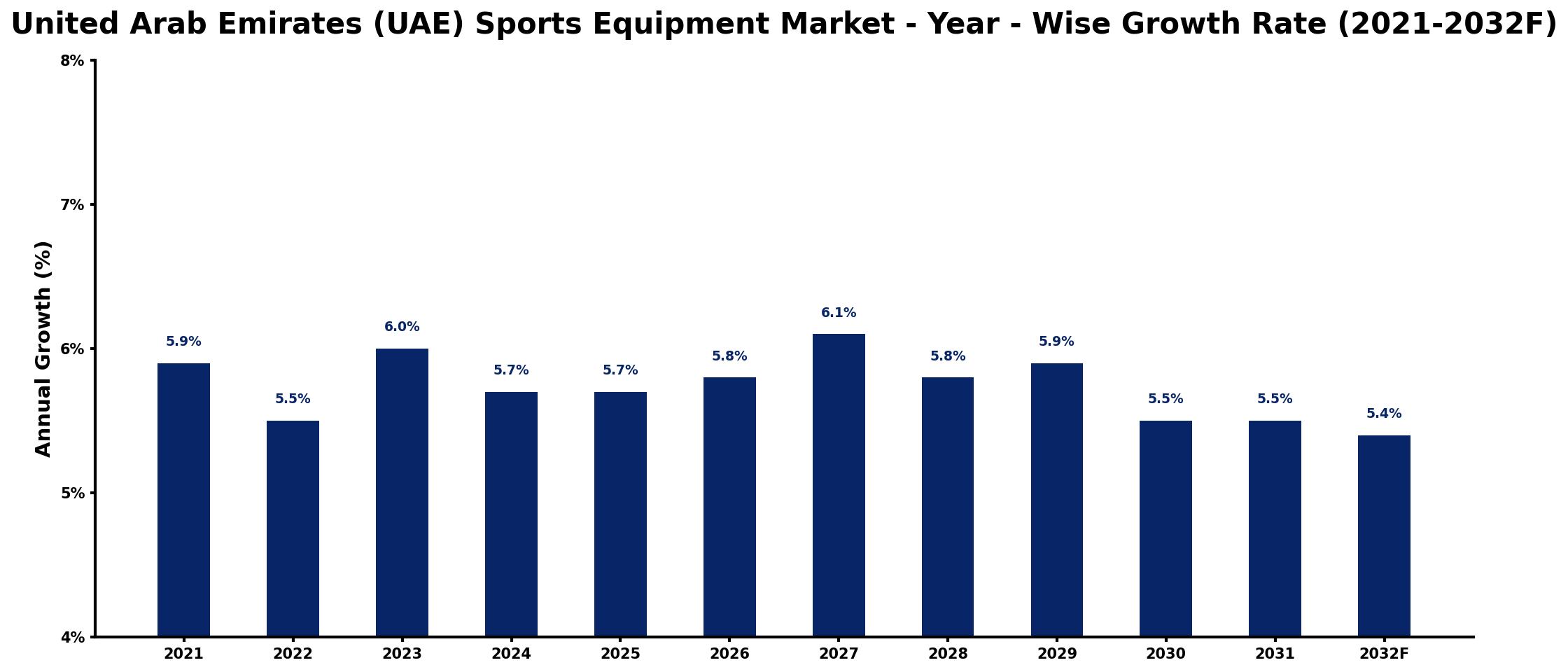
The table below presents the year‑wise growth rates along with the key drivers influencing the market
| Year | Growth Rate | Major Drivers |
| 2021 | 5.9% | Rising fitness awareness among consumers |
| 2022 | 5.5% | Increased investment in recreational facilities |
| 2023 | 6.0% | Growing youth participation in activities |
| 2024 | 5.7% | Expansion of online retail platforms |
| 2025 | 5.7% | Surge in health-focused lifestyle trends |
| 2026 | 5.8% | Growing popularity of team competitions |
| 2027 | 6.1% | Increased sponsorships for local events |
| 2028 | 5.8% | Development of community fitness programs |
| 2029 | 5.9% | Emergence of innovative training methods |
| 2030 | 5.5% | Rise in corporate wellness initiatives |
| 2031 | 5.5% | Enhanced focus on sustainable practices |
| 2032 | 5.4% | growing commercial sector adoption |
Note: Market size estimations and growth projections presented in this report are based on 6Wresearch's proprietary forecasting methodology, utilizing the latest available industry data, government publications, and primary research inputs.
United Arab Emirates (UAE) Sports Equipment Market Synopsis
The UAE Sports Equipment market is characterized by a robust demand for both fitness and recreational equipment. An increasing number of fitness enthusiasts and athletes are investing in high-quality gear, motivated by a desire for both performance enhancement and health benefits. The diverse climate and numerous outdoor sporting opportunities further stimulate the need for specialized equipment across various sports.
On the supply side, both local and international brands compete vigorously, introducing innovative products tailored to the local demographic's preferences. This competitive landscape fosters continuous advancement in product offerings, ensuring consumers have access to the latest technologies and designs that enhance their sporting experience.
United Arab Emirates (UAE) Sports Equipment Market Key Takeaways
- The market reflects a significant shift toward health and fitness-oriented investments among consumers.
- Government initiatives are actively fostering a culture of sports participation across all age groups.
- Competition is intensifying among established global and local brands, pushing innovation forward.
- COVID-19's effects were transient, with a strong recovery observed as lifestyle activities resume.
- New sporting events hosted in the UAE are catalyzing increased interest in sports participation and equipment purchases.
Evaluation of Restraints in United Arab Emirates (UAE) Sports Equipment Market
Despite the growth prospects, the UAE Sports Equipment Market faces challenges such as market saturation and fierce competition among established brands. These conditions make it difficult for new entrants to carve out their market share. Additionally, the shifting preferences of consumers require brands to remain agile, adapting their product lines to meet evolving demands. The risk of economic fluctuations also looms large, potentially influencing consumer spending behaviors.
United Arab Emirates (UAE) Sports Equipment Market Trends
Several trends are shaping the UAE Sports Equipment Market, including the rise of smart sports technology that integrates performance tracking with user-friendly applications. Eco-friendly materials and sustainable practices are increasingly important to consumers, prompting brands to innovate in this space. Moreover, the increasing popularity of home fitness solutions and outdoor sporting activities reflects changing lifestyles, influenced by recent global events and a desire for convenience.
United Arab Emirates (UAE) Sports Equipment Market Opportunities
The market presents substantial opportunities for investment, particularly in areas such as personalized fitness solutions and health-focused sports gear. Collaborations with fitness influencers and community-oriented sports programs can enhance brand visibility and loyalty. Additionally, the development of mobile applications for fitness tracking and virtual training offers avenues for growth, as consumers increasingly seek holistic health and fitness experiences.
Government Initiatives in the United Arab Emirates (UAE) Sports Equipment Market
The UAE government has launched numerous initiatives aimed at promoting sports and physical well-being among its citizens. From establishing national sports programs to enhancing public sports facilities, there is a clear commitment to fostering a culture of fitness. Investment in community sports events and partnerships with educational institutions underscores the governments role in encouraging wider participation in physical activities.
Future Insights of the United Arab Emirates (UAE) Sports Equipment Market
Looking ahead to 2026-2032, the UAE Sports Equipment Market is expected to experience transformative growth. The ongoing prioritization of health and fitness, supported by government initiatives and a rising affluent demographic, will drive demand. Innovations in technology and sustainability practices will further define the competitive landscape, offering brands opportunities to differentiate themselves. As the nation continues to attract major sporting events, the alignment of consumer interest with high-quality sports equipment will sustain market momentum.
United Arab Emirates (UAE) Sports Equipment Market Latest Developments (2025 - 2026)
Recent trends indicate a strategic shift in the UAE sports equipment market towards enhancing digital engagement and e-commerce platforms. Companies are increasingly investing in online sales channels to reach tech-savvy consumers, reflecting the broader global shift toward digital commerce. Furthermore, collaborations between brands and local fitness influencers are becoming more common, aimed at increasing brand awareness and driving customer loyalty through authentic engagements.
United Arab Emirates (UAE) Sports Equipment Market - Key Attractiveness of the Report
- 10 Years of Market Numbers
- Historical Data Starting from 2022 to 2025
- Base Year: 2025
- Forecast Data until 2032
- Key Performance Indicators Impacting the Market
- Major Upcoming Developments and Projects
Key Highlights of the Report:
- United Arab Emirates (UAE) Sports Equipment Market Outlook
- Market Size of United Arab Emirates (UAE) Sports Equipment Market, 2025
- Forecast of United Arab Emirates (UAE) Sports Equipment Market, 2032
- Historical Data and Forecast of United Arab Emirates (UAE) Sports Equipment Revenues & Volume for the Period 2022-2032F
- United Arab Emirates (UAE) Sports Equipment Market Trend Evolution
- United Arab Emirates (UAE) Sports Equipment Market Drivers and Challenges
- United Arab Emirates (UAE) Sports Equipment Price Trends
- United Arab Emirates (UAE) Sports Equipment Porter's Five Forces
- United Arab Emirates (UAE) Sports Equipment Industry Life Cycle
- Historical Data and Forecast of United Arab Emirates (UAE) Sports Equipment Market Revenues & Volume By Product for the Period 2022-2032F
- Historical Data and Forecast of United Arab Emirates (UAE) Sports Equipment Market Revenues & Volume By Ball over net games for the Period 2022-2032F
- Historical Data and Forecast of United Arab Emirates (UAE) Sports Equipment Market Revenues & Volume By Ball games for the Period 2022-2032F
- Historical Data and Forecast of United Arab Emirates (UAE) Sports Equipment Market Revenues & Volume By Fitness/Strength equipment for the Period 2022-2032F
- Historical Data and Forecast of United Arab Emirates (UAE) Sports Equipment Market Revenues & Volume By Athletic training equipment for the Period 2022-2032F
- Historical Data and Forecast of United Arab Emirates (UAE) Sports Equipment Market Revenues & Volume By Others for the Period 2022-2032F
- Historical Data and Forecast of United Arab Emirates (UAE) Sports Equipment Market Revenues & Volume By Distribution Channel for the Period 2022-2032F
- Historical Data and Forecast of United Arab Emirates (UAE) Sports Equipment Market Revenues & Volume By Online retail for the Period 2022-2032F
- Historical Data and Forecast of United Arab Emirates (UAE) Sports Equipment Market Revenues & Volume By Specialty & sports shops for the Period 2022-2032F
- Historical Data and Forecast of United Arab Emirates (UAE) Sports Equipment Market Revenues & Volume By Department & discount stores for the Period 2022-2032F
- United Arab Emirates (UAE) Sports Equipment Import Export Trade Statistics
- Market Opportunity Assessment By Product
- Market Opportunity Assessment By Distribution Channel
- United Arab Emirates (UAE) Sports Equipment Top Companies Market Share
- United Arab Emirates (UAE) Sports Equipment Competitive Benchmarking By Technical and Operational Parameters
- United Arab Emirates (UAE) Sports Equipment Company Profiles
- United Arab Emirates (UAE) Sports Equipment Key Strategic Recommendations






































