United Arab Emirates (UAE) Stackers Market Size, Share & Growth Rate
The United Arab Emirates (UAE) Stackers Market was estimated at USD 234 Million in 2025 and is projected to reach USD 306 Million by 2032, growing at a CAGR of 3.9% from 2026 to 2032. This growth trajectory is being driven by the UAE's dynamic industrial landscape and the escalating demand for efficient material handling solutions across various sectors. The rise in e-commerce activities, coupled with advancements in automation technology, is further propelling the need for stackers that enhance operational efficiency in logistics and warehousing.
United Arab Emirates (UAE) Stackers Market Year-wise Growth Rate and Key Drivers
This graph highlights how the United Arab Emirates (UAE) Stackers Market has steadily grown over the years, supported by major growth factors.
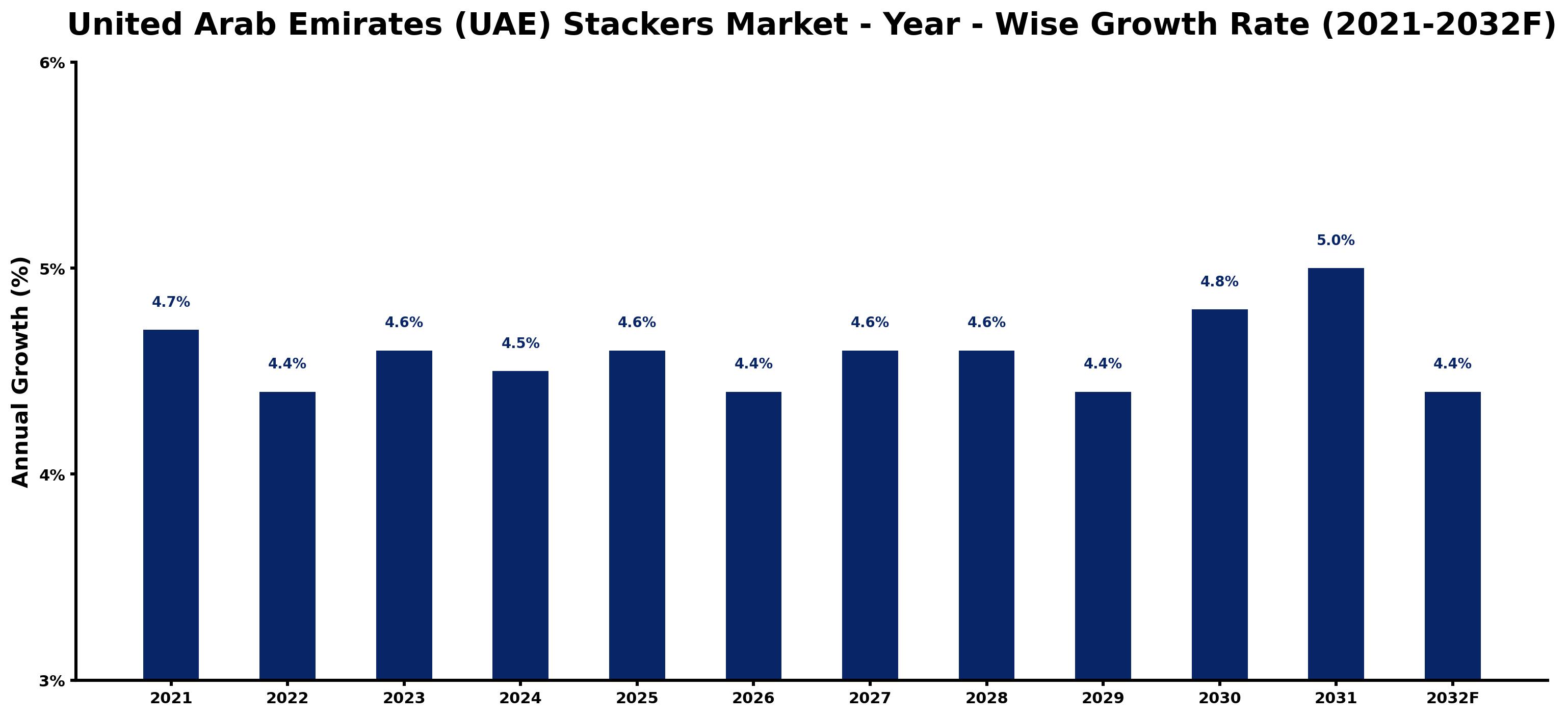
The table below presents the year‑wise growth rates along with the key drivers influencing the market
| Year | Growth Rate | Major Drivers |
| 2021 | 4.7% | Government infrastructure modernization initiatives |
| 2022 | 4.4% | Rapid growth in telecom and data center sectors |
| 2023 | 4.6% | Growing renewable energy integration projects |
| 2024 | 4.5% | Increasing industrial automation investments |
| 2025 | 4.6% | Increasing adoption of advanced technologies |
| 2026 | 4.4% | Increasing industrial automation investments |
| 2027 | 4.6% | Increasing industrial infrastructure investments |
| 2028 | 4.6% | Increasing industrial automation investments |
| 2029 | 4.4% | Expansion of transportation and logistics networks |
| 2030 | 4.8% | Increasing industrial automation investments |
| 2031 | 5.0% | Expansion of commercial construction activities |
| 2032 | 4.4% | Growing renewable energy integration projects |
Note - Market size estimations and growth projections presented in this report are based on 6Wresearch's advanced forecasting approach, validated with industry datasets as of June 2026.
United Arab Emirates (UAE) Stackers Market Synopsis
The stackers market in the UAE is witnessing a robust evolution, characterized by a shift towards modernized material handling equipment. Businesses are increasingly recognizing the importance of stackers in optimizing space and improving productivity, especially in densely populated warehouse environments. This trend reflects a broader movement towards automation and efficiency in the region's logistics and manufacturing sectors.
As the UAE continues to assert itself as a pivotal trade hub, the demand for stackers is being amplified by the increasing volume of goods transported and stored. Industries ranging from retail to pharmaceuticals are adopting stackers to facilitate quick and safe movement of materials, thereby supporting the economy's broader goals of diversification and growth.
United Arab Emirates (UAE) Stackers Market Key Takeaways
- The UAE stackers market is experiencing consistent growth, fueled by a focus on automation and efficiency.
- Increased industrialization and the rise of e-commerce are significant contributors to market demand.
- Stackers are increasingly favored for their versatility compared to other material handling equipment.
- The post-pandemic recovery has led to heightened investments in logistics and supply chain infrastructure.
- Technological advancements are driving the development of smarter, more efficient stacker systems.
Evaluation of Restraints in United Arab Emirates (UAE) Stackers Market
Despite the robust growth prospects, the UAE stackers market contends with several constraints. Notably, competition from alternative material handling solutions such as forklifts and automated conveyor systems poses a significant challenge. The advantages of stackers, including their maneuverability and space efficiency, must be effectively communicated to prospective buyers to maintain market share. Moreover, fluctuations in raw material prices, as well as regulatory challenges associated with imports, can disrupt supply chains and impact production costs.
United Arab Emirates (UAE) Stackers Market Trends
The shift towards automation continues to dominate trends in the UAE stackers market. Many facilities are increasingly integrating robotic systems and automated guided vehicles (AGVs) with stackers to enhance operational synergy. Additionally, there is a notable emphasis on energy-efficient designs and sustainable practices, as companies look to reduce their carbon footprints while maintaining efficiency. These trends reflect a broader commitment to innovation within the region's industrial practices.
United Arab Emirates (UAE) Stackers Market Opportunities
A wealth of opportunities exists within the UAE stackers market, particularly for manufacturers that focus on customization and advanced technology integration. The burgeoning e-commerce sector provides a ripe environment for stackers designed for rapid and efficient material handling. Additionally, as businesses strive for sustainability, there is a growing market for stackers that incorporate energy-efficient technologies. Investing in research and development can yield high returns as companies seek to modernize their operations.
Government Initiatives in the United Arab Emirates (UAE) Stackers Market
The UAE government has implemented several initiatives to bolster the industrial and logistics sectors, directly benefiting the stackers market. Public spending on infrastructure development, particularly in logistics hubs, facilitates enhanced supply chain efficiencies. Moreover, programs promoting technological advancement and automation in material handling are driving adoption. These initiatives align with the nation's broader economic diversification goals, ensuring a supportive environment for stacker manufacturers.
Future Insights of the United Arab Emirates (UAE) Stackers Market
Looking ahead to 2026-2032, the UAE stackers market is poised for a transformative phase driven by technological advancements and shifts in consumer behavior. The ongoing push towards automation will catalyze the development of more sophisticated stackers, equipped with features such as IoT connectivity and advanced safety protocols. As the region's logistics and warehousing demands evolve, stackers will increasingly become integral to efficient operations, paving the way for continued market expansion.
United Arab Emirates (UAE) Stackers Market Latest Developments (May 2025 - June 2026)
Recent developments in the UAE stackers market indicate a surge in investment toward advanced material handling technologies. Many companies are pivoting to include stackers in their automation strategies, adapting to the growing demand for more efficient inventory management solutions. Furthermore, there is an observable trend towards collaboration between stacker manufacturers and technology firms to develop smarter systems that enhance operational capabilities within warehouses and distribution centers.
United Arab Emirates (UAE) Stackers Market - Key Attractiveness of the Report
- 10 Years of Market Numbers
- Historical Data Starting from 2022 to 2025
- Base Year: 2025
- Forecast Data until 2032
- Key Performance Indicators Impacting the Market
- Major Upcoming Developments and Projects
Key Highlights of the Report:
- United Arab Emirates (UAE) Stackers Market Outlook
- Market Size of United Arab Emirates (UAE) Stackers Market, 2025
- Forecast of United Arab Emirates (UAE) Stackers Market, 2032
- Historical Data and Forecast of United Arab Emirates (UAE) Stackers Revenues & Volume for the Period 2022-2032F
- United Arab Emirates (UAE) Stackers Market Trend Evolution
- United Arab Emirates (UAE) Stackers Market Drivers and Challenges
- United Arab Emirates (UAE) Stackers Price Trends
- United Arab Emirates (UAE) Stackers Porter's Five Forces
- United Arab Emirates (UAE) Stackers Industry Life Cycle
- Historical Data and Forecast of United Arab Emirates (UAE) Stackers Market Revenues & Volume By Type for the Period 2022-2032F
- Historical Data and Forecast of United Arab Emirates (UAE) Stackers Market Revenues & Volume By Electric for the Period 2022-2032F
- Historical Data and Forecast of United Arab Emirates (UAE) Stackers Market Revenues & Volume By Manual/Hydraulic for the Period 2022-2032F
- Historical Data and Forecast of United Arab Emirates (UAE) Stackers Market Revenues & Volume By Semi-Electric for the Period 2022-2032F
- Historical Data and Forecast of United Arab Emirates (UAE) Stackers Market Revenues & Volume By End-User for the Period 2022-2032F
- Historical Data and Forecast of United Arab Emirates (UAE) Stackers Market Revenues & Volume By Retail & Wholesale for the Period 2022-2032F
- Historical Data and Forecast of United Arab Emirates (UAE) Stackers Market Revenues & Volume By Logistics for the Period 2022-2032F
- Historical Data and Forecast of United Arab Emirates (UAE) Stackers Market Revenues & Volume By Automobile for the Period 2022-2032F
- Historical Data and Forecast of United Arab Emirates (UAE) Stackers Market Revenues & Volume By Food & Beverages for the Period 2022-2032F
- Historical Data and Forecast of United Arab Emirates (UAE) Stackers Market Revenues & Volume By Others for the Period 2022-2032F
- United Arab Emirates (UAE) Stackers Import Export Trade Statistics
- Market Opportunity Assessment By Type
- Market Opportunity Assessment By End-User
- United Arab Emirates (UAE) Stackers Top Companies Market Share
- United Arab Emirates (UAE) Stackers Competitive Benchmarking By Technical and Operational Parameters
- United Arab Emirates (UAE) Stackers Company Profiles
- United Arab Emirates (UAE) Stackers Key Strategic Recommendations






































