United Arab Emirates (UAE) Tables Market Summary
The united arab emirates (uae) tables market was estimated at USD 477 Million in 2025 and is projected to reach USD 626 Million by 2032, growing at a CAGR of 4.8% from 2026 to 2032.
United Arab Emirates (UAE) Tables Market Year-wise Growth Rate and Key Drivers
This graph highlights how the United Arab Emirates (UAE) Tables Market has steadily grown over the past five years, supported by major growth factors.
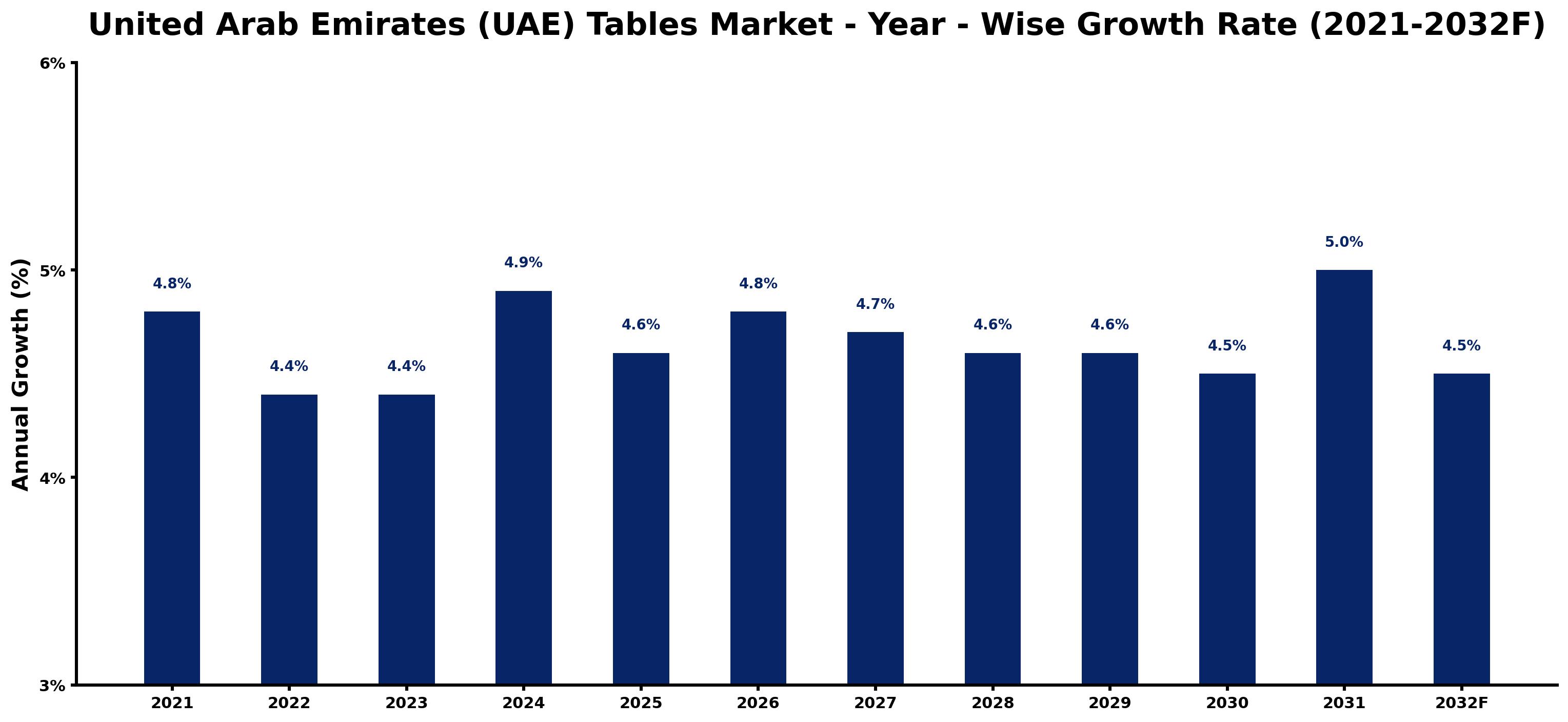
The table below presents the year wise growth rates along with the key drivers influencing the market
| Year | Growth Rate | Major Drivers |
| 2021 | 4.8% | Post-lockdown retail projects sparked interest in luxury furniture, including upscale tables. |
| 2022 | 4.4% | The influx of expatriates and tourists created unique dining experience demands. |
| 2023 | 4.4% | Increased construction activities in Dubai led to a surge in table manufacturing. |
| 2024 | 4.9% | High-profile events stimulated local hospitality sectors, boosting demand for premium tables. |
| 2025 | 4.6% | Sustainable materials gained traction, influencing table design preferences in upscale markets. |
| 2026 | 4.8% | Innovations in smart furniture captured attention, creating niche opportunities for tech-oriented tables. |
| 2027 | 4.7% | Local artisan craftsmanship highlighted UAE culture, attracting buyers interested in unique designs. |
| 2028 | 4.6% | E-commerce platforms expanded, allowing consumers to explore diverse table options easily. |
| 2029 | 4.6% | Corporate office renovations spurred a need for functional yet aesthetic table solutions. |
| 2030 | 4.5% | Growing eco-conscious consumer bases encouraged brands to adopt sustainable table materials. |
| 2031 | 5.0% | Urbanization trends shifted focus towards multifunctional furniture, including adaptable tables. |
| 2032 | 4.5% | Luxury lifestyle branding among local designers propelled premium table creations across markets. |
Note - Market size estimations and growth projections presented in this report are based on 6Wresearch's advanced forecasting approach, validated with industry datasets as of June 2026.
United Arab Emirates (UAE) Tables Market Synopsis
The United Arab Emirates (UAE) Tables Market is projected to reach 4.8% and witness significant growth during the forecast period (2026-2032). This growth stems from an increasing demand across various sectors, including residential, commercial, and hospitality. As urbanization accelerates, the need for functional yet stylish tables has become imperative in modern design aesthetics.
United Arab Emirates (UAE) Tables Market Growth Drivers
Several key factors are driving the growth of the tables market in the UAE. The ongoing urban development projects coupled with a booming population have resulted in a surge in demand for tables in homes and commercial spaces. The hospitality sector, particularly, has seen a robust increase in the need for tables as restaurants, hotels, and cafes aim to enhance customer experience through quality furnishings. Key growth drivers include:
- The rapid urbanization in the UAE continues to create opportunities for residential and commercial space design, resulting in heightened demand for various types of tables.
- The hospitality and tourism sectors are expanding, increasing the need for versatile and attractive tables in dining and lounge areas.
- A growing emphasis on interior design among consumers encourages the purchase of aesthetically pleasing and functional tables that complement modern lifestyles.
- Innovations in materials and design further drive interest, as consumers seek unique furnishings that stand out in their spaces.
- Increased disposable income among consumers facilitates spending on high-quality, stylish tables, further fuelling market growth.
United Arab Emirates (UAE) Tables Market Challenges and Restraints
Despite its promising growth trajectory, the United Arab Emirates (UAE) Tables Market faces several challenges that may impede its progress. The competitive landscape includes not only local manufacturers but also a plethora of imported goods, often at lower price points. Key challenges include:
- Intense competition from imported furniture could potentially undermine local manufacturers' market share.
- Economic fluctuations and consumer spending patterns following the Covid-19 pandemic may lead to decreased demand for non-essential furniture items.
- Disruptions in global supply chains can affect the availability and pricing of raw materials essential for table production.
- Consumer preferences are shifting towards sustainable and eco-friendly products, requiring manufacturers to innovate and adapt.
- Seasonal variations in demand, particularly within the tourism sector, can lead to unpredictable sales cycles.
United Arab Emirates (UAE) Tables Market Covid-19 Impact Analysis
The outbreak of the Covid-19 pandemic in 2025 significantly affected the UAE tables market, particularly within the hospitality industry, where table demand saw a marked decline due to restrictive measures and reduced customer footfall. However, as the economy gradually reopened, there was a noticeable resurgence in demand for tables. This can be attributed to several factors, such as:
- An increase in home office setups as remote working gained traction, driving the demand for functional office tables.
- A renewed focus on creating inviting living spaces led to increased investment in home furnishings, including tables.
- The pandemic highlighted the importance of versatile and adaptable furniture that can accommodate various uses, further influencing consumer choices.
- As outdoor dining became a popular alternative, the demand for garden and patio tables also saw significant growth.
- The surge in e-commerce and online shopping provided new channels for table sales, mitigating some of the pandemic's adverse effects on traditional retail.
United Arab Emirates (UAE) Tables Market Government Investment and Initiatives
The UAE government has actively supported initiatives aimed at expanding both the residential and commercial furniture markets, including the tables sector. The focus on infrastructure development, particularly through investments in real estate and tourism, is expected to bolster market conditions for table manufacturers. Key government initiatives include:
- Public investment in mega projects and tourism development, enhancing the demand for furniture in hotels and restaurants.
- Incentives aimed at local manufacturers to encourage innovation and competitiveness in furniture design and production.
- Commitment to sustainability, encouraging manufacturers to adopt eco-friendly practices and materials.
- Support for small and medium enterprises (SMEs) within the furniture sector to strengthen local production capabilities.
- Promotion of design and architecture events that highlight local craftsmanship and innovation in furniture design.
United Arab Emirates (UAE) Tables Market Latest Developments (May 2025 - June 2026)
Recent developments in the UAE tables market have focused on the evolving design trends and consumer preferences. As businesses and consumers recognize the importance of high-quality and stylish furniture, there is an increased emphasis on customization and versatility. Noteworthy industry trends during this period include:
- Increased demand for multifunctional tables that serve multiple purposes in residential and commercial settings.
- The rise of online platforms facilitating the sale of furniture, allowing consumers greater accessibility and variety.
- Growing focus on ergonomic designs addressing consumer health and comfort, especially in home office setups.
- Continued interest in eco-friendly materials and sustainable manufacturing practices among consumers and manufacturers alike.
- Enhanced collaboration between local designers and manufacturers to produce unique, culturally inspired furniture pieces.
United Arab Emirates (UAE) Tables Market - Key Attractiveness of the Report
- 10 Years of Market Numbers
- Historical Data Starting from 2022 to 2025
- Base Year: 2025
- Forecast Data until 2032
- Key Performance Indicators Impacting the Market
- Major Upcoming Developments and Projects
Key Highlights of the Report:
- United Arab Emirates (UAE) Tables Market Outlook
- Market Size of United Arab Emirates (UAE) Tables Market, 2025
- Forecast of United Arab Emirates (UAE) Tables Market, 2032
- Historical Data and Forecast of United Arab Emirates (UAE) Tables Revenues & Volume for the Period 2022-2032F
- United Arab Emirates (UAE) Tables Market Trend Evolution
- United Arab Emirates (UAE) Tables Market Drivers and Challenges
- United Arab Emirates (UAE) Tables Price Trends
- United Arab Emirates (UAE) Tables Porter's Five Forces
- United Arab Emirates (UAE) Tables Industry Life Cycle
- Historical Data and Forecast of United Arab Emirates (UAE) Tables Market Revenues & Volume By Types for the Period 2022-2032F
- Historical Data and Forecast of United Arab Emirates (UAE) Tables Market Revenues & Volume By Fabric for the Period 2022-2032F
- Historical Data and Forecast of United Arab Emirates (UAE) Tables Market Revenues & Volume By Leather for the Period 2022-2032F
- Historical Data and Forecast of United Arab Emirates (UAE) Tables Market Revenues & Volume By Metal for the Period 2022-2032F
- Historical Data and Forecast of United Arab Emirates (UAE) Tables Market Revenues & Volume By Wooden for the Period 2022-2032F
- Historical Data and Forecast of United Arab Emirates (UAE) Tables Market Revenues & Volume By Others for the Period 2022-2032F
- Historical Data and Forecast of United Arab Emirates (UAE) Tables Market Revenues & Volume By Applications for the Period 2022-2032F
- Historical Data and Forecast of United Arab Emirates (UAE) Tables Market Revenues & Volume By Family for the Period 2022-2032F
- Historical Data and Forecast of United Arab Emirates (UAE) Tables Market Revenues & Volume By Office for the Period 2022-2032F
- Historical Data and Forecast of United Arab Emirates (UAE) Tables Market Revenues & Volume By Others for the Period 2022-2032F
- United Arab Emirates (UAE) Tables Import Export Trade Statistics
- Market Opportunity Assessment By Types
- Market Opportunity Assessment By Applications
- United Arab Emirates (UAE) Tables Top Companies Market Share
- United Arab Emirates (UAE) Tables Competitive Benchmarking By Technical and Operational Parameters
- United Arab Emirates (UAE) Tables Company Profiles
- United Arab Emirates (UAE) Tables Key Strategic Recommendations






































