United Arab Emirates (UAE) Tailors Scissor Market Size, Share & Growth Rate
The United Arab Emirates (UAE) Tailors Scissor Market was estimated at USD 480 Million in 2025 and is projected to reach USD 822 Million by 2032, growing at a CAGR of 8.0% from 2026 to 2032. This impressive trajectory is driven primarily by the booming textile and fashion sectors, alongside an increasingly fashion-conscious consumer base that demands high-quality tailoring tools. As the UAE continues to establish itself as a fashion hub in the region, the need for precision cutting tools among tailors and fashion designers is anticipated to surge.
United Arab Emirates (UAE) Tailors Scissor Market Year-wise Growth Rate and Key Drivers
This graph highlights how the United Arab Emirates (UAE) Tailors Scissor Market has steadily grown over the years, supported by major growth factors.
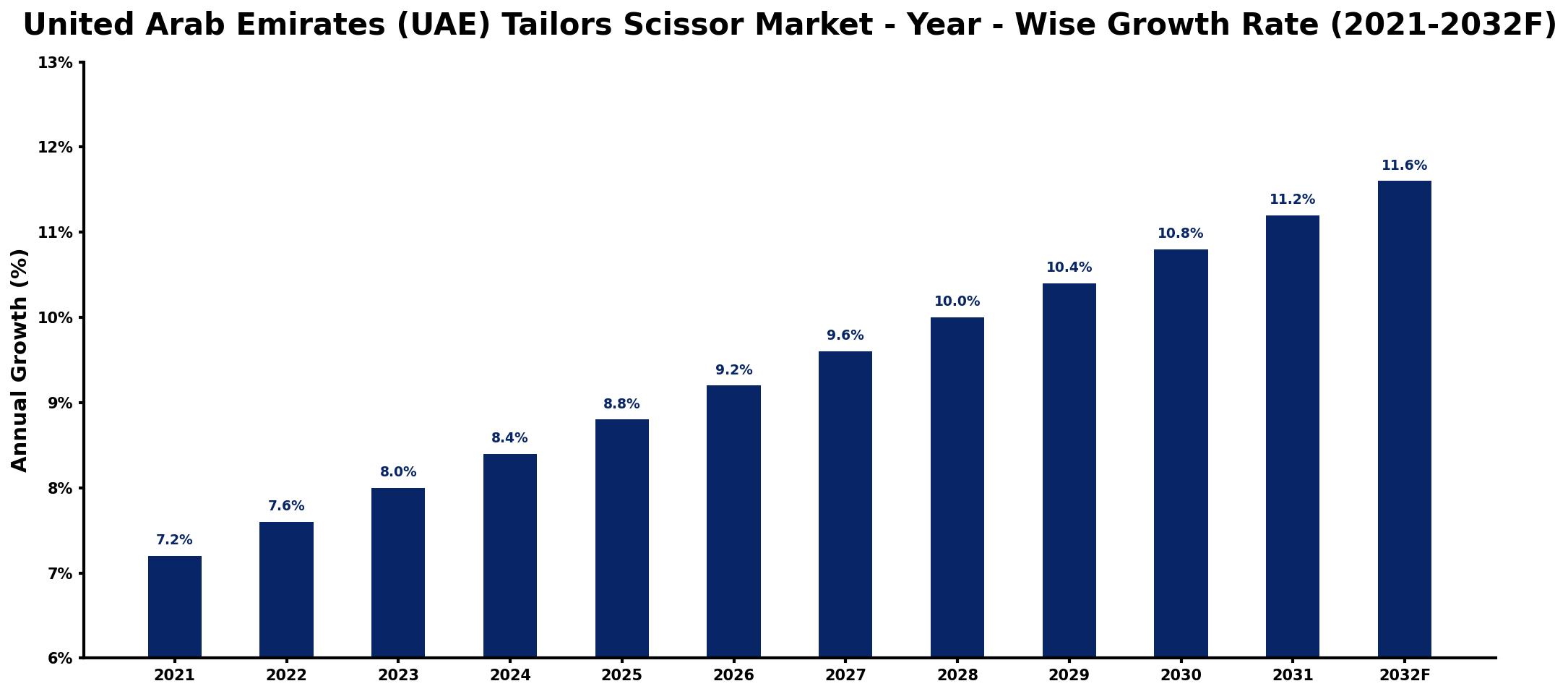
The table below presents the year‑wise growth rates along with the key drivers influencing the market
| Year | Growth Rate | Major Drivers |
| 2021 | 7.2% | Increased demand from fashion industry |
| 2022 | 7.6% | Growth in home sewing trends |
| 2023 | 8.0% | Rising interest in crafting activities |
| 2024 | 8.4% | Expansion of textile manufacturing sector |
| 2025 | 8.8% | Surge in online retail platforms |
| 2026 | 9.2% | Investment in local production facilities |
| 2027 | 9.6% | Increasing popularity of DIY projects |
| 2028 | 10.0% | rising demand from electronics |
| 2029 | 10.4% | Boost in customization service offerings |
| 2030 | 10.8% | Rise in eco-friendly product demand |
| 2031 | 11.2% | increased capital investment inflows |
| 2032 | 11.6% | Increased focus on sustainable practices |
Note: Market size estimations and growth projections presented in this report are based on 6Wresearch's proprietary forecasting methodology, utilizing the latest available industry data, government publications, and primary research inputs.
United Arab Emirates (UAE) Tailors Scissor Market Synopsis
Following a period of disruption due to the pandemic, the UAE Tailors Scissor market is positioned for robust growth, propelled by a resurgence in the fashion industry. Tailors and designers are increasingly recognizing the critical role of high-quality scissors in their craft, leading to a steady demand for durable and precise cutting tools.
Looking ahead, the market is set to evolve with trends favoring innovative design and functionality in tailoring scissors. The shift towards online tailoring services and greater reliance on digital platforms highlights the need for adaptable tools that meet contemporary demands, thereby enhancing craftsmanship while maintaining competitive pricing.
United Arab Emirates (UAE) Tailors Scissor Market Key Takeaways
- The market is poised for substantial growth, reflecting the expansion of the UAE's textile and fashion industries.
- High-quality materials and craftsmanship remain essential for maintaining competitive advantage.
- Adoption of online services has reshaped the demand landscape for tailoring equipment.
- Established international brands dominate the market, setting benchmarks for quality and innovation.
- Emerging trends favor multifunctional scissors tailored to modern design and cutting needs.
Evaluation of Restraints in United Arab Emirates (UAE) Tailors Scissor Market
While the market exhibits strong growth potential, it is not without its challenges. Sourcing high-quality materials poses a significant restraint, affecting the overall quality and durability of scissors produced in the region. Additionally, a shortage of skilled labor capable of maintaining traditional craftsmanship standards complicates production processes. Furthermore, competitive pressure from cheaper imported scissors threatens local manufacturers, prompting a need for cost-effective solutions without compromising quality.
United Arab Emirates (UAE) Tailors Scissor Market Trends
Current trends within the UAE Tailors Scissor market reveal a shift towards multifunctional designs that cater to diverse fabric types and cutting styles. As sustainability gains prominence, many manufacturers are exploring eco-friendly materials and production processes. Additionally, technological advancements are driving the development of precision tools, enhancing user experience and output quality. The rise of e-commerce in tailoring services is also reshaping consumer expectations, making it imperative for scissor manufacturers to innovate continuously.
United Arab Emirates (UAE) Tailors Scissor Market Opportunities
Significant growth opportunities exist within the UAE Tailors Scissor market, particularly in the realm of product innovation. As consumers increasingly seek tailored solutions, manufacturers can capitalize on trends by developing specialized scissors that cater to specific needs, such as fabric type or tailoring technique. The expansion of online retail channels presents an avenue for reaching a broader customer base, while partnerships with local fashion schools can cultivate brand loyalty and showcase craftsmanship to the next generation of tailors.
Government Initiatives in the United Arab Emirates (UAE) Tailors Scissor Market
The UAE government has undertaken various initiatives to promote the textile and fashion industries, which indirectly support the tailors scissor market. Public spending on infrastructure aimed at boosting manufacturing capabilities is evident, alongside incentives for businesses adopting sustainable practices. Programs designed to support local artisans and craftsmen are vital in fostering a skilled workforce, further enhancing the quality of tailoring tools available in the market.
Future Insights of the United Arab Emirates (UAE) Tailors Scissor Market
Looking forward to the period from 2026 to 2032, the UAE Tailors Scissor market is expected to thrive as the fashion industry continues to expand. Innovations in material science and ergonomic design will likely play a pivotal role in shaping future products. The increasing emphasis on customization and personalization in fashion will drive demand for high-quality tailoring tools, establishing a lucrative landscape for manufacturers willing to adapt and innovate in response to evolving consumer preferences.
United Arab Emirates (UAE) Tailors Scissor Market Latest Developments (2025 - 2026)
The UAE Tailors Scissor market has recently experienced a surge in product launches focused on enhanced functionality and design. Manufacturers are increasingly collaborating with designers to create bespoke scissors that cater to contemporary tailoring needs. Additionally, advancements in online retail platforms have made high-quality scissors more accessible to consumers, while educational workshops promote awareness of the importance of precision tools in the tailoring process.
United Arab Emirates (UAE) Tailors Scissor Market - Key Attractiveness of the Report
- 10 Years of Market Numbers
- Historical Data Starting from 2022 to 2025
- Base Year: 2025
- Forecast Data until 2032
- Key Performance Indicators Impacting the Market
- Major Upcoming Developments and Projects
Key Highlights of the Report:
- United Arab Emirates (UAE) Tailors Scissor Market Outlook
- Market Size of United Arab Emirates (UAE) Tailors Scissor Market, 2025
- Forecast of United Arab Emirates (UAE) Tailors Scissor Market, 2032
- Historical Data and Forecast of United Arab Emirates (UAE) Tailors Scissor Revenues & Volume for the Period 2022-2032F
- United Arab Emirates (UAE) Tailors Scissor Market Trend Evolution
- United Arab Emirates (UAE) Tailors Scissor Market Drivers and Challenges
- United Arab Emirates (UAE) Tailors Scissor Price Trends
- United Arab Emirates (UAE) Tailors Scissor Porter's Five Forces
- United Arab Emirates (UAE) Tailors Scissor Industry Life Cycle
- Historical Data and Forecast of United Arab Emirates (UAE) Tailors Scissor Market Revenues & Volume By Product for the Period 2022-2032F
- Historical Data and Forecast of United Arab Emirates (UAE) Tailors Scissor Market Revenues & Volume By Standard Scissors for the Period 2022-2032F
- Historical Data and Forecast of United Arab Emirates (UAE) Tailors Scissor Market Revenues & Volume By Customized Scissors for the Period 2022-2032F
- Historical Data and Forecast of United Arab Emirates (UAE) Tailors Scissor Market Revenues & Volume By Applications for the Period 2022-2032F
- Historical Data and Forecast of United Arab Emirates (UAE) Tailors Scissor Market Revenues & Volume By Household for the Period 2022-2032F
- Historical Data and Forecast of United Arab Emirates (UAE) Tailors Scissor Market Revenues & Volume By Commercial for the Period 2022-2032F
- United Arab Emirates (UAE) Tailors Scissor Import Export Trade Statistics
- Market Opportunity Assessment By Product
- Market Opportunity Assessment By Applications
- United Arab Emirates (UAE) Tailors Scissor Top Companies Market Share
- United Arab Emirates (UAE) Tailors Scissor Competitive Benchmarking By Technical and Operational Parameters
- United Arab Emirates (UAE) Tailors Scissor Company Profiles
- United Arab Emirates (UAE) Tailors Scissor Key Strategic Recommendations






































