United Arab Emirates (UAE) Textile Bags Market Size, Share & Growth Rate
The United Arab Emirates (UAE) Textile Bags Market was estimated at USD 779 Million in 2025 and is projected to reach USD 1108 Million by 2032, growing at a CAGR of 5.2% from 2026 to 2032. This robust growth trajectory is driven by the booming retail and e-commerce sectors, where sustainable and reusable packaging solutions are increasingly favored. Moreover, heightened consumer awareness regarding environmental concerns is pushing businesses to adopt textile bags as a viable alternative to traditional plastic options.
United Arab Emirates (UAE) Textile Bags Market Year-wise Growth Rate and Key Drivers
This graph highlights how the United Arab Emirates (UAE) Textile Bags Market has steadily grown over the years, supported by major growth factors.
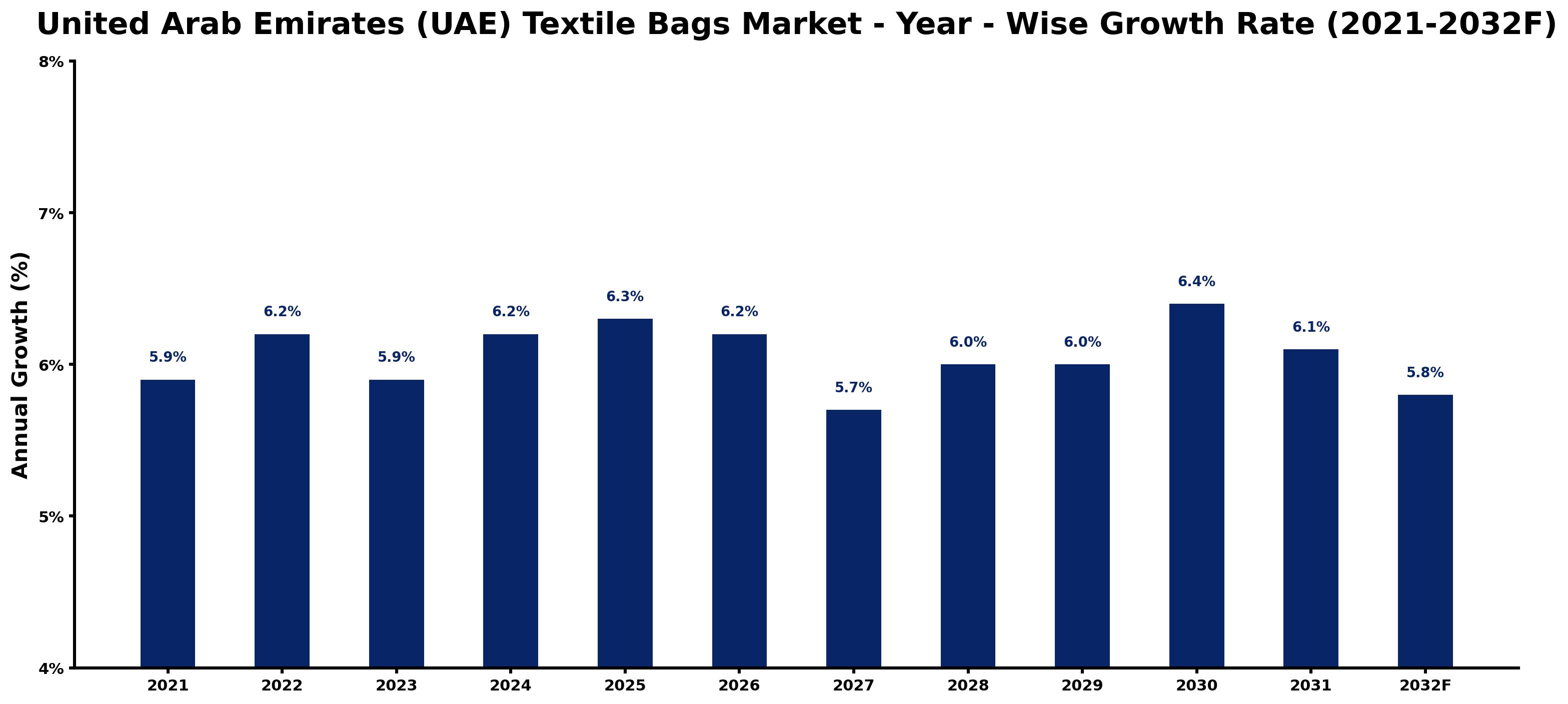
The table below presents the year‑wise growth rates along with the key drivers influencing the market
| Year | Growth Rate | Major Drivers |
| 2021 | 5.9% | Growing renewable energy integration projects |
| 2022 | 6.2% | Growing urbanization and commercial development |
| 2023 | 5.9% | Increasing industrial infrastructure investments |
| 2024 | 6.2% | Government infrastructure modernization initiatives |
| 2025 | 6.3% | Increasing adoption of advanced technologies |
| 2026 | 6.2% | Increasing adoption of advanced technologies |
| 2027 | 5.7% | Expansion of transportation and logistics networks |
| 2028 | 6.0% | Increasing adoption of advanced technologies |
| 2029 | 6.0% | Growing urbanization and commercial development |
| 2030 | 6.4% | Expansion of transportation and logistics networks |
| 2031 | 6.1% | Rising electricity demand across industries |
| 2032 | 5.8% | Expansion of manufacturing activities |
Note - Market size estimations and growth projections presented in this report are based on 6Wresearch’s advanced forecasting approach, validated with industry datasets as of June 2026.
United Arab Emirates (UAE) Textile Bags Market Synopsis
The UAE textile bags market is witnessing a surge in demand as both consumers and businesses shift towards eco-friendly practices. This trend is significantly influenced by government regulations aimed at reducing plastic waste and encouraging sustainable consumption. As a result, textile bags made from natural fibers like jute and cotton are gaining traction in various industries, including retail and hospitality.
Additionally, the customization of textile bags for branding purposes is becoming increasingly popular among businesses looking to enhance their visibility. As more companies recognize the marketing potential of reusable bags, the market is set to evolve, catering to a diverse array of consumer preferences and business needs.
United Arab Emirates (UAE) Textile Bags Market Key Takeaways
- The market is driven by a shift toward sustainable packaging solutions in retail and e-commerce.
- Growing awareness of environmental issues is propelling the demand for textile bags.
- Customization and branding opportunities are becoming key factors for business adoption.
- Government initiatives promoting eco-friendly products are fostering market growth.
- Technological advancements in textile production are enhancing product quality and durability.
Evaluation of Restraints in United Arab Emirates (UAE) Textile Bags Market
Despite the positive growth outlook, the UAE textile bags market contends with several challenges. Competing packaging materials, such as biodegradable plastics and paper bags, present alternatives that appeal to cost-sensitive consumers. In addition, fluctuations in raw material prices may affect production costs, making it imperative for market players to strategically position their products by emphasizing the long-term benefits of reusable textile bags over disposable options. This distinction will be crucial in overcoming the appeal of lower-cost disposable packaging solutions.
United Arab Emirates (UAE) Textile Bags Market Trends
Several trends are shaping the textile bags market in the UAE. One prominent trend is the growing popularity of organic and recycled materials in manufacturing textile bags, which appeals to environmentally conscious consumers. Another significant trend is the increasing use of digital printing technologies that allow for more intricate designs and quicker turnaround times for custom orders. Moreover, the integration of smart features, such as QR codes and NFC chips, is beginning to enhance user engagement and traceability in branding efforts.
United Arab Emirates (UAE) Textile Bags Market Opportunities
The market presents multiple avenues for growth, particularly in the realm of product innovation. Companies can explore creating multifunctional textile bags tailored for specific industries, such as food delivery or event merchandising. Furthermore, partnerships with local businesses and retailers for exclusive product lines could catalyze market penetration. As consumer preferences continue to evolve, opportunities for customization and co-branding strategies will also expand, allowing businesses to differentiate themselves in a crowded marketplace.
Government Initiatives in the United Arab Emirates (UAE) Textile Bags Market
The UAE government is actively promoting initiatives aimed at reducing plastic consumption and enhancing sustainability. Policies that advocate for the use of eco-friendly materials in packaging are being implemented to support the textile bags market. Additionally, public awareness campaigns are encouraging citizens and businesses alike to adopt reusable products. Such efforts are not only aimed at preserving the environment but also aligning with the broader vision of sustainable development in the UAE.
Future Insights of the United Arab Emirates (UAE) Textile Bags Market
Looking ahead to 2026-2032, the UAE textile bags market is poised for substantial growth, driven by ongoing environmental policies and consumer preferences for sustainability. The increasing adoption of textile bags in both online and offline retail formats will enhance market penetration. As technological advancements continue to shape production capabilities, we anticipate an influx of innovative products that cater to the specific needs of various sectors, ensuring a competitive landscape. Businesses that align with these evolving trends will likely thrive in this expanding market.
United Arab Emirates (UAE) Textile Bags Market Latest Developments (May 2025 - June 2026)
In the most recent period, there has been a marked increase in collaborative efforts between manufacturers and retailers to promote eco-friendly textile bags. Additionally, innovations in materials and design have been on the rise, catering to diverse consumer preferences. Market players are also focusing on enhancing their online presence as e-commerce continues to grow, enabling them to reach broader audiences. These developments suggest a dynamic shift in how textile bags are perceived and utilized across different sectors.
United Arab Emirates (UAE) Textile Bags Market - Key Attractiveness of the Report
- 10 Years of Market Numbers
- Historical Data Starting from 2022 to 2025
- Base Year: 2025
- Forecast Data until 2032
- Key Performance Indicators Impacting the Market
- Major Upcoming Developments and Projects
Key Highlights of the Report:
- United Arab Emirates (UAE) Textile Bags Market Outlook
- Market Size of United Arab Emirates (UAE) Textile Bags Market, 2025
- Forecast of United Arab Emirates (UAE) Textile Bags Market, 2032
- Historical Data and Forecast of United Arab Emirates (UAE) Textile Bags Revenues & Volume for the Period 2022-2032F
- United Arab Emirates (UAE) Textile Bags Market Trend Evolution
- United Arab Emirates (UAE) Textile Bags Market Drivers and Challenges
- United Arab Emirates (UAE) Textile Bags Price Trends
- United Arab Emirates (UAE) Textile Bags Porter's Five Forces
- United Arab Emirates (UAE) Textile Bags Industry Life Cycle
- Historical Data and Forecast of United Arab Emirates (UAE) Textile Bags Market Revenues & Volume By Size for the Period 2022-2032F
- Historical Data and Forecast of United Arab Emirates (UAE) Textile Bags Market Revenues & Volume By Less than 14" x 26" for the Period 2022-2032F
- Historical Data and Forecast of United Arab Emirates (UAE) Textile Bags Market Revenues & Volume By 18" x 30" for the Period 2022-2032F
- Historical Data and Forecast of United Arab Emirates (UAE) Textile Bags Market Revenues & Volume By 22" x 36" for the Period 2022-2032F
- Historical Data and Forecast of United Arab Emirates (UAE) Textile Bags Market Revenues & Volume By 22" x 40" for the Period 2022-2032F
- Historical Data and Forecast of United Arab Emirates (UAE) Textile Bags Market Revenues & Volume By Above 28" x 40" for the Period 2022-2032F
- Historical Data and Forecast of United Arab Emirates (UAE) Textile Bags Market Revenues & Volume By Material Type for the Period 2022-2032F
- Historical Data and Forecast of United Arab Emirates (UAE) Textile Bags Market Revenues & Volume By Cotton for the Period 2022-2032F
- Historical Data and Forecast of United Arab Emirates (UAE) Textile Bags Market Revenues & Volume By Burlap for the Period 2022-2032F
- Historical Data and Forecast of United Arab Emirates (UAE) Textile Bags Market Revenues & Volume By Others for the Period 2022-2032F
- Historical Data and Forecast of United Arab Emirates (UAE) Textile Bags Market Revenues & Volume By Sales Channel for the Period 2022-2032F
- Historical Data and Forecast of United Arab Emirates (UAE) Textile Bags Market Revenues & Volume By Retailers for the Period 2022-2032F
- Historical Data and Forecast of United Arab Emirates (UAE) Textile Bags Market Revenues & Volume By Wholesalers for the Period 2022-2032F
- Historical Data and Forecast of United Arab Emirates (UAE) Textile Bags Market Revenues & Volume By E-commerce for the Period 2022-2032F
- United Arab Emirates (UAE) Textile Bags Import Export Trade Statistics
- Market Opportunity Assessment By Size
- Market Opportunity Assessment By Material Type
- Market Opportunity Assessment By Sales Channel
- United Arab Emirates (UAE) Textile Bags Top Companies Market Share
- United Arab Emirates (UAE) Textile Bags Competitive Benchmarking By Technical and Operational Parameters
- United Arab Emirates (UAE) Textile Bags Company Profiles
- United Arab Emirates (UAE) Textile Bags Key Strategic Recommendations






































