United Arab Emirates (UAE) Textile Market Summary
The united arab emirates (uae) textile market was estimated at USD 442 Million in 2025 and is projected to reach USD 610 Million by 2032, growing at a CAGR of 5.3% from 2026 to 2032.
United Arab Emirates (UAE) Textile Market Year-wise Growth Rate and Key Drivers
This graph highlights how the United Arab Emirates (UAE) Textile Market has steadily grown over the past five years, supported by major growth factors.
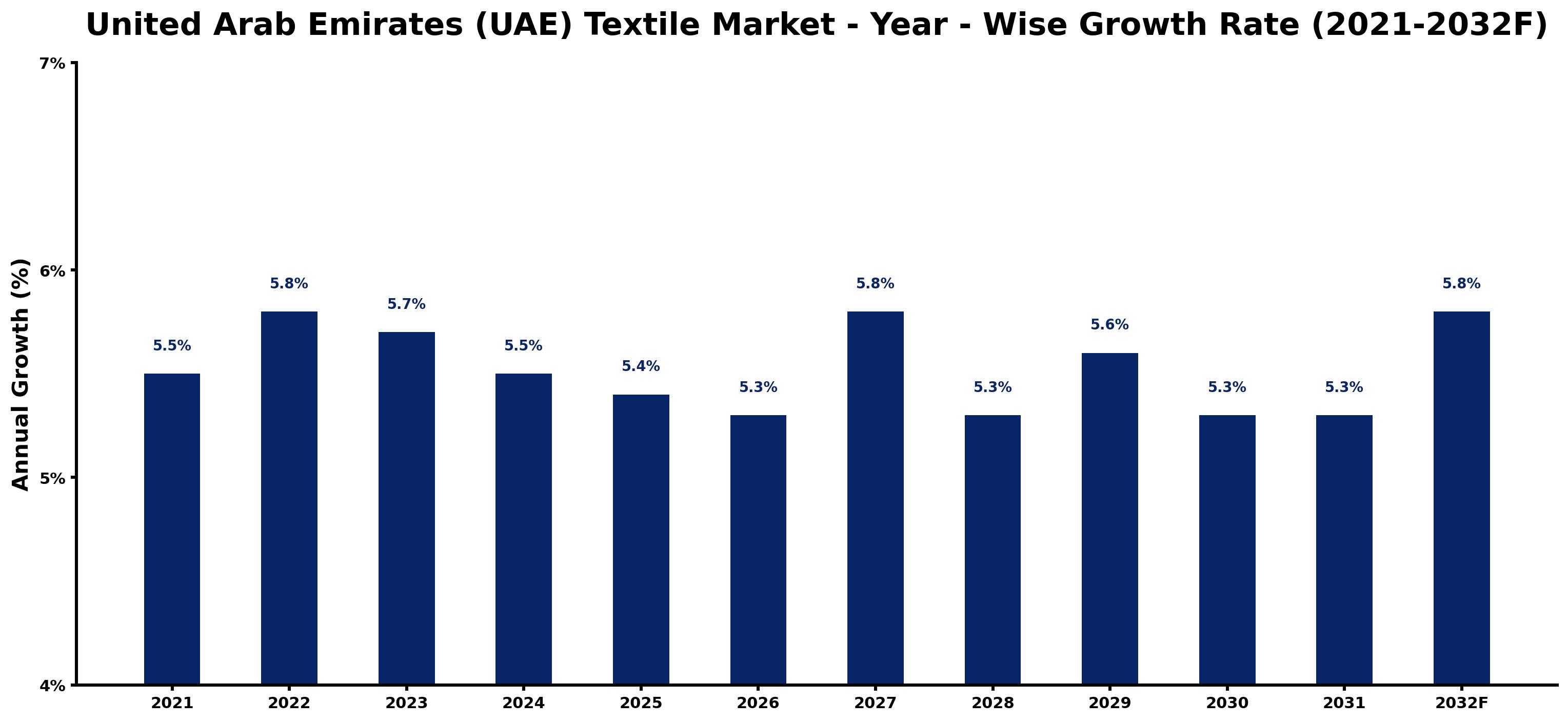
The table below presents the year wise growth rates along with the key drivers influencing the market
| Year | Growth Rate | Major Drivers |
| 2021 | 5.5% | Post-lockdown retail projects revitalized consumer interest in local textile brands. |
| 2022 | 5.8% | Emerging e-commerce platforms transformed traditional shopping habits across the UAE. |
| 2023 | 5.7% | Sustainability trends pushed brands to adopt eco-friendly textile production methods. |
| 2024 | 5.5% | UAE's Expo showcased cultural textiles, enhancing global awareness and demand. |
| 2025 | 5.4% | Luxury fashion collaborations highlighted local artisans, attracting affluent consumers' attention. |
| 2026 | 5.3% | Increased tourism from global events spurred demand for traditional and contemporary textiles. |
| 2027 | 5.8% | Regional collaborations boosted market access for UAE textile manufacturers and designers. |
| 2028 | 5.3% | Urbanization trends led to significant investments in textile retail infrastructure projects. |
| 2029 | 5.6% | Technological innovations in fabric printing improved production efficiencies and customization. |
| 2030 | 5.3% | Local manufacturing initiatives reduced reliance on imported textiles, enhancing sustainability. |
| 2031 | 5.3% | Cultural festivals promoted heritage textiles, encouraging consumer engagement and interest. |
| 2032 | 5.8% | Diverse demographic shifts necessitated adaptive strategies for textile market offerings. |
Note - Market size estimations and growth projections presented in this report are based on 6Wresearch's advanced forecasting approach, validated with industry datasets as of June 2026.
United Arab Emirates (UAE) Textile Market Synopsis
The United Arab Emirates (UAE) Textile Market is projected to reach 5.3% and witness significant growth during the forecast period (2026-2032). This sector is a crucial element of the Emirati economy, encompassing a diverse range of products, such as apparel, home textiles, technical textiles, and fabrics utilized across various applications. The UAE textile industry's evolution is intrinsically linked to its robust retail and fashion sectors, catering to an expansive market driven by both local and international demands.
United Arab Emirates (UAE) Textile Market Growth Drivers
The growth trajectory of the UAE textile market is influenced by several pivotal factors:
- The diverse consumer base in the UAE, which includes a significant expatriate population, fosters a broad demand for various types of textiles and apparel, reflecting diverse cultural preferences.
- The prominence of the UAE as a global fashion and luxury hub has augmented the demand for high-quality textiles and designer apparel, attracting both international brands and local innovations.
- Government initiatives aimed at bolstering the textile and fashion sectors have catalyzed growth, particularly through high-profile events like Dubai Fashion Week, enhancing exposure for local talent and products.
- The expansion of e-commerce platforms and online retailing has revolutionized shopping habits, allowing consumers to access a wider range of textile products effortlessly, thus driving market sales.
- Emerging trends in sustainable textiles and eco-conscious consumer behavior are pushing manufacturers towards innovative and environmentally friendly textile solutions, opening avenues for growth in future markets.
United Arab Emirates (UAE) Textile Market Challenges and Restraints
Notwithstanding the promising growth prospects, the UAE textile market contends with several challenges:
- Intense competition from global textile manufacturing countries presents challenges as these regions offer lower production costs and larger production capacities, affecting local market positioning.
- Sustainability issues, including the sector's environmental impact on water usage and waste generation, necessitate a shift toward more responsible manufacturing practices to align with global standards.
- The fluctuating prices of raw materials can create uncertainties in production costs, thus impacting pricing strategies and profitability for local textile manufacturers.
- Market saturation in certain segments may limit growth opportunities for traditional textile brands, compelling them to innovate and diversify their product offerings to remain competitive.
- Regulatory hurdles and compliance with international standards can impose additional costs on manufacturers, complicating market entry and expansion strategies for new entrants.
United Arab Emirates (UAE) Textile Market Government Investment and Initiatives
The UAE government plays a crucial role in the development of the textile market through various investments and initiatives aimed at fostering growth:
- Public spending directed toward infrastructure development, such as transportation and logistics, supports the efficient movement of textile products, enhancing competitiveness in the global market.
- Supportive policies encouraging local manufacturing and product innovation have been implemented, aimed at reducing dependency on imports and promoting homegrown brands.
- Investment in research and development is encouraged, particularly in the realm of sustainable textiles, aligning the industry with global sustainability trends and consumer demand.
- Events and exhibitions sponsored by the government provide platforms for showcasing local talent and products, thereby enhancing visibility and attracting interest from both domestic and international markets.
- Fostering partnerships between the public and private sectors has resulted in collaborative projects that aim to elevate the standard of textile production and increase market accessibility for local manufacturers.
United Arab Emirates (UAE) Textile Market Latest Developments (May 2025 - June 2026)
During the recent period from May 2025 to June 2026, the UAE textile market has witnessed several noteworthy developments:
- There has been a marked increase in the establishment of online retail platforms, reflecting a consumer shift towards e-commerce as a primary shopping channel for textile products.
- Local manufacturers have begun adopting advanced technologies in textile production, including automation and artificial intelligence, resulting in improved efficiency and reduced production times.
- The sustainability focus has intensified, with numerous textile companies implementing eco-friendly practices in their production processes, contributing to a greener industry outlook.
- Collaborations between educational institutions and textile firms have emerged, aiming to bridge the skill gap and foster innovation in textile design and manufacturing methodologies.
- The participation of UAE brands in international trade fairs has increased, setting the stage for potential exports and enhancing the country's reputation as a leading textile hub.
United Arab Emirates (UAE) Textile Market - Key Attractiveness of the Report
- 10 Years of Market Numbers
- Historical Data Starting from 2022 to 2025
- Base Year: 2025
- Forecast Data until 2032
- Key Performance Indicators Impacting the Market
- Major Upcoming Developments and Projects
Key Highlights of the Report:
- United Arab Emirates (UAE) Textile Market Outlook
- Market Size of United Arab Emirates (UAE) Textile Market, 2025
- Forecast of United Arab Emirates (UAE) Textile Market, 2032
- Historical Data and Forecast of United Arab Emirates (UAE) Textile Revenues & Volume for the Period 2022-2032F
- United Arab Emirates (UAE) Textile Market Trend Evolution
- United Arab Emirates (UAE) Textile Market Drivers and Challenges
- United Arab Emirates (UAE) Textile Price Trends
- United Arab Emirates (UAE) Textile Porter's Five Forces
- United Arab Emirates (UAE) Textile Industry Life Cycle
- Historical Data and Forecast of United Arab Emirates (UAE) Textile Market Revenues & Volume By Raw Material Types for the Period 2022-2032F
- Historical Data and Forecast of United Arab Emirates (UAE) Textile Market Revenues & Volume By Cotton for the Period 2022-2032F
- Historical Data and Forecast of United Arab Emirates (UAE) Textile Market Revenues & Volume By Chemical for the Period 2022-2032F
- Historical Data and Forecast of United Arab Emirates (UAE) Textile Market Revenues & Volume By Wool for the Period 2022-2032F
- Historical Data and Forecast of United Arab Emirates (UAE) Textile Market Revenues & Volume By Silk for the Period 2022-2032F
- Historical Data and Forecast of United Arab Emirates (UAE) Textile Market Revenues & Volume By Others for the Period 2022-2032F
- Historical Data and Forecast of United Arab Emirates (UAE) Textile Market Revenues & Volume By Product Types for the Period 2022-2032F
- Historical Data and Forecast of United Arab Emirates (UAE) Textile Market Revenues & Volume By Natural Fibers for the Period 2022-2032F
- Historical Data and Forecast of United Arab Emirates (UAE) Textile Market Revenues & Volume By Polyesters for the Period 2022-2032F
- Historical Data and Forecast of United Arab Emirates (UAE) Textile Market Revenues & Volume By Nylon for the Period 2022-2032F
- Historical Data and Forecast of United Arab Emirates (UAE) Textile Market Revenues & Volume By Others for the Period 2022-2032F
- Historical Data and Forecast of United Arab Emirates (UAE) Textile Market Revenues & Volume By Applications for the Period 2022-2032F
- Historical Data and Forecast of United Arab Emirates (UAE) Textile Market Revenues & Volume By Household for the Period 2022-2032F
- Historical Data and Forecast of United Arab Emirates (UAE) Textile Market Revenues & Volume By Technical for the Period 2022-2032F
- Historical Data and Forecast of United Arab Emirates (UAE) Textile Market Revenues & Volume By Fashion & Clothing for the Period 2022-2032F
- Historical Data and Forecast of United Arab Emirates (UAE) Textile Market Revenues & Volume By Others for the Period 2022-2032F
- United Arab Emirates (UAE) Textile Import Export Trade Statistics
- Market Opportunity Assessment By Raw Material Types
- Market Opportunity Assessment By Product Types
- Market Opportunity Assessment By Applications
- United Arab Emirates (UAE) Textile Top Companies Market Share
- United Arab Emirates (UAE) Textile Competitive Benchmarking By Technical and Operational Parameters
- United Arab Emirates (UAE) Textile Company Profiles
- United Arab Emirates (UAE) Textile Key Strategic Recommendations






































