United Arab Emirates (UAE) Thermostats Market Summary
The united arab emirates (uae) thermostats market was estimated at USD 1165 Million in 2025 and is projected to reach USD 1665 Million by 2032, growing at a CAGR of 6.2% from 2026 to 2032.
United Arab Emirates (UAE) Thermostats Market Year-wise Growth Rate and Key Drivers
This graph highlights how the United Arab Emirates (UAE) Thermostats Market has steadily grown over the past five years, supported by major growth factors.
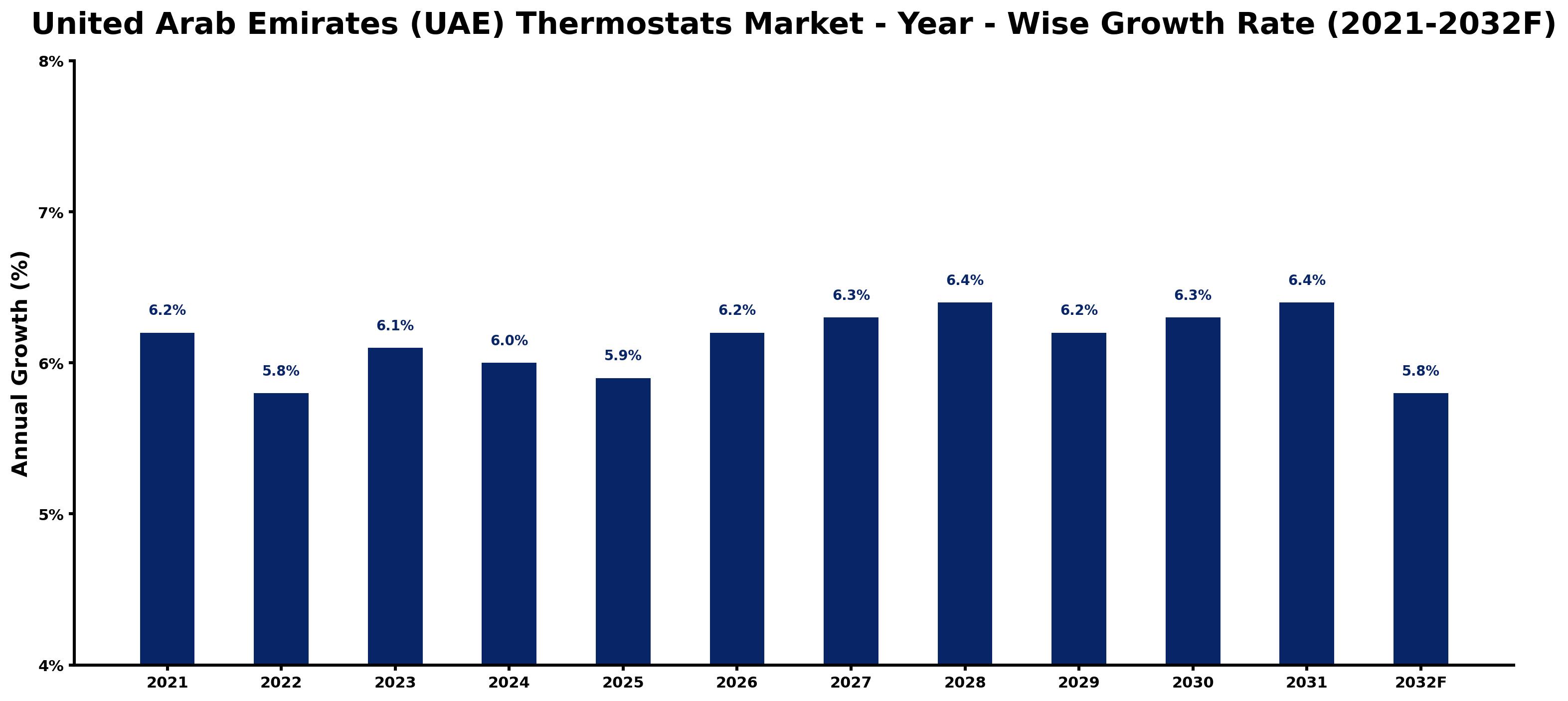
The table below presents the year wise growth rates along with the key drivers influencing the market
| Year | Growth Rate | Major Drivers |
| 2021 | 6.2% | Post-lockdown retail projects emphasized smart home technology integration in UAE households. |
| 2022 | 5.8% | Rising property developments in Dubai sparked interest in high-tech thermostat solutions. |
| 2023 | 6.1% | Hot climate conditions underscored the necessity for energy-efficient cooling systems. |
| 2024 | 6.0% | Smart building trends drove interest in IoT-connected thermostats across commercial spaces. |
| 2025 | 5.9% | Sustainability goals pushed businesses to upgrade to smart energy management systems. |
| 2026 | 6.2% | Increased focus on wellness in homes encouraged the use of climate control technologies. |
| 2027 | 6.3% | The construction boom in Abu Dhabi led to heightened thermostat market investments. |
| 2028 | 6.4% | Smart city projects in the GCC region fostered demand for advanced HVAC technology. |
| 2029 | 6.2% | Consumer preference shifted towards home automation, influencing thermostat purchase decisions. |
| 2030 | 6.3% | Corporate energy efficiency mandates pressured companies to enhance thermal management solutions. |
| 2031 | 6.4% | Long-term climate goals necessitated innovative thermostat capabilities for reduced energy consumption. |
| 2032 | 5.8% | Technological collaborations among HVAC companies fueled a competitive thermostat market landscape. |
Note - Market size estimations and growth projections presented in this report are based on 6Wresearch's advanced forecasting approach, validated with industry datasets as of June 2026.
United Arab Emirates (UAE) Thermostats Market Synopsis
The United Arab Emirates (UAE) Thermostats Market is projected to reach 6.2% and witness significant growth during the forecast period (2026-2032). This market encapsulates the manufacturing, distribution, and sale of various thermostat types that are integral to heating, ventilation, and air conditioning (HVAC) systems within the UAE. Thermostats play a crucial role in regulating indoor temperatures, ensuring energy efficiency and comfort in residential, commercial, and industrial environments.
United Arab Emirates (UAE) Thermostats Market Growth Drivers
Numerous factors contribute to the expansion of the UAE thermostats market:
- The UAE has witnessed substantial infrastructural advancements and real estate development, prompting a surge in HVAC system installations, which inherently increases the demand for thermostats.
- The integration of smart home technologies has gained traction within the UAE, propelled by rising disposable incomes and a consumer preference for modern conveniences. This trend has led to an increased adoption of smart thermostats that can be remotely controlled via mobile applications.
- Government initiatives focusing on energy efficiency have catalyzed the demand for advanced thermostats designed to minimize energy consumption and reduce carbon footprints, aligning with national sustainability goals.
- With the regional climate characterized by high temperatures, the necessity for effective temperature regulation systems has further fueled the market for HVAC systems and their critical components, including thermostats.
- The growing emphasis on comfort and energy management in both residential and commercial sectors is reinforcing the market's demand dynamics, encouraging investment in innovative solutions.
United Arab Emirates (UAE) Thermostats Market Challenges and Restraints
Despite the promising growth trajectory, the UAE thermostats market grapples with several challenges:
- Traditional thermostats still maintain a strong foothold in the market due to their affordability and simplicity, making it challenging to persuade consumers to transition to higher-cost smart alternatives.
- The economic landscape is unpredictable, influenced by global trends and regional variables, which can impact consumer spending behaviors and affect overall thermostat demand.
- Supply chain disruptions, particularly those seen during the Covid-19 pandemic, have underscored vulnerabilities in the market, potentially resulting in fluctuating product availability.
- Consumer awareness and understanding of smart thermostat technologies may vary, posing a barrier to widespread adoption as potential users might lack familiarity with the benefits and functionalities of these products.
- Potential technological obsolescence presents a risk in a rapidly evolving market, where manufacturers must continuously innovate to keep pace with emerging trends and consumer expectations.
United Arab Emirates (UAE) Thermostats Market Government Investment and Initiatives
The UAE government has initiated a series of policies and investment strategies to enhance energy efficiency in the country, which directly impacts the thermostats market:
- National strategies focusing on sustainable development have spurred public spending on infrastructure, thereby increasing the installation of HVAC systems that require advanced thermostatic control.
- Government incentives for adopting smart technologies in both residential and commercial properties have created a favorable environment for the proliferation of smart thermostats.
- Regulatory frameworks promoting energy efficiency standards across buildings necessitate the installation of compliant thermostat systems, which further drives market demand.
- Investment in research and development by public and private entities is promoting innovation, leading to the introduction of more efficient, user-friendly thermostat technologies.
- Public awareness campaigns aimed at educating consumers about energy savings associated with modern thermostatic solutions have bolstered market interest and adoption.
United Arab Emirates (UAE) Thermostats Market Latest Developments (May 2025 - June 2026)
The period from May 2025 to June 2026 has seen noteworthy advancements in the UAE thermostats market:
- A marked increase in the introduction of IoT-enabled thermostats has occurred, reflecting a consumer trend toward smart home integration and energy management systems.
- Partnerships between technology firms and HVAC manufacturers have become more prevalent, aimed at developing advanced thermostat solutions that enhance user experience and energy efficiency.
- Prominent industry exhibitions and trade shows have highlighted innovative thermostat technologies, showcasing an increasing interest in sustainable and smart home solutions among consumers and businesses alike.
- Regulatory adaptations have been made to accommodate the growing demand for energy-efficient products, ensuring that new thermostat technologies meet stringent government standards.
- The growing focus on sustainability has led to enhanced marketing efforts aimed at educating both consumers and contractors about the benefits of switching to modern thermostatic solutions.
United Arab Emirates (UAE) Thermostats Market - Key Attractiveness of the Report
- 10 Years of Market Numbers
- Historical Data Starting from 2022 to 2025
- Base Year: 2025
- Forecast Data until 2032
- Key Performance Indicators Impacting the Market
- Major Upcoming Developments and Projects
Key Highlights of the Report:
- United Arab Emirates (UAE) Thermostats Market Outlook
- Market Size of United Arab Emirates (UAE) Thermostats Market, 2025
- Forecast of United Arab Emirates (UAE) Thermostats Market, 2032
- Historical Data and Forecast of United Arab Emirates (UAE) Thermostats Revenues & Volume for the Period 2022-2032F
- United Arab Emirates (UAE) Thermostats Market Trend Evolution
- United Arab Emirates (UAE) Thermostats Market Drivers and Challenges
- United Arab Emirates (UAE) Thermostats Price Trends
- United Arab Emirates (UAE) Thermostats Porter's Five Forces
- United Arab Emirates (UAE) Thermostats Industry Life Cycle
- Historical Data and Forecast of United Arab Emirates (UAE) Thermostats Market Revenues & Volume By Products for the Period 2022-2032F
- Historical Data and Forecast of United Arab Emirates (UAE) Thermostats Market Revenues & Volume By Smart Thermostat for the Period 2022-2032F
- Historical Data and Forecast of United Arab Emirates (UAE) Thermostats Market Revenues & Volume By Mechanical Thermostat for the Period 2022-2032F
- Historical Data and Forecast of United Arab Emirates (UAE) Thermostats Market Revenues & Volume By Programmable Thermostat for the Period 2022-2032F
- Historical Data and Forecast of United Arab Emirates (UAE) Thermostats Market Revenues & Volume By Distribution Channel for the Period 2022-2032F
- Historical Data and Forecast of United Arab Emirates (UAE) Thermostats Market Revenues & Volume By Utility for the Period 2022-2032F
- Historical Data and Forecast of United Arab Emirates (UAE) Thermostats Market Revenues & Volume By Retail for the Period 2022-2032F
- Historical Data and Forecast of United Arab Emirates (UAE) Thermostats Market Revenues & Volume By Security for the Period 2022-2032F
- Historical Data and Forecast of United Arab Emirates (UAE) Thermostats Market Revenues & Volume By HVAC for the Period 2022-2032F
- Historical Data and Forecast of United Arab Emirates (UAE) Thermostats Market Revenues & Volume By Mode of Operations for the Period 2022-2032F
- Historical Data and Forecast of United Arab Emirates (UAE) Thermostats Market Revenues & Volume By Line Voltage for the Period 2022-2032F
- Historical Data and Forecast of United Arab Emirates (UAE) Thermostats Market Revenues & Volume By Low Voltage for the Period 2022-2032F
- Historical Data and Forecast of United Arab Emirates (UAE) Thermostats Market Revenues & Volume By Millivolt for the Period 2022-2032F
- Historical Data and Forecast of United Arab Emirates (UAE) Thermostats Market Revenues & Volume By Applications for the Period 2022-2032F
- Historical Data and Forecast of United Arab Emirates (UAE) Thermostats Market Revenues & Volume By Residential for the Period 2022-2032F
- Historical Data and Forecast of United Arab Emirates (UAE) Thermostats Market Revenues & Volume By Commercial for the Period 2022-2032F
- United Arab Emirates (UAE) Thermostats Import Export Trade Statistics
- Market Opportunity Assessment By Products
- Market Opportunity Assessment By Distribution Channel
- Market Opportunity Assessment By Mode of Operations
- Market Opportunity Assessment By Applications
- United Arab Emirates (UAE) Thermostats Top Companies Market Share
- United Arab Emirates (UAE) Thermostats Competitive Benchmarking By Technical and Operational Parameters
- United Arab Emirates (UAE) Thermostats Company Profiles
- United Arab Emirates (UAE) Thermostats Key Strategic Recommendations






































