United Arab Emirates (UAE) Traditional Leather Market Size, Share & Growth Rate
The United Arab Emirates (UAE) Traditional Leather Market was estimated at USD 935 Million in 2025 and is projected to reach USD 1330 Million by 2032, growing at a CAGR of 5.2% from 2026 to 2032. This growth trajectory is fueled by the enduring appeal of authentic craftsmanship and the cultural significance of traditional leather goods. As UAE emerges as a global luxury shopping destination, the demand for premium-quality, handmade leather products continues to strengthen.
United Arab Emirates (UAE) Traditional Leather Market Year-wise Growth Rate and Key Drivers
This graph highlights how the United Arab Emirates (UAE) Traditional Leather Market has steadily grown over the years, supported by major growth factors.
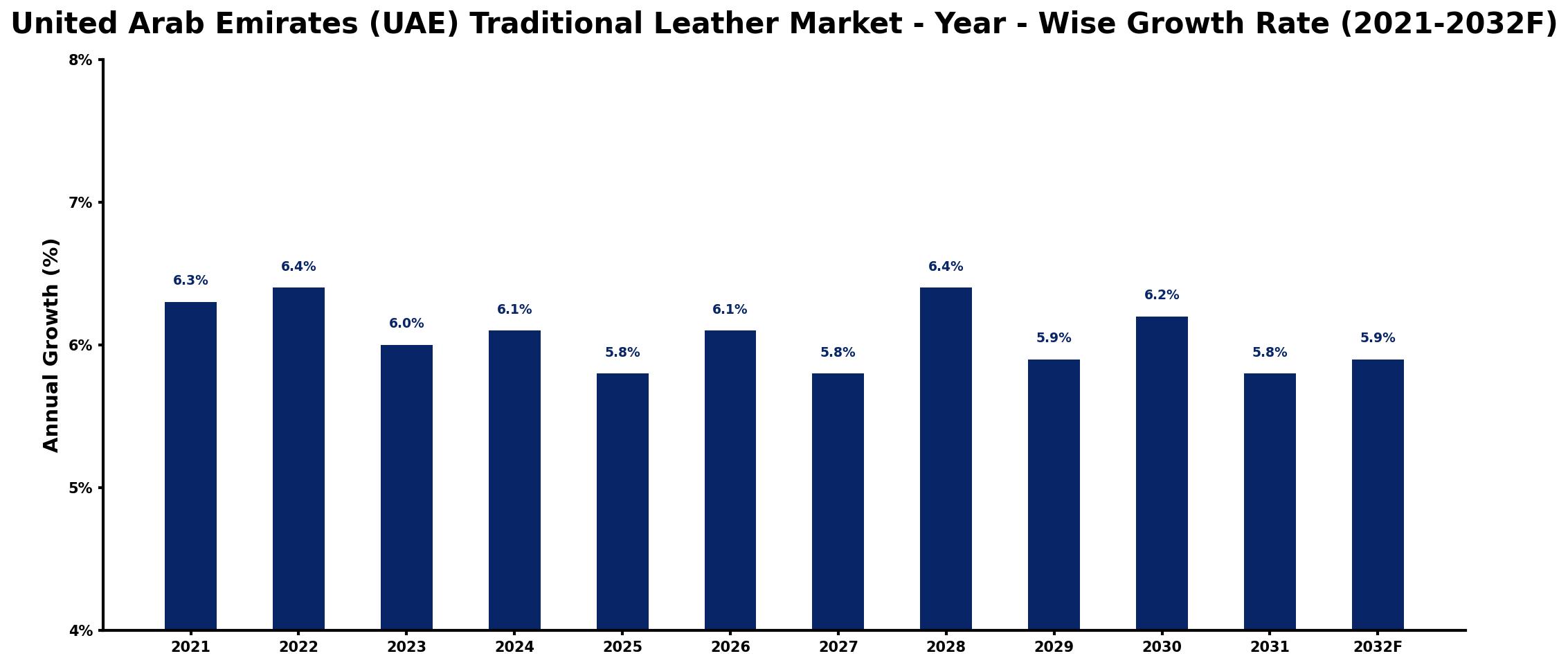
The table below presents the year‑wise growth rates along with the key drivers influencing the market
| Year | Growth Rate | Major Drivers |
| 2021 | 6.3% | Rising consumer spending on fashion |
| 2022 | 6.4% | Increased tourism driving sales |
| 2023 | 6.0% | Growing online retail platforms |
| 2024 | 6.1% | Expansion of luxury brands presence |
| 2025 | 5.8% | Emerging markets seeking quality products |
| 2026 | 6.1% | Sustainability trends influencing purchases |
| 2027 | 5.8% | Collaborations with local artisans |
| 2028 | 6.4% | Cultural events boosting product visibility |
| 2029 | 5.9% | Investment in innovative manufacturing techniques |
| 2030 | 6.2% | Enhanced distribution channels for products |
| 2031 | 5.8% | E-commerce growth accelerating market reach |
| 2032 | 5.9% | Focus on customization and personalization |
Note: Market size estimations and growth projections presented in this report are based on 6Wresearch's proprietary forecasting methodology, utilizing the latest available industry data, government publications, and primary research inputs.
United Arab Emirates (UAE) Traditional Leather Market Synopsis
The strongest force shaping the UAE Traditional Leather Market right now is the rich cultural heritage that underpins craftsmanship in the region. Traditional leather products resonate with consumers' desires for authenticity and connection to the past, fostering a unique appreciation for artisanal goods that modern alternatives cannot replicate.
Artisans and small workshops play a pivotal role in this landscape, creating distinctive leather products that include belts, wallets, and shoes. Despite challenges such as competition from synthetic materials and the risks posed by rapid modernization, the market demonstrates remarkable resilience, driven by both local pride and international interest in heritage craftsmanship.
United Arab Emirates (UAE) Traditional Leather Market Key Takeaways
- The market thrives on a blend of cultural significance and premium craftsmanship.
- Demand is increasingly influenced by the luxury shopping experience in the UAE.
- E-commerce and digital platforms have become vital for artisans post-COVID-19.
- Preserving traditional skills and high-quality raw materials is essential for growth.
- Increasing interest in handmade products supports niche market expansion.
Evaluation of Restraints in United Arab Emirates (UAE) Traditional Leather Market
The UAE Traditional Leather Market faces notable restraints that could impede its growth. A primary concern is the preservation of traditional craftsmanship, which is threatened by modernization and the rise of automated production methods. This shift not only affects the livelihoods of skilled artisans but also raises questions about the authenticity and quality of traditional products. Additionally, fluctuating consumer preferences, particularly the growing inclination toward synthetic alternatives, pose a challenge for maintaining market demand for traditional leather goods. Ensuring a steady supply of high-quality raw materials is crucial, as any disruption could further limit production capabilities.
United Arab Emirates (UAE) Traditional Leather Market Trends
Several trends are currently shaping the UAE Traditional Leather Market. Firstly, the integration of digital platforms is redefining how artisans market their products, allowing them to reach a broader audience and adapt to changing consumer behaviors. Sustainability is also becoming a focal point, as consumers increasingly seek eco-friendly production methods and materials. Furthermore, collaborations between artisans and contemporary designers are merging traditional skills with modern aesthetics, appealing to both local and international buyers. This evolution reinforces the unique position of traditional leather within the broader luxury market.
United Arab Emirates (UAE) Traditional Leather Market Opportunities
The future of the UAE Traditional Leather Market holds significant growth and investment opportunities. As global interest in sustainability rises, there is a chance for artisans to innovate by incorporating eco-friendly practices and materials in their production processes. Additionally, expanding e-commerce capabilities present a valuable pathway for artisans to penetrate new markets and increase sales. Collaborations with luxury brands or participation in international trade fairs could further enhance visibility and attract affluent consumers. The continued rise of experiential retail also offers artisans a platform to showcase their skills and create a unique shopping experience.
Government Initiatives in the United Arab Emirates (UAE) Traditional Leather Market
The UAE government actively supports traditional craftsmanship through various initiatives aimed at preserving cultural heritage. Policies encouraging artisan training programs and funding for small businesses contribute to the sustainability of the leather industry. Public spending on cultural festivals and exhibitions also highlights the importance of traditional goods, promoting artisans and their products to both local and international audiences. Incentives for businesses adopting sustainable practices further reinforce government commitment to balancing modernization with cultural preservation.
Future Insights of the United Arab Emirates (UAE) Traditional Leather Market
Looking ahead to 2026-2032, the UAE Traditional Leather Market is poised for substantial transformation. As consumer preferences continue to evolve towards sustainability and authentic craftsmanship, the market's growth will likely be driven by the convergence of tradition and innovation. Digital transformation will play a pivotal role in this evolution, enabling artisans to adapt and thrive in a competitive environment. Moreover, the revival of tourism post-pandemic will bolster demand for traditional leather products, as both local residents and visitors seek unique, culturally rich experiences.
United Arab Emirates (UAE) Traditional Leather Market Latest Developments (2025 - 2026)
In recent months, the UAE Traditional Leather Market has witnessed a marked increase in interest from international buyers seeking authentic products. Artisans have increasingly leveraged digital platforms to showcase their craftsmanship, leading to a rise in online sales. Additionally, initiatives aimed at preserving traditional skills are gaining traction, with workshops and training programs being implemented to engage younger generations. Collaborations between traditional artisans and contemporary brands are also on the rise, reflecting a growing trend towards hybrid products that resonate with diverse consumer preferences.
United Arab Emirates (UAE) Traditional Leather Market - Key Attractiveness of the Report
- 10 Years of Market Numbers
- Historical Data Starting from 2022 to 2025
- Base Year: 2025
- Forecast Data until 2032
- Key Performance Indicators Impacting the Market
- Major Upcoming Developments and Projects
Key Highlights of the Report:
- United Arab Emirates (UAE) Traditional Leather Market Outlook
- Market Size of United Arab Emirates (UAE) Traditional Leather Market, 2025
- Forecast of United Arab Emirates (UAE) Traditional Leather Market, 2032
- Historical Data and Forecast of United Arab Emirates (UAE) Traditional Leather Revenues & Volume for the Period 2022-2032F
- United Arab Emirates (UAE) Traditional Leather Market Trend Evolution
- United Arab Emirates (UAE) Traditional Leather Market Drivers and Challenges
- United Arab Emirates (UAE) Traditional Leather Price Trends
- United Arab Emirates (UAE) Traditional Leather Porter's Five Forces
- United Arab Emirates (UAE) Traditional Leather Industry Life Cycle
- Historical Data and Forecast of United Arab Emirates (UAE) Traditional Leather Market Revenues & Volume By Raw Material for the Period 2022-2032F
- Historical Data and Forecast of United Arab Emirates (UAE) Traditional Leather Market Revenues & Volume By Bovine for the Period 2022-2032F
- Historical Data and Forecast of United Arab Emirates (UAE) Traditional Leather Market Revenues & Volume By Goat for the Period 2022-2032F
- Historical Data and Forecast of United Arab Emirates (UAE) Traditional Leather Market Revenues & Volume By Sheep for the Period 2022-2032F
- Historical Data and Forecast of United Arab Emirates (UAE) Traditional Leather Market Revenues & Volume By Pig for the Period 2022-2032F
- Historical Data and Forecast of United Arab Emirates (UAE) Traditional Leather Market Revenues & Volume By Exotic Leather for the Period 2022-2032F
- Historical Data and Forecast of United Arab Emirates (UAE) Traditional Leather Market Revenues & Volume By Finishing Type for the Period 2022-2032F
- Historical Data and Forecast of United Arab Emirates (UAE) Traditional Leather Market Revenues & Volume By Aniline for the Period 2022-2032F
- Historical Data and Forecast of United Arab Emirates (UAE) Traditional Leather Market Revenues & Volume By Semi-aniline for the Period 2022-2032F
- Historical Data and Forecast of United Arab Emirates (UAE) Traditional Leather Market Revenues & Volume By Pigmented for the Period 2022-2032F
- Historical Data and Forecast of United Arab Emirates (UAE) Traditional Leather Market Revenues & Volume By Antiqued for the Period 2022-2032F
- Historical Data and Forecast of United Arab Emirates (UAE) Traditional Leather Market Revenues & Volume By Embossed for the Period 2022-2032F
- Historical Data and Forecast of United Arab Emirates (UAE) Traditional Leather Market Revenues & Volume By Others for the Period 2022-2032F
- Historical Data and Forecast of United Arab Emirates (UAE) Traditional Leather Market Revenues & Volume By End-User for the Period 2022-2032F
- Historical Data and Forecast of United Arab Emirates (UAE) Traditional Leather Market Revenues & Volume By Footwear for the Period 2022-2032F
- Historical Data and Forecast of United Arab Emirates (UAE) Traditional Leather Market Revenues & Volume By Interior for the Period 2022-2032F
- Historical Data and Forecast of United Arab Emirates (UAE) Traditional Leather Market Revenues & Volume By Furnishing for the Period 2022-2032F
- Historical Data and Forecast of United Arab Emirates (UAE) Traditional Leather Market Revenues & Volume By Automobile for the Period 2022-2032F
- Historical Data and Forecast of United Arab Emirates (UAE) Traditional Leather Market Revenues & Volume By Sporting Goods for the Period 2022-2032F
- Historical Data and Forecast of United Arab Emirates (UAE) Traditional Leather Market Revenues & Volume By Luxury GoodS for the Period 2022-2032F
- Historical Data and Forecast of United Arab Emirates (UAE) Traditional Leather Market Revenues & Volume By Wallets Garments for the Period 2022-2032F
- United Arab Emirates (UAE) Traditional Leather Import Export Trade Statistics
- Market Opportunity Assessment By Raw Material
- Market Opportunity Assessment By Finishing Type
- Market Opportunity Assessment By End-User
- United Arab Emirates (UAE) Traditional Leather Top Companies Market Share
- United Arab Emirates (UAE) Traditional Leather Competitive Benchmarking By Technical and Operational Parameters
- United Arab Emirates (UAE) Traditional Leather Company Profiles
- United Arab Emirates (UAE) Traditional Leather Key Strategic Recommendations






































