United Arab Emirates (UAE) Transaction Monitoring Market Size & Growth Rate (2026-2032)
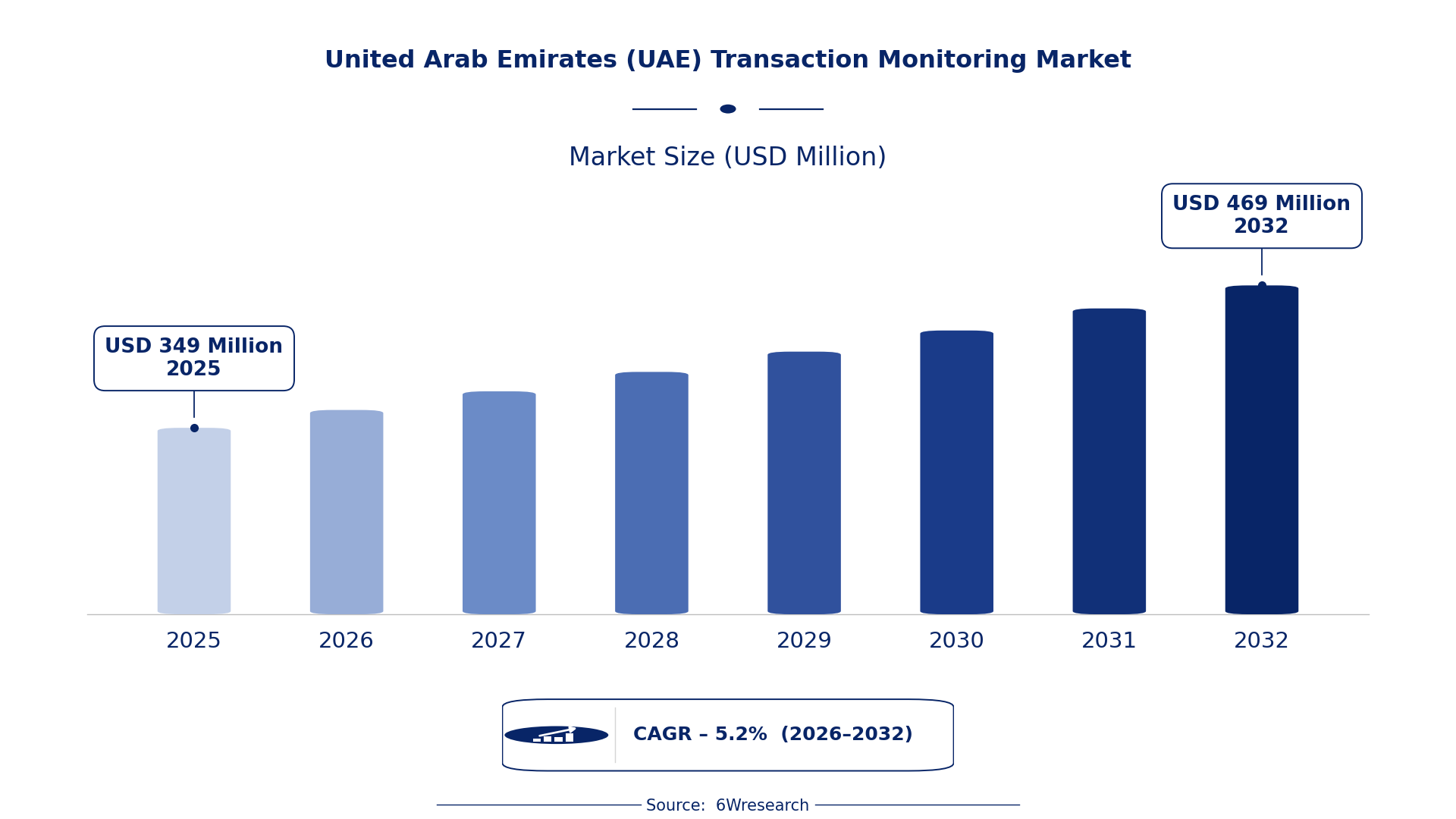
The United Arab Emirates (UAE) Transaction Monitoring Market was estimated at USD 349 Million in 2025 and is projected to reach USD 469 Million by 2032, growing at a CAGR of 5.2% from 2026 to 2032.
United Arab Emirates (UAE) Transaction Monitoring Market Synopsis
The need for effective transaction monitoring solutions in the UAE has skyrocketed as financial institutions strive to counteract fraud and meet increasingly complex regulatory demands. As a global financial center, the UAE's vibrant economy experiences high transaction volumes, necessitating sophisticated tools that ensure compliance and security.
With a growing number of technology providers entering the UAE market, organizations are gaining access to cutting-edge solutions tailored to local needs. These innovations are aimed at real-time monitoring and anomaly detection, vital components in the fight against money laundering and financial crime.
United Arab Emirates (UAE) Transaction Monitoring Market Year-wise Growth Rate and Key Drivers
This graph illustrates the annual growth rates of the United Arab Emirates (UAE) Transaction Monitoring Market from 2021 to 2032, highlighting a steady upward trajectory and projected expansion over the forecast period.
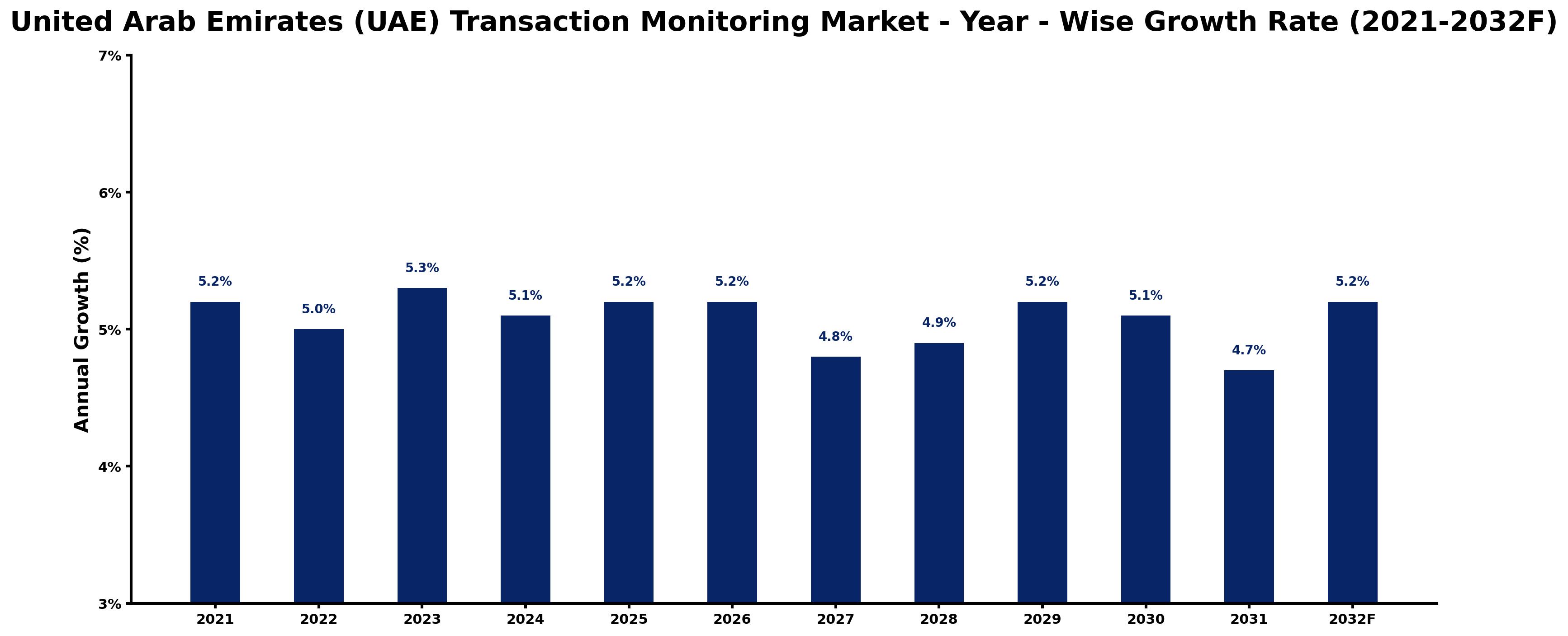
The table below presents the year‑wise growth rates along with the key drivers influencing the market
| Year | Growth Rate | Major Drivers |
| 2021 | 5.2% | Central Bank of UAE increases anti-money laundering regulations. |
| 2022 | 5.0% | Adoption of digital payments boosts fraud detection needs. |
| 2023 | 5.3% | Financial Free Zones attract startups requiring transaction oversight. |
| 2024 | 5.1% | New KYC guidelines mandated by UAE governmental authorities. |
| 2025 | 5.2% | Emergence of fintech firms necessitates advanced monitoring solutions. |
| 2026 | 5.2% | Increased cross-border transactions drive compliance demand. |
| 2027 | 4.8% | UAE law enforcement enhances cooperation with financial institutions. |
| 2028 | 4.9% | Growth in e-commerce requires robust fraud prevention measures. |
| 2029 | 5.2% | Rising cybersecurity threats stimulate demand for monitoring tools. |
| 2030 | 5.1% | UAE's Vision 2021 emphasizes transparency in financial transactions. |
| 2031 | 4.7% | Digital currency launches increase transaction monitoring requirements. |
| 2032 | 5.2% | National strategy promotes integrity in financial systems. |
Note: Market size estimations and growth projections presented in this report are based on 6Wresearch's proprietary forecasting methodology, utilizing the latest available industry data, government publications, and primary research inputs.
United Arab Emirates (UAE) Transaction Monitoring Market Key Takeaways
Below are some of the specific key takeaways from the market, including:
- The transaction monitoring market is driven by heightened regulatory scrutiny and financial crime prevention efforts.
- Demand for real-time analytics and behavioral monitoring is surging among financial institutions.
- Advanced technologies such as AI and machine learning are becoming essential in transaction monitoring solutions.
- The UAE government's stringent AML regulations are significantly shaping market growth.
- COVID-19 accelerated the adoption of transaction monitoring tools across various financial sectors.
Evaluation of Restraints in United Arab Emirates (UAE) Transaction Monitoring Market
Despite its potential for growth, the UAE Transaction Monitoring Market faces notable challenges. One key restraint is the rapidly evolving tactics of financial criminals, which often outpace the capabilities of existing monitoring solutions. on top of that, the sheer volume and diversity of transactions complicate effective monitoring, requiring institutions to continuously enhance their systems. Compliance with intricate regulatory frameworks can also strain resources and divert attention from core business functions, making it imperative for organizations to adopt an integrated approach towards compliance and technology.
United Arab Emirates (UAE) Transaction Monitoring Market Trends
Several trends are shaping the future of transaction monitoring in the UAE. Increased investment in automation and AI-driven analytics is transforming traditional monitoring approaches, allowing for proactive risk management. Additionally, the integration of cloud-based solutions provides enhanced scalability and flexibility for financial institutions. A growing emphasis on customer-centric practices is prompting organizations to refine their monitoring systems to minimize false positives, ensuring a smoother customer experience while maintaining compliance.
United Arab Emirates (UAE) Transaction Monitoring Market Opportunities
The transaction monitoring market presents a wealth of opportunities for growth and investment. With an increasing emphasis on AML compliance, there is a strong demand for innovative technologies capable of real-time data analysis and reporting. The expanding fintech landscape in the UAE also creates avenues for partnerships and collaborations that can enhance service offerings. Organizations looking to streamline their compliance processes through advanced technology stand to gain a competitive edge in the increasingly regulated environment.
Government Initiatives in the United Arab Emirates (UAE) Transaction Monitoring Market
The UAE government is actively shaping the transaction monitoring market through a series of initiatives aimed at enhancing financial security and compliance. With the region's status as a global financial hub, government policies focus on establishing stringent regulatory frameworks that guide financial institutions in their transaction monitoring efforts. These initiatives are vital for mitigating risks associated with financial crimes.
- A national strategy for combating money laundering launched in early 2023 aims to fortify regulatory compliance among financial entities.
- Current regulatory updates are underway, focusing on integrating advanced transaction monitoring technologies into existing frameworks.
- The establishment of a dedicated task force is ongoing, aimed at improving collaboration between governmental bodies and financial institutions on AML initiatives.
- A planned public awareness campaign is set to roll out by mid-2026, focusing on the importance of compliance and secure transactions for businesses.
Future Insights of the United Arab Emirates (UAE) Transaction Monitoring Market
Looking ahead to the period from 2026 to 2032, the UAE Transaction Monitoring Market is expected to experience continued growth. Advances in technology will likely play a key role, with artificial intelligence and machine learning becoming increasingly integrated into monitoring systems. Regulatory pressures will not only sustain but enhance the demand for sophisticated solutions that can adapt to an ever-changing financial environment. The urgency for effective compliance mechanisms will drive innovation, positioning companies that invest strategically in technology as leaders in this space.
United Arab Emirates (UAE) Transaction Monitoring Market Latest Developments
Recent developments in the UAE Transaction Monitoring Market reflect a dynamic sector focused on innovation and compliance. Over the last year, financial institutions have accelerated the adoption of advanced solutions to enhance their monitoring capabilities. These developments indicate a market adapting quickly to both regulatory demands and technological advancements.
- A leading regional operator announced the deployment of a new AI-powered monitoring tool in early 2023, significantly improving fraud detection capabilities.
- A partnership between fintech companies to create a collaborative monitoring platform is currently underway, aimed at sharing data and enhancing security protocols.
- Ongoing training initiatives for financial professionals are being conducted to improve understanding and implementation of AML strategies.
- By late 2026, a comprehensive software upgrade is planned for major banking institutions, focusing on integrating cloud technologies for enhanced transaction processing.
United Arab Emirates (UAE) Transaction Monitoring Market - Key Attractiveness of the Report
- 10 Years of Market Numbers
- Historical Data Starting from 2022 to 2025
- Base Year: 2025
- Forecast Data until 2032
- Key Performance Indicators Impacting the Market
- Major Upcoming Developments and Projects
Key Highlights of the Report:
- United Arab Emirates (UAE) Transaction Monitoring Market Outlook
- Market Size of United Arab Emirates (UAE) Transaction Monitoring Market, 2025
- Forecast of United Arab Emirates (UAE) Transaction Monitoring Market, 2032
- Historical Data and Forecast of United Arab Emirates (UAE) Transaction Monitoring Revenues & Volume for the Period 2022-2032F
- United Arab Emirates (UAE) Transaction Monitoring Market Trend Evolution
- United Arab Emirates (UAE) Transaction Monitoring Market Drivers and Challenges
- United Arab Emirates (UAE) Transaction Monitoring Price Trends
- United Arab Emirates (UAE) Transaction Monitoring Porter's Five Forces
- United Arab Emirates (UAE) Transaction Monitoring Industry Life Cycle
- Historical Data and Forecast of United Arab Emirates (UAE) Transaction Monitoring Market Revenues & Volume By Application Area for the Period 2022-2032F
- Historical Data and Forecast of United Arab Emirates (UAE) Transaction Monitoring Market Revenues & Volume By AML for the Period 2022-2032F
- Historical Data and Forecast of United Arab Emirates (UAE) Transaction Monitoring Market Revenues & Volume By FDP for the Period 2022-2032F
- Historical Data and Forecast of United Arab Emirates (UAE) Transaction Monitoring Market Revenues & Volume By Compliance Management for the Period 2022-2032F
- Historical Data and Forecast of United Arab Emirates (UAE) Transaction Monitoring Market Revenues & Volume By Customer Identity Management for the Period 2022-2032F
- Historical Data and Forecast of United Arab Emirates (UAE) Transaction Monitoring Market Revenues & Volume By Component for the Period 2022-2032F
- Historical Data and Forecast of United Arab Emirates (UAE) Transaction Monitoring Market Revenues & Volume By Solution for the Period 2022-2032F
- Historical Data and Forecast of United Arab Emirates (UAE) Transaction Monitoring Market Revenues & Volume By Services for the Period 2022-2032F
- Historical Data and Forecast of United Arab Emirates (UAE) Transaction Monitoring Market Revenues & Volume By Function for the Period 2022-2032F
- Historical Data and Forecast of United Arab Emirates (UAE) Transaction Monitoring Market Revenues & Volume By Case Management for the Period 2022-2032F
- Historical Data and Forecast of United Arab Emirates (UAE) Transaction Monitoring Market Revenues & Volume By KYC/Customer Onboarding for the Period 2022-2032F
- Historical Data and Forecast of United Arab Emirates (UAE) Transaction Monitoring Market Revenues & Volume By Dashboard and Reporting for the Period 2022-2032F
- Historical Data and Forecast of United Arab Emirates (UAE) Transaction Monitoring Market Revenues & Volume By Watch List Screening for the Period 2022-2032F
- Historical Data and Forecast of United Arab Emirates (UAE) Transaction Monitoring Market Revenues & Volume By Deployment Mode for the Period 2022-2032F
- Historical Data and Forecast of United Arab Emirates (UAE) Transaction Monitoring Market Revenues & Volume By On-Premises for the Period 2022-2032F
- Historical Data and Forecast of United Arab Emirates (UAE) Transaction Monitoring Market Revenues & Volume By Cloud for the Period 2022-2032F
- Historical Data and Forecast of United Arab Emirates (UAE) Transaction Monitoring Market Revenues & Volume By Organization Size for the Period 2022-2032F
- Historical Data and Forecast of United Arab Emirates (UAE) Transaction Monitoring Market Revenues & Volume By SMEs for the Period 2022-2032F
- Historical Data and Forecast of United Arab Emirates (UAE) Transaction Monitoring Market Revenues & Volume By Large Enterprises for the Period 2022-2032F
- Historical Data and Forecast of United Arab Emirates (UAE) Transaction Monitoring Market Revenues & Volume By Vertical for the Period 2022-2032F
- Historical Data and Forecast of United Arab Emirates (UAE) Transaction Monitoring Market Revenues & Volume By Banking, Financial Services, and Insurance for the Period 2022-2032F
- Historical Data and Forecast of United Arab Emirates (UAE) Transaction Monitoring Market Revenues & Volume By Government and Defense for the Period 2022-2032F
- Historical Data and Forecast of United Arab Emirates (UAE) Transaction Monitoring Market Revenues & Volume By IT and Telecom for the Period 2022-2032F
- Historical Data and Forecast of United Arab Emirates (UAE) Transaction Monitoring Market Revenues & Volume By Retail for the Period 2022-2032F
- Historical Data and Forecast of United Arab Emirates (UAE) Transaction Monitoring Market Revenues & Volume By Healthcare for the Period 2022-2032F
- Historical Data and Forecast of United Arab Emirates (UAE) Transaction Monitoring Market Revenues & Volume By Energy and Utilities for the Period 2022-2032F
- Historical Data and Forecast of United Arab Emirates (UAE) Transaction Monitoring Market Revenues & Volume By Manufacturing for the Period 2022-2032F
- Historical Data and Forecast of United Arab Emirates (UAE) Transaction Monitoring Market Revenues & Volume By Others for the Period 2022-2032F
- United Arab Emirates (UAE) Transaction Monitoring Import Export Trade Statistics
- Market Opportunity Assessment By Application Area
- Market Opportunity Assessment By Component
- Market Opportunity Assessment By Function
- Market Opportunity Assessment By Deployment Mode
- Market Opportunity Assessment By Organization Size
- Market Opportunity Assessment By Vertical
- United Arab Emirates (UAE) Transaction Monitoring Top Companies Market Share
- United Arab Emirates (UAE) Transaction Monitoring Competitive Benchmarking By Technical and Operational Parameters
- United Arab Emirates (UAE) Transaction Monitoring Company Profiles
- United Arab Emirates (UAE) Transaction Monitoring Key Strategic Recommendations






































