United Arab Emirates (UAE) Vegetable oils Market Summary
The united arab emirates (uae) vegetable oils market was estimated at USD 212 Million in 2025 and is projected to reach USD 295 Million by 2032, growing at a CAGR of 5.6% from 2026 to 2032.
United Arab Emirates (UAE) Vegetable oils Market Year-wise Growth Rate and Key Drivers
This graph highlights how the United Arab Emirates (UAE) Vegetable oils Market has steadily grown over the past five years, supported by major growth factors.
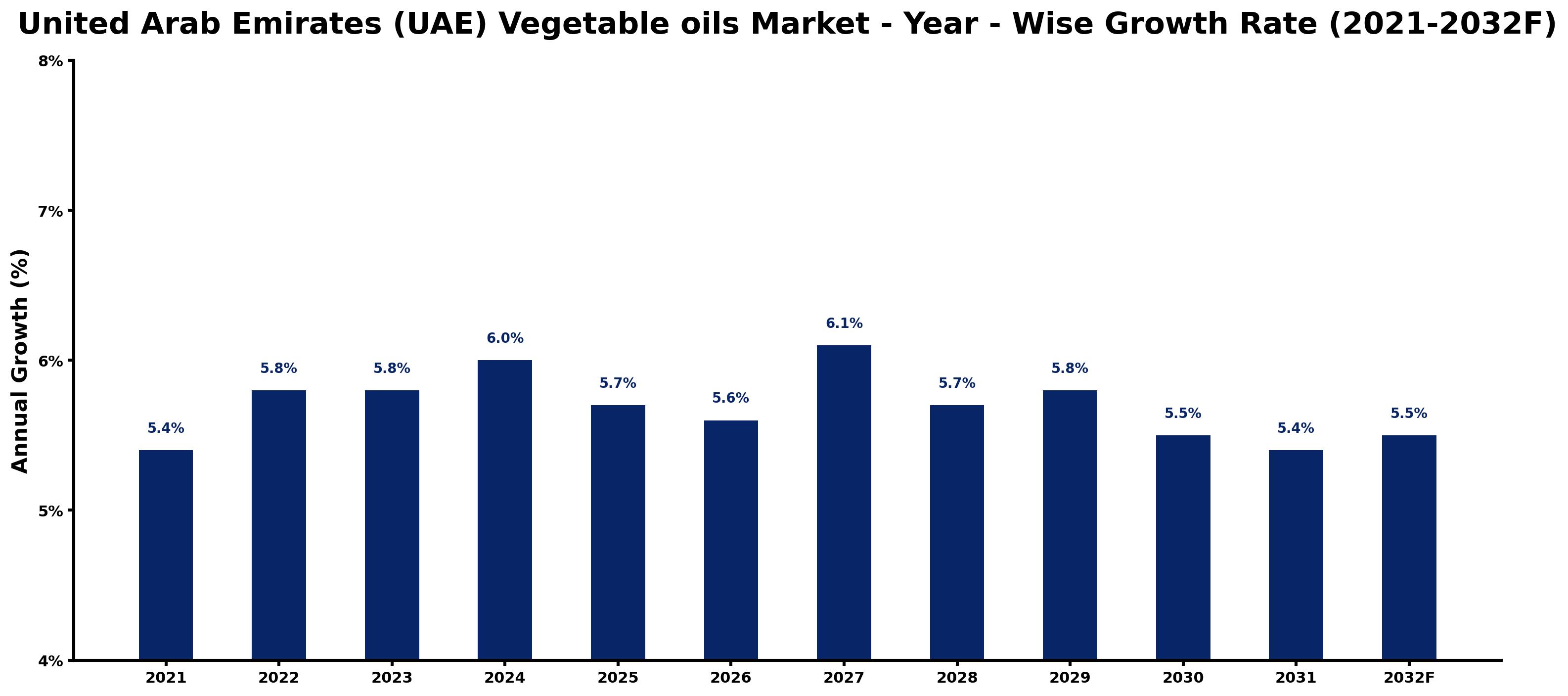
The table below presents the year wise growth rates along with the key drivers influencing the market
| Year | Growth Rate | Major Drivers |
| 2021 | 5.4% | A surge in health-conscious consumers shifts preferences towards plant-based oils steadily. |
| 2022 | 5.8% | E-commerce platforms expand offerings, making vegetable oils accessible across the UAE. |
| 2023 | 5.8% | Local farms boost production capabilities, enhancing the supply of regional oil varieties. |
| 2024 | 6.0% | International trade agreements facilitate easier importation of varied vegetable oil types. |
| 2025 | 5.7% | Culinary trends emphasize Mediterranean diets, increasing demand for olive and sunflower oils. |
| 2026 | 5.6% | Sustainability campaigns promote environmentally friendly sourcing of vegetable oil products. |
| 2027 | 6.1% | Food service sector recovery post-pandemic highlights the need for bulk oil purchases. |
| 2028 | 5.7% | Health regulations encourage low-trans fat alternatives, driving growth in refined oil sales. |
| 2029 | 5.8% | Rising awareness of omega fatty acids fuels interest in specific health-focused oils. |
| 2030 | 5.5% | Innovative packaging solutions enhance product shelf life, appealing to busy urban consumers. |
| 2031 | 5.4% | Plant-based diets gain traction, increasing demand for diverse vegetable oil options. |
| 2032 | 5.5% | Culinary tourism introduces international oils, diversifying consumer choices in the market. |
Note - Market size estimations and growth projections presented in this report are based on 6Wresearch's advanced forecasting approach, validated with industry datasets as of June 2026.
United Arab Emirates (UAE) Vegetable oils Market Synopsis
The United Arab Emirates (UAE) Vegetable oils Market is projected to reach 5.6% and witness significant growth during the forecast period (2026-2032). The market dynamics are largely influenced by rising consumption patterns, evolving dietary preferences, and substantial industrial applications of vegetable oils across various sectors. The demand for vegetable oils in the UAE is being driven by a growing population, increased urbanization, and an expanding food processing industry, leading to a robust market outlook.
United Arab Emirates (UAE) Vegetable oils Market Growth Drivers
A variety of factors are steering growth in the UAE vegetable oils market, primarily the increasing population which elevates the overall consumption of vegetable oils in household cooking. The following points elaborate on these key drivers:
- The rapid urbanization across the UAE is leading to a marked increase in demand for processed and convenience food, which in turn requires higher quantities of vegetable oils as essential cooking components.
- Shifting dietary habits, particularly a greater emphasis on health-conscious cooking options, have spurred the consumption of oils perceived as healthier, such as olive and coconut oils.
- Government initiatives aimed at promoting public health have fostered a greater awareness among consumers regarding nutritional benefits, thus bolstering the demand for specific vegetable oil types.
- With the expansion of the food processing sector, there has been a corresponding rise in the need for vegetable oils as critical ingredients in various packaged products, enhancing market consumption.
- The increasing interest in foodservice establishments and restaurants, which rely on vegetable oils for frying and cooking, plays a critical role in augmenting market growth.
United Arab Emirates (UAE) Vegetable oils Market Challenges and Restraints
Despite the positive growth trajectory, the UAE vegetable oils market faces several challenges that could impede its expansion. Among these obstacles are the following:
- The UAE's heavy reliance on imported vegetable oils makes the market susceptible to external shocks, such as fluctuations in global commodity prices and international supply chain disruptions.
- Environmental concerns related to the production of vegetable oils have become increasingly prominent, as practices such as deforestation for crop cultivation raise sustainability issues among eco-conscious consumers.
- Market volatility can also arise from geopolitical tensions that affect trade routes and import dependencies, consequently impacting pricing and availability.
- The COVID-19 pandemic has revealed vulnerabilities in the supply chain, leading to increased price fluctuations and inconsistent availability of vegetable oils during critical periods.
- Regulatory challenges and compliance with international standards can also pose barriers for new entrants and existing players looking to innovate within the market.
United Arab Emirates (UAE) Vegetable oils Market Government Investment and Initiatives
The UAE government has implemented various initiatives to enhance the vegetable oils market, focusing on sustainability, innovation, and food security. Key initiatives include:
- The introduction of policies aimed at increasing local production capacities for vegetable oils, encouraging investments in agricultural technologies and sustainable farming methods.
- Support for research and development in the food processing industry to improve efficiency and reduce waste, thereby increasing the overall availability of vegetable oils.
- Public digestion programs that aim to raise awareness about healthy dietary practices, further promoting the consumption of vegetable oils with known health benefits.
- Adopting regulatory frameworks that facilitate trade while ensuring that imported vegetable oils meet stringent quality and safety standards.
- Investment in infrastructure improvements within the supply chain to ensure timely distribution and reduce reliance on imports, contributing to market stability.
United Arab Emirates (UAE) Vegetable oils Market Latest Developments (May 2025 - June 2026)
Between May 2025 and June 2026, the United Arab Emirates (UAE) vegetable oils market has observed notable developments that reflect broader industry trends. Key highlights during this period include:
- The continued progression of local producers to enhance the quality and range of vegetable oils available in the market, catering to both domestic and export demands.
- An emergence of new brands focusing on organic and specialty oils, reflecting a consumer shift towards cleaner label products and health-conscious choices.
- Increased collaboration among industry stakeholders to improve supply chain resilience, reducing vulnerabilities identified during the pandemic.
- The establishment of partnerships aimed at leveraging technology for better traceability and transparency within the vegetable oils supply chain.
- Growing interest in sustainability initiatives, with companies adopting eco-friendly packaging solutions and processes to minimize their environmental footprint.
United Arab Emirates (UAE) Vegetable oils Market - Key Attractiveness of the Report
- 10 Years of Market Numbers
- Historical Data Starting from 2022 to 2025
- Base Year: 2025
- Forecast Data until 2032
- Key Performance Indicators Impacting the Market
- Major Upcoming Developments and Projects
Key Highlights of the Report:
- United Arab Emirates (UAE) Vegetable oils Market Outlook
- Market Size of United Arab Emirates (UAE) Vegetable oils Market, 2025
- Forecast of United Arab Emirates (UAE) Vegetable oils Market, 2032
- Historical Data and Forecast of United Arab Emirates (UAE) Vegetable oils Revenues & Volume for the Period 2022-2032F
- United Arab Emirates (UAE) Vegetable oils Market Trend Evolution
- United Arab Emirates (UAE) Vegetable oils Market Drivers and Challenges
- United Arab Emirates (UAE) Vegetable oils Price Trends
- United Arab Emirates (UAE) Vegetable oils Porter's Five Forces
- United Arab Emirates (UAE) Vegetable oils Industry Life Cycle
- Historical Data and Forecast of United Arab Emirates (UAE) Vegetable oils Market Revenues & Volume By Types for the Period 2022-2032F
- Historical Data and Forecast of United Arab Emirates (UAE) Vegetable oils Market Revenues & Volume By Palm Oil for the Period 2022-2032F
- Historical Data and Forecast of United Arab Emirates (UAE) Vegetable oils Market Revenues & Volume By Soybean Oil for the Period 2022-2032F
- Historical Data and Forecast of United Arab Emirates (UAE) Vegetable oils Market Revenues & Volume By Rapeseed Oil for the Period 2022-2032F
- Historical Data and Forecast of United Arab Emirates (UAE) Vegetable oils Market Revenues & Volume By Sunflower Oil for the Period 2022-2032F
- Historical Data and Forecast of United Arab Emirates (UAE) Vegetable oils Market Revenues & Volume By Olive Oil for the Period 2022-2032F
- Historical Data and Forecast of United Arab Emirates (UAE) Vegetable oils Market Revenues & Volume By Others for the Period 2022-2032F
- Historical Data and Forecast of United Arab Emirates (UAE) Vegetable oils Market Revenues & Volume By Applications for the Period 2022-2032F
- Historical Data and Forecast of United Arab Emirates (UAE) Vegetable oils Market Revenues & Volume By Food for the Period 2022-2032F
- Historical Data and Forecast of United Arab Emirates (UAE) Vegetable oils Market Revenues & Volume By Feed for the Period 2022-2032F
- Historical Data and Forecast of United Arab Emirates (UAE) Vegetable oils Market Revenues & Volume By Industrial for the Period 2022-2032F
- United Arab Emirates (UAE) Vegetable oils Import Export Trade Statistics
- Market Opportunity Assessment By Types
- Market Opportunity Assessment By Applications
- United Arab Emirates (UAE) Vegetable oils Top Companies Market Share
- United Arab Emirates (UAE) Vegetable oils Competitive Benchmarking By Technical and Operational Parameters
- United Arab Emirates (UAE) Vegetable oils Company Profiles
- United Arab Emirates (UAE) Vegetable oils Key Strategic Recommendations






































