United Arab Emirates (UAE) Wardrobes Market Summary
The united arab emirates (uae) wardrobes market was estimated at USD 204 Million in 2025 and is projected to reach USD 284 Million by 2032, growing at a CAGR of 5.7% from 2026 to 2032.
United Arab Emirates (UAE) Wardrobes Market Year-wise Growth Rate and Key Drivers
This graph highlights how the United Arab Emirates (UAE) Wardrobes Market has steadily grown over the past five years, supported by major growth factors.
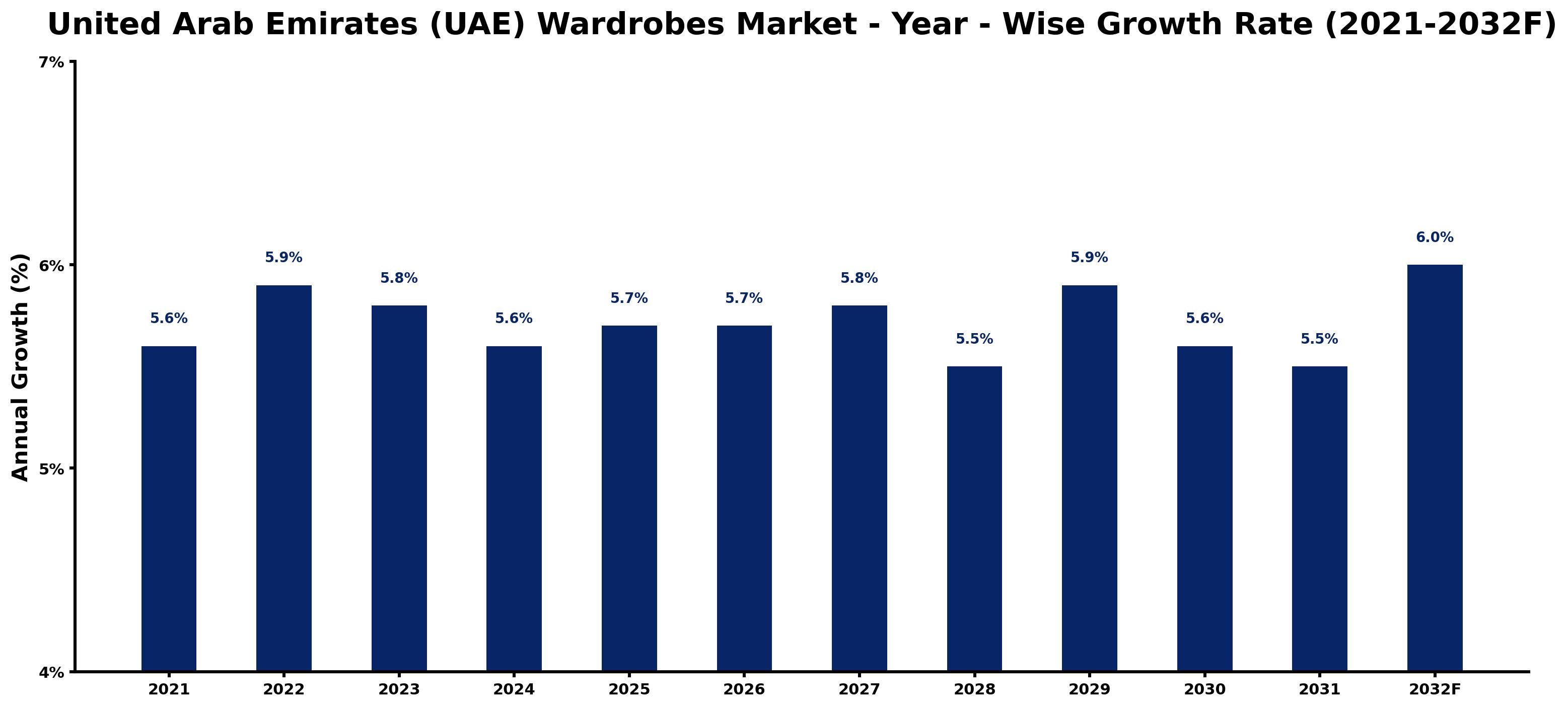
The table below presents the year wise growth rates along with the key drivers influencing the market
| Year | Growth Rate | Major Drivers |
| 2021 | 5.6% | Post-lockdown retail projects revitalized interest in home improvement investments across the UAE. |
| 2022 | 5.9% | Increased urbanization drove the demand for stylish yet functional wardrobe solutions in cities. |
| 2023 | 5.8% | Sustainable materials gained traction, influencing wardrobe designs to favor eco-friendly options. |
| 2024 | 5.6% | Technological advancements in e-commerce transformed traditional shopping experiences for wardrobes. |
| 2025 | 5.7% | The growing expatriate population led to diverse styling preferences in wardrobe designs. |
| 2026 | 5.7% | Smart home integration trends pushed manufacturers to innovate with tech-savvy wardrobe solutions. |
| 2027 | 5.8% | Rising disposable incomes allowed consumers to invest in premium, customized wardrobe options. |
| 2028 | 5.5% | Sustainability campaigns motivated brands to focus on recyclable and ethically sourced materials. |
| 2029 | 5.9% | The influx of luxury developments emphasized the need for high-end, tailored wardrobe solutions. |
| 2030 | 5.6% | Expansion of retail outlets in emerging areas improved access to various wardrobe styles. |
| 2031 | 5.5% | Cultural shifts towards personalization in interiors heightened the significance of wardrobe customization. |
| 2032 | 6.0% | Increased focus on wellness and decluttering led many to reconsider wardrobe organization techniques. |
Note - Market size estimations and growth projections presented in this report are based on 6Wresearch's advanced forecasting approach, validated with industry datasets as of June 2026.
United Arab Emirates (UAE) Wardrobes Market Synopsis
The United Arab Emirates (UAE) Wardrobes Market is projected to reach 5.7% and witness significant growth during the forecast period (2026-2032). This evolving market encompasses the production, import, distribution, and sales of wardrobes and closet systems tailored for storage and organization across both residential and commercial spaces. Wardrobes serve as essential furniture components, providing vital storage solutions for clothing, accessories, and various personal items, thereby enhancing the functional and aesthetic aspects of living and work environments.
United Arab Emirates (UAE) Wardrobes Market Growth Drivers
The expansion of the United Arab Emirates (UAE) Wardrobes Market can be attributed to multiple synergistic factors. Firstly, the buoyant real estate sector is a primary catalyst, as there has been a notable increase in residential and commercial construction activities. This surge generates a heightened requirement for wardrobes to effectively furnish and organize diverse spaces.
- The continuous urbanization trend in cities across the UAE is leading to a growing need for efficient storage solutions in compact living environments.
- Consumer preferences are increasingly shifting towards modern, stylish, and multi-functional furniture that aligns with contemporary design trends.
- There is a rising awareness of the benefits of space-saving solutions, encouraging homeowners to invest in innovative wardrobe designs.
- The implementation of smart technology in furniture is gaining traction, with wardrobes now offering integrated features such as lighting and organization aids.
- Increasing disposable incomes and enhanced living standards are propelling demand for high-quality and aesthetically pleasing furniture products.
United Arab Emirates (UAE) Wardrobes Market Challenges and Restraints
While the outlook for the United Arab Emirates (UAE) Wardrobes Market appears optimistic, several challenges could impede its growth trajectory. One of the foremost concerns is the competition posed by cost-effective alternatives, as consumers increasingly explore budget-friendly options like self-assembled or modular wardrobe solutions.
- The market must contend with fluctuating raw material costs, which could impact pricing strategies for wardrobe manufacturers.
- There are challenges related to supply chain disruptions that could affect the timely availability of wardrobe components.
- Increased consumer preference for sustainability may necessitate investments in eco-friendly materials, potentially increasing production costs.
- The impact of global economic uncertainties may lead to cautious consumer spending, affecting discretionary purchases such as furniture.
- The proliferation of online retail has intensified competition in the market, requiring traditional retailers to adapt to changing consumer purchasing behaviors.
United Arab Emirates (UAE) Wardrobes Market Government Investment and Initiatives
The government of the United Arab Emirates has been actively investing in initiatives designed to boost the construction and interior design sectors, which directly influence the United Arab Emirates (UAE) Wardrobes Market. Strategic development plans aimed at urban expansion, including affordable housing projects and commercial complexes, are expected to create additional demand for wardrobes.
- The UAE Vision 2021 project emphasizes sustainable development and urban planning, fostering environments conducive to the growth of the furniture market.
- Various incentive programs are being introduced to encourage local manufacturing of furniture and related products, which may lower dependency on imports.
- Government-backed initiatives focus on enhancing the overall aesthetic quality of urban spaces, reinforcing the demand for well-designed storage solutions.
- Investment in infrastructure development is anticipated to stimulate the market by revitalizing areas where new wardrobes are needed.
- Policies promoting economic diversification are set to bolster sectors beyond oil, leading to increased investments in residential and commercial interiors.
United Arab Emirates (UAE) Wardrobes Market Latest Developments (May 2025 - June 2026)
Recent developments in the United Arab Emirates (UAE) Wardrobes Market indicate a shift towards innovative design and functionality. The period from May 2025 to June 2026 has seen a surge in collaboration between various furniture designers and technology firms, focusing on smart wardrobe solutions that cater to the modern consumer's needs. Increasingly, traditional retailers are enhancing their online presence to reach a broader audience, addressing the changing shopping habits of consumers who prefer online purchasing platforms.
- Advancements in production technologies are leading to the introduction of customizable wardrobes, allowing consumers to select dimensions, styles, and internal configurations.
- Trade exhibitions and conventions are increasingly showcasing sustainable materials, attracting environmentally conscious buyers in the market.
- The economic recovery post-Covid-19 has invigorated the home improvement sector, with many consumers investing in upgrading their living spaces, including wardrobes.
- Marketing strategies are prioritizing digital channels to effectively engage a tech-savvy consumer base, emphasizing product versatility and design elegance.
- The industry is witnessing a trend towards multi-functional furniture pieces that blend aesthetics with practical storage solutions, appealing to urban dwellers.
United Arab Emirates (UAE) Wardrobes Market - Key Attractiveness of the Report
- 10 Years of Market Numbers
- Historical Data Starting from 2022 to 2025
- Base Year: 2025
- Forecast Data until 2032
- Key Performance Indicators Impacting the Market
- Major Upcoming Developments and Projects
Key Highlights of the Report:
- United Arab Emirates (UAE) Wardrobes Market Outlook
- Market Size of United Arab Emirates (UAE) Wardrobes Market, 2025
- Forecast of United Arab Emirates (UAE) Wardrobes Market, 2032
- Historical Data and Forecast of United Arab Emirates (UAE) Wardrobes Revenues & Volume for the Period 2022-2032F
- United Arab Emirates (UAE) Wardrobes Market Trend Evolution
- United Arab Emirates (UAE) Wardrobes Market Drivers and Challenges
- United Arab Emirates (UAE) Wardrobes Price Trends
- United Arab Emirates (UAE) Wardrobes Porter's Five Forces
- United Arab Emirates (UAE) Wardrobes Industry Life Cycle
- Historical Data and Forecast of United Arab Emirates (UAE) Wardrobes Market Revenues & Volume By Type for the Period 2022-2032F
- Historical Data and Forecast of United Arab Emirates (UAE) Wardrobes Market Revenues & Volume By Finished Wardrobes for the Period 2022-2032F
- Historical Data and Forecast of United Arab Emirates (UAE) Wardrobes Market Revenues & Volume By Customized Wardrobes for the Period 2022-2032F
- Historical Data and Forecast of United Arab Emirates (UAE) Wardrobes Market Revenues & Volume By Application for the Period 2022-2032F
- Historical Data and Forecast of United Arab Emirates (UAE) Wardrobes Market Revenues & Volume By Residential Use for the Period 2022-2032F
- Historical Data and Forecast of United Arab Emirates (UAE) Wardrobes Market Revenues & Volume By Commercial Use for the Period 2022-2032F
- United Arab Emirates (UAE) Wardrobes Import Export Trade Statistics
- Market Opportunity Assessment By Type
- Market Opportunity Assessment By Application
- United Arab Emirates (UAE) Wardrobes Top Companies Market Share
- United Arab Emirates (UAE) Wardrobes Competitive Benchmarking By Technical and Operational Parameters
- United Arab Emirates (UAE) Wardrobes Company Profiles
- United Arab Emirates (UAE) Wardrobes Key Strategic Recommendations






































