United Arab Emirates (UAE) Warm Air Heating and Air Conditioning Market Summary
The united arab emirates (uae) warm air heating and air conditioning market was estimated at USD 945 Million in 2025 and is projected to reach USD 1777 Million by 2032, growing at a CAGR of 10.9% from 2026 to 2032.
United Arab Emirates (UAE) Warm Air Heating and Air Conditioning Market Year-wise Growth Rate and Key Drivers
This graph highlights how the United Arab Emirates (UAE) Warm Air Heating and Air Conditioning Market has steadily grown over the past five years, supported by major growth factors.
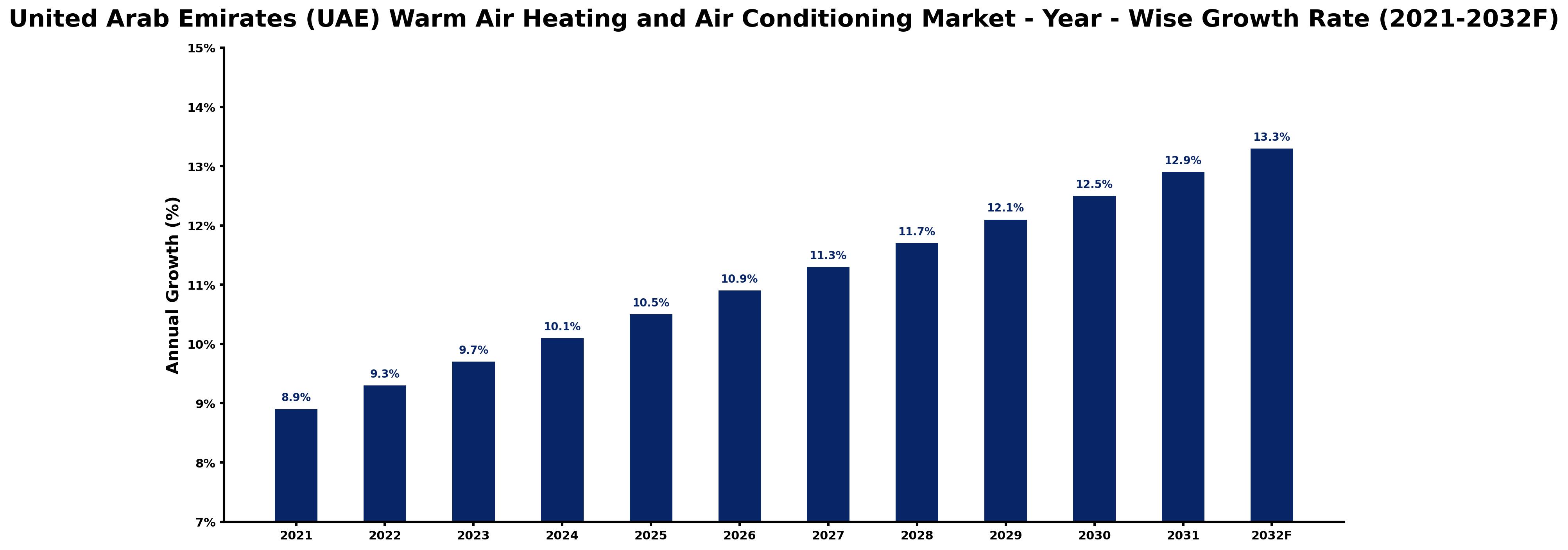
The table below presents the year wise growth rates along with the key drivers influencing the market
| Year | Growth Rate | Major Drivers |
| 2021 | 8.9% | Post-lockdown retail projects fueled substantial investments in HVAC systems across UAE. |
| 2022 | 9.3% | Emerging luxury developments in Dubai and Abu Dhabi increased demand for sophisticated air conditioning solutions. |
| 2023 | 9.7% | Rising temperatures prompted residential consumers to prioritize energy-efficient heating and cooling systems. |
| 2024 | 10.1% | GCC construction pipelines expanded rapidly, boosting orders for commercial HVAC equipment and services. |
| 2025 | 10.5% | Sustainability trends encouraged many firms to adopt eco-friendly heating and cooling technologies. |
| 2026 | 10.9% | Infrastructure investments for Expo 2020 projects enhanced awareness of HVAC innovations and standards. |
| 2027 | 11.3% | Localized manufacturing initiatives led to more competitive pricing for heating and cooling systems. |
| 2028 | 11.7% | Smart city developments like Neom triggered demand for integrated climate control solutions in urban centers. |
| 2029 | 12.1% | Consumer preferences shifted toward automated systems with advanced IoT capabilities and smart features. |
| 2030 | 12.5% | The hospitality sector sought cutting-edge climate solutions to enhance guest experiences and efficiency. |
| 2031 | 12.9% | Regulatory updates on energy efficiency standards prompted businesses to upgrade outdated HVAC units. |
| 2032 | 13.3% | Emerging technologies in renewable energy inspired a market shift toward hybrid heating solutions. |
Note - Market size estimations and growth projections presented in this report are based on 6Wresearch's advanced forecasting approach, validated with industry datasets as of June 2026.
United Arab Emirates (UAE) Warm Air Heating and Air Conditioning Market Synopsis
The United Arab Emirates (UAE) Warm Air Heating and Air Conditioning Market is projected to reach 10.9% and witness significant growth during the forecast period (2026-2032). The market's expansion is primarily influenced by the extreme temperatures and humidity levels prevalent across the region, coupled with rapid urbanization and a growing population that demands effective indoor climate control solutions. Both residential and commercial sectors are increasingly adopting warm air heating and air conditioning systems as essential elements for ensuring comfort and air quality.
United Arab Emirates (UAE) Warm Air Heating and Air Conditioning Market Growth Drivers
Several key factors are propelling the growth of the United Arab Emirates (UAE) Warm Air Heating and Air Conditioning Market. These include:
- The extreme climatic conditions during the summer months necessitate efficient air conditioning solutions to maintain comfortable indoor environments.
- Rapid urban development, characterized by the construction of high-rise buildings and residential complexes, has significantly increased the demand for advanced HVAC systems capable of managing vast indoor spaces.
- There is a growing emphasis on energy efficiency, prompting consumers and businesses to invest in sustainable HVAC solutions that can reduce electricity consumption and environmental impact.
- The integration of smart technologies in HVAC systems is enhancing user experience and energy management, thus driving market interest.
- Government initiatives aimed at promoting green building practices through regulations and incentives are further supporting the adoption of modern air conditioning solutions.
United Arab Emirates (UAE) Warm Air Heating and Air Conditioning Market Challenges and Restraints
Despite the promising outlook, the United Arab Emirates (UAE) Warm Air Heating and Air Conditioning Market faces several challenges that could hinder growth. Notably, energy consumption associated with air conditioning systems poses a significant concern, as the increasing demand for cooling can lead to greater electricity usage. Furthermore, the availability of skilled technicians for installation and maintenance services is crucial for ensuring system efficiency and longevity. Fluctuations in material costs can also impact the pricing of HVAC systems, potentially affecting consumer purchasing decisions.
United Arab Emirates (UAE) Warm Air Heating and Air Conditioning Market Government Investment and Initiatives
The United Arab Emirates (UAE) government has implemented a range of initiatives aimed at promoting the growth of the Warm Air Heating and Air Conditioning Market. Investments in sustainable infrastructure and energy-efficient building practices are at the forefront of these initiatives. Policies encouraging the adoption of green technologies emphasize the importance of reducing carbon emissions and improving air quality. Additionally, various public spending programs are directed towards enhancing urban development projects that necessitate advanced HVAC systems, thereby stimulating market growth.
United Arab Emirates (UAE) Warm Air Heating and Air Conditioning Market Latest Developments (May 2025 - June 2026)
Recent developments in the United Arab Emirates (UAE) Warm Air Heating and Air Conditioning Market have highlighted a focused trend towards smart HVAC solutions that integrate IoT technologies. Innovations in system design and energy efficiency are becoming paramount as businesses and homeowners increasingly seek intelligent climate control options. Furthermore, partnerships between local contractors and international technology providers are emerging, fostering the exchange of advanced HVAC solutions tailored to the UAE's unique climate conditions.
United Arab Emirates (UAE) Warm Air Heating and Air Conditioning Market - Key Attractiveness of the Report
- 10 Years of Market Numbers
- Historical Data Starting from 2022 to 2025
- Base Year: 2025
- Forecast Data until 2032
- Key Performance Indicators Impacting the Market
- Major Upcoming Developments and Projects
Key Highlights of the Report:
- United Arab Emirates (UAE) Warm Air Heating and Air Conditioning Market Outlook
- Market Size of United Arab Emirates (UAE) Warm Air Heating and Air Conditioning Market, 2025
- Forecast of United Arab Emirates (UAE) Warm Air Heating and Air Conditioning Market, 2032
- Historical Data and Forecast of United Arab Emirates (UAE) Warm Air Heating and Air Conditioning Revenues & Volume for the Period 2022-2032F
- United Arab Emirates (UAE) Warm Air Heating and Air Conditioning Market Trend Evolution
- United Arab Emirates (UAE) Warm Air Heating and Air Conditioning Market Drivers and Challenges
- United Arab Emirates (UAE) Warm Air Heating and Air Conditioning Price Trends
- United Arab Emirates (UAE) Warm Air Heating and Air Conditioning Porter's Five Forces
- United Arab Emirates (UAE) Warm Air Heating and Air Conditioning Industry Life Cycle
- Historical Data and Forecast of United Arab Emirates (UAE) Warm Air Heating and Air Conditioning Market Revenues & Volume By Components for the Period 2022-2032F
- Historical Data and Forecast of United Arab Emirates (UAE) Warm Air Heating and Air Conditioning Market Revenues & Volume By Sensors for the Period 2022-2032F
- Historical Data and Forecast of United Arab Emirates (UAE) Warm Air Heating and Air Conditioning Market Revenues & Volume By Controllers & Constrolled Devices for the Period 2022-2032F
- Historical Data and Forecast of United Arab Emirates (UAE) Warm Air Heating and Air Conditioning Market Revenues & Volume By Applications for the Period 2022-2032F
- Historical Data and Forecast of United Arab Emirates (UAE) Warm Air Heating and Air Conditioning Market Revenues & Volume By Residential for the Period 2022-2032F
- Historical Data and Forecast of United Arab Emirates (UAE) Warm Air Heating and Air Conditioning Market Revenues & Volume By Commercial for the Period 2022-2032F
- Historical Data and Forecast of United Arab Emirates (UAE) Warm Air Heating and Air Conditioning Market Revenues & Volume By Industrial for the Period 2022-2032F
- United Arab Emirates (UAE) Warm Air Heating and Air Conditioning Import Export Trade Statistics
- Market Opportunity Assessment By Components
- Market Opportunity Assessment By Applications
- United Arab Emirates (UAE) Warm Air Heating and Air Conditioning Top Companies Market Share
- United Arab Emirates (UAE) Warm Air Heating and Air Conditioning Competitive Benchmarking By Technical and Operational Parameters
- United Arab Emirates (UAE) Warm Air Heating and Air Conditioning Company Profiles
- United Arab Emirates (UAE) Warm Air Heating and Air Conditioning Key Strategic Recommendations






































