United Arab Emirates (UAE) Website Builder Market Size, Share & Growth Rate
The United Arab Emirates (UAE) Website Builder Market was estimated at USD 220 Million in 2025 and is projected to reach USD 301 Million by 2032, growing at a CAGR of 4.6% from 2026 to 2032. This growth trajectory is primarily driven by the digital transformation across various sectors and an escalating demand for online presence among both businesses and individuals. As e-commerce continues to expand and businesses recognize the essential role of branding in the digital space, the website builder market is expected to flourish.
United Arab Emirates (UAE) Website Builder Market Year-wise Growth Rate and Key Drivers
This graph highlights how the United Arab Emirates (UAE) Website Builder Market has steadily grown over the years, supported by major growth factors.
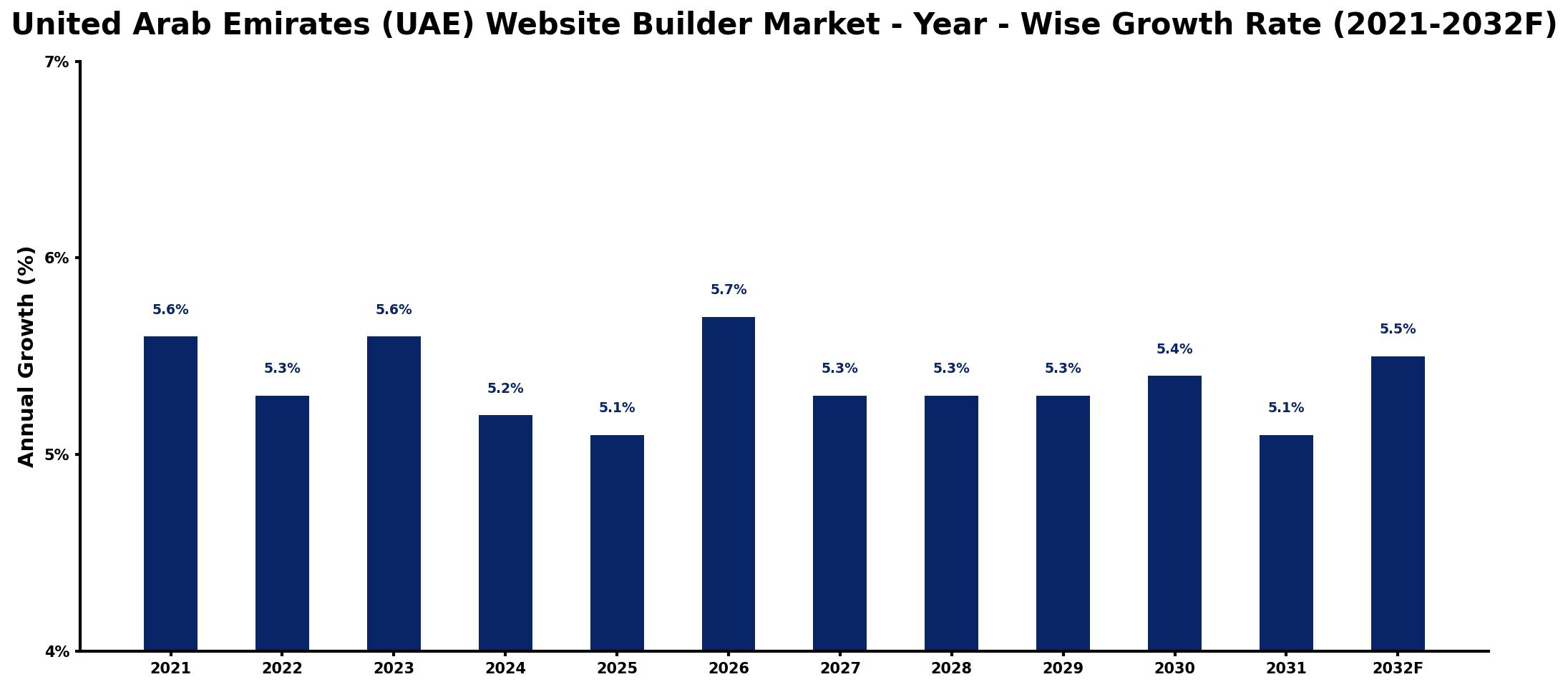
The table below presents the year‑wise growth rates along with the key drivers influencing the market
| Year | Growth Rate | Major Drivers |
| 2021 | 5.6% | Rise in digital marketing demand |
| 2022 | 5.3% | Increased small business online presence |
| 2023 | 5.6% | Growth in e-commerce sector investments |
| 2024 | 5.2% | Expansion of remote work solutions |
| 2025 | 5.1% | Surge in mobile internet usage |
| 2026 | 5.7% | Adoption of cloud-based services |
| 2027 | 5.3% | Emergence of new tech startups |
| 2028 | 5.3% | improved processing technologies adoption |
| 2029 | 5.3% | Investment in digital content creation |
| 2030 | 5.4% | Focus on user experience enhancements |
| 2031 | 5.1% | Demand for personalized online services |
| 2032 | 5.5% | Increase in online education platforms |
Note: Market size estimations and growth projections presented in this report are based on 6Wresearch's proprietary forecasting methodology, utilizing the latest available industry data, government publications, and primary research inputs.
United Arab Emirates (UAE) Website Builder Market Synopsis
The most significant force shaping the United Arab Emirates (UAE) Website Builder Market is the pressing need for businesses to establish a robust online presence. With digital marketing becoming increasingly critical to success, website builders provide essential tools for creating professional websites, simplifying the process for users without technical backgrounds.
Furthermore, the COVID-19 pandemic accelerated this shift, prompting businesses to pivot their operations online. This surge in demand underscores a new norm where digital visibility is crucial for growth, making the website builder market a vital area for investment and innovation.
United Arab Emirates (UAE) Website Builder Market Key Takeaways
- The UAE website builder market is projected to grow from USD 220 Million in 2025 to USD 301 Million by 2032.
- Digital transformation is the primary driver for market expansion, facilitating online presence for various sectors.
- The surge in e-commerce activities highlights the importance of effective online branding and visibility.
- Website builders are increasingly favored for their user-friendly interfaces, catering to a diverse user base.
- The market is experiencing continued growth post-pandemic as businesses prioritize digital presence.
Evaluation of Restraints in United Arab Emirates (UAE) Website Builder Market
Despite its growth, the UAE Website Builder Market faces notable constraints. The presence of established global platforms creates fierce competition, challenging newer entrants striving to capture market share. Additionally, addressing the diverse needs of users—ranging from novice entrepreneurs to experienced web developers—necessitates ongoing enhancement of features. This demand for continuous improvement can strain resources, making it crucial for new players to find unique selling propositions to differentiate themselves.
United Arab Emirates (UAE) Website Builder Market Trends
Current trends in the UAE website builder market reflect a growing reliance on mobile-optimized designs and integrated e-commerce solutions. The emphasis on mobile accessibility aligns with increasing smartphone usage among consumers, which influences how businesses present themselves online. Additionally, artificial intelligence and machine learning are beginning to play a role in personalizing user experiences, helping users create tailored websites efficiently. As online branding evolves, a shift towards customizable and dynamic website solutions is becoming increasingly evident.
United Arab Emirates (UAE) Website Builder Market Opportunities
Opportunities in the UAE Website Builder Market are abundant, particularly for platforms that can innovate and offer enhanced functionality. The increasing preference for e-commerce among consumers creates a demand for builders that provide seamless integration with online payment systems and inventory management tools. Furthermore, as more small and medium-sized enterprises emerge, there is a rising need for localized solutions that cater to the specific cultural and business nuances of the UAE market. Investing in such tailored offerings could yield significant returns.
Government Initiatives in the United Arab Emirates (UAE) Website Builder Market
The UAE government actively supports the growth of digital sectors, including the website builder market, through various initiatives and policies aimed at fostering innovation and entrepreneurship. Programs designed to enhance digital literacy and access to technology are being implemented, encouraging businesses to go digital. Furthermore, public funding and incentives for tech startups are helping to create a more competitive landscape, providing a fertile ground for the website builder market to thrive.
Future Insights of the United Arab Emirates (UAE) Website Builder Market
Looking ahead to 2026-2032, the UAE Website Builder Market is likely to witness accelerated growth driven by technological advancements and a continuing emphasis on digital presence. As businesses increasingly prioritize online visibility, investment in user-friendly, innovative solutions will become paramount. Additionally, as global trends in web development evolve, the local market is expected to adapt, creating opportunities for platforms that embrace change and cater to the evolving preferences of users.
United Arab Emirates (UAE) Website Builder Market Latest Developments (2025 - 2026)
Recent developments in the UAE website builder market have focused on enhancing user experience through the integration of advanced technologies like artificial intelligence and machine learning. Companies are also prioritizing security features to build trust among users, particularly in light of increasing online transactions. Additionally, initiatives to foster partnerships between local tech firms and educational institutions are underway, aiming to cultivate a skilled workforce capable of driving future innovations in the market.
United Arab Emirates (UAE) Website Builder Market - Key Attractiveness of the Report
- 10 Years of Market Numbers
- Historical Data Starting from 2022 to 2025
- Base Year: 2025
- Forecast Data until 2032
- Key Performance Indicators Impacting the Market
- Major Upcoming Developments and Projects
Key Highlights of the Report:
- United Arab Emirates (UAE) Website Builder Market Outlook
- Market Size of United Arab Emirates (UAE) Website Builder Market, 2025
- Forecast of United Arab Emirates (UAE) Website Builder Market, 2032
- Historical Data and Forecast of United Arab Emirates (UAE) Website Builder Revenues & Volume for the Period 2022-2032F
- United Arab Emirates (UAE) Website Builder Market Trend Evolution
- United Arab Emirates (UAE) Website Builder Market Drivers and Challenges
- United Arab Emirates (UAE) Website Builder Price Trends
- United Arab Emirates (UAE) Website Builder Porter's Five Forces
- United Arab Emirates (UAE) Website Builder Industry Life Cycle
- Historical Data and Forecast of United Arab Emirates (UAE) Website Builder Market Revenues & Volume By Deployment Type for the Period 2022-2032F
- Historical Data and Forecast of United Arab Emirates (UAE) Website Builder Market Revenues & Volume By Cloud-Based for the Period 2022-2032F
- Historical Data and Forecast of United Arab Emirates (UAE) Website Builder Market Revenues & Volume By On-Premise for the Period 2022-2032F
- Historical Data and Forecast of United Arab Emirates (UAE) Website Builder Market Revenues & Volume By Type for the Period 2022-2032F
- Historical Data and Forecast of United Arab Emirates (UAE) Website Builder Market Revenues & Volume By Mobile Website Builders for the Period 2022-2032F
- Historical Data and Forecast of United Arab Emirates (UAE) Website Builder Market Revenues & Volume By PC Website Builders for the Period 2022-2032F
- Historical Data and Forecast of United Arab Emirates (UAE) Website Builder Market Revenues & Volume By End Users for the Period 2022-2032F
- Historical Data and Forecast of United Arab Emirates (UAE) Website Builder Market Revenues & Volume By Individuals for the Period 2022-2032F
- Historical Data and Forecast of United Arab Emirates (UAE) Website Builder Market Revenues & Volume By SMEs for the Period 2022-2032F
- Historical Data and Forecast of United Arab Emirates (UAE) Website Builder Market Revenues & Volume By Large Enterprises for the Period 2022-2032F
- United Arab Emirates (UAE) Website Builder Import Export Trade Statistics
- Market Opportunity Assessment By Deployment Type
- Market Opportunity Assessment By Type
- Market Opportunity Assessment By End Users
- United Arab Emirates (UAE) Website Builder Top Companies Market Share
- United Arab Emirates (UAE) Website Builder Competitive Benchmarking By Technical and Operational Parameters
- United Arab Emirates (UAE) Website Builder Company Profiles
- United Arab Emirates (UAE) Website Builder Key Strategic Recommendations






































