United Arab Emirates (UAE) Wood Processing Market Size, Share & Growth Rate
The United Arab Emirates (UAE) Wood Processing Market was estimated at USD 1390 Million in 2025 and is projected to reach USD 2032 Million by 2032, growing at a CAGR of 5.6% from 2026 to 2032. This growth trajectory is primarily fueled by the robust expansion of the construction and real estate sectors, which continuously demand high-quality processed wood for various applications. Additionally, as sustainability becomes a key focus within the industry, more businesses are adopting eco-friendly practices, further stimulating market growth.
United Arab Emirates (UAE) Wood Processing Market Year-wise Growth Rate and Key Drivers
This graph highlights how the United Arab Emirates (UAE) Wood Processing Market has steadily grown over the years, supported by major growth factors.
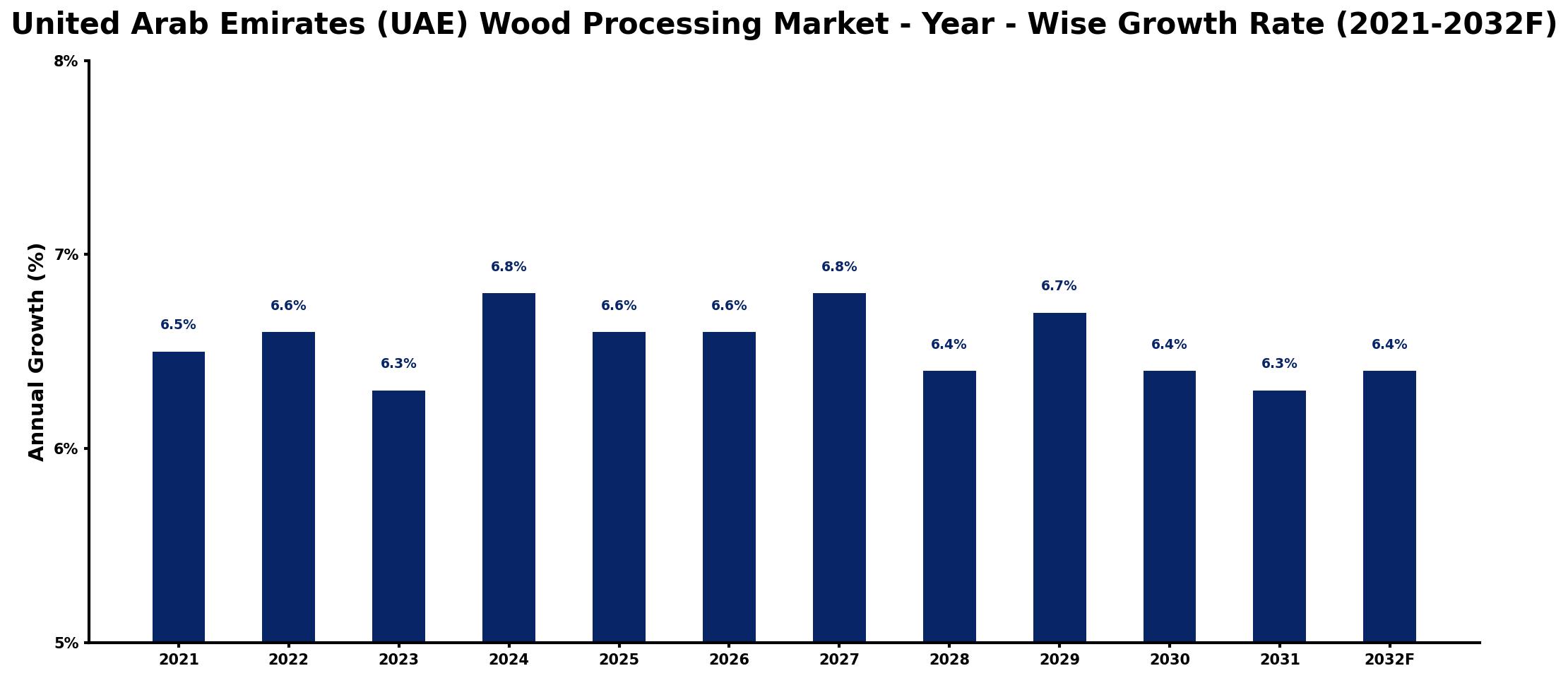
The table below presents the year‑wise growth rates along with the key drivers influencing the market
| Year | Growth Rate | Major Drivers |
| 2021 | 6.5% | Rising construction sector investments |
| 2022 | 6.6% | Increased demand for sustainable materials |
| 2023 | 6.3% | Growth in real estate projects |
| 2024 | 6.8% | Expansion of furniture manufacturing industry |
| 2025 | 6.6% | Surge in tourism infrastructure development |
| 2026 | 6.6% | Boost in interior design services |
| 2027 | 6.8% | Growing popularity of eco-friendly products |
| 2028 | 6.4% | Increase in renovation activities |
| 2029 | 6.7% | Higher disposable income levels |
| 2030 | 6.4% | rising procurement volume requirements |
| 2031 | 6.3% | Development of smart city initiatives |
| 2032 | 6.4% | Rising export opportunities for exports |
Note: Market size estimations and growth projections presented in this report are based on 6Wresearch's proprietary forecasting methodology, utilizing the latest available industry data, government publications, and primary research inputs.
United Arab Emirates (UAE) Wood Processing Market Synopsis
The most significant force currently shaping the UAE wood processing market is the construction boom, which drives the demand for a diverse range of wood products. As developers seek to enhance the aesthetic appeal and functionality of structures, the requirement for processed wood has surged, resulting in a vibrant marketplace.
In addition to construction, the furniture sector is rapidly evolving, leveraging high-quality processed wood to cater to varying consumer preferences. The emphasis on customization and luxury items has prompted manufacturers to innovate continually, showcasing the dynamic nature of the UAE wood processing landscape.
United Arab Emirates (UAE) Wood Processing Market Key Takeaways
- The market is poised for sustained growth driven by the booming construction and real estate sectors.
- Technological advancements are improving efficiency in wood processing, enhancing product quality.
- There is a growing emphasis on sustainable practices as environmental concerns gain traction.
- The furniture industry's evolution is significantly influencing market dynamics, emphasizing custom and luxury products.
- COVID-19 posed challenges, but the sector is adapting and strategizing for recovery and growth.
Evaluation of Restraints in United Arab Emirates (UAE) Wood Processing Market
Despite its growth potential, the UAE wood processing market faces several restraints that could hinder its expansion. One of the most pressing challenges is the necessity for continuous investment in advanced technology and machinery, which can be quite costly. Additionally, the industry must navigate the increasing environmental regulations that demand a shift toward sustainable production methods. This transformation often involves significant adjustments to established processes, presenting a barrier for some players in the market.
United Arab Emirates (UAE) Wood Processing Market Trends
Several trends are currently shaping the UAE wood processing market. Notably, there is a marked shift towards the adoption of innovative technologies that enhance production efficiency and reduce waste. Furthermore, the push for sustainable materials is encouraging companies to explore eco-friendly wood alternatives and processing methods. Customization has also gained traction, with consumers seeking unique and personalized wooden products, influencing manufacturers to diversify their offerings.
United Arab Emirates (UAE) Wood Processing Market Opportunities
There are substantial opportunities for growth and investment within the UAE wood processing market. The increasing focus on sustainable construction and eco-friendly products presents a chance for companies to position themselves as leaders in this niche. Additionally, the demand for high-quality custom furniture is on the rise, creating avenues for businesses to capitalize on consumer preferences for uniqueness and luxury. The ongoing expansion of the construction sector further enhances prospects for suppliers of processed wood, solidifying their roles in a thriving market.
Government Initiatives in the United Arab Emirates (UAE) Wood Processing Market
The UAE government has implemented several initiatives to foster growth in the wood processing sector. Policies aimed at promoting sustainable construction practices have encouraged businesses to adopt eco-friendly approaches. Public spending on infrastructure projects continues to boost demand for processed wood products. Furthermore, government incentives for innovation and technology adoption in manufacturing processes are expected to drive efficiency and competitiveness within the market.
Future Insights of the United Arab Emirates (UAE) Wood Processing Market
Looking ahead to 2026-2032, the UAE wood processing market is poised for significant advancements. The ongoing construction boom, coupled with a growing emphasis on sustainability, will likely fuel the demand for processed wood products. Innovations in technology will continue to drive efficiency, enabling manufacturers to meet evolving consumer expectations. Additionally, with the government's support for sustainable practices, the market is expected to evolve in alignment with global trends, paving the way for a vibrant and competitive landscape.
United Arab Emirates (UAE) Wood Processing Market Latest Developments (2025 - 2026)
Recent developments in the UAE wood processing market reflect a strategic shift towards sustainability and innovation. Companies are increasingly focusing on adopting advanced technologies that enhance production capabilities while minimizing environmental impact. Collaborations between industry players and research institutions are becoming more common, facilitating the development of new eco-friendly materials. Furthermore, market participants are adjusting their strategies to cater to the rising demand for customized and luxury wooden products, ensuring their offerings remain competitive in a dynamic landscape.
United Arab Emirates (UAE) Wood Processing Market - Key Attractiveness of the Report
- 10 Years of Market Numbers
- Historical Data Starting from 2022 to 2025
- Base Year: 2025
- Forecast Data until 2032
- Key Performance Indicators Impacting the Market
- Major Upcoming Developments and Projects
Key Highlights of the Report:
- United Arab Emirates (UAE) Wood Processing Market Outlook
- Market Size of United Arab Emirates (UAE) Wood Processing Market, 2025
- Forecast of United Arab Emirates (UAE) Wood Processing Market, 2032
- Historical Data and Forecast of United Arab Emirates (UAE) Wood Processing Revenues & Volume for the Period 2022-2032F
- United Arab Emirates (UAE) Wood Processing Market Trend Evolution
- United Arab Emirates (UAE) Wood Processing Market Drivers and Challenges
- United Arab Emirates (UAE) Wood Processing Price Trends
- United Arab Emirates (UAE) Wood Processing Porter's Five Forces
- United Arab Emirates (UAE) Wood Processing Industry Life Cycle
- Historical Data and Forecast of United Arab Emirates (UAE) Wood Processing Market Revenues & Volume By Type for the Period 2022-2032F
- Historical Data and Forecast of United Arab Emirates (UAE) Wood Processing Market Revenues & Volume By Wood Chips for the Period 2022-2032F
- Historical Data and Forecast of United Arab Emirates (UAE) Wood Processing Market Revenues & Volume By Sawn Wood Lumber for the Period 2022-2032F
- Historical Data and Forecast of United Arab Emirates (UAE) Wood Processing Market Revenues & Volume By Others for the Period 2022-2032F
- United Arab Emirates (UAE) Wood Processing Import Export Trade Statistics
- Market Opportunity Assessment By Type
- United Arab Emirates (UAE) Wood Processing Top Companies Market Share
- United Arab Emirates (UAE) Wood Processing Competitive Benchmarking By Technical and Operational Parameters
- United Arab Emirates (UAE) Wood Processing Company Profiles
- United Arab Emirates (UAE) Wood Processing Key Strategic Recommendations






































