United Kingdom (UK) Applicant Tracking System Market Size & Growth Rate (2026-2032)
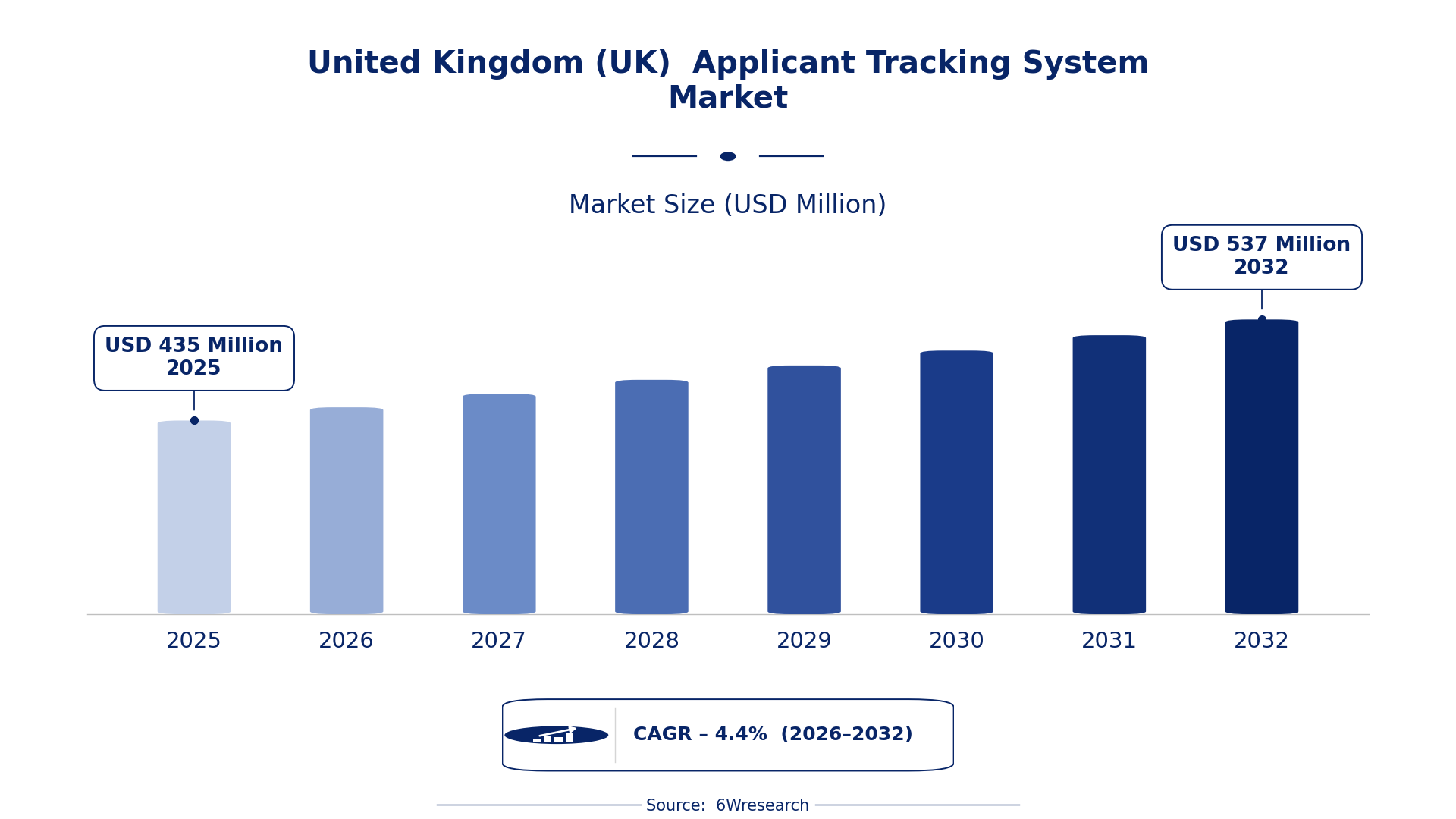
The United Kingdom (UK) Applicant Tracking System Market was estimated at USD 435 Million in 2025 and is projected to reach USD 537 Million by 2032, growing at a CAGR of 4.4% from 2026 to 2032.
United Kingdom (UK) Applicant Tracking System Market Synopsis
As organizations in the UK strive for a competitive edge, the demand for Applicant Tracking Systems (ATS) has surged. Businesses are increasingly recognizing the value of adopting technology that not only streamlines recruitment processes but also enhances the overall candidate experience, making ATS solutions indispensable.
With a growing emphasis on data-driven hiring practices, companies are turning to ATS platforms that integrate advanced technologies such as artificial intelligence and machine learning. These innovations facilitate better candidate matching and improve recruitment efficiency, positioning organizations to attract top talent more effectively.
United Kingdom (UK) Applicant Tracking System Market Year-wise Growth Rate and Key Drivers
This graph illustrates the annual growth rates of the United Kingdom (UK) Applicant Tracking System Market from 2021 to 2032, highlighting a steady upward trajectory and projected expansion over the forecast period.
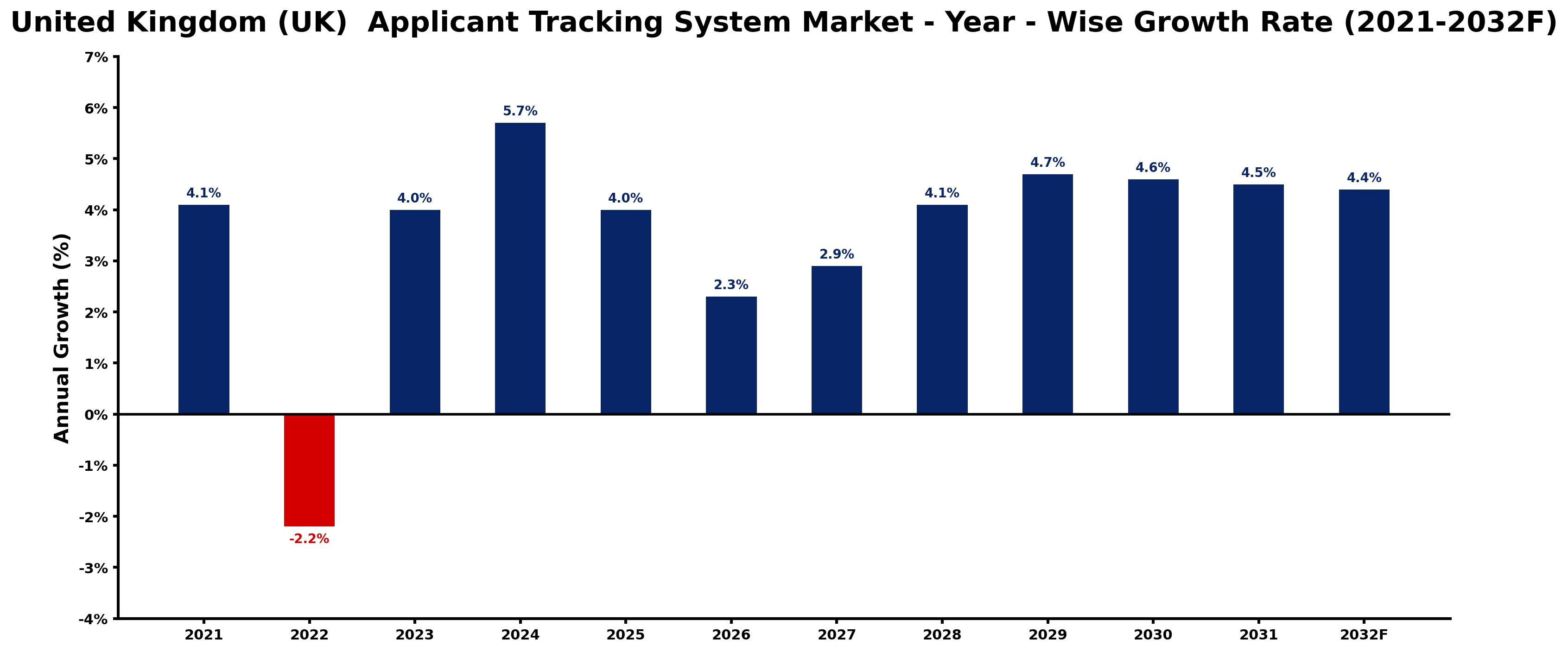
The table below presents the year‑wise growth rates along with the key drivers influencing the market
| Year | Growth Rate | Major Drivers |
| 2021 | 4.1% | UK's focus on remote hiring practices post-pandemic |
| 2022 | -2.2% | GDPR compliance costs hindered system implementations. |
| 2023 | 4.0% | Increased demand for digital recruitment solutions in industries |
| 2024 | 5.7% | Government policies promoting workforce diversity initiatives |
| 2025 | 4.0% | Surge in startups adopting digital hiring technologies |
| 2026 | 2.3% | Rising unemployment rates driving recruitment technology use |
| 2027 | 2.9% | Technological advancements in AI for candidate screening |
| 2028 | 4.1% | Enhanced data security regulations boosting ATS adoption |
| 2029 | 4.7% | Growing importance of employer branding in recruitment |
| 2030 | 4.6% | Work-from-home trend increasing reliance on remote hiring |
| 2031 | 4.5% | Shift towards skills-based hiring strategies among businesses |
| 2032 | 4.4% | Integration of ATS with HR software solutions expanding |
Note: Market size estimations and growth projections presented in this report are based on 6Wresearch's proprietary forecasting methodology, utilizing the latest available industry data, government publications, and primary research inputs.
United Kingdom (UK) Applicant Tracking System Market Key Takeaways
Below are some of the specific key takeaways from the market, including:
- Cloud-based ATS solutions are gaining traction due to their flexibility and accessibility.
- Integration of AI and machine learning is transforming candidate screening and recruitment strategies.
- Mobile-friendly ATS interfaces are essential to cater to the increasing number of job seekers using smartphones.
- Compliance with data privacy regulations, such as GDPR, is crucial for ATS vendors to maintain trust.
- The market is evolving to meet the demands of remote hiring and data-driven decision-making.
Evaluation of Restraints in United Kingdom (UK) Applicant Tracking System Market
Despite its promising growth, the UK ATS market faces notable constraints. Chief among these is the intense competition among vendors, which complicates differentiation for companies offering similar solutions. on top of that, the rapid pace of technological advancements necessitates continuous updates to meet changing recruitment trends, placing pressure on ATS providers. Compliance with stringent data privacy regulations like GDPR adds another layer of complexity, compelling vendors to invest heavily in data security while navigating the evolving regulatory landscape.
United Kingdom (UK) Applicant Tracking System Market Trends
Several key trends are shaping the UK ATS market. A marked shift towards cloud-based solutions is evident as companies seek scalable and cost-effective recruitment tools. The integration of AI and machine learning into ATS platforms is not just a trend but a necessity for automating repetitive tasks and enhancing candidate screening. on top of that, mobile accessibility is becoming increasingly important, as job seekers are leveraging smartphones to search for opportunities. The heightened focus on data security and GDPR compliance reflects the industry's commitment to protecting sensitive information.
United Kingdom (UK) Applicant Tracking System Market Opportunities
Opportunities abound in the UK ATS market as businesses continue to prioritize efficient recruitment solutions. Investment in innovative ATS providers that incorporate AI-driven features and data analytics capabilities is likely to yield significant returns. Additionally, as remote work becomes a staple, ATS solutions catering to this shift present substantial growth potential. The demand for enhanced candidate experiences and streamlined application processes further underscores the lucrative avenues for investment in this sector.
Government Initiatives in the United Kingdom (UK) Applicant Tracking System Market
Government policies are playing a crucial role in shaping the trajectory of the UK ATS market. With a focus on ensuring fair competition and protecting candidate data, regulations like GDPR are pivotal. The UK government is also promoting technology adoption within organizations to enhance recruitment processes, thereby improving workforce efficiency.
- A regulatory framework established in 2025 mandates compliance with GDPR for companies using ATS, reinforcing data protection.
- The Competition and Markets Authority (CMA) is currently overseeing the ATS market to prevent anti-competitive practices.
- Recently launched initiatives encourage businesses to adopt modern recruitment technologies, improving overall efficiency.
- Ongoing government programs focus on digital skills training to help HR professionals adapt to new ATS technologies.
- Upcoming policies aim to incentivize SMEs to adopt ATS solutions, enhancing their recruitment capabilities by 2028.
Future Insights of the United Kingdom (UK) Applicant Tracking System Market
Looking ahead to 2026-2032, the UK ATS market is set for steady growth, driven by technological advancements and an increasing focus on efficient talent acquisition. The ongoing shift towards remote work and the growing volume of job applications will fuel demand for innovative ATS solutions. As AI and machine learning technologies continue to evolve, ATS providers will enhance their offerings, leading to improved recruitment outcomes and candidate experiences.
United Kingdom (UK) Applicant Tracking System Market Latest Developments
In the past year, the UK ATS market has seen significant activity as organizations adapt to changing recruitment landscapes. Companies are investing in new technologies and features to stay competitive, reflecting the urgent need for efficient hiring processes amidst evolving job market conditions.
- A major technology vendor announced the rollout of an enhanced ATS platform in early 2025, featuring AI-driven candidate matching capabilities.
- An initiative to integrate mobile-friendly interfaces into existing ATS solutions began in mid-2025 and remains underway, aimed at improving user experience.
- A partnership between leading ATS providers and data security firms was established in Q2 2025 to enhance compliance with GDPR regulations.
- Upcoming product launches in the second half of 2026 promise to introduce advanced analytics features, streamlining recruitment strategies.
- Recent enhancements to existing ATS platforms were completed by late 2025, focusing on improving data privacy measures.
United Kingdom (UK) Applicant Tracking System Market - Key Attractiveness of the Report
- 10 Years of Market Numbers
- Historical Data Starting from 2022 to 2025
- Base Year: 2025
- Forecast Data until 2032
- Key Performance Indicators Impacting the Market
- Major Upcoming Developments and Projects
Key Highlights of the Report:
- United Kingdom (UK) Applicant Tracking System Market Outlook
- Market Size of United Kingdom (UK) Applicant Tracking System Market, 2025
- Forecast of United Kingdom (UK) Applicant Tracking System Market, 2032
- Historical Data and Forecast of United Kingdom (UK) Applicant Tracking System Revenues & Volume for the Period 2022-2032F
- United Kingdom (UK) Applicant Tracking System Market Trend Evolution
- United Kingdom (UK) Applicant Tracking System Market Drivers and Challenges
- United Kingdom (UK) Applicant Tracking System Price Trends
- United Kingdom (UK) Applicant Tracking System Porter's Five Forces
- United Kingdom (UK) Applicant Tracking System Industry Life Cycle
- Historical Data and Forecast of United Kingdom (UK) Applicant Tracking System Market Revenues & Volume By Component for the Period 2022-2032F
- Historical Data and Forecast of United Kingdom (UK) Applicant Tracking System Market Revenues & Volume By Software for the Period 2022-2032F
- Historical Data and Forecast of United Kingdom (UK) Applicant Tracking System Market Revenues & Volume By Services for the Period 2022-2032F
- Historical Data and Forecast of United Kingdom (UK) Applicant Tracking System Market Revenues & Volume By Organization Size for the Period 2022-2032F
- Historical Data and Forecast of United Kingdom (UK) Applicant Tracking System Market Revenues & Volume By SMEs for the Period 2022-2032F
- Historical Data and Forecast of United Kingdom (UK) Applicant Tracking System Market Revenues & Volume By Large Enterprises for the Period 2022-2032F
- Historical Data and Forecast of United Kingdom (UK) Applicant Tracking System Market Revenues & Volume By Deployment Mode for the Period 2022-2032F
- Historical Data and Forecast of United Kingdom (UK) Applicant Tracking System Market Revenues & Volume By On-Premises for the Period 2022-2032F
- Historical Data and Forecast of United Kingdom (UK) Applicant Tracking System Market Revenues & Volume By Cloud for the Period 2022-2032F
- Historical Data and Forecast of United Kingdom (UK) Applicant Tracking System Market Revenues & Volume By Vertical for the Period 2022-2032F
- Historical Data and Forecast of United Kingdom (UK) Applicant Tracking System Market Revenues & Volume By BFSI for the Period 2022-2032F
- Historical Data and Forecast of United Kingdom (UK) Applicant Tracking System Market Revenues & Volume By Government for the Period 2022-2032F
- Historical Data and Forecast of United Kingdom (UK) Applicant Tracking System Market Revenues & Volume By Manufacturing for the Period 2022-2032F
- Historical Data and Forecast of United Kingdom (UK) Applicant Tracking System Market Revenues & Volume By Telecom and IT for the Period 2022-2032F
- Historical Data and Forecast of United Kingdom (UK) Applicant Tracking System Market Revenues & Volume By Consumer Goods and Retail for the Period 2022-2032F
- Historical Data and Forecast of United Kingdom (UK) Applicant Tracking System Market Revenues & Volume By Healthcare and Lifesciencs for the Period 2022-2032F
- Historical Data and Forecast of United Kingdom (UK) Applicant Tracking System Market Revenues & Volume By Energy and Utilities for the Period 2022-2032F
- Historical Data and Forecast of United Kingdom (UK) Applicant Tracking System Market Revenues & Volume By Transportation and Logistics for the Period 2022-2032F
- United Kingdom (UK) Applicant Tracking System Import Export Trade Statistics
- Market Opportunity Assessment By Component
- Market Opportunity Assessment By Organization Size
- Market Opportunity Assessment By Deployment Mode
- Market Opportunity Assessment By Vertical
- United Kingdom (UK) Applicant Tracking System Top Companies Market Share
- United Kingdom (UK) Applicant Tracking System Competitive Benchmarking By Technical and Operational Parameters
- United Kingdom (UK) Applicant Tracking System Company Profiles
- United Kingdom (UK) Applicant Tracking System Key Strategic Recommendations






































