United Kingdom (UK) Artificial Intelligence Platform Market Size & Growth Rate (2026-2032)
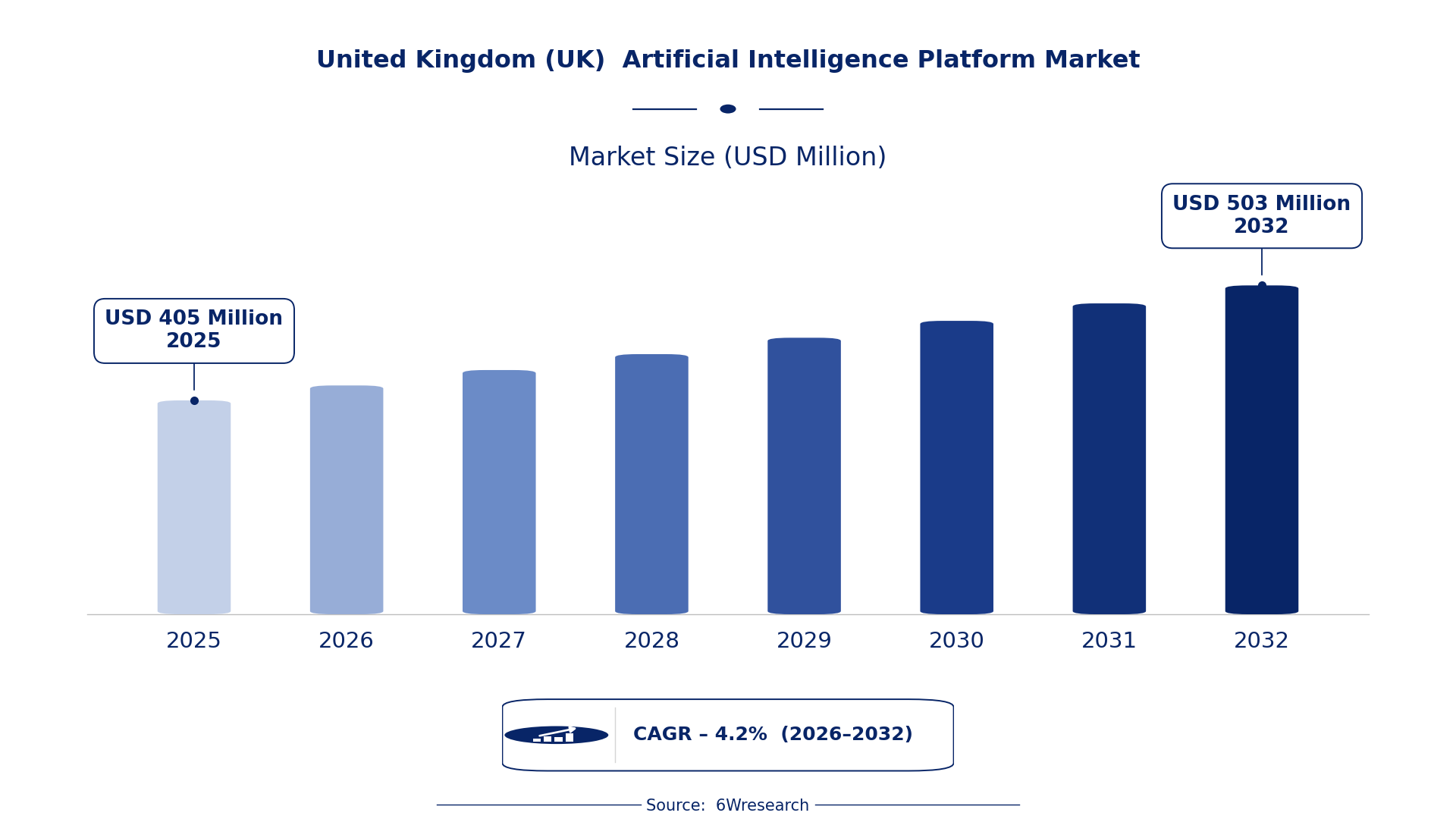
The United Kingdom (UK) Artificial Intelligence Platform Market was estimated at USD 405 Million in 2025 and is projected to reach USD 503 Million by 2032, growing at a CAGR of 4.2% from 2026 to 2032.
United Kingdom (UK) Artificial Intelligence Platform Market Synopsis
The increasing adoption of AI technologies across various sectors is the most influential force in shaping the UK Artificial Intelligence Platform Market. Industries such as healthcare, finance, and retail are not just experimenting but are deeply integrating AI solutions to enhance operational efficiency and customer engagement.
As businesses pivot toward digital transformation, the demand for AI platforms is surging. The market is not just expanding in size but is also diversifying, with platforms now offering specialized solutions in machine learning, natural language processing, and computer vision, catering to unique industry needs.
United Kingdom (UK) Artificial Intelligence Platform Market Year-wise Growth Rate and Key Drivers
This graph illustrates the annual growth rates of the United Kingdom (UK) Artificial Intelligence Platform Market from 2021 to 2032, highlighting a steady upward trajectory and projected expansion over the forecast period.
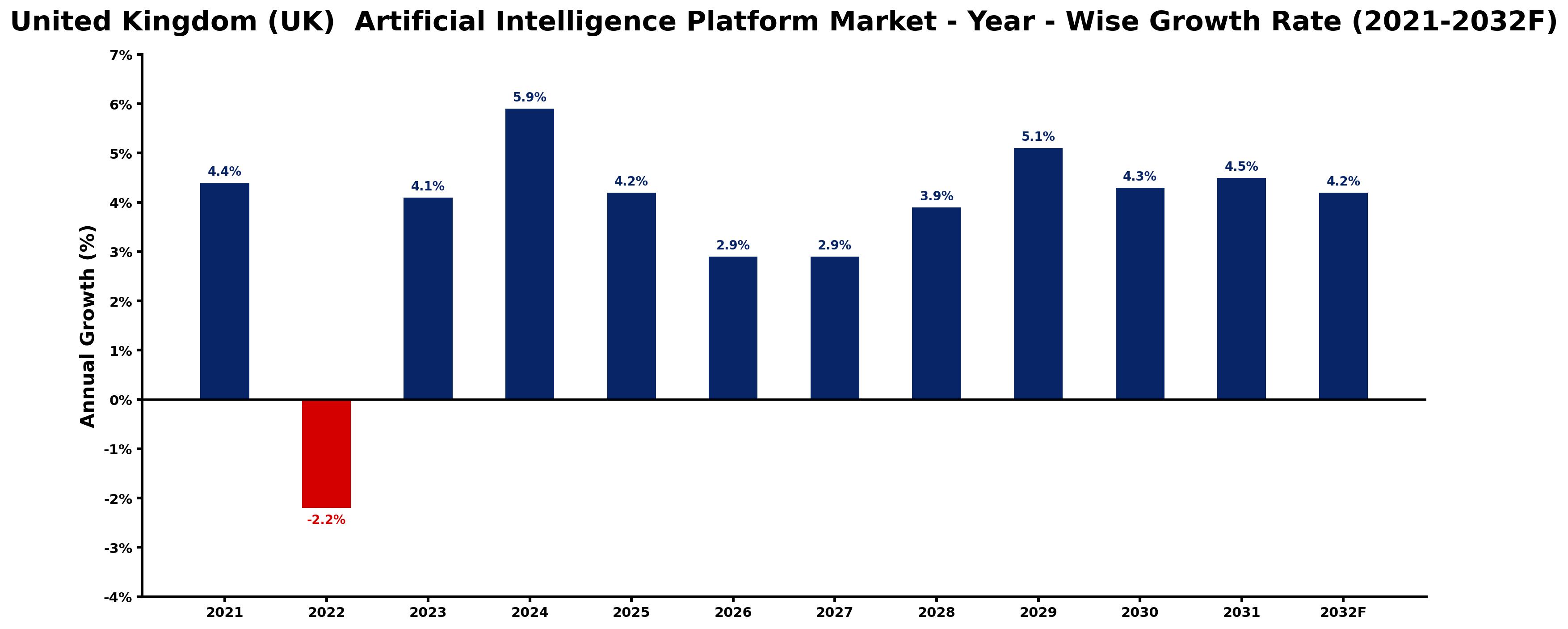
The table below presents the year‑wise growth rates along with the key drivers influencing the market
| Year | Growth Rate | Major Drivers |
| 2021 | 4.4% | UK government’s AI strategy funding for innovation projects. |
| 2022 | -2.2% | UK's Data Protection Act limits AI data usage. |
| 2023 | 4.1% | Rising adoption of AI in financial services and fintech. |
| 2024 | 5.9% | Increased investment in AI-driven climate change solutions. |
| 2025 | 4.2% | Growth of AI in UK transportation and logistics networks. |
| 2026 | 2.9% | Emergence of UK AI startups in edtech market. |
| 2027 | 2.9% | Greater integration of AI in retail customer experiences. |
| 2028 | 3.9% | Support for AI-enhanced cybersecurity initiatives by NCSC. |
| 2029 | 5.1% | Focus on AI for public safety and emergency services. |
| 2030 | 4.3% | Development of regional AI hubs in major cities. |
| 2031 | 4.5% | Increased demand for AI training in higher education. |
| 2032 | 4.2% | Collaboration between universities and industries for AI research. |
Note: Market size estimations and growth projections presented in this report are based on 6Wresearch's proprietary forecasting methodology, utilizing the latest available industry data, government publications, and primary research inputs.
United Kingdom (UK) Artificial Intelligence Platform Market Key Takeaways
Below are some of the specific key takeaways from the market, including:
- Healthcare and finance sectors lead the adoption of AI platforms, driving substantial market growth.
- There is a noticeable trend toward ethical AI practices, ensuring transparency in AI applications.
- Investment in research and development is critical for enhancing platform capabilities.
- Startups are emerging with innovative solutions, challenging established players in the market.
- Government initiatives are actively promoting AI innovation and ethical considerations.
Evaluation of Restraints in United Kingdom (UK) Artificial Intelligence Platform Market
Despite the promising growth trajectory, the UK Artificial Intelligence Platform Market faces notable restraints. A significant challenge is the shortage of skilled talent in AI development and implementation, which can impede the pace at which businesses adopt these technologies. Additionally, concerns surrounding data privacy and compliance with stringent regulations continue to pose hurdles for AI platform providers. The rapid evolution of AI technologies demands continuous investment in research and development, making it essential for companies to remain agile and competitive.
United Kingdom (UK) Artificial Intelligence Platform Market Trends
Current trends indicate a surge in the deployment of AI-powered chatbots, enhancing customer service experiences across sectors. Predictive analytics tools are gaining traction, providing businesses with actionable insights for better decision-making. on top of that, the integration of machine learning algorithms for personalized recommendations is becoming a staple in retail and e-commerce, significantly improving customer engagement and satisfaction.
Ethical AI practices are increasingly emphasized, with businesses striving for transparency and accountability in their AI implementations. As market players invest heavily in innovation, the competition will likely intensify, pushing boundaries on technology capabilities.
United Kingdom (UK) Artificial Intelligence Platform Market Opportunities
The UK Artificial Intelligence Platform Market is rich with investment opportunities, particularly within healthcare and financial services. Platforms that facilitate personalized medicine and advanced diagnostics stand to benefit significantly. Similarly, financial institutions are increasingly seeking AI solutions for fraud detection and risk assessment, presenting a ripe opportunity for innovative AI platforms.
In retail, AI platforms focused on customer analytics and supply chain optimization are in high demand. Manufacturing sectors are also exploring predictive maintenance solutions, promising substantial growth potential in the coming years. Investing in emerging startups that specialize in cutting-edge AI technologies could yield high returns as the market matures.
Government Initiatives in the United Kingdom (UK) Artificial Intelligence Platform Market
Government policy plays a crucial role in shaping the trajectory of the UK Artificial Intelligence Platform Market. The UK government has demonstrated a clear commitment to fostering AI innovation through various strategic initiatives aimed at promoting research, skills development, and ethical AI practices. These efforts not only enhance the market's growth potential but also underscore the importance of responsible AI use.
- A recently completed AI Sector Deal aimed at establishing the UK as a global leader in AI by investing in R&D and infrastructure.
- A current initiative to enhance skills training in AI, ensuring a steady pipeline of qualified professionals in the field.
- Ongoing efforts by the Centre for Data Ethics and Innovation to develop frameworks that guide ethical AI deployment.
- A planned public-private initiative to expand AI research capabilities in universities, expected to launch in the next fiscal year.
- Establishment of the AI Council to provide strategic oversight on AI policy and drive collaboration between the government and industry.
Future Insights of the United Kingdom (UK) Artificial Intelligence Platform Market
Looking ahead, the UK Artificial Intelligence Platform Market is on a clear upward trajectory from 2026 to 2032. With a strong emphasis on digital transformation and automation across various sectors, the demand for AI technologies is anticipated to surge. Investment in AI startups and ongoing government initiatives will further drive innovation, solidifying the UK’s position in the global AI arena.
As advancements in technologies such as machine learning and natural language processing continue to evolve, businesses will increasingly leverage these tools for improved operational efficiency and enhanced customer experiences. The market’s expansion appears both inevitable and promising.
United Kingdom (UK) Artificial Intelligence Platform Market Latest Developments
Recent industry activity within the UK Artificial Intelligence Platform Market has been dynamic, showcasing a range of developments that reflect the sector's growth and innovation. Companies are increasingly focusing on enhancing their AI capabilities to meet the rising demand across various industries.
- A leading technology vendor launched a next-generation AI platform in early 2025, designed to integrate seamlessly with existing enterprise systems.
- Partnerships between universities and tech companies are currently underway, aimed at fostering innovation in AI research and development.
- An initiative to upgrade AI training programs began in mid-2025 and remains ongoing, focusing on equipping professionals with necessary skills.
- A major technology player is expected to roll out an AI-driven analytics tool by Q3 2026, targeting the retail sector for enhanced customer insights.
- A pilot program for ethical AI use in public services was completed in late 2025, yielding promising results that may inform future policy.
United Kingdom (UK) Artificial Intelligence Platform Market - Key Attractiveness of the Report
- 10 Years of Market Numbers
- Historical Data Starting from 2022 to 2025
- Base Year: 2025
- Forecast Data until 2032
- Key Performance Indicators Impacting the Market
- Major Upcoming Developments and Projects
Key Highlights of the Report:
- United Kingdom (UK) Artificial Intelligence Platform Market Outlook
- Market Size of United Kingdom (UK) Artificial Intelligence Platform Market, 2025
- Forecast of United Kingdom (UK) Artificial Intelligence Platform Market, 2032
- Historical Data and Forecast of United Kingdom (UK) Artificial Intelligence Platform Revenues & Volume for the Period 2022-2032F
- United Kingdom (UK) Artificial Intelligence Platform Market Trend Evolution
- United Kingdom (UK) Artificial Intelligence Platform Market Drivers and Challenges
- United Kingdom (UK) Artificial Intelligence Platform Price Trends
- United Kingdom (UK) Artificial Intelligence Platform Porter's Five Forces
- United Kingdom (UK) Artificial Intelligence Platform Industry Life Cycle
- Historical Data and Forecast of United Kingdom (UK) Artificial Intelligence Platform Market Revenues & Volume By Component for the Period 2022-2032F
- Historical Data and Forecast of United Kingdom (UK) Artificial Intelligence Platform Market Revenues & Volume By Tools for the Period 2022-2032F
- Historical Data and Forecast of United Kingdom (UK) Artificial Intelligence Platform Market Revenues & Volume By Services for the Period 2022-2032F
- Historical Data and Forecast of United Kingdom (UK) Artificial Intelligence Platform Market Revenues & Volume By Application for the Period 2022-2032F
- Historical Data and Forecast of United Kingdom (UK) Artificial Intelligence Platform Market Revenues & Volume By Forecasts and prescriptive models for the Period 2022-2032F
- Historical Data and Forecast of United Kingdom (UK) Artificial Intelligence Platform Market Revenues & Volume By Chatbots for the Period 2022-2032F
- Historical Data and Forecast of United Kingdom (UK) Artificial Intelligence Platform Market Revenues & Volume By Speech recognition for the Period 2022-2032F
- Historical Data and Forecast of United Kingdom (UK) Artificial Intelligence Platform Market Revenues & Volume By Text recognition for the Period 2022-2032F
- Historical Data and Forecast of United Kingdom (UK) Artificial Intelligence Platform Market Revenues & Volume By Others for the Period 2022-2032F
- Historical Data and Forecast of United Kingdom (UK) Artificial Intelligence Platform Market Revenues & Volume By Deployment Mode for the Period 2022-2032F
- Historical Data and Forecast of United Kingdom (UK) Artificial Intelligence Platform Market Revenues & Volume By Cloud for the Period 2022-2032F
- Historical Data and Forecast of United Kingdom (UK) Artificial Intelligence Platform Market Revenues & Volume By On-Premises for the Period 2022-2032F
- Historical Data and Forecast of United Kingdom (UK) Artificial Intelligence Platform Market Revenues & Volume By Tools for the Period 2022-2032F
- Historical Data and Forecast of United Kingdom (UK) Artificial Intelligence Platform Market Revenues & Volume By NLP for the Period 2022-2032F
- Historical Data and Forecast of United Kingdom (UK) Artificial Intelligence Platform Market Revenues & Volume By ML for the Period 2022-2032F
- United Kingdom (UK) Artificial Intelligence Platform Import Export Trade Statistics
- Market Opportunity Assessment By Component
- Market Opportunity Assessment By Application
- Market Opportunity Assessment By Deployment Mode
- Market Opportunity Assessment By Tools
- United Kingdom (UK) Artificial Intelligence Platform Top Companies Market Share
- United Kingdom (UK) Artificial Intelligence Platform Competitive Benchmarking By Technical and Operational Parameters
- United Kingdom (UK) Artificial Intelligence Platform Company Profiles
- United Kingdom (UK) Artificial Intelligence Platform Key Strategic Recommendations






































