United Kingdom (UK) Automotive Reversing Radar Market Size, Share & Growth Rate
The United Kingdom (UK) Automotive Reversing Radar Market was estimated at USD 227 Million in 2025 and is projected to reach USD 318 Million by 2032, growing at a CAGR of 4.9% from 2026 to 2032. This growth trajectory is primarily driven by heightened concerns regarding vehicle safety, underscored by both consumer demand and regulatory imperatives. As safety becomes increasingly paramount for vehicle manufacturers and buyers alike, the installation of reversing radar systems is poised to become a common feature in new vehicle models.
United Kingdom (UK) Automotive Reversing Radar Market Year-wise Growth Rate and Key Drivers
This graph highlights how the United Kingdom (UK) Automotive Reversing Radar Market has steadily grown over the years, supported by major growth factors.
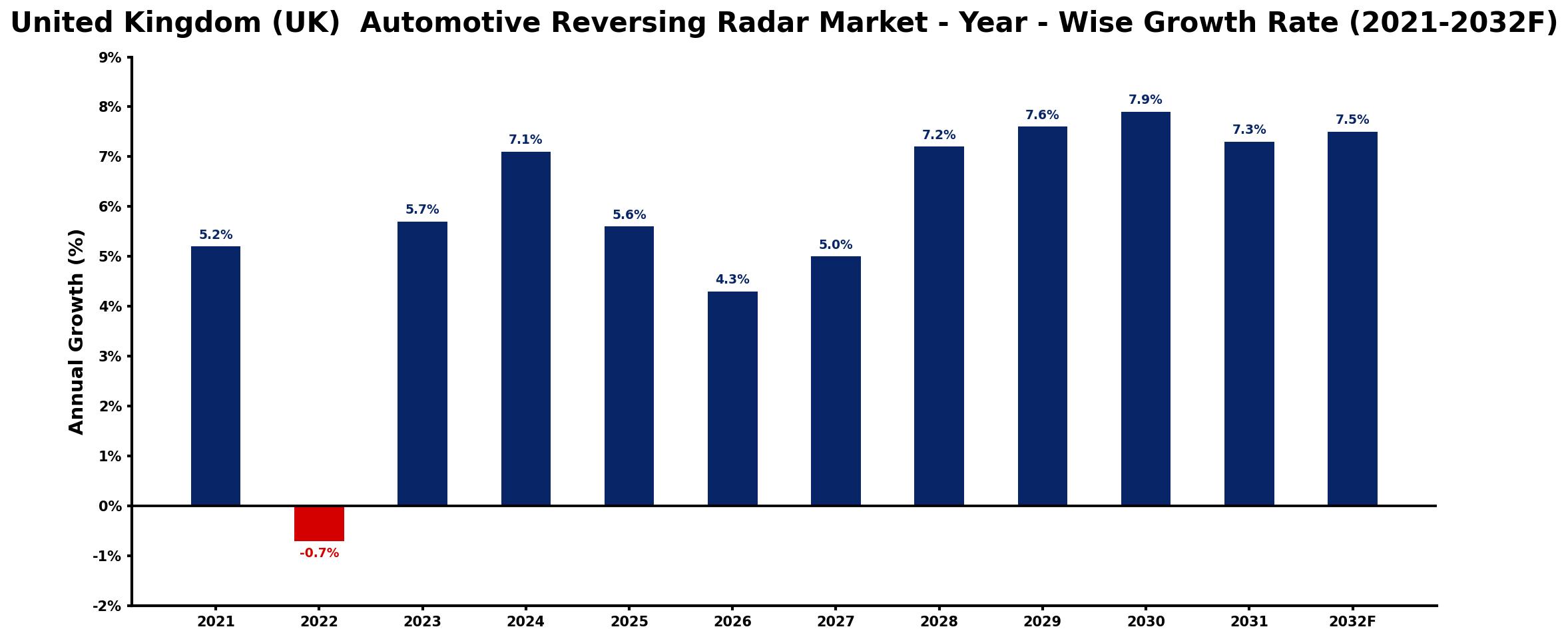
The table below presents the year‑wise growth rates along with the key drivers influencing the market
| Year | Growth Rate | Major Drivers |
| 2021 | 5.2% | Rising safety regulations driving demand |
| 2022 | -0.7% | weak end-use demand conditions |
| 2023 | 5.7% | Increased consumer awareness on safety |
| 2024 | 7.1% | Technological advancements enhancing features |
| 2025 | 5.6% | Growing urbanization boosting demand |
| 2026 | 4.3% | Investment in smart vehicle technologies |
| 2027 | 5.0% | Expansion of aftermarket service offerings |
| 2028 | 7.2% | Surge in electric vehicle adoption |
| 2029 | 7.6% | Increased partnerships with tech firms |
| 2030 | 7.9% | Focus on sustainability and safety |
| 2031 | 7.3% | Rising awareness of pedestrian safety |
| 2032 | 7.5% | Emergence of advanced driver assistance |
Note: Market size estimations and growth projections presented in this report are based on 6Wresearch's proprietary forecasting methodology, utilizing the latest available industry data, government publications, and primary research inputs.
United Kingdom (UK) Automotive Reversing Radar Market Synopsis
The automotive reversing radar market in the UK is evolving rapidly, reflecting the broader trends towards enhanced vehicle safety and advanced driver assistance systems (ADAS). Not only do these systems aid drivers in navigating tight spaces, but they also play a crucial role in preventing accidents, making them a desirable addition for both consumers and manufacturers.
As the UK government continues to promote stringent safety standards, consumer awareness regarding vehicle safety features is on the rise. The integration of reversing radar systems with other technological advancements, such as improved sensors and object detection capabilities, further drives the market's growth and attractiveness.
United Kingdom (UK) Automotive Reversing Radar Market Key Takeaways
- The market is forecasted to grow substantially, driven by increasing regulatory requirements for vehicle safety.
- Consumer demand for advanced safety features is elevating the adoption rate of reversing radar systems.
- Technological innovations are improving sensor accuracy, making reversing radar systems more effective.
- Manufacturers face pressures related to the cost and complexity of advanced radar systems.
- Integration with other safety systems is becoming a crucial aspect of market development.
Evaluation of Restraints in United Kingdom (UK) Automotive Reversing Radar Market
Despite its growth potential, the automotive reversing radar market in the UK encounters significant hurdles. One of the primary restraints is the increasing complexity and cost associated with developing advanced radar systems, particularly those incorporating features such as object recognition and distance measurement. This necessitates substantial investment in research and development, which can strain smaller manufacturers. Additionally, ensuring the reliability and accuracy of these systems across varying driving conditions remains a critical challenge, compelling manufacturers to prioritize rigorous testing and quality control measures.
United Kingdom (UK) Automotive Reversing Radar Market Trends
Several trends are shaping the automotive reversing radar market in the UK. One notable trend is the growing integration of reversing radar systems with other ADAS technologies, such as lane departure warnings and collision avoidance systems. This interconnected approach enhances overall vehicle safety and functionality. Furthermore, as public awareness of road safety issues grows, manufacturers are increasingly focusing on user-friendly interfaces and intuitive features that cater to driver needs. The increasing incorporation of Artificial Intelligence in obstacle detection also stands out as a transformative development in the market.
United Kingdom (UK) Automotive Reversing Radar Market Opportunities
The automotive reversing radar market in the UK presents numerous opportunities for growth and investment. As consumer awareness regarding vehicle safety continues to rise, manufacturers who innovate with cost-effective solutions will be well-positioned to capture market share. Moreover, the push for electric and autonomous vehicles opens new avenues for integrating advanced reversing radar systems. Investment in R&D to enhance system accuracy and reduce costs could also foster increased adoption rates among consumers and fleet operators alike.
Government Initiatives in the United Kingdom (UK) Automotive Reversing Radar Market
The UK government plays a pivotal role in shaping the automotive reversing radar market through various safety regulations and initiatives. Campaigns promoting vehicle safety standards and potential mandates for advanced driver assistance systems (ADAS) in new vehicles are driving the adoption of reversing radar technologies. As part of its commitment to road safety, the government is likely to continue pushing for enhanced safety measures, encouraging manufacturers to incorporate such systems in their offerings.
Future Insights of the United Kingdom (UK) Automotive Reversing Radar Market
Looking ahead to the period between 2026 and 2032, the UK automotive reversing radar market is expected to experience substantial transformation. Key drivers will include ongoing advancements in technology, coupled with a concerted effort from manufacturers to integrate these systems seamlessly into the vehicle ecosystem. As regulatory frameworks become more stringent, the demand for reversing radar systems will likely become a standard feature in new vehicle models, further solidifying their role in promoting driver safety and convenience.
United Kingdom (UK) Automotive Reversing Radar Market Latest Developments (2025 - 2026)
The automotive reversing radar market in the UK is currently undergoing dynamic changes, driven by technological advancements and increasing consumer expectations. Recent developments have highlighted significant strides in sensor technology, enhancing the precision and reliability of these systems. Furthermore, collaborative efforts between manufacturers and tech companies are fostering innovative solutions that integrate reversing radars with broader safety systems, enhancing overall vehicle functionality and safety.
United Kingdom (UK) Automotive Reversing Radar Market - Key Attractiveness of the Report
- 10 Years of Market Numbers
- Historical Data Starting from 2022 to 2025
- Base Year: 2025
- Forecast Data until 2032
- Key Performance Indicators Impacting the Market
- Major Upcoming Developments and Projects
Key Highlights of the Report:
- United Kingdom (UK) Automotive Reversing Radar Market Outlook
- Market Size of United Kingdom (UK) Automotive Reversing Radar Market, 2025
- Forecast of United Kingdom (UK) Automotive Reversing Radar Market, 2032
- Historical Data and Forecast of United Kingdom (UK) Automotive Reversing Radar Revenues & Volume for the Period 2022-2032F
- United Kingdom (UK) Automotive Reversing Radar Market Trend Evolution
- United Kingdom (UK) Automotive Reversing Radar Market Drivers and Challenges
- United Kingdom (UK) Automotive Reversing Radar Price Trends
- United Kingdom (UK) Automotive Reversing Radar Porter's Five Forces
- United Kingdom (UK) Automotive Reversing Radar Industry Life Cycle
- Historical Data and Forecast of United Kingdom (UK) Automotive Reversing Radar Market Revenues & Volume By Type for the Period 2022-2032F
- Historical Data and Forecast of United Kingdom (UK) Automotive Reversing Radar Market Revenues & Volume By Ultrasonic for the Period 2022-2032F
- Historical Data and Forecast of United Kingdom (UK) Automotive Reversing Radar Market Revenues & Volume By Electromagnetic for the Period 2022-2032F
- Historical Data and Forecast of United Kingdom (UK) Automotive Reversing Radar Market Revenues & Volume By Application for the Period 2022-2032F
- Historical Data and Forecast of United Kingdom (UK) Automotive Reversing Radar Market Revenues & Volume By Passenger Vehicle for the Period 2022-2032F
- Historical Data and Forecast of United Kingdom (UK) Automotive Reversing Radar Market Revenues & Volume By Commercial Vehicle for the Period 2022-2032F
- United Kingdom (UK) Automotive Reversing Radar Import Export Trade Statistics
- Market Opportunity Assessment By Type
- Market Opportunity Assessment By Application
- United Kingdom (UK) Automotive Reversing Radar Top Companies Market Share
- United Kingdom (UK) Automotive Reversing Radar Competitive Benchmarking By Technical and Operational Parameters
- United Kingdom (UK) Automotive Reversing Radar Company Profiles
- United Kingdom (UK) Automotive Reversing Radar Key Strategic Recommendations






































