United Kingdom (UK) Aviation Test Equipment Market Size, Share & Growth Rate
The United Kingdom (UK) Aviation Test Equipment Market was estimated at USD 318 Million in 2025 and is projected to reach USD 394 Million by 2032, growing at a CAGR of 3.1% from 2026 to 2032. This upward trajectory is fueled by the aviation sector's relentless pursuit of safety, regulatory compliance, and operational efficiency. The increasing complexity of aircraft systems further necessitates advanced testing solutions, prompting a robust demand for innovative ground support equipment and testing instruments.
United Kingdom (UK) Aviation Test Equipment Market Year-wise Growth Rate and Key Drivers
This graph highlights how the United Kingdom (UK) Aviation Test Equipment Market has steadily grown over the years, supported by major growth factors.
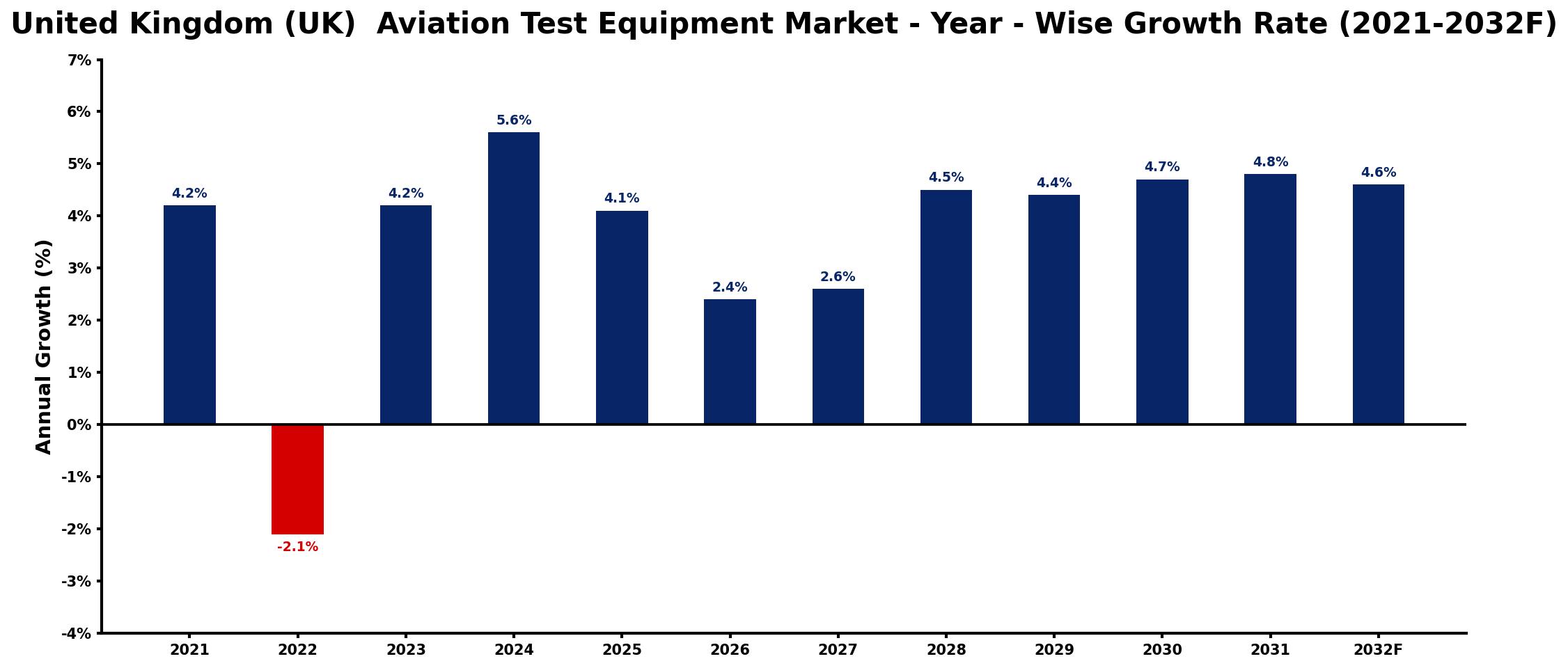
The table below presents the year‑wise growth rates along with the key drivers influencing the market
| Year | Growth Rate | Major Drivers |
| 2021 | 4.2% | Rising demand for air travel |
| 2022 | -2.1% | Decreased investments in infrastructure |
| 2023 | 4.2% | Technological advancements boosting efficiency |
| 2024 | 5.6% | Expansion of commercial flight operations |
| 2025 | 4.1% | Growing focus on safety regulations |
| 2026 | 2.4% | Increased military expenditure on modernization |
| 2027 | 2.6% | Development of renewable energy sources |
| 2028 | 4.5% | Emergence of urban air mobility |
| 2029 | 4.4% | Strengthening global supply chains |
| 2030 | 4.7% | growing regional consumption patterns |
| 2031 | 4.8% | strengthening international trade flows |
| 2032 | 4.6% | Investments in automation technologies |
Note: Market size estimations and growth projections presented in this report are based on 6Wresearch's proprietary forecasting methodology, utilizing the latest available industry data, government publications, and primary research inputs.
United Kingdom (UK) Aviation Test Equipment Market Synopsis
Despite recent momentum stemming from heightened safety regulations and technological advancements, the UK Aviation Test Equipment Market is set to evolve significantly. Future growth is poised to be driven by an increased focus on digitalization and sustainable practices within the industry, which necessitate more sophisticated testing solutions.
As the market continues to mature, the integration of automated and portable testing devices is becoming more prevalent. This shift not only enhances operational efficiency but also aligns with the aviation industry's commitment to environmentally friendly practices. Stakeholders must stay vigilant to capitalize on emerging trends and changing regulatory landscapes.
United Kingdom (UK) Aviation Test Equipment Market Key Takeaways
- The market is experiencing steady growth driven by an increased demand for safety and compliance in aviation.
- Emerging technologies such as AI and IoT are reshaping testing processes, making them more efficient and accurate.
- Portable and handheld equipment is gaining traction due to its convenience and flexibility for on-site applications.
- Investment opportunities are prevalent in the development of advanced testing equipment aligned with industry advancements.
- Government policies are actively promoting innovation while adapting to the post-Brexit regulatory landscape.
Evaluation of Restraints in United Kingdom (UK) Aviation Test Equipment Market
Several constraints impact the UK Aviation Test Equipment Market, primarily stemming from stringent regulatory frameworks that necessitate high standards for equipment compliance. The rapid pace of technological change creates a pressing need for frequent upgrades, challenging manufacturers to maintain competitiveness while managing costs. Moreover, the complexities of modern aircraft systems require specialized testing solutions, which may pose entry barriers for smaller firms lacking sufficient capital investment. The ongoing economic ramifications of Brexit further compound these challenges, as uncertainties surrounding trade agreements continue to evolve.
United Kingdom (UK) Aviation Test Equipment Market Trends
Significant trends are currently shaping the UK Aviation Test Equipment Market. The growing demand for automated testing solutions is evident, reflecting a desire for enhanced accuracy and reduced human error. Furthermore, the integration of digital technologies, including artificial intelligence and the Internet of Things, is revolutionizing testing protocols, paving the way for predictive maintenance approaches. A marked shift towards portable and environmentally sustainable testing devices signifies a broader commitment to efficient and responsible aviation practices.
United Kingdom (UK) Aviation Test Equipment Market Opportunities
The landscape of the UK Aviation Test Equipment Market is ripe with opportunities, particularly in the realm of innovative technologies tailored for aircraft maintenance, repair, and overhaul. The rising focus on predictive maintenance opens avenues for partnerships with airlines and maintenance facilities, offering a competitive edge for companies willing to invest in R&D. Additionally, leveraging the UKs established aerospace engineering expertise can catalyze advancements in testing equipment, aligning with the industrys push toward digitization.
Government Initiatives in the United Kingdom (UK) Aviation Test Equipment Market
The UK government is actively engaged in enhancing safety and efficiency standards within the aviation sector, which includes formulating policies that govern the Aviation Test Equipment Market. This encompasses the implementation of regulations set by the Civil Aviation Authority (CAA), which stipulates necessary protocols for maintenance and calibration of testing equipment. The government also supports innovation through funding initiatives and collaborations with industry stakeholders, ensuring that the sector remains competitive in a global context, particularly in light of post-Brexit adaptations.
Future Insights of the United Kingdom (UK) Aviation Test Equipment Market
Looking ahead to 2026-2032, the UK Aviation Test Equipment Market is projected to thrive, bolstered by ongoing advancements in aircraft technology and a heightened emphasis on efficient testing procedures. As air passenger traffic continues to rise and both commercial and military aviation sectors expand, the demand for reliable testing solutions will intensify. The industrys commitment to safety and regulatory compliance will drive further investment in specialized testing equipment, ensuring that market participants remain agile in an ever-evolving landscape.
United Kingdom (UK) Aviation Test Equipment Market Latest Developments (2025 - 2026)
Recent developments in the UK Aviation Test Equipment Market indicate a strong trajectory toward integrating more sophisticated testing technologies. The industry is witnessing an influx of portable testing solutions designed for real-time data collection and analysis, which enhances overall efficiency in aircraft maintenance operations. Additionally, strategic partnerships are emerging between equipment manufacturers and aviation service providers, aimed at co-developing innovative solutions that address the evolving demands of the sector. Such collaborations are expected to drive further advancements and streamline testing processes across the industry.
United Kingdom (UK) Aviation Test Equipment Market - Key Attractiveness of the Report
- 10 Years of Market Numbers
- Historical Data Starting from 2022 to 2025
- Base Year: 2025
- Forecast Data until 2032
- Key Performance Indicators Impacting the Market
- Major Upcoming Developments and Projects
Key Highlights of the Report:
- United Kingdom (UK) Aviation Test Equipment Market Outlook
- Market Size of United Kingdom (UK) Aviation Test Equipment Market, 2025
- Forecast of United Kingdom (UK) Aviation Test Equipment Market, 2032
- Historical Data and Forecast of United Kingdom (UK) Aviation Test Equipment Revenues & Volume for the Period 2022-2032F
- United Kingdom (UK) Aviation Test Equipment Market Trend Evolution
- United Kingdom (UK) Aviation Test Equipment Market Drivers and Challenges
- United Kingdom (UK) Aviation Test Equipment Price Trends
- United Kingdom (UK) Aviation Test Equipment Porter's Five Forces
- United Kingdom (UK) Aviation Test Equipment Industry Life Cycle
- Historical Data and Forecast of United Kingdom (UK) Aviation Test Equipment Market Revenues & Volume By Product for the Period 2022-2032F
- Historical Data and Forecast of United Kingdom (UK) Aviation Test Equipment Market Revenues & Volume By Electrical Aviation Test Equipment for the Period 2022-2032F
- Historical Data and Forecast of United Kingdom (UK) Aviation Test Equipment Market Revenues & Volume By Hydraulic Aviation Test Equipment for the Period 2022-2032F
- Historical Data and Forecast of United Kingdom (UK) Aviation Test Equipment Market Revenues & Volume By Power Aviation Test Equipment for the Period 2022-2032F
- Historical Data and Forecast of United Kingdom (UK) Aviation Test Equipment Market Revenues & Volume By Pneumatic Aviation Test Equipment for the Period 2022-2032F
- Historical Data and Forecast of United Kingdom (UK) Aviation Test Equipment Market Revenues & Volume By End User for the Period 2022-2032F
- Historical Data and Forecast of United Kingdom (UK) Aviation Test Equipment Market Revenues & Volume By Commercial for the Period 2022-2032F
- Historical Data and Forecast of United Kingdom (UK) Aviation Test Equipment Market Revenues & Volume By Defense/Military Sector for the Period 2022-2032F
- United Kingdom (UK) Aviation Test Equipment Import Export Trade Statistics
- Market Opportunity Assessment By Product
- Market Opportunity Assessment By End User
- United Kingdom (UK) Aviation Test Equipment Top Companies Market Share
- United Kingdom (UK) Aviation Test Equipment Competitive Benchmarking By Technical and Operational Parameters
- United Kingdom (UK) Aviation Test Equipment Company Profiles
- United Kingdom (UK) Aviation Test Equipment Key Strategic Recommendations






































