United Kingdom (UK) Ballast Water Treatment Market Size, Share & Growth Rate
The United Kingdom (UK) Ballast Water Treatment Market was estimated at USD 340 Million in 2025 and is projected to reach USD 422 Million by 2032, growing at a CAGR of 3.1% from 2026 to 2032. This growth is largely fueled by stringent international regulations that necessitate the effective management of ballast water to prevent the introduction of invasive marine species. The UK's dynamic maritime industry, characterized by significant shipping traffic, underscores the urgent need for compliance with the International Maritime Organization (IMO) standards and the adoption of innovative ballast water treatment technologies.
United Kingdom (UK) Ballast Water Treatment Market Year-wise Growth Rate and Key Drivers
This graph highlights how the United Kingdom (UK) Ballast Water Treatment Market has steadily grown over the years, supported by major growth factors.
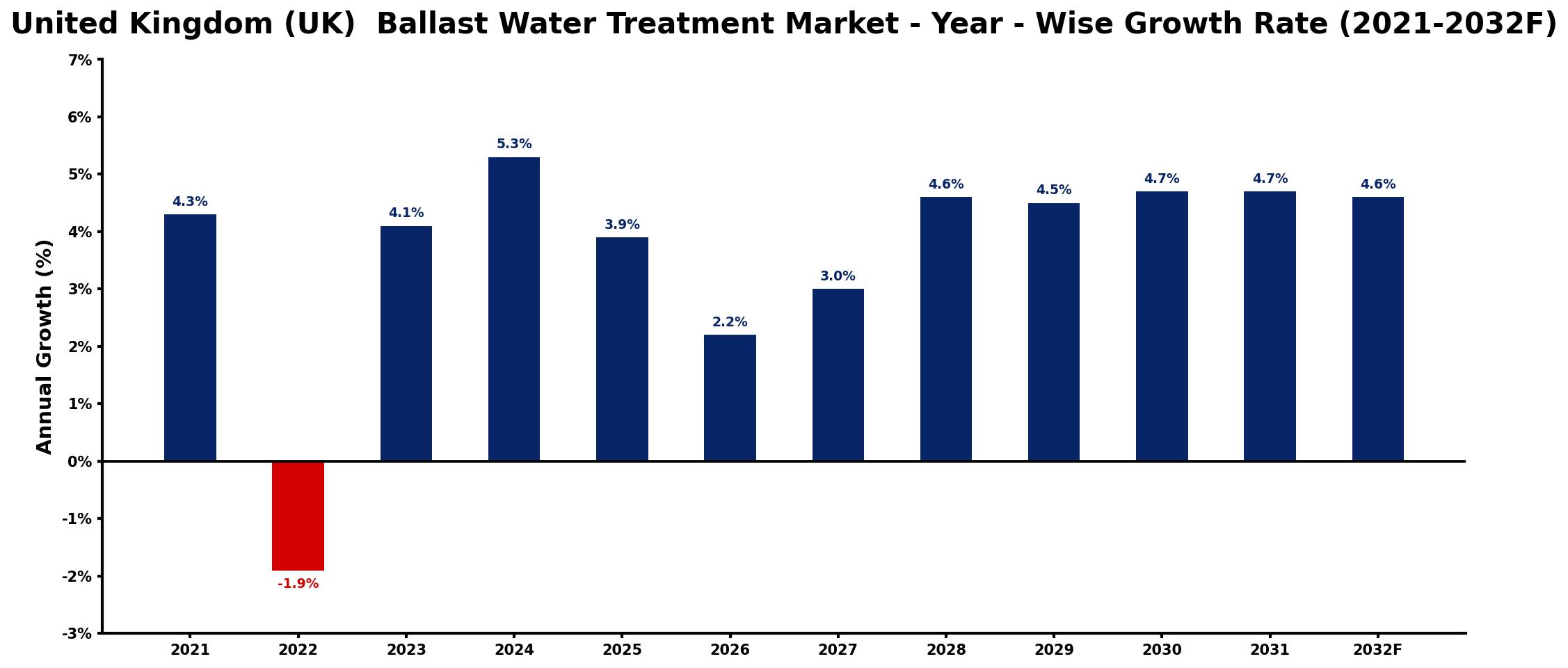
The table below presents the year‑wise growth rates along with the key drivers influencing the market
| Year | Growth Rate | Major Drivers |
| 2021 | 4.3% | Increased global environmental regulations |
| 2022 | -1.9% | Decreased shipping industry investments |
| 2023 | 4.1% | Growing focus on sustainability practices |
| 2024 | 5.3% | Rising demand for eco-friendly solutions |
| 2025 | 3.9% | Expansion of maritime industry technologies |
| 2026 | 2.2% | Increased adoption of compliance standards |
| 2027 | 3.0% | Growing international trade activities |
| 2028 | 4.6% | Surge in marine ecosystem protection |
| 2029 | 4.5% | Heightened awareness of biodiversity preservation |
| 2030 | 4.7% | Advancements in innovation and technology |
| 2031 | 4.7% | Strengthened partnerships in marine sectors |
| 2032 | 4.6% | Enhanced government funding initiatives |
Note: Market size estimations and growth projections presented in this report are based on 6Wresearch's proprietary forecasting methodology, utilizing the latest available industry data, government publications, and primary research inputs.
United Kingdom (UK) Ballast Water Treatment Market Synopsis
The UKs ballast water treatment market is experiencing notable momentum, driven by increasing awareness surrounding marine environmental protection. As regulatory pressures mount, shipping companies are compelled to invest in advanced treatment systems, ensuring compliance while safeguarding marine biodiversity. Innovations such as UV radiation and electrochlorination are becoming essential tools in this evolving landscape.
Furthermore, the collaboration between government agencies and industry stakeholders is pivotal in enhancing port infrastructure to facilitate effective ballast water management. This symbiotic relationship fosters both technological advancements and regulatory compliance, positioning the UK market favorably for sustained growth.
United Kingdom (UK) Ballast Water Treatment Market Key Takeaways
- The market is significantly influenced by adherence to international regulations aimed at mitigating the risks of invasive species.
- Technological advancements in treatment methods are driving efficiency and enhancing system reliability.
- Government investment in maritime infrastructure is critical for supporting ballast water management initiatives.
- Environmental conservation awareness is increasingly motivating shipping companies to upgrade their ballast water treatment systems.
- The market's growth is accompanied by challenges related to compliance costs and the reliability of various treatment technologies.
Evaluation of Restraints in United Kingdom (UK) Ballast Water Treatment Market
Despite the positive growth trajectory, the UK ballast water treatment market grapples with significant restraints. One of the primary challenges is the substantial investment required to install advanced treatment systems that comply with stringent IMO regulations. For many shipping companies, particularly smaller operators, the financial burden can be a significant barrier. Additionally, varying maritime conditions and the need for continual technological improvements present challenges in ensuring consistent system effectiveness across different environments. This complexity necessitates ongoing research and development, which can slow the pace of adoption for new technologies.
United Kingdom (UK) Ballast Water Treatment Market Trends
The current trends in the UK ballast water treatment market indicate a strong shift towards sustainable solutions. With growing ecological awareness, there is an increasing preference for systems that integrate renewable energy sources. UV treatment technologies, coupled with automated monitoring systems, are gaining traction due to their efficiency and minimal environmental impact. Moreover, the emphasis on digital solutions for real-time monitoring and data analytics is expected to shape future treatment processes, enabling proactive management of ballast water systems.
United Kingdom (UK) Ballast Water Treatment Market Opportunities
The UK ballast water treatment market offers substantial growth opportunities for stakeholders willing to invest in innovative technologies and sustainable practices. The rising demand for compliant treatment systems across the maritime sector creates avenues for companies to develop tailored solutions that address specific regulatory needs. Furthermore, the expansion of green shipping initiatives presents an opportunity for businesses to align with environmental standards while enhancing their market presence.
Government Initiatives in the United Kingdom (UK) Ballast Water Treatment Market
The UK government plays a vital role in driving the ballast water treatment market through stringent adherence to international regulations such as the IMO Ballast Water Management Convention. Initiatives focused on enhancing port infrastructure are crucial for facilitating compliance and operational efficiency. Additionally, government-backed programs aimed at promoting environmental sustainability are encouraging shipping companies to adopt advanced treatment systems, fostering a more responsible maritime industry.
Future Insights of the United Kingdom (UK) Ballast Water Treatment Market
Looking ahead to the period from 2026 to 2032, the UK ballast water treatment market is poised for robust growth, largely driven by continued regulatory developments and advancements in technology. As international shipping standards evolve, companies will need to adapt rapidly to stay compliant, opening doors for innovative treatment solutions. The focus on environmental sustainability will likely increase, pushing the market toward greener technologies that minimize ecological impact while ensuring operational efficacy.
United Kingdom (UK) Ballast Water Treatment Market Latest Developments (2025 - 2026)
In recent months, there has been a noticeable surge in research and development within the UK ballast water treatment sector, particularly focusing on enhancing the efficiency of existing systems. Industry stakeholders are increasingly collaborating with government agencies to create frameworks that promote compliance and sustainable practices. Additionally, new pilot programs are being launched to test the effectiveness of emerging technologies, indicating a proactive approach to addressing regulatory challenges while safeguarding marine ecosystems.
United Kingdom (UK) Ballast Water Treatment Market - Key Attractiveness of the Report
- 10 Years of Market Numbers
- Historical Data Starting from 2022 to 2025
- Base Year: 2025
- Forecast Data until 2032
- Key Performance Indicators Impacting the Market
- Major Upcoming Developments and Projects
Key Highlights of the Report:
- United Kingdom (UK) Ballast Water Treatment Market Outlook
- Market Size of United Kingdom (UK) Ballast Water Treatment Market, 2025
- Forecast of United Kingdom (UK) Ballast Water Treatment Market, 2032
- Historical Data and Forecast of United Kingdom (UK) Ballast Water Treatment Revenues & Volume for the Period 2022-2032F
- United Kingdom (UK) Ballast Water Treatment Market Trend Evolution
- United Kingdom (UK) Ballast Water Treatment Market Drivers and Challenges
- United Kingdom (UK) Ballast Water Treatment Price Trends
- United Kingdom (UK) Ballast Water Treatment Porter's Five Forces
- United Kingdom (UK) Ballast Water Treatment Industry Life Cycle
- Historical Data and Forecast of United Kingdom (UK) Ballast Water Treatment Market Revenues & Volume By Technology for the Period 2022-2032F
- Historical Data and Forecast of United Kingdom (UK) Ballast Water Treatment Market Revenues & Volume By Physical Disinfection for the Period 2022-2032F
- Historical Data and Forecast of United Kingdom (UK) Ballast Water Treatment Market Revenues & Volume By Mechanical Method for the Period 2022-2032F
- Historical Data and Forecast of United Kingdom (UK) Ballast Water Treatment Market Revenues & Volume By Chemical Method for the Period 2022-2032F
- Historical Data and Forecast of United Kingdom (UK) Ballast Water Treatment Market Revenues & Volume By Service for the Period 2022-2032F
- Historical Data and Forecast of United Kingdom (UK) Ballast Water Treatment Market Revenues & Volume By Installation & Calibration for the Period 2022-2032F
- Historical Data and Forecast of United Kingdom (UK) Ballast Water Treatment Market Revenues & Volume By Performance Measurement for the Period 2022-2032F
- Historical Data and Forecast of United Kingdom (UK) Ballast Water Treatment Market Revenues & Volume By Recommissioning for the Period 2022-2032F
- United Kingdom (UK) Ballast Water Treatment Import Export Trade Statistics
- Market Opportunity Assessment By Technology
- Market Opportunity Assessment By Service
- United Kingdom (UK) Ballast Water Treatment Top Companies Market Share
- United Kingdom (UK) Ballast Water Treatment Competitive Benchmarking By Technical and Operational Parameters
- United Kingdom (UK) Ballast Water Treatment Company Profiles
- United Kingdom (UK) Ballast Water Treatment Key Strategic Recommendations






































