United Kingdom (UK) Cleaning Products and Detergents Market Summary
The united kingdom (uk) cleaning products and detergents market was estimated at USD 337 Million in 2025 and is projected to reach USD 419 Million by 2032, growing at a CAGR of 2.8% from 2026 to 2032.
United Kingdom (UK) Cleaning Products and Detergents Market Year-wise Growth Rate and Key Drivers
This graph highlights how the United Kingdom (UK) Cleaning Products and Detergents Market has steadily grown over the past five years, supported by major growth factors.
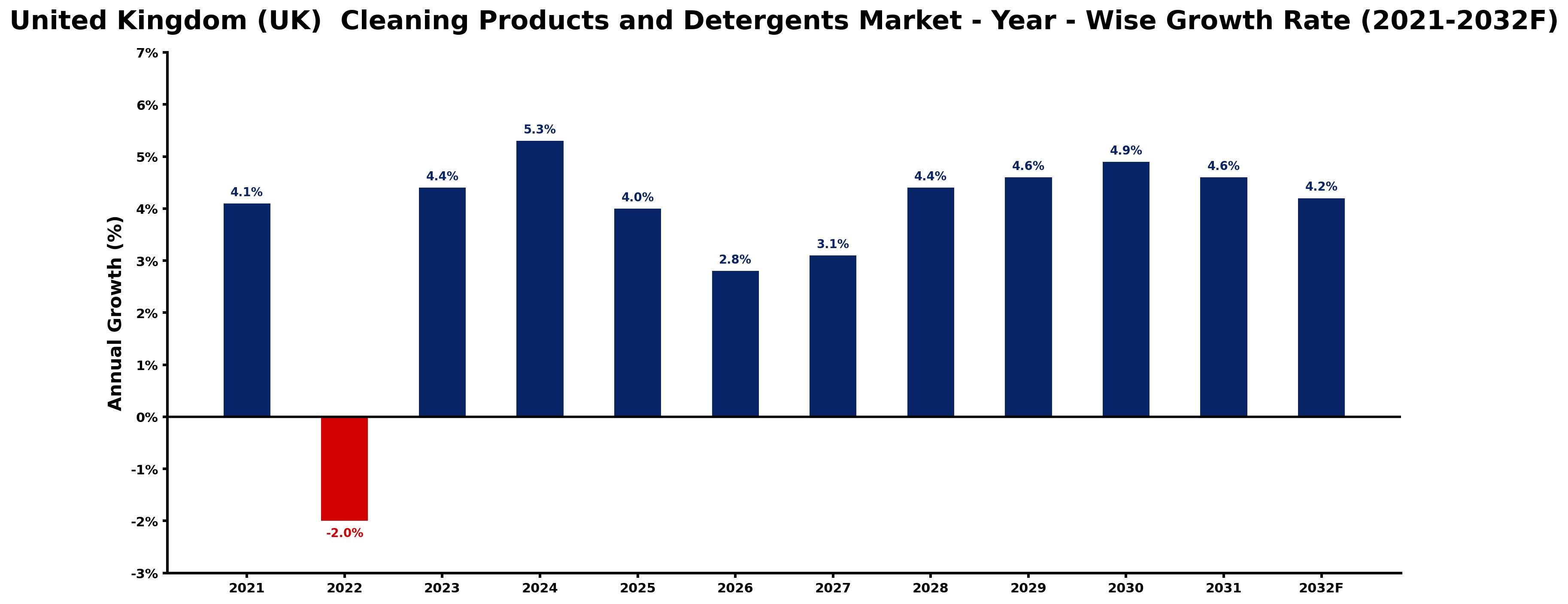
The table below presents the year wise growth rates along with the key drivers influencing the market
| Year | Growth Rate | Major Drivers |
| 2021 | 4.1% | Post-lockdown retail projects ignited a heightened focus on cleanliness and hygiene. |
| 2022 | -2.0% | Heightened environmental awareness prompted consumers to seek ecofriendly alternatives, reducing traditional cleaning product sales. |
| 2023 | 4.4% | Rising urbanization led to increased demand for effective cleaning solutions in households. |
| 2024 | 5.3% | Innovative marketing campaigns highlighted the benefits of powerful, fast-acting detergents. |
| 2025 | 4.0% | E-commerce platforms expanded, making cleaning products more accessible to diverse consumers. |
| 2026 | 2.8% | Emerging trends showcased multi-functional cleaners, streamlining the cleaning process for busy lives. |
| 2027 | 3.1% | Health-conscious consumers favored disinfectants, driven by ongoing public health awareness. |
| 2028 | 4.4% | Sustainability initiatives prompted brands to explore biodegradable and refillable packaging options. |
| 2029 | 4.6% | Increased competition among brands fostered a broader range of product innovations and choices. |
| 2030 | 4.9% | Collaboration with tech firms led to smart cleaning solutions, appealing to tech-savvy consumers. |
| 2031 | 4.6% | Consumer loyalty programs gained traction, enhancing brand engagement and long-term sales. |
| 2032 | 4.2% | Global supply chain improvements fostered a consistent availability of cleaning products across markets. |
Note - Market size estimations and growth projections presented in this report are based on 6Wresearch's advanced forecasting approach, validated with industry datasets as of June 2026.
United Kingdom (UK) Cleaning Products and Detergents Market Synopsis
The United Kingdom (UK) Cleaning Products and Detergents Market is projected to reach 2.8% and witness significant growth during the forecast period (2026-2032). This market encompasses a comprehensive array of products tailored for household, industrial, and institutional cleaning applications. Driven by heightened consumer awareness surrounding hygiene, particularly post-COVID-19, and a growing preference for eco-friendly options, the UK market is evolving rapidly. Furthermore, stringent government regulations concerning chemical safety and environmental impacts are shaping product development, steering manufacturers towards sustainable solutions.
United Kingdom (UK) Cleaning Products and Detergents Market Growth Drivers
Key factors propelling the UK Cleaning Products and Detergents Market include:
- Increased consumer awareness regarding hygiene standards, especially triggered by the pandemic, has led to a surge in demand for effective cleaning solutions across both residential and commercial sectors.
- The rising popularity of eco-friendly and biodegradable cleaning products reflects a broader environmental consciousness, incentivizing manufacturers to innovate and reformulate existing products.
- Product innovations, such as specialized formulations targeting specific cleaning challenges, are gaining traction, appealing to consumers seeking both performance and sustainability.
- The trend towards premium cleaning products showcases a willingness among consumers to invest in higher-quality solutions that promise enhanced efficacy and safety.
- The expansion of online retail channels and e-commerce platforms is facilitating broader access to cleaning products, driving competitive pricing and consumer choice.
United Kingdom (UK) Cleaning Products and Detergents Market Challenges and Restraints
The UK Cleaning Products and Detergents Market is also confronted with several challenges:
- Manufacturers face pressure to comply with stringent environmental regulations that govern chemical usage, necessitating significant investments in reformulation and sustainable practices.
- The transition towards eco-friendly products can lead to increased operational costs, impacting margins, especially for smaller manufacturers striving to compete in a highly consolidated market.
- Intense competition from established brands and emerging private labels creates a challenging landscape, where differentiation and brand loyalty are crucial for market success.
- Consumer skepticism regarding product efficacy in eco-friendly alternatives may slow adoption rates, requiring manufacturers to invest in consumer education and effective marketing strategies.
- Fluctuating raw material prices and supply chain disruptions can lead to unpredictable cost structures, complicating pricing strategies in a competitive market.
United Kingdom (UK) Cleaning Products and Detergents Market Government Investment and Initiatives
In the United Kingdom, government policies significantly influence the Cleaning Products and Detergents Market. Regulatory frameworks such as REACH (Registration, Evaluation, Authorisation and Restriction of Chemicals) mandate high standards for chemical usage, ensuring product safety and minimizing environmental impact. Furthermore, the UK government actively promotes sustainability through initiatives aimed at reducing plastic waste, including support for biodegradable product development and sustainable packaging practices. Public investments are increasingly directed towards research and innovation in green chemistry, encouraging companies to pursue eco-sensitive formulations. These government-led initiatives not only drive compliance but also align with broader environmental goals, reflecting the nation's commitment to a sustainable future.
United Kingdom (UK) Cleaning Products and Detergents Market Latest Developments (May 2025 - June 2026)
Recent developments in the UK Cleaning Products and Detergents Market highlight industry shifts towards more sustainable practices and consumer preferences. Manufacturers are responding to the growing demand for eco-friendly formulations by increasing their investments in research and development—focusing on biodegradable and non-toxic ingredients. Additionally, marketing strategies are evolving to emphasize the importance of sustainability, as brands highlight their commitment to environmental responsibility. This period has also seen an uptick in partnerships across the supply chain aimed at improving packaging sustainability and addressing consumer concerns over plastic waste. Furthermore, the rise of e-commerce continues to revolutionize distribution channels, providing brands with new avenues to reach health-conscious consumers.
United Kingdom (UK) Cleaning Products and Detergents Market - Key Attractiveness of the Report
- 10 Years of Market Numbers
- Historical Data Starting from 2022 to 2025
- Base Year: 2025
- Forecast Data until 2032
- Key Performance Indicators Impacting the Market
- Major Upcoming Developments and Projects
Q1: What are the primary drivers of growth in the United Kingdom (UK) Cleaning Products and Detergents Market? A1: The key drivers include heightened hygiene awareness due to COVID-19, increased demand for eco-friendly products, innovations in product formulations, and the trend towards premium cleaning solutions.
Q2: How does government policy impact the Cleaning Products and Detergents Market in the UK? A2: Government regulations ensure product safety and promote sustainability, influencing manufacturers to adopt eco-friendly practices and comply with stringent standards.
Q3: What challenges do manufacturers face in the UK Cleaning Products and Detergents Market? A3: Challenges include compliance costs associated with environmental regulations, intense competition, and the demand for innovative, effective cleaning solutions.
Q4: What recent trends are shaping the UK Cleaning Products and Detergents Market? A4: Recent trends include a shift towards sustainable and biodegradable products, increased online retail presence, and consumer emphasis on effective and safe cleaning solutions.
Key Highlights of the Report:
- United Kingdom (UK) Cleaning Products and Detergents Market Outlook
- Market Size of United Kingdom (UK) Cleaning Products and Detergents Market, 2025
- Forecast of United Kingdom (UK) Cleaning Products and Detergents Market, 2032
- Historical Data and Forecast of United Kingdom (UK) Cleaning Products and Detergents Revenues & Volume for the Period 2022-2032F
- United Kingdom (UK) Cleaning Products and Detergents Market Trend Evolution
- United Kingdom (UK) Cleaning Products and Detergents Market Drivers and Challenges
- United Kingdom (UK) Cleaning Products and Detergents Price Trends
- United Kingdom (UK) Cleaning Products and Detergents Porter's Five Forces
- United Kingdom (UK) Cleaning Products and Detergents Industry Life Cycle
- Historical Data and Forecast of United Kingdom (UK) Cleaning Products and Detergents Market Revenues & Volume By Type for the Period 2022-2032F
- Historical Data and Forecast of United Kingdom (UK) Cleaning Products and Detergents Market Revenues & Volume By Anionic Detergents for the Period 2022-2032F
- Historical Data and Forecast of United Kingdom (UK) Cleaning Products and Detergents Market Revenues & Volume By Cationic Detergents for the Period 2022-2032F
- Historical Data and Forecast of United Kingdom (UK) Cleaning Products and Detergents Market Revenues & Volume By Non-ionic Detergents for the Period 2022-2032F
- Historical Data and Forecast of United Kingdom (UK) Cleaning Products and Detergents Market Revenues & Volume By Zwitterionic (Amphoteric) Detergents for the Period 2022-2032F
- Historical Data and Forecast of United Kingdom (UK) Cleaning Products and Detergents Market Revenues & Volume By Applications for the Period 2022-2032F
- Historical Data and Forecast of United Kingdom (UK) Cleaning Products and Detergents Market Revenues & Volume By Laundry Cleaning Products for the Period 2022-2032F
- Historical Data and Forecast of United Kingdom (UK) Cleaning Products and Detergents Market Revenues & Volume By Household Cleaning Products for the Period 2022-2032F
- Historical Data and Forecast of United Kingdom (UK) Cleaning Products and Detergents Market Revenues & Volume By Dishwashing Products for the Period 2022-2032F
- Historical Data and Forecast of United Kingdom (UK) Cleaning Products and Detergents Market Revenues & Volume By Fuel Additives for the Period 2022-2032F
- Historical Data and Forecast of United Kingdom (UK) Cleaning Products and Detergents Market Revenues & Volume By Biological Reagent for the Period 2022-2032F
- Historical Data and Forecast of United Kingdom (UK) Cleaning Products and Detergents Market Revenues & Volume By Others for the Period 2022-2032F
- United Kingdom (UK) Cleaning Products and Detergents Import Export Trade Statistics
- Market Opportunity Assessment By Type
- Market Opportunity Assessment By Applications
- United Kingdom (UK) Cleaning Products and Detergents Top Companies Market Share
- United Kingdom (UK) Cleaning Products and Detergents Competitive Benchmarking By Technical and Operational Parameters
- United Kingdom (UK) Cleaning Products and Detergents Company Profiles
- United Kingdom (UK) Cleaning Products and Detergents Key Strategic Recommendations






































