United Kingdom (UK) Composable Infrastructure Market Size & Growth Rate (2026-2032)
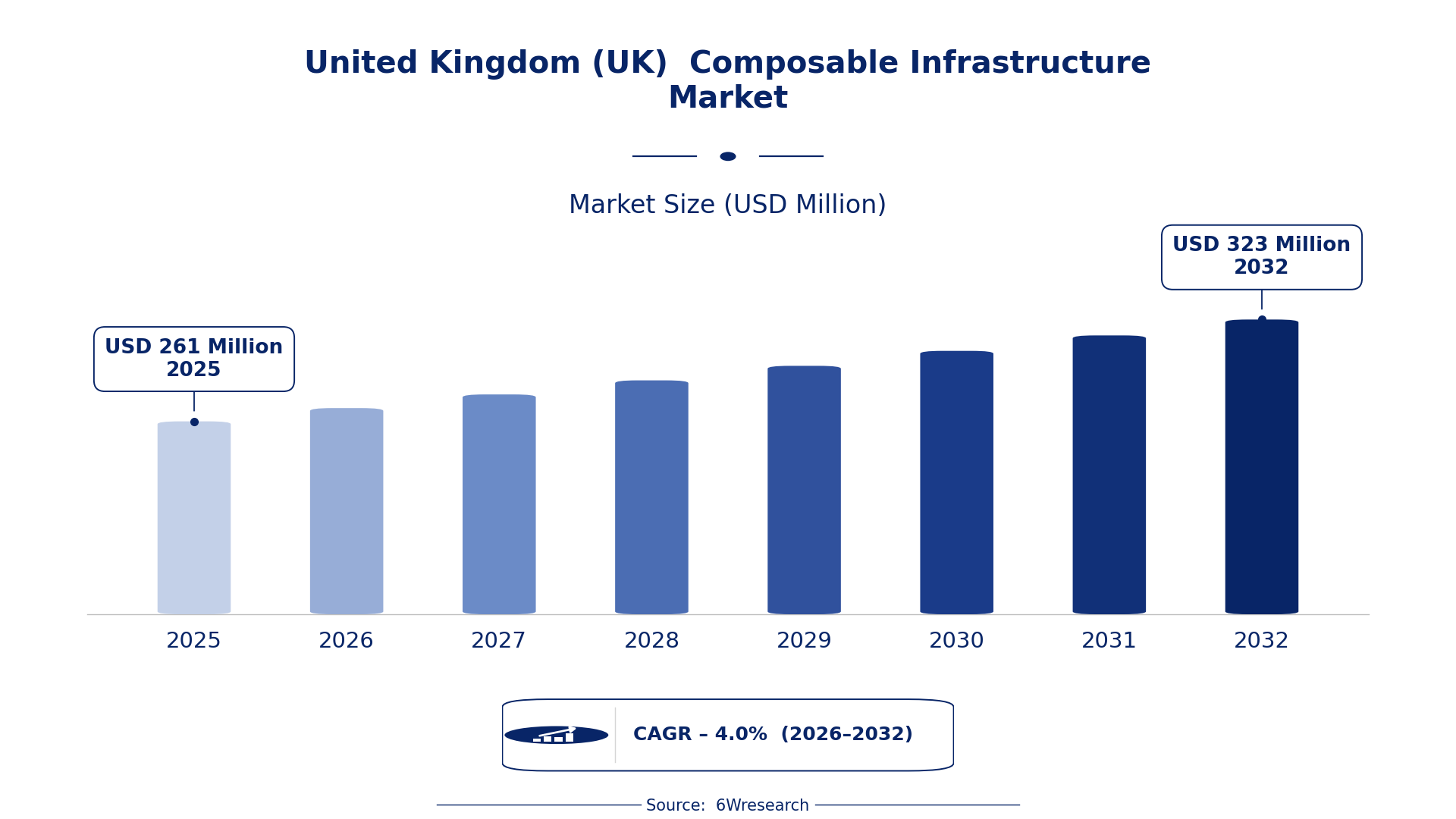
The United Kingdom (UK) Composable Infrastructure Market was estimated at USD 261 Million in 2025 and is projected to reach USD 323 Million by 2032, growing at a CAGR of 4.0% from 2026 to 2032.
United Kingdom (UK) Composable Infrastructure Market Synopsis
The UK composable infrastructure market is witnessing a notable shift as businesses prioritize flexibility and efficiency in their IT strategies. Organizations are increasingly recognizing the value of dynamic resource allocation in supporting their digital transformation efforts, prompting a surge in demand for composable solutions.
With the rise of cloud computing, edge computing, and hybrid IT environments, composable infrastructure is no longer a niche solution but a critical component of modern IT strategy. The UK market is aligning itself with these trends, as enterprises look to enhance agility and scalability in their operations.
United Kingdom (UK) Composable Infrastructure Market Year-wise Growth Rate and Key Drivers
This graph illustrates the annual growth rates of the United Kingdom (UK) Composable Infrastructure Market from 2021 to 2032, highlighting a steady upward trajectory and projected expansion over the forecast period.
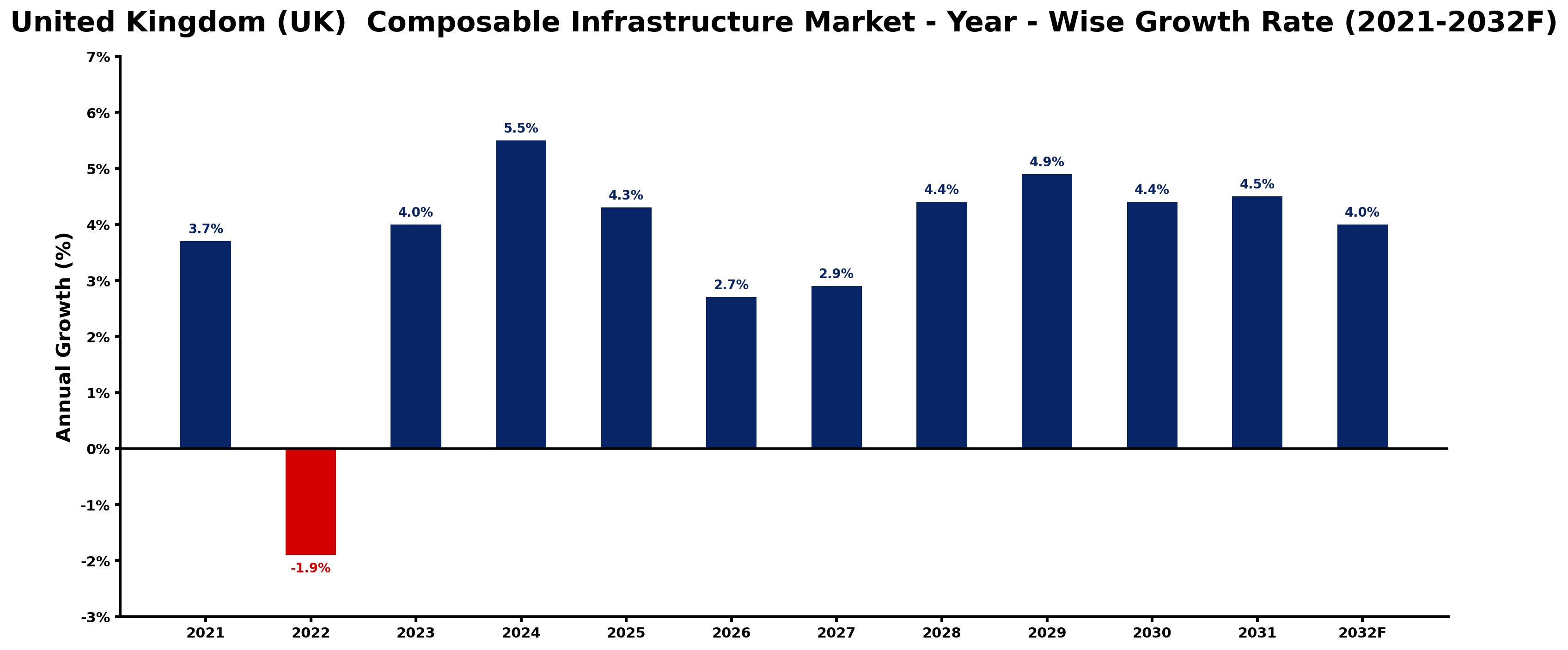
The table below presents the year‑wise growth rates along with the key drivers influencing the market
| Year | Growth Rate | Major Drivers |
| 2021 | 3.7% | Increased adoption of digital transformation initiatives by UK SMEs. |
| 2022 | -1.9% | Supply chain issues from post-Brexit trade regulations. |
| 2023 | 4.0% | Government's digital infrastructure strategy boosting composable solutions adoption. |
| 2024 | 5.5% | Surge in software-defined networking investments by UK enterprises. |
| 2025 | 4.3% | Growth in edge computing requirements driving composable infrastructure needs. |
| 2026 | 2.7% | Accelerated migration to hybrid cloud models among British firms. |
| 2027 | 2.9% | Rise in demand for scalable IT resources in finance sector. |
| 2028 | 4.4% | Implementation of open-source technologies in UK tech industry. |
| 2029 | 4.9% | Financial services adopting composable architecture for agility. |
| 2030 | 4.4% | Emergence of 5G spurring demand for adaptable IT infrastructure. |
| 2031 | 4.5% | UK cybersecurity policies enhancing interest in composable environments. |
| 2032 | 4.0% | Increase in remote work fostering need for flexible IT solutions. |
Note: Market size estimations and growth projections presented in this report are based on 6Wresearch's proprietary forecasting methodology, utilizing the latest available industry data, government publications, and primary research inputs.
United Kingdom (UK) Composable Infrastructure Market Key Takeaways
Below are some of the specific key takeaways from the market, including:
- The market is driven by the need for dynamic resource allocation and effective IT management.
- Growth is propelled by the increasing adoption of cloud computing and edge computing technologies.
- Enterprises are focusing on infrastructure automation to reduce manual intervention and optimize resource utilization.
- Education on the benefits of composable architecture remains a key challenge for market players.
- Government initiatives are actively supporting the development of digital infrastructure in the UK.
Evaluation of Restraints in United Kingdom (UK) Composable Infrastructure Market
The primary restraint impacting the UK composable infrastructure market is the need for educational outreach to potential customers. Many enterprises are entrenched in traditional IT models, making it difficult to shift their mindset towards composable architecture. This resistance can hinder the adoption of innovative IT solutions. Additionally, concerns about interoperability with existing systems pose technical challenges that vendors must address to facilitate smoother transitions and broader acceptance.
United Kingdom (UK) Composable Infrastructure Market Trends
A noticeable trend in the UK market is the increasing integration of virtualization and software-defined technologies, allowing for more automated and efficient operations. The convergence of these technologies is reshaping how organizations approach their IT infrastructure. on top of that, the adoption of microservices architectures is driving demand for composable solutions that enable seamless integration across hybrid and multi-cloud environments.
United Kingdom (UK) Composable Infrastructure Market Opportunities
The UK market presents various opportunities for growth and investment. As enterprises continue to embrace digital transformation, there is a strong demand for solutions that enhance IT agility. Organizations looking to modernize their infrastructure can invest in composable solutions to better manage workloads and optimize resource allocation. Additionally, partnerships between technology vendors and service providers can enhance the development and deployment of innovative composable infrastructure solutions.
Government Initiatives in the United Kingdom (UK) Composable Infrastructure Market
Government policy in the UK is increasingly supportive of composable infrastructure, emphasizing flexibility and scalability within IT systems. Current initiatives focus on promoting cloud computing and virtualization technologies, which are crucial for enhancing resource utilization and reducing operational costs. These policies are vital as they create a conducive environment for technological advancements in the composable infrastructure space.
- A national digital infrastructure upgrade programme launched recently, aimed at enhancing cloud capabilities across public and private sectors.
- Current initiatives include ongoing workshops and training sessions to educate enterprises on the benefits of composable infrastructure.
- A regulatory framework introduced in 2025 to ensure data security and interoperability among composable solutions.
- Planned public-private initiatives expected to expand digital infrastructure access by 2028, focusing on underserved regions.
Future Insights of the United Kingdom (UK) Composable Infrastructure Market
Looking ahead to 2026-2032, the UK composable infrastructure market is expected to evolve significantly. As businesses continue to prioritize agility, solutions that offer dynamic resource management will be in high demand. on top of that, advancements in AI and machine learning technologies will likely further enhance the capabilities of composable infrastructure, enabling organizations to optimize their IT environments more effectively. This period will also witness increasing collaboration between public and private sectors to bolster the digital infrastructure, paving the way for widespread adoption.
United Kingdom (UK) Composable Infrastructure Market Latest Developments
Over the past 12-14 months, the United Kingdom (UK) composable infrastructure market has seen a surge in activity, driven by both technological advancements and government initiatives. This momentum reflects a growing recognition of the importance of flexible IT solutions in meeting the evolving needs of businesses.
- A major technology vendor announced a new composable infrastructure solution in early 2025, focusing on enhanced automation and integration capabilities.
- An initiative that began in mid-2025 remains underway, aimed at developing educational resources for businesses to better understand composable infrastructure benefits.
- A partnership between leading technology firms was formed in Q3 2025 to create joint solutions for hybrid cloud environments.
- A rollout expected to begin in the second half of 2026 will focus on expanding composable infrastructure offerings to SMEs across the UK.
United Kingdom (UK) Composable Infrastructure Market - Key Attractiveness of the Report
- 10 Years of Market Numbers
- Historical Data Starting from 2022 to 2025
- Base Year: 2025
- Forecast Data until 2032
- Key Performance Indicators Impacting the Market
- Major Upcoming Developments and Projects
Key Highlights of the Report:
- United Kingdom (UK) Composable Infrastructure Market Outlook
- Market Size of United Kingdom (UK) Composable Infrastructure Market, 2025
- Forecast of United Kingdom (UK) Composable Infrastructure Market, 2032
- Historical Data and Forecast of United Kingdom (UK) Composable Infrastructure Revenues & Volume for the Period 2022-2032F
- United Kingdom (UK) Composable Infrastructure Market Trend Evolution
- United Kingdom (UK) Composable Infrastructure Market Drivers and Challenges
- United Kingdom (UK) Composable Infrastructure Price Trends
- United Kingdom (UK) Composable Infrastructure Porter's Five Forces
- United Kingdom (UK) Composable Infrastructure Industry Life Cycle
- Historical Data and Forecast of United Kingdom (UK) Composable Infrastructure Market Revenues & Volume By Type for the Period 2022-2032F
- Historical Data and Forecast of United Kingdom (UK) Composable Infrastructure Market Revenues & Volume By Software for the Period 2022-2032F
- Historical Data and Forecast of United Kingdom (UK) Composable Infrastructure Market Revenues & Volume By Hardware for the Period 2022-2032F
- Historical Data and Forecast of United Kingdom (UK) Composable Infrastructure Market Revenues & Volume By for the Period 2022-2032F
- Historical Data and Forecast of United Kingdom (UK) Composable Infrastructure Market Revenues & Volume By RoW for the Period 2022-2032F
- Historical Data and Forecast of United Kingdom (UK) Composable Infrastructure Market Revenues & Volume By Vertical for the Period 2022-2032F
- Historical Data and Forecast of United Kingdom (UK) Composable Infrastructure Market Revenues & Volume By BFSI for the Period 2022-2032F
- Historical Data and Forecast of United Kingdom (UK) Composable Infrastructure Market Revenues & Volume By Healthcare for the Period 2022-2032F
- Historical Data and Forecast of United Kingdom (UK) Composable Infrastructure Market Revenues & Volume By IT for the Period 2022-2032F
- Historical Data and Forecast of United Kingdom (UK) Composable Infrastructure Market Revenues & Volume By Telecom for the Period 2022-2032F
- Historical Data and Forecast of United Kingdom (UK) Composable Infrastructure Market Revenues & Volume By Government for the Period 2022-2032F
- Historical Data and Forecast of United Kingdom (UK) Composable Infrastructure Market Revenues & Volume By Manufacturing for the Period 2022-2032F
- United Kingdom (UK) Composable Infrastructure Import Export Trade Statistics
- Market Opportunity Assessment By Type
- Market Opportunity Assessment By
- Market Opportunity Assessment By Vertical
- United Kingdom (UK) Composable Infrastructure Top Companies Market Share
- United Kingdom (UK) Composable Infrastructure Competitive Benchmarking By Technical and Operational Parameters
- United Kingdom (UK) Composable Infrastructure Company Profiles
- United Kingdom (UK) Composable Infrastructure Key Strategic Recommendations






































