United Kingdom (UK) Confectionery Processing Equipment Market Size, Share & Growth Rate
The United Kingdom (UK) Confectionery Processing Equipment Market was estimated at USD 469 Million in 2025 and is projected to reach USD 578 Million by 2032, growing at a CAGR of 3.0% from 2026 to 2032. This growth trajectory is primarily driven by advancements in automation and the increasing need for efficient production processes in the confectionery sector. As consumer preferences shift toward innovative and customized confectionery products, manufacturers are investing in advanced processing technologies to enhance their production capabilities.
United Kingdom (UK) Confectionery Processing Equipment Market Year-wise Growth Rate and Key Drivers
This graph highlights how the United Kingdom (UK) Confectionery Processing Equipment Market has steadily grown over the years, supported by major growth factors.
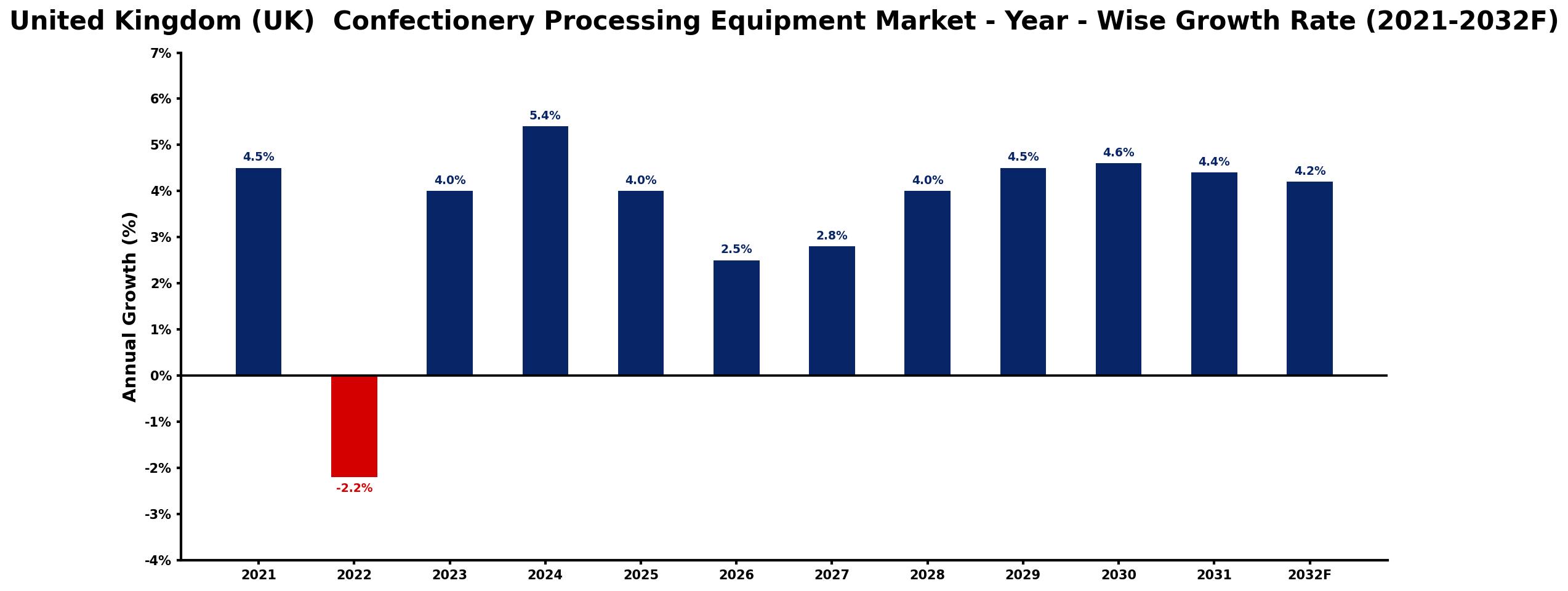
The table below presents the year‑wise growth rates along with the key drivers influencing the market
| Year | Growth Rate | Major Drivers |
| 2021 | 4.5% | rising demand for sweet treats |
| 2022 | -2.2% | decreased consumer spending patterns |
| 2023 | 4.0% | increased investment in automation |
| 2024 | 5.4% | expansion of snack food market |
| 2025 | 4.0% | growing trend for healthy options |
| 2026 | 2.5% | surge in online food sales |
| 2027 | 2.8% | innovation in flavor profiles |
| 2028 | 4.0% | rising popularity of artisanal products |
| 2029 | 4.5% | increased focus on sustainability practices |
| 2030 | 4.6% | heightened interest in premium offerings |
| 2031 | 4.4% | growing demand for convenience foods |
| 2032 | 4.2% | growing emerging market penetration |
Note: Market size estimations and growth projections presented in this report are based on 6Wresearch's proprietary forecasting methodology, utilizing the latest available industry data, government publications, and primary research inputs.
United Kingdom (UK) Confectionery Processing Equipment Market Synopsis
The most significant force currently shaping the UK confectionery processing equipment market is the rapid advancement in automation technology. Enhanced automation not only improves production efficiency but also ensures adherence to strict hygiene standards, a critical requirement in food manufacturing. Additionally, the industry's demand for versatile processing solutions continues to stimulate investment in state-of-the-art equipment.
Moreover, the push for sustainability within the confectionery sector further drives the market. Manufacturers are increasingly focused on minimizing waste and optimizing resources, necessitating equipment that accommodates environmentally friendly practices. This alignment with consumer trends toward healthier and more sustainable options reinforces the market's growth potential.
United Kingdom (UK) Confectionery Processing Equipment Market Key Takeaways
- The market is projected to experience steady growth driven by automation and production efficiency.
- Customization and versatility in processing equipment are critical for meeting diverse consumer demands.
- Stringent hygiene standards influence equipment design and material selection, promoting food safety.
- Technological innovations such as precision molding are optimizing manufacturing processes.
- Government regulations ensure quality and safety, impacting operational practices in the sector.
Evaluation of Restraints in United Kingdom (UK) Confectionery Processing Equipment Market
Despite the optimistic outlook, the UK confectionery processing equipment market faces certain restraints. The rapid pace of technological advancements creates a challenge for manufacturers in terms of keeping up with new developments while ensuring quality and safety in production. Additionally, the integration of digital technologies and automation often requires substantial investment, which may pose a barrier for some smaller producers. Collaboration between equipment manufacturers and confectionery companies is essential to address these hurdles effectively, allowing for the development of tailored solutions that enhance productivity and minimize operational downtime.
United Kingdom (UK) Confectionery Processing Equipment Market Trends
The market is currently witnessing a trend toward increased automation, with manufacturers adopting smart technologies for more streamlined operations. This shift facilitates real-time monitoring and control over production processes, enhancing overall efficiency. Additionally, there is a growing emphasis on sustainability, with equipment designed to reduce energy consumption and minimize waste becoming more prominent. Moreover, the rise of health-conscious consumer behaviors is pushing manufacturers to explore alternative ingredients and packaging solutions, thus necessitating innovative processing technologies.
United Kingdom (UK) Confectionery Processing Equipment Market Opportunities
Significant opportunities for growth exist in the realm of product innovation. As the confectionery market expands, manufacturers who invest in cutting-edge processing equipment will be better positioned to capitalize on consumer trends. The demand for bespoke and health-oriented confectionery products offers a niche for specialized processing solutions. Furthermore, exploring partnerships and collaborations can open avenues for research and development, enhancing the capabilities of confectionery processing equipment to meet future demands.
Government Initiatives in the United Kingdom (UK) Confectionery Processing Equipment Market
Government policies in the UK play a pivotal role in shaping the confectionery processing equipment market. Regulations focused on food safety and hygiene are critical to ensuring public health and maintaining industry standards. Moreover, initiatives that promote innovation in food processing technology are encouraging manufacturers to invest in modern equipment. Public funding and support programs aimed at enhancing operational efficiency and sustainability further provide a conducive environment for market growth.
Future Insights of the United Kingdom (UK) Confectionery Processing Equipment Market
Looking ahead to 2026-2032, the UK confectionery processing equipment market is expected to continue its upward trajectory. Factors such as increasing demand for innovative and health-conscious confectionery products will drive ongoing investment in advanced technologies. Furthermore, as the industry adapts to evolving consumer preferences and regulatory requirements, manufacturers will likely focus on developing more versatile and efficient equipment solutions. This adaptability will be key to achieving long-term growth and maintaining competitive advantage in a dynamic market landscape.
United Kingdom (UK) Confectionery Processing Equipment Market Latest Developments (2025 - 2026)
Recent developments in the UK confectionery processing equipment market indicate a strong trend toward automation and smart manufacturing practices. Manufacturers are increasingly investing in technologies that offer real-time data analytics to optimize production efficiency. Additionally, the introduction of sustainability-focused equipment is gaining traction, as companies seek to reduce their environmental footprint. Collaborative initiatives between manufacturers and technology providers are also on the rise, fostering innovation and enhancing product offerings within the sector.
United Kingdom (UK) Confectionery Processing Equipment Market - Key Attractiveness of the Report
- 10 Years of Market Numbers
- Historical Data Starting from 2022 to 2025
- Base Year: 2025
- Forecast Data until 2032
- Key Performance Indicators Impacting the Market
- Major Upcoming Developments and Projects
Key Highlights of the Report:
- United Kingdom (UK) Confectionery Processing Equipment Market Outlook
- Market Size of United Kingdom (UK) Confectionery Processing Equipment Market, 2025
- Forecast of United Kingdom (UK) Confectionery Processing Equipment Market, 2032
- Historical Data and Forecast of United Kingdom (UK) Confectionery Processing Equipment Revenues & Volume for the Period 2022-2032F
- United Kingdom (UK) Confectionery Processing Equipment Market Trend Evolution
- United Kingdom (UK) Confectionery Processing Equipment Market Drivers and Challenges
- United Kingdom (UK) Confectionery Processing Equipment Price Trends
- United Kingdom (UK) Confectionery Processing Equipment Porter's Five Forces
- United Kingdom (UK) Confectionery Processing Equipment Industry Life Cycle
- Historical Data and Forecast of United Kingdom (UK) Confectionery Processing Equipment Market Revenues & Volume By Product for the Period 2022-2032F
- Historical Data and Forecast of United Kingdom (UK) Confectionery Processing Equipment Market Revenues & Volume By Soft Confectionery for the Period 2022-2032F
- Historical Data and Forecast of United Kingdom (UK) Confectionery Processing Equipment Market Revenues & Volume By Hard Candies for the Period 2022-2032F
- Historical Data and Forecast of United Kingdom (UK) Confectionery Processing Equipment Market Revenues & Volume By Chewing Gums for the Period 2022-2032F
- Historical Data and Forecast of United Kingdom (UK) Confectionery Processing Equipment Market Revenues & Volume By Gummies & Jellies for the Period 2022-2032F
- Historical Data and Forecast of United Kingdom (UK) Confectionery Processing Equipment Market Revenues & Volume By Others for the Period 2022-2032F
- Historical Data and Forecast of United Kingdom (UK) Confectionery Processing Equipment Market Revenues & Volume By Type for the Period 2022-2032F
- Historical Data and Forecast of United Kingdom (UK) Confectionery Processing Equipment Market Revenues & Volume By Thermal for the Period 2022-2032F
- Historical Data and Forecast of United Kingdom (UK) Confectionery Processing Equipment Market Revenues & Volume By Mixers for the Period 2022-2032F
- Historical Data and Forecast of United Kingdom (UK) Confectionery Processing Equipment Market Revenues & Volume By Blenders And Cutters for the Period 2022-2032F
- Historical Data and Forecast of United Kingdom (UK) Confectionery Processing Equipment Market Revenues & Volume By Extrusion for the Period 2022-2032F
- Historical Data and Forecast of United Kingdom (UK) Confectionery Processing Equipment Market Revenues & Volume By Cooling for the Period 2022-2032F
- Historical Data and Forecast of United Kingdom (UK) Confectionery Processing Equipment Market Revenues & Volume By Coating for the Period 2022-2032F
- Historical Data and Forecast of United Kingdom (UK) Confectionery Processing Equipment Market Revenues & Volume By Others for the Period 2022-2032F
- Historical Data and Forecast of United Kingdom (UK) Confectionery Processing Equipment Market Revenues & Volume By Mode Of Operation for the Period 2022-2032F
- Historical Data and Forecast of United Kingdom (UK) Confectionery Processing Equipment Market Revenues & Volume By Automatic for the Period 2022-2032F
- Historical Data and Forecast of United Kingdom (UK) Confectionery Processing Equipment Market Revenues & Volume By Semi-automatic for the Period 2022-2032F
- United Kingdom (UK) Confectionery Processing Equipment Import Export Trade Statistics
- Market Opportunity Assessment By Product
- Market Opportunity Assessment By Type
- Market Opportunity Assessment By Mode Of Operation
- United Kingdom (UK) Confectionery Processing Equipment Top Companies Market Share
- United Kingdom (UK) Confectionery Processing Equipment Competitive Benchmarking By Technical and Operational Parameters
- United Kingdom (UK) Confectionery Processing Equipment Company Profiles
- United Kingdom (UK) Confectionery Processing Equipment Key Strategic Recommendations






































