United Kingdom (UK) Containers as a Service Market Size & Growth Rate (2026-2032)
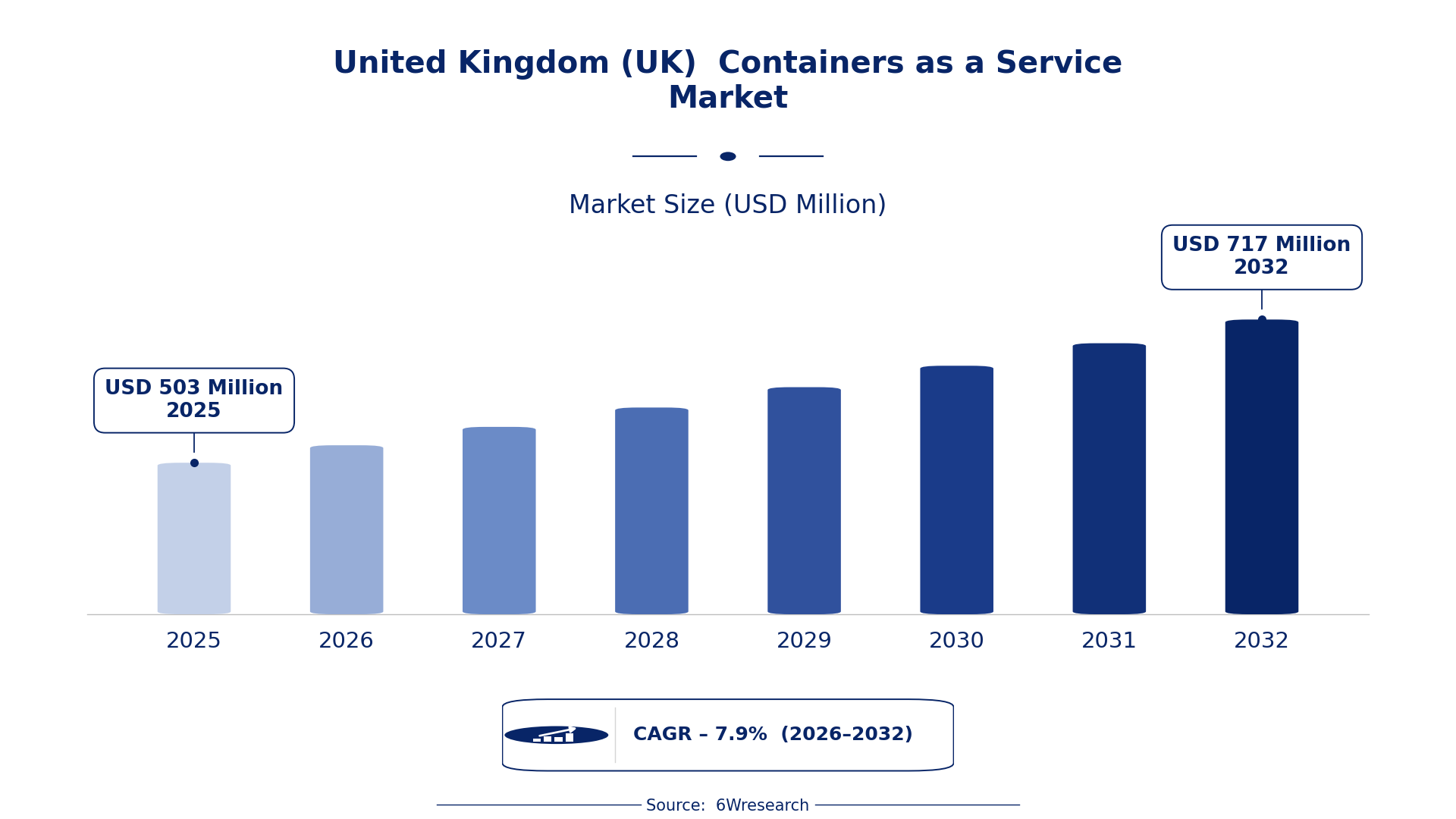
The United Kingdom (UK) Containers as a Service Market was estimated at USD 503 Million in 2025 and is projected to reach USD 717 Million by 2032, growing at a CAGR of 7.9% from 2026 to 2032.
United Kingdom (UK) Containers as a Service Market Synopsis
The demand for Containers as a Service (CaaS) is witnessing significant momentum in the UK, driven by an increasing number of enterprises embracing cloud-native technologies. This trend has led to the rapid adoption of container orchestration platforms that simplify the deployment and management of applications in a more agile manner.
As organizations prioritize scalability and efficiency, CaaS solutions are becoming integral to their IT strategies. The ability to deploy, manage, and scale applications without the complexities of underlying infrastructure is resonating well with businesses looking to innovate and speed up their development cycles.
United Kingdom (UK) Containers as a Service Market Year-wise Growth Rate and Key Drivers
This graph illustrates the annual growth rates of the United Kingdom (UK) Containers as a Service Market from 2021 to 2032, highlighting a steady upward trajectory and projected expansion over the forecast period.
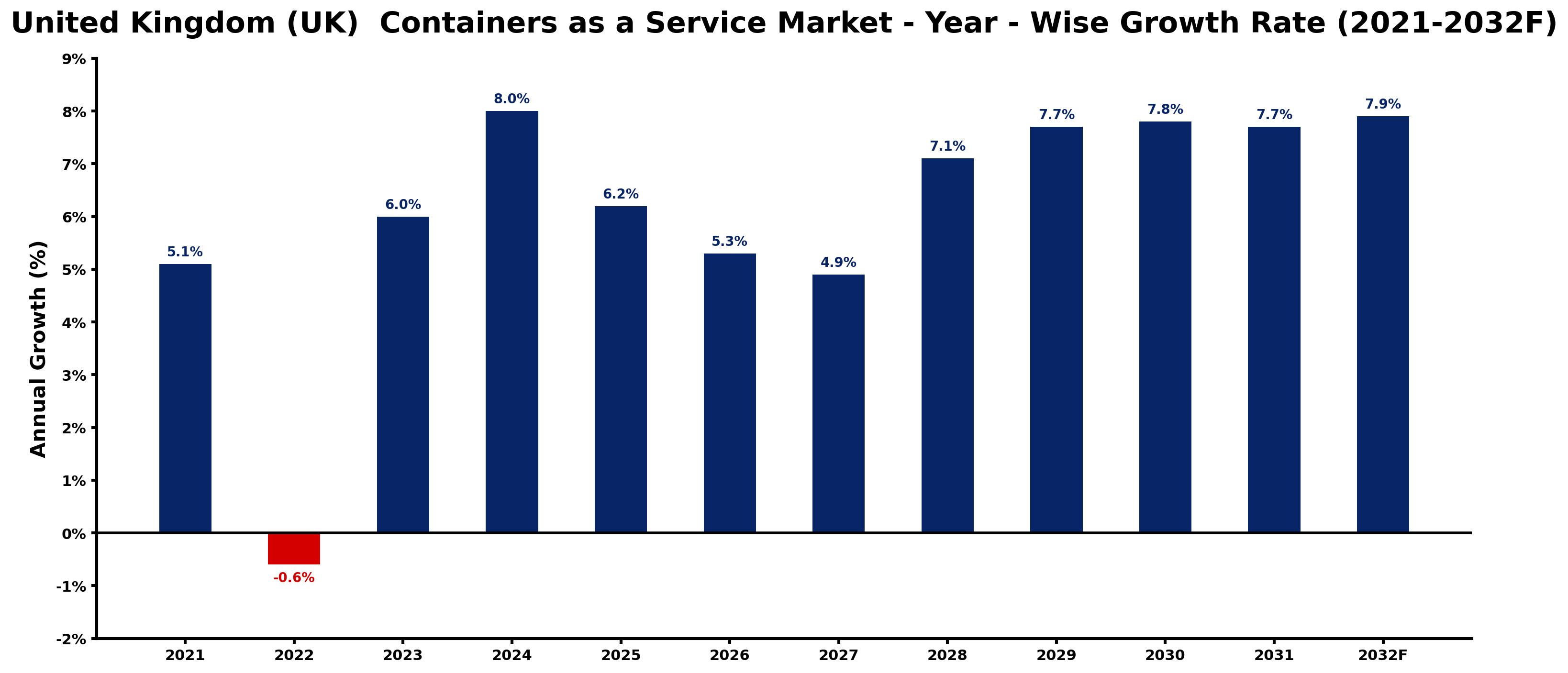
The table below presents the year‑wise growth rates along with the key drivers influencing the market
| Year | Growth Rate | Major Drivers |
| 2021 | 5.1% | Increased adoption of Kubernetes for orchestration |
| 2022 | -0.6% | UK Cloud Computing Strategy v2 delayed adoption in containers |
| 2023 | 6.0% | Government funding for cloud-native application innovation |
| 2024 | 8.0% | Rise in e-commerce driving microservices architecture |
| 2025 | 6.2% | Tech industry shift towards serverless computing solutions |
| 2026 | 5.3% | Growth in remote working boosting container scalability needs |
| 2027 | 4.9% | Focus on reducing IT overhead through containerization |
| 2028 | 7.1% | Emergence of DevOps practices enhancing deployment speed |
| 2029 | 7.7% | Increased emphasis on multi-cloud strategies for flexibility |
| 2030 | 7.8% | Growing cybersecurity regulations favoring containerized applications |
| 2031 | 7.7% | Investment in container security tools improving market trust |
| 2032 | 7.9% | Surge in enterprises migrating legacy systems to containers |
Note: Market size estimations and growth projections presented in this report are based on 6Wresearch's proprietary forecasting methodology, utilizing the latest available industry data, government publications, and primary research inputs.
United Kingdom (UK) Containers as a Service Market Key Takeaways
Below are some of the specific key takeaways from the market, including:
- The UK CaaS market is rapidly expanding, fueled by the surge in cloud-native adoption across various sectors.
- Scalability and agility are the primary drivers for enterprises transitioning to CaaS platforms.
- Integration capabilities with existing IT frameworks significantly enhance operational efficiency.
- Vendor lock-in and interoperability issues remain prominent concerns for businesses considering CaaS solutions.
- Government policies promoting cloud adoption positively influence market dynamics.
Evaluation of Restraints in United Kingdom (UK) Containers as a Service Market
Despite its growth, the UK Containers as a Service market faces several restraints. A primary concern is the potential for vendor lock-in, which can hinder organizations from easily switching providers or integrating with other platforms. Additionally, compatibility issues with existing IT infrastructures can complicate the adoption of CaaS solutions, particularly for businesses operating in hybrid cloud environments. Organizations must also address data residency and sovereignty issues when utilizing global CaaS providers, adding another layer of complexity to their deployment strategies. These factors collectively influence decision-making and can limit operational scalability.
United Kingdom (UK) Containers as a Service Market Trends
Several trends are shaping the UK CaaS market. One of the most notable is the growing emphasis on automation and DevOps practices, which is essential for maintaining operational efficiency. Enterprises are increasingly adopting microservices architectures, allowing them to break applications into smaller, manageable components that can be deployed independently.
Additionally, the integration of artificial intelligence and machine learning capabilities within CaaS platforms is gaining traction. This integration facilitates smarter resource allocation and enhances application performance. As businesses seek to optimize their cloud strategies, these trends will likely continue to drive demand for CaaS solutions in the UK.
United Kingdom (UK) Containers as a Service Market Opportunities
The UK CaaS market presents several promising growth opportunities. The increasing push for digital transformation across industries provides fertile ground for CaaS adoption. Organizations looking to innovate their application development processes can benefit significantly from the flexibility and scalability offered by CaaS solutions.
on top of that, as businesses continue to explore hybrid and multi-cloud strategies, CaaS providers that can ensure interoperability and compatibility with various platforms will capture a larger share of the market. The demand for enhanced security measures within CaaS offerings also represents an area ripe for investment and development.
Government Initiatives in the United Kingdom (UK) Containers as a Service Market
Government policies are playing a crucial role in shaping the United Kingdom’s CaaS market. Regulatory frameworks promoting cloud adoption and the transformation of digital services are creating a favorable environment for market growth. Public sector priorities, particularly in enhancing digital infrastructure and data protection, significantly impact how businesses adopt CaaS solutions.
- A recently completed initiative focused on enhancing cloud computing capabilities within public sector organizations, aimed at increasing operational efficiency.
- Current ongoing programs support digital transformation efforts across various industries, fostering the adoption of cloud technologies, including CaaS.
- Planned investments in national digital infrastructure upgrades are expected to bolster the CaaS market by improving connectivity and accessibility.
- Regulatory frameworks introduced in 2025 mandate transparency in cloud billing practices, enhancing trust in CaaS solutions.
- Efforts to create standards for interoperability among CaaS platforms are currently underway, aiming to alleviate vendor lock-in concerns.
Future Insights of the United Kingdom (UK) Containers as a Service Market
Looking ahead to 2026-2032, the UK Containers as a Service market is expected to experience robust growth. As organizations increasingly prioritize agility and speed in application development, CaaS platforms will become essential tools for IT departments. The ongoing shift towards cloud-native architectures will further drive demand, particularly as businesses seek to modernize their legacy systems.
Investments in AI-driven CaaS solutions will likely enhance operational capabilities, allowing organizations to streamline workflows and optimize resource usage. on top of that, as regulatory landscapes evolve, companies will demand CaaS offerings that prioritize compliance and security, influencing future product development.
United Kingdom (UK) Containers as a Service Market Latest Developments
In the past year, the UK Containers as a Service market has seen notable activity, reflecting the industry's dynamic nature. Companies are actively pursuing enhancements to their CaaS offerings, and the integration of advanced technologies is at the forefront of these developments.
- A major technology vendor launched an upgraded CaaS platform in early 2025, featuring enhanced automation tools and improved integration capabilities.
- A partnership between two leading regional operators was established in mid-2025 to co-develop CaaS solutions tailored for the healthcare sector, now underway.
- An initiative aimed at optimizing cloud security protocols for CaaS users began in Q3 2025 and is currently in progress, focusing on data protection measures.
- Upcoming plans for a public-private initiative are expected to roll out by late 2026, aimed at expanding access to cloud services in underserved regions.
- A comprehensive service upgrade is anticipated to be completed by early 2026, enhancing user experience and operational efficiency for existing CaaS customers.
United Kingdom (UK) Containers as a Service Market - Key Attractiveness of the Report
- 10 Years of Market Numbers
- Historical Data Starting from 2022 to 2025
- Base Year: 2025
- Forecast Data until 2032
- Key Performance Indicators Impacting the Market
- Major Upcoming Developments and Projects
Key Highlights of the Report:
- United Kingdom (UK) Containers as a Service Market Outlook
- Market Size of United Kingdom (UK) Containers as a Service Market, 2025
- Forecast of United Kingdom (UK) Containers as a Service Market, 2032
- Historical Data and Forecast of United Kingdom (UK) Containers as a Service Revenues & Volume for the Period 2022-2032F
- United Kingdom (UK) Containers as a Service Market Trend Evolution
- United Kingdom (UK) Containers as a Service Market Drivers and Challenges
- United Kingdom (UK) Containers as a Service Price Trends
- United Kingdom (UK) Containers as a Service Porter's Five Forces
- United Kingdom (UK) Containers as a Service Industry Life Cycle
- Historical Data and Forecast of United Kingdom (UK) Containers as a Service Market Revenues & Volume By Service Type for the Period 2022-2032F
- Historical Data and Forecast of United Kingdom (UK) Containers as a Service Market Revenues & Volume By Management & Orchestration for the Period 2022-2032F
- Historical Data and Forecast of United Kingdom (UK) Containers as a Service Market Revenues & Volume By Security for the Period 2022-2032F
- Historical Data and Forecast of United Kingdom (UK) Containers as a Service Market Revenues & Volume By Monitoring and Analytics for the Period 2022-2032F
- Historical Data and Forecast of United Kingdom (UK) Containers as a Service Market Revenues & Volume By Storage and Networking for the Period 2022-2032F
- Historical Data and Forecast of United Kingdom (UK) Containers as a Service Market Revenues & Volume By Continuous Integration and Continuous Deployment (CI/CD) for the Period 2022-2032F
- Historical Data and Forecast of United Kingdom (UK) Containers as a Service Market Revenues & Volume By Training and Consulting for the Period 2022-2032F
- Historical Data and Forecast of United Kingdom (UK) Containers as a Service Market Revenues & Volume By Support and Maintenance for the Period 2022-2032F
- Historical Data and Forecast of United Kingdom (UK) Containers as a Service Market Revenues & Volume By Deployment Model for the Period 2022-2032F
- Historical Data and Forecast of United Kingdom (UK) Containers as a Service Market Revenues & Volume By Public Cloud for the Period 2022-2032F
- Historical Data and Forecast of United Kingdom (UK) Containers as a Service Market Revenues & Volume By Private Cloud for the Period 2022-2032F
- Historical Data and Forecast of United Kingdom (UK) Containers as a Service Market Revenues & Volume By Hybrid Cloud for the Period 2022-2032F
- Historical Data and Forecast of United Kingdom (UK) Containers as a Service Market Revenues & Volume By Organization Size for the Period 2022-2032F
- Historical Data and Forecast of United Kingdom (UK) Containers as a Service Market Revenues & Volume By Small and Medium-Sized Enterprises (SMEs) for the Period 2022-2032F
- Historical Data and Forecast of United Kingdom (UK) Containers as a Service Market Revenues & Volume By Large Enterprises for the Period 2022-2032F
- Historical Data and Forecast of United Kingdom (UK) Containers as a Service Market Revenues & Volume By Vertical for the Period 2022-2032F
- Historical Data and Forecast of United Kingdom (UK) Containers as a Service Market Revenues & Volume By Retail and Consumer Goods for the Period 2022-2032F
- Historical Data and Forecast of United Kingdom (UK) Containers as a Service Market Revenues & Volume By Manufacturing for the Period 2022-2032F
- Historical Data and Forecast of United Kingdom (UK) Containers as a Service Market Revenues & Volume By Media, Entertainment and Gaming for the Period 2022-2032F
- Historical Data and Forecast of United Kingdom (UK) Containers as a Service Market Revenues & Volume By IT and Telecommunications for the Period 2022-2032F
- Historical Data and Forecast of United Kingdom (UK) Containers as a Service Market Revenues & Volume By Healthcare for the Period 2022-2032F
- Historical Data and Forecast of United Kingdom (UK) Containers as a Service Market Revenues & Volume By BFSI for the Period 2022-2032F
- Historical Data and Forecast of United Kingdom (UK) Containers as a Service Market Revenues & Volume By Transportation & Logistics for the Period 2022-2032F
- United Kingdom (UK) Containers as a Service Import Export Trade Statistics
- Market Opportunity Assessment By Service Type
- Market Opportunity Assessment By Deployment Model
- Market Opportunity Assessment By Organization Size
- Market Opportunity Assessment By Vertical
- United Kingdom (UK) Containers as a Service Top Companies Market Share
- United Kingdom (UK) Containers as a Service Competitive Benchmarking By Technical and Operational Parameters
- United Kingdom (UK) Containers as a Service Company Profiles
- United Kingdom (UK) Containers as a Service Key Strategic Recommendations






































