United Kingdom (UK) Digital Intelligence Platform Market Size & Growth Rate (2026-2032)
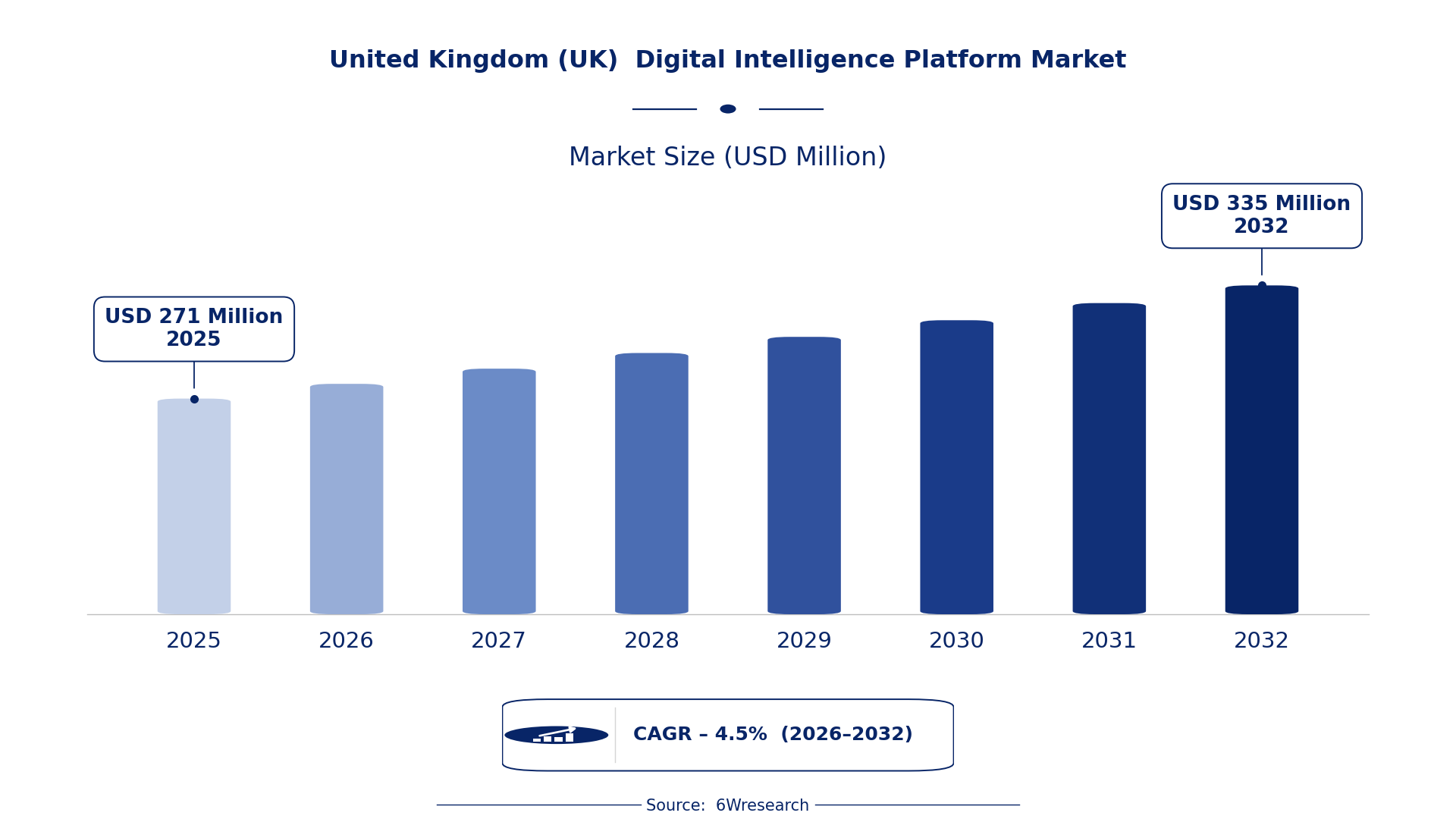
The United Kingdom (UK) Digital Intelligence Platform Market was estimated at USD 271 Million in 2025 and is projected to reach USD 335 Million by 2032, growing at a CAGR of 4.5% from 2026 to 2032.
United Kingdom (UK) Digital Intelligence Platform Market Synopsis
The demand for digital intelligence platforms in the UK is not merely a trend; it’s a fundamental shift in how organizations operate. Companies are increasingly relying on these platforms to harness vast amounts of data, enabling them to make informed decisions that enhance operational efficiency and customer engagement.
As sectors such as finance, healthcare, and retail embrace advanced analytics, the need for real-time insights has become paramount. This market is witnessing significant investment, driven by the desire to optimize business processes and deliver personalized customer experiences.
United Kingdom (UK) Digital Intelligence Platform Market Year-wise Growth Rate and Key Drivers
This graph illustrates the annual growth rates of the United Kingdom (UK) Digital Intelligence Platform Market from 2021 to 2032, highlighting a steady upward trajectory and projected expansion over the forecast period.
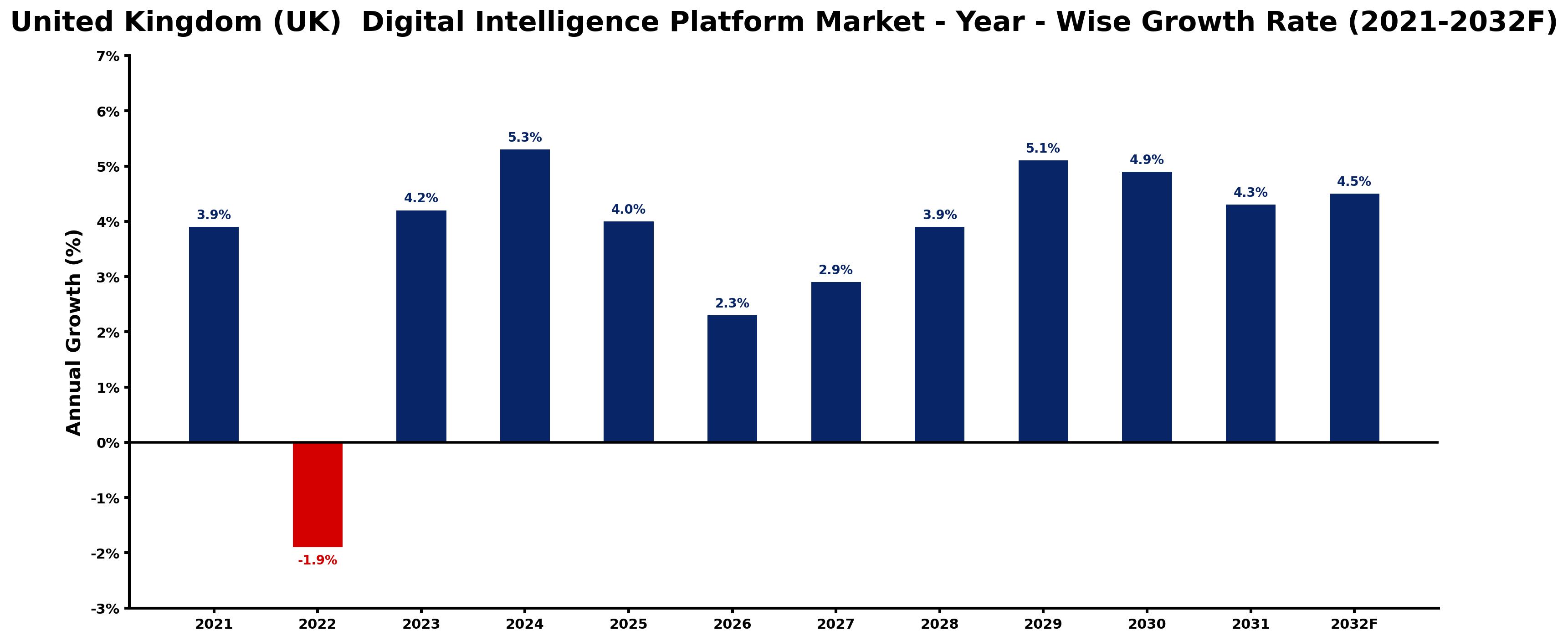
The table below presents the year‑wise growth rates along with the key drivers influencing the market
| Year | Growth Rate | Major Drivers |
| 2021 | 3.9% | Increased investment in UK AI and machine learning initiatives. |
| 2022 | -1.9% | Increased GDPR compliance costs for digital solutions providers. |
| 2023 | 4.2% | UK businesses focusing on enhancing customer experience through analytics. |
| 2024 | 5.3% | Rise in demand for remote work digital solutions post-pandemic. |
| 2025 | 4.0% | Growing adoption of data-driven decision making among SMEs. |
| 2026 | 2.3% | UK government incentives for tech innovation and development. |
| 2027 | 2.9% | Demand for cybersecurity solutions boosting digital intelligence services. |
| 2028 | 3.9% | Increased data protection awareness driving analytics usage. |
| 2029 | 5.1% | Emergence of FinTech startups requiring advanced digital insights. |
| 2030 | 4.9% | HealthTech companies seeking predictive analytics for patient care. |
| 2031 | 4.3% | Education sector's shift towards data-informed teaching strategies. |
| 2032 | 4.5% | Rising need for real-time data insights in retail industries. |
Note: Market size estimations and growth projections presented in this report are based on 6Wresearch's proprietary forecasting methodology, utilizing the latest available industry data, government publications, and primary research inputs.
United Kingdom (UK) Digital Intelligence Platform Market Key Takeaways
Below are some of the specific key takeaways from the market, including:
- The integration of AI and machine learning is crucial for enhancing analytics capabilities.
- Real-time data processing is a key demand driver across various industries.
- Healthcare and finance are leading sectors in adopting digital intelligence solutions.
- Data governance and compliance remain critical challenges for businesses.
- Investment in personalized customer experiences is accelerating market growth.
Evaluation of Restraints in United Kingdom (UK) Digital Intelligence Platform Market
Despite the promising outlook, several factors are limiting the growth of the digital intelligence platform market in the UK. One primary concern is the overwhelming volume of data organizations must manage, which complicates maintaining data integrity and accuracy. Additionally, businesses struggle to deploy scalable analytics solutions that can deliver actionable insights in real-time.
Technological advancements are rapid, and organizations often find it challenging to keep pace. Alongside this, the complexities of data governance and compliance requirements present further hurdles, making it essential for companies to navigate these issues effectively to capitalize on market opportunities.
United Kingdom (UK) Digital Intelligence Platform Market Trends
Several trends are currently shaping the digital intelligence platform market in the UK. The increasing focus on predictive analytics is notable, with businesses leveraging data to anticipate customer behavior and streamline operations. on top of that, the integration of machine learning algorithms is becoming standard practice, driving more sophisticated analytical capabilities.
Another trend is the growing emphasis on ethical AI and data practices. As consumers become more aware of data privacy issues, companies are prioritizing transparency and responsible data use in their analytics strategies. This shift not only helps in compliance but also builds trust with customers.
United Kingdom (UK) Digital Intelligence Platform Market Opportunities
Opportunities abound in the UK digital intelligence platform market, especially for companies willing to invest in innovative solutions. The healthcare sector, for instance, presents substantial growth potential, as organizations seek to harness data for improved patient outcomes and operational efficiency. Similarly, the retail sector is ripe for transformation, with personalized marketing and customer experience initiatives driving demand for advanced analytics.
on top of that, small and medium enterprises (SMEs) are beginning to recognize the value of digital intelligence platforms, creating a fresh market segment that larger players can target. As these businesses strive to compete with established firms, the demand for scalable, user-friendly analytics solutions is expected to rise.
Government Initiatives in the United Kingdom (UK) Digital Intelligence Platform Market
Government policy in the UK is significantly influencing the digital intelligence platform market, focusing on ethical data practices and fostering innovation. The regulatory framework established by bodies such as the Information Commissioner's Office (ICO) seeks to ensure data protection and algorithmic transparency, vital for building consumer trust. These initiatives not only safeguard user data but also promote a competitive environment for digital intelligence solutions.
- A regulatory framework introduced in 2025 mandating data protection and algorithmic transparency to enhance consumer trust.
- A national digital infrastructure upgrade programme now in its rollout phase to support advanced analytics capabilities.
- Current initiatives focused on promoting AI-driven technologies in public sectors, enhancing their analytical capabilities.
- A planned public-private partnership expected to boost investment in data analytics projects by 2028.
Future Insights of the United Kingdom (UK) Digital Intelligence Platform Market
Looking ahead to 2026-2032, the UK digital intelligence platform market is set for steady growth. As organizations continue to recognize the value of data-driven decision-making, demand for advanced analytics solutions will persist. The integration of AI and machine learning will further enhance these platforms, providing deeper insights and fostering innovation across sectors.
on top of that, the ongoing emphasis on data privacy and ethical practices will shape the competitive dynamics. Companies that prioritize compliance and transparency are likely to gain a competitive edge, particularly as consumer awareness of these issues grows. In this evolving environment, adaptability and forward-thinking strategies will be key to capitalizing on emerging opportunities.
United Kingdom (UK) Digital Intelligence Platform Market Latest Developments
Over the past year, the UK digital intelligence platform market has seen a surge in activity, driven by technological advancements and increased investment. Organizations are rapidly adopting new tools to enhance their analytics capabilities, reflecting a broader recognition of data as a critical asset. The focus on real-time insights and AI integration continues to dominate discussions within the industry.
- A major technology vendor launched a new AI-driven analytics platform in early 2025, aimed at simplifying data interpretation for businesses.
- An initiative that began in mid-2025 and remains underway focuses on integrating advanced machine learning capabilities into existing digital platforms.
- By late 2025, a consortium of leading firms completed a project aimed at developing standardized protocols for data governance.
- A rollout expected to begin in the second half of 2026 aims to expand access to analytics tools for SMEs across the UK.
United Kingdom (UK) Digital Intelligence Platform Market - Key Attractiveness of the Report
- 10 Years of Market Numbers
- Historical Data Starting from 2022 to 2025
- Base Year: 2025
- Forecast Data until 2032
- Key Performance Indicators Impacting the Market
- Major Upcoming Developments and Projects
Key Highlights of the Report:
- United Kingdom (UK) Digital Intelligence Platform Market Outlook
- Market Size of United Kingdom (UK) Digital Intelligence Platform Market, 2025
- Forecast of United Kingdom (UK) Digital Intelligence Platform Market, 2032
- Historical Data and Forecast of United Kingdom (UK) Digital Intelligence Platform Revenues & Volume for the Period 2022-2032F
- United Kingdom (UK) Digital Intelligence Platform Market Trend Evolution
- United Kingdom (UK) Digital Intelligence Platform Market Drivers and Challenges
- United Kingdom (UK) Digital Intelligence Platform Price Trends
- United Kingdom (UK) Digital Intelligence Platform Porter's Five Forces
- United Kingdom (UK) Digital Intelligence Platform Industry Life Cycle
- Historical Data and Forecast of United Kingdom (UK) Digital Intelligence Platform Market Revenues & Volume By Component for the Period 2022-2032F
- Historical Data and Forecast of United Kingdom (UK) Digital Intelligence Platform Market Revenues & Volume By Analytics for the Period 2022-2032F
- Historical Data and Forecast of United Kingdom (UK) Digital Intelligence Platform Market Revenues & Volume By Data Management for the Period 2022-2032F
- Historical Data and Forecast of United Kingdom (UK) Digital Intelligence Platform Market Revenues & Volume By Engagement Optimization for the Period 2022-2032F
- Historical Data and Forecast of United Kingdom (UK) Digital Intelligence Platform Market Revenues & Volume By Vertical for the Period 2022-2032F
- Historical Data and Forecast of United Kingdom (UK) Digital Intelligence Platform Market Revenues & Volume By Banking, Financial Services & Insurance (BFSI) for the Period 2022-2032F
- Historical Data and Forecast of United Kingdom (UK) Digital Intelligence Platform Market Revenues & Volume By Retail & E-commerce for the Period 2022-2032F
- Historical Data and Forecast of United Kingdom (UK) Digital Intelligence Platform Market Revenues & Volume By Telecommunication & IT for the Period 2022-2032F
- Historical Data and Forecast of United Kingdom (UK) Digital Intelligence Platform Market Revenues & Volume By Media & Entertainment for the Period 2022-2032F
- Historical Data and Forecast of United Kingdom (UK) Digital Intelligence Platform Market Revenues & Volume By Travel & Hospitality for the Period 2022-2032F
- Historical Data and Forecast of United Kingdom (UK) Digital Intelligence Platform Market Revenues & Volume By Public Sector for the Period 2022-2032F
- Historical Data and Forecast of United Kingdom (UK) Digital Intelligence Platform Market Revenues & Volume By Healthcare for the Period 2022-2032F
- Historical Data and Forecast of United Kingdom (UK) Digital Intelligence Platform Market Revenues & Volume By Others for the Period 2022-2032F
- Historical Data and Forecast of United Kingdom (UK) Digital Intelligence Platform Market Revenues & Volume By Touchpoint for the Period 2022-2032F
- Historical Data and Forecast of United Kingdom (UK) Digital Intelligence Platform Market Revenues & Volume By Company Website for the Period 2022-2032F
- Historical Data and Forecast of United Kingdom (UK) Digital Intelligence Platform Market Revenues & Volume By Mobile for the Period 2022-2032F
- Historical Data and Forecast of United Kingdom (UK) Digital Intelligence Platform Market Revenues & Volume By E-mail for the Period 2022-2032F
- Historical Data and Forecast of United Kingdom (UK) Digital Intelligence Platform Market Revenues & Volume By Social Media for the Period 2022-2032F
- Historical Data and Forecast of United Kingdom (UK) Digital Intelligence Platform Market Revenues & Volume By Web for the Period 2022-2032F
- Historical Data and Forecast of United Kingdom (UK) Digital Intelligence Platform Market Revenues & Volume By Kiosks & POS for the Period 2022-2032F
- Historical Data and Forecast of United Kingdom (UK) Digital Intelligence Platform Market Revenues & Volume By Others for the Period 2022-2032F
- Historical Data and Forecast of United Kingdom (UK) Digital Intelligence Platform Market Revenues & Volume By Organization Size for the Period 2022-2032F
- Historical Data and Forecast of United Kingdom (UK) Digital Intelligence Platform Market Revenues & Volume By Large Enterprises for the Period 2022-2032F
- Historical Data and Forecast of United Kingdom (UK) Digital Intelligence Platform Market Revenues & Volume By Small & Medium Enterprises (SMEs) for the Period 2022-2032F
- United Kingdom (UK) Digital Intelligence Platform Import Export Trade Statistics
- Market Opportunity Assessment By Component
- Market Opportunity Assessment By Vertical
- Market Opportunity Assessment By Touchpoint
- Market Opportunity Assessment By Organization Size
- United Kingdom (UK) Digital Intelligence Platform Top Companies Market Share
- United Kingdom (UK) Digital Intelligence Platform Competitive Benchmarking By Technical and Operational Parameters
- United Kingdom (UK) Digital Intelligence Platform Company Profiles
- United Kingdom (UK) Digital Intelligence Platform Key Strategic Recommendations






































