United Kingdom (UK) Estradiol Market Size, Share & Growth Rate
The United Kingdom (UK) Estradiol Market was estimated at USD 432 Million in 2025 and is projected to reach USD 535 Million by 2032, growing at a CAGR of 3.1% from 2026 to 2032. This growth trajectory is primarily fueled by the increasing prevalence of menopausal symptoms among women, which has heightened the demand for effective hormone replacement therapies. In tandem with an aging population, the market is also benefiting from advancements in drug delivery systems and a greater focus on personalized treatment approaches.
United Kingdom (UK) Estradiol Market Year-wise Growth Rate and Key Drivers
This graph highlights how the United Kingdom (UK) Estradiol Market has steadily grown over the years, supported by major growth factors.
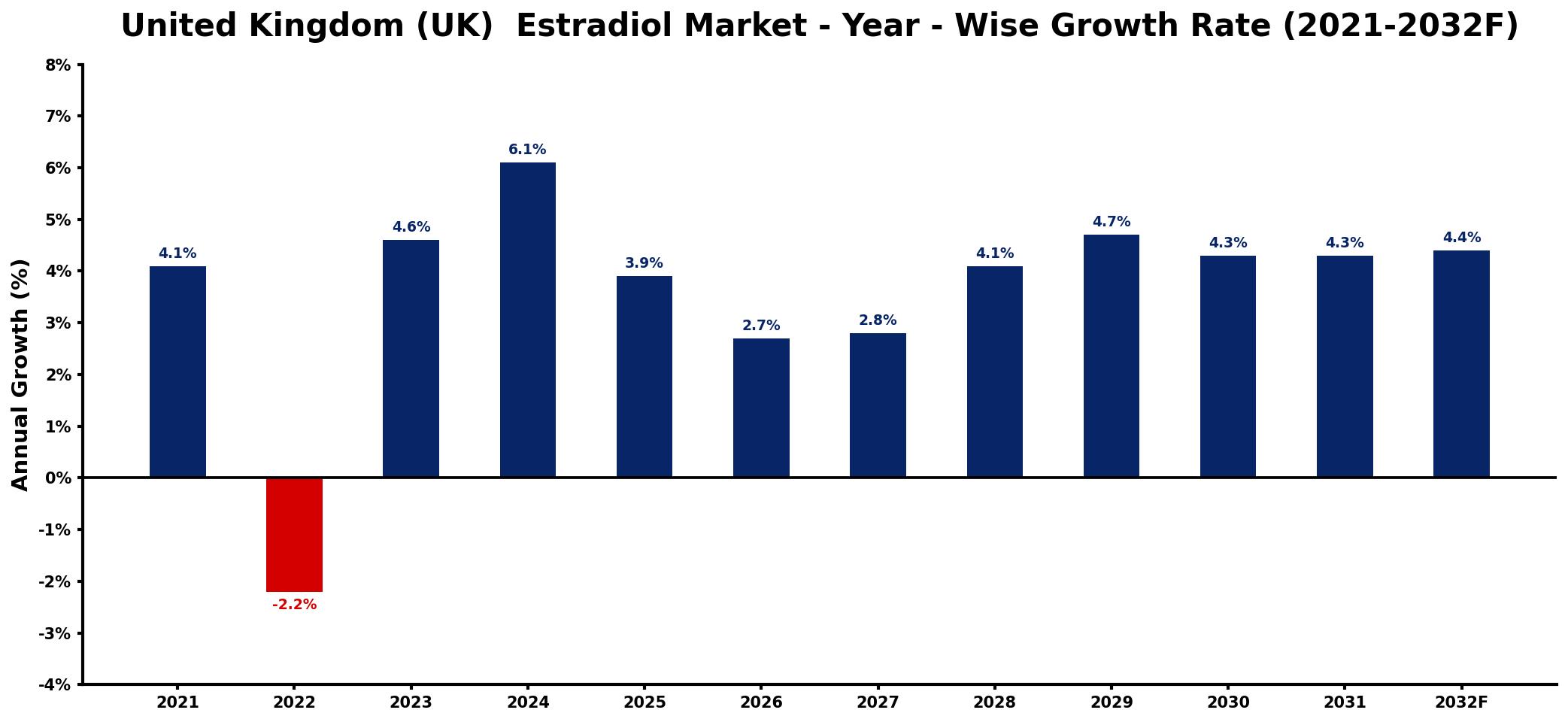
The table below presents the year‑wise growth rates along with the key drivers influencing the market
| Year | Growth Rate | Major Drivers |
| 2021 | 4.1% | Rising demand for hormone therapies |
| 2022 | -2.2% | Market stabilization amid regulatory changes |
| 2023 | 4.6% | Increased healthcare investment initiatives |
| 2024 | 6.1% | Expansion of women's health programs |
| 2025 | 3.9% | Growing awareness of menopause management |
| 2026 | 2.7% | Advancements in pharmaceutical technologies |
| 2027 | 2.8% | Increased prevalence of hormone disorders |
| 2028 | 4.1% | Broader access to healthcare services |
| 2029 | 4.7% | Surge in telehealth adoption rates |
| 2030 | 4.3% | Strengthened partnerships in research sectors |
| 2031 | 4.3% | Emerging markets driving product interest |
| 2032 | 4.4% | Innovations in personalized medicine approaches |
Note: Market size estimations and growth projections presented in this report are based on 6Wresearch's proprietary forecasting methodology, utilizing the latest available industry data, government publications, and primary research inputs.
United Kingdom (UK) Estradiol Market Synopsis
The strongest force shaping the UK Estradiol Market is the rising awareness around menopausal health. As societal attitudes shift towards more open discussions about menopause, more women are seeking effective relief from symptoms, driving demand for estradiol-based products.
In addition, the evolution of drug delivery methods, including transdermal patches and gels, is significantly enhancing treatment experiences. These innovations not only improve the efficacy of estradiol therapies but also promote adherence among patients, thereby further stimulating market growth.
United Kingdom (UK) Estradiol Market Key Takeaways
- The market is experiencing steady growth due to increased awareness of menopausal health issues.
- Innovative delivery methods are reshaping how estradiol therapies are administered.
- Demand for personalized medicine is on the rise, leading to tailored treatment options for patients.
- Regulatory frameworks and pricing pressures pose challenges that companies must navigate.
- Investment opportunities abound for firms focused on women's health and hormonal therapies.
Evaluation of Restraints in United Kingdom (UK) Estradiol Market
Despite the positive outlook, the UK Estradiol Market faces several restraints that could impede growth. Regulatory hurdles are a significant concern, as changes can affect product availability and compliance costs. The competitive landscape, characterized by generic alternatives and other hormone replacement therapies, exerts downward pressure on pricing, complicating profitability for manufacturers. Additionally, issues related to patent expirations can dilute brand loyalty, forcing companies to innovate continuously to maintain market share.
United Kingdom (UK) Estradiol Market Trends
Current trends in the UK Estradiol Market reflect a pronounced shift towards patient-centric healthcare solutions. There's a growing adoption of advanced delivery systems, with transdermal patches and gels gaining traction for their convenience and effectiveness. Moreover, healthcare providers are increasingly embracing personalized medicine, allowing for tailored estradiol treatment plans that cater to individual patient needs and preferences. As patients demand more options, the introduction of diverse formulations and dosages further enriches the market landscape.
United Kingdom (UK) Estradiol Market Opportunities
The landscape for investment in the UK Estradiol market is ripe with opportunities. As awareness surrounding hormonal treatments expands, there is significant potential for companies specializing in innovative estradiol formulations. Furthermore, the trend towards personalized medicine presents avenues for businesses that focus on precision approaches to treatment. Collaborative partnerships aimed at research and development could lead to breakthroughs that align with the growing demand for effective menopausal symptom management.
Government Initiatives in the United Kingdom (UK) Estradiol Market
In the UK, the Estradiol market operates under stringent government regulations designed to ensure safety and efficacy. The Medicines and Healthcare products Regulatory Agency (MHRA) is responsible for overseeing the approval process for estradiol products, ensuring they meet high-quality standards. Additionally, the National Institute for Health and Care Excellence (NICE) provides valuable guidance on the cost-effectiveness of these treatments, influencing their inclusion in the National Health Service (NHS) and ensuring public access to essential medications.
Future Insights of the United Kingdom (UK) Estradiol Market
Looking ahead to 2026-2032, the UK Estradiol Market is positioned for moderate growth driven by an aging population and heightened recognition of womens health issues. The demand for estradiol-based hormone replacement therapies is set to increase, spurred by rising cases of menopausal symptoms. Technological advancements in drug delivery and a burgeoning focus on personalized treatment strategies will likely further amplify market dynamics, although companies will need to navigate regulatory complexities and competitive pressures thoughtfully.
United Kingdom (UK) Estradiol Market Latest Developments (2025 - 2026)
Recent developments in the UK Estradiol market have focused on improving treatment options and delivery methods. Manufacturers are exploring new formulations that enhance patient adherence and satisfaction. Furthermore, collaborative efforts between pharmaceutical companies and healthcare providers aim to expand the availability of innovative estradiol therapies, ensuring that the evolving needs of women experiencing menopausal symptoms are met more effectively. As technology evolves, the market is likely to see greater integration of digital health solutions into treatment protocols.
United Kingdom (UK) Estradiol Market - Key Attractiveness of the Report
- 10 Years of Market Numbers
- Historical Data Starting from 2022 to 2025
- Base Year: 2025
- Forecast Data until 2032
- Key Performance Indicators Impacting the Market
- Major Upcoming Developments and Projects
Key Highlights of the Report:
- United Kingdom (UK) Estradiol Market Outlook
- Market Size of United Kingdom (UK) Estradiol Market, 2025
- Forecast of United Kingdom (UK) Estradiol Market, 2032
- Historical Data and Forecast of United Kingdom (UK) Estradiol Revenues & Volume for the Period 2022-2032F
- United Kingdom (UK) Estradiol Market Trend Evolution
- United Kingdom (UK) Estradiol Market Drivers and Challenges
- United Kingdom (UK) Estradiol Price Trends
- United Kingdom (UK) Estradiol Porter's Five Forces
- United Kingdom (UK) Estradiol Industry Life Cycle
- Historical Data and Forecast of United Kingdom (UK) Estradiol Market Revenues & Volume By Product Type for the Period 2022-2032F
- Historical Data and Forecast of United Kingdom (UK) Estradiol Market Revenues & Volume By a-Estradiol for the Period 2022-2032F
- Historical Data and Forecast of United Kingdom (UK) Estradiol Market Revenues & Volume By End-User for the Period 2022-2032F
- Historical Data and Forecast of United Kingdom (UK) Estradiol Market Revenues & Volume By Pharmaceutical for the Period 2022-2032F
- Historical Data and Forecast of United Kingdom (UK) Estradiol Market Revenues & Volume By Biological Research for the Period 2022-2032F
- Historical Data and Forecast of United Kingdom (UK) Estradiol Market Revenues & Volume By Others for the Period 2022-2032F
- United Kingdom (UK) Estradiol Import Export Trade Statistics
- Market Opportunity Assessment By Product Type
- Market Opportunity Assessment By End-User
- United Kingdom (UK) Estradiol Top Companies Market Share
- United Kingdom (UK) Estradiol Competitive Benchmarking By Technical and Operational Parameters
- United Kingdom (UK) Estradiol Company Profiles
- United Kingdom (UK) Estradiol Key Strategic Recommendations






































