United Kingdom (UK) Field Force Automation Market Size & Growth Rate (2026-2032)
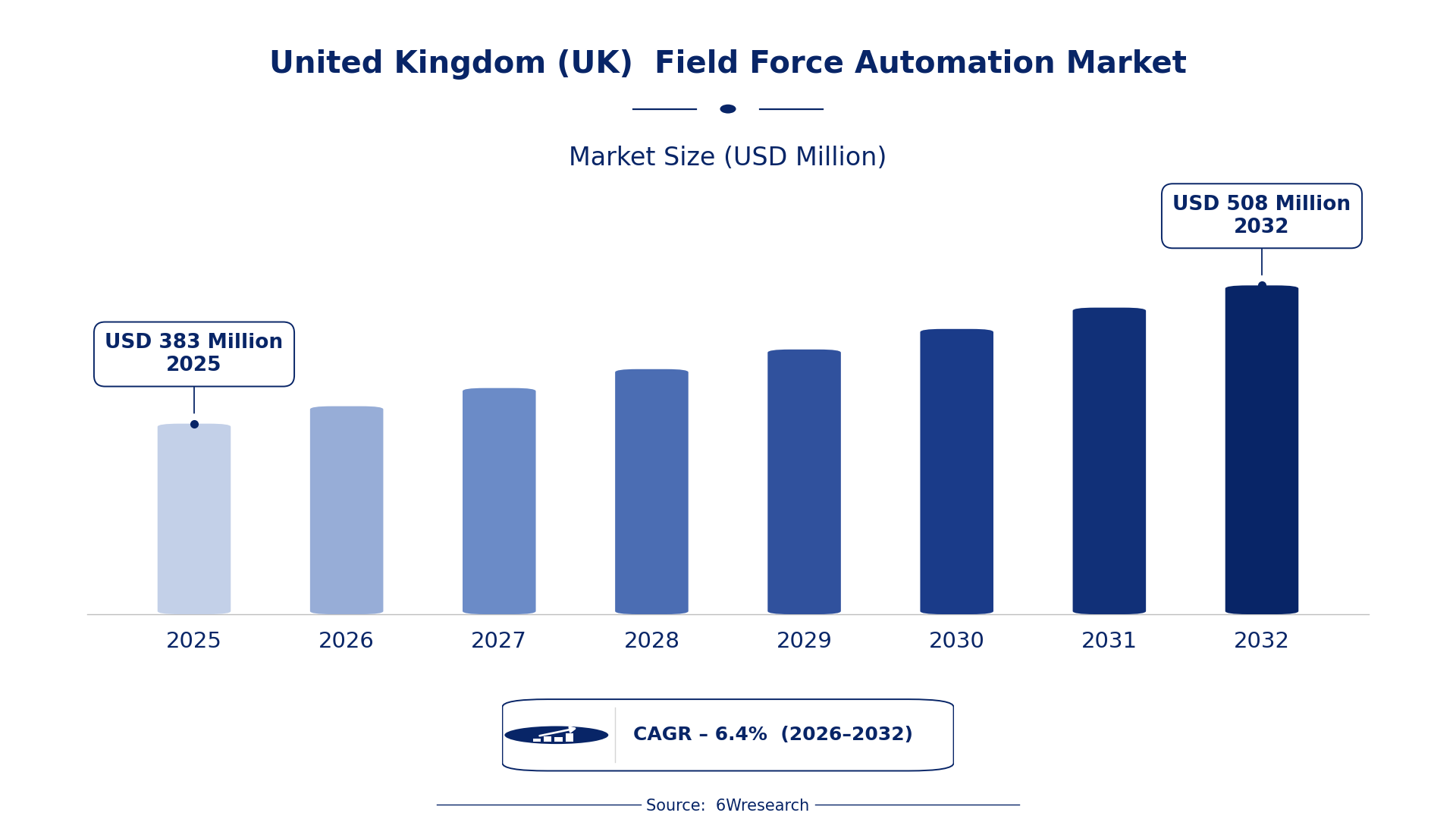
The United Kingdom (UK) Field Force Automation Market was estimated at USD 383 Million in 2025 and is projected to reach USD 508 Million by 2032, growing at a CAGR of 6.4% from 2026 to 2032.
United Kingdom (UK) Field Force Automation Market Synopsis
The United Kingdom's Field Force Automation market is currently characterized by a surge in demand for efficient, technology-driven solutions. Organizations are increasingly recognizing that automating field operations can lead to notable improvements in productivity and customer satisfaction, especially as mobile technology becomes more entrenched in everyday business processes.
As various sectors, including utilities, healthcare, and construction, adapt to modern operational challenges, the integration of AI and IoT into field force automation is gaining traction. This trend is not merely a passing phase; it indicates a fundamental shift in how companies operate and engage with their field workforce.
United Kingdom (UK) Field Force Automation Market Year-wise Growth Rate and Key Drivers
This graph illustrates the annual growth rates of the United Kingdom (UK) Field Force Automation Market from 2021 to 2032, highlighting a steady upward trajectory and projected expansion over the forecast period.
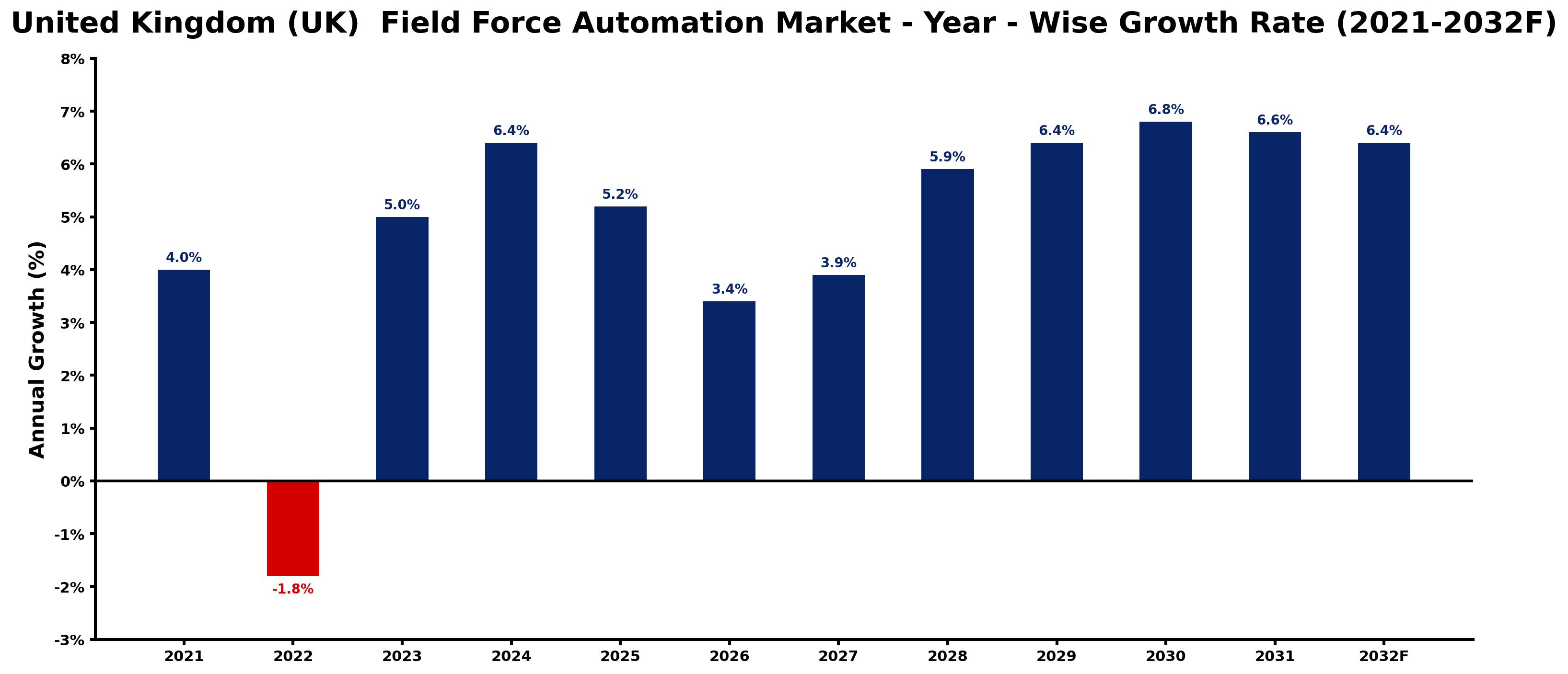
The table below presents the year‑wise growth rates along with the key drivers influencing the market
| Year | Growth Rate | Major Drivers |
| 2021 | 4.0% | Rise in UK mobile workforce management solutions adoption |
| 2022 | -1.8% | Delayed adoption due to Brexit transition challenges. |
| 2023 | 5.0% | Increased demand for real-time data access in logistics |
| 2024 | 6.4% | UK's push for remote workforce efficiency enhancements |
| 2025 | 5.2% | Growing need for field service optimization technologies |
| 2026 | 3.4% | Enhanced mobile broadband infrastructure in urban areas |
| 2027 | 3.9% | UK's focus on improving customer experience in service |
| 2028 | 5.9% | Increasing regulatory focus on field safety compliance |
| 2029 | 6.4% | Growth in servicing electric vehicles across the UK |
| 2030 | 6.8% | Higher investment in AI-driven field service scheduling |
| 2031 | 6.6% | Emergence of smart tools for field technicians |
| 2032 | 6.4% | Development of integrated solutions for multi-channel service |
Note: Market size estimations and growth projections presented in this report are based on 6Wresearch's proprietary forecasting methodology, utilizing the latest available industry data, government publications, and primary research inputs.
United Kingdom (UK) Field Force Automation Market Key Takeaways
Below are some of the specific key takeaways from the market, including:
- The integration of AI and IoT technologies is driving innovation in field service operations.
- Cloud-based solutions are increasingly favored for their scalability and accessibility.
- Field force automation is becoming essential for enhancing customer service and operational efficiency.
- Companies are investing heavily in mobile technologies to facilitate real-time data access.
- Sustainability and eco-friendly practices are gaining importance in automation strategies.
Evaluation of Restraints in United Kingdom (UK) Field Force Automation Market
Despite the promising outlook, several restraints hinder market growth. Data security remains a top concern, as the sensitive nature of field data requires robust protection mechanisms. Integration issues with legacy systems can create bottlenecks, slowing down the adoption of new technologies. on top of that, some field workers exhibit resistance to transitioning from traditional methods to automated solutions, necessitating thorough training and support. Regulatory compliance adds another layer of complexity, as companies must navigate various standards while managing geographically dispersed teams.
United Kingdom (UK) Field Force Automation Market Trends
Recent trends in the UK Field Force Automation market indicate a strong shift towards mobile-first solutions. Organizations are increasingly utilizing user-friendly applications that empower field workers with instant access to critical information. on top of that, the rise of predictive analytics through AI is enabling businesses to anticipate operational challenges and streamline resource allocation effectively. Environmental sustainability is also becoming a driving force, as businesses seek automation solutions that minimize their carbon footprint.
United Kingdom (UK) Field Force Automation Market Opportunities
The market is ripe with opportunities, particularly as companies across various sectors seek to enhance productivity. Investment in field force automation software providers and hardware manufacturers is likely to yield substantial returns. The focus on digital transformation within the UK, driven by government initiatives, presents a fertile ground for innovative technologies aimed at automating field operations. Companies willing to capitalize on this trend can establish a strong foothold in the expanding market.
Government Initiatives in the United Kingdom (UK) Field Force Automation Market
Government policies are actively shaping the Field Force Automation market in the UK by promoting the adoption of advanced technologies. Initiatives aimed at enhancing efficiency and productivity are crucial, as they encourage businesses to invest in modern field operations management. The regulatory framework is being strengthened to ensure data security and compliance, which is essential for fostering trust in automation solutions.
- A national digital infrastructure upgrade programme now in its rollout phase aims to enhance connectivity for field operations.
- A regulatory framework introduced in 2025 mandates data protection measures for field data, ensuring compliance and security.
- Recent funding initiatives have been launched to support businesses adopting field force automation technologies.
- Ongoing efforts focus on public-private partnerships to drive innovation in smart technologies for field operations.
- Future plans include a strategic review aimed at integrating sustainable practices into field operations by 2028.
Future Insights of the United Kingdom (UK) Field Force Automation Market
Looking ahead to 2026-2032, the UK Field Force Automation market is set to flourish as organizations increasingly prioritize efficiency and customer engagement. The demand for real-time data and mobile capabilities will continue to rise, pushing companies to adopt more sophisticated automation solutions. As the government reinforces its commitment to digital transformation, businesses must adapt and innovate to remain competitive in this rapidly evolving environment.
United Kingdom (UK) Field Force Automation Market Latest Developments
The last year has seen notable activity in the UK Field Force Automation market, with advancements in technology and increased investments shaping the industry. Companies are rapidly rolling out new solutions that enhance operational efficiency and improve the user experience for field workers. This trend reflects a growing acknowledgment of the importance of automation in maintaining competitiveness.
- A leading technology vendor completed the launch of a new field service management platform in early 2025, offering advanced analytics capabilities.
- An ongoing initiative that began in late 2025 focuses on integrating AI-driven insights into field operations to enhance decision-making.
- By mid-2026, a major construction firm plans to implement a comprehensive workforce management system aimed at optimizing resource allocation.
- A recent partnership between two key players aims to develop IoT-enabled devices for real-time monitoring of field activities, currently underway.
- Upcoming regulatory changes anticipated in late 2026 will introduce stricter standards for data management in field operations.
United Kingdom (UK) Field Force Automation Market - Key Attractiveness of the Report
- 10 Years of Market Numbers
- Historical Data Starting from 2022 to 2025
- Base Year: 2025
- Forecast Data until 2032
- Key Performance Indicators Impacting the Market
- Major Upcoming Developments and Projects
Key Highlights of the Report:
- United Kingdom (UK) Field Force Automation Market Outlook
- Market Size of United Kingdom (UK) Field Force Automation Market, 2025
- Forecast of United Kingdom (UK) Field Force Automation Market, 2032
- Historical Data and Forecast of United Kingdom (UK) Field Force Automation Revenues & Volume for the Period 2022-2032F
- United Kingdom (UK) Field Force Automation Market Trend Evolution
- United Kingdom (UK) Field Force Automation Market Drivers and Challenges
- United Kingdom (UK) Field Force Automation Price Trends
- United Kingdom (UK) Field Force Automation Porter's Five Forces
- United Kingdom (UK) Field Force Automation Industry Life Cycle
- Historical Data and Forecast of United Kingdom (UK) Field Force Automation Market Revenues & Volume By Component for the Period 2022-2032F
- Historical Data and Forecast of United Kingdom (UK) Field Force Automation Market Revenues & Volume By Solution for the Period 2022-2032F
- Historical Data and Forecast of United Kingdom (UK) Field Force Automation Market Revenues & Volume By Services for the Period 2022-2032F
- Historical Data and Forecast of United Kingdom (UK) Field Force Automation Market Revenues & Volume By Industry for the Period 2022-2032F
- Historical Data and Forecast of United Kingdom (UK) Field Force Automation Market Revenues & Volume By IT and Telecom for the Period 2022-2032F
- Historical Data and Forecast of United Kingdom (UK) Field Force Automation Market Revenues & Volume By Healthcare and Life Sciences for the Period 2022-2032F
- Historical Data and Forecast of United Kingdom (UK) Field Force Automation Market Revenues & Volume By Manufacturing for the Period 2022-2032F
- Historical Data and Forecast of United Kingdom (UK) Field Force Automation Market Revenues & Volume By Transportation and Logistics for the Period 2022-2032F
- Historical Data and Forecast of United Kingdom (UK) Field Force Automation Market Revenues & Volume By Construction and Real Estate for the Period 2022-2032F
- Historical Data and Forecast of United Kingdom (UK) Field Force Automation Market Revenues & Volume By Energy and Utilities for the Period 2022-2032F
- Historical Data and Forecast of United Kingdom (UK) Field Force Automation Market Revenues & Volume By Others for the Period 2022-2032F
- Historical Data and Forecast of United Kingdom (UK) Field Force Automation Market Revenues & Volume By Deployment Type for the Period 2022-2032F
- Historical Data and Forecast of United Kingdom (UK) Field Force Automation Market Revenues & Volume By On-Premises for the Period 2022-2032F
- Historical Data and Forecast of United Kingdom (UK) Field Force Automation Market Revenues & Volume By Cloud for the Period 2022-2032F
- Historical Data and Forecast of United Kingdom (UK) Field Force Automation Market Revenues & Volume By Organization Size for the Period 2022-2032F
- Historical Data and Forecast of United Kingdom (UK) Field Force Automation Market Revenues & Volume By SMEs for the Period 2022-2032F
- Historical Data and Forecast of United Kingdom (UK) Field Force Automation Market Revenues & Volume By Large Enterprises for the Period 2022-2032F
- United Kingdom (UK) Field Force Automation Import Export Trade Statistics
- Market Opportunity Assessment By Component
- Market Opportunity Assessment By Industry
- Market Opportunity Assessment By Deployment Type
- Market Opportunity Assessment By Organization Size
- United Kingdom (UK) Field Force Automation Top Companies Market Share
- United Kingdom (UK) Field Force Automation Competitive Benchmarking By Technical and Operational Parameters
- United Kingdom (UK) Field Force Automation Company Profiles
- United Kingdom (UK) Field Force Automation Key Strategic Recommendations






































