United Kingdom (UK) Fruit Powder Market Size, Share & Growth Rate
The United Kingdom (UK) Fruit Powder Market was estimated at USD 488 Million in 2025 and is projected to reach USD 604 Million by 2032, growing at a CAGR of 3.1% from 2026 to 2032. This growth is primarily fueled by the increasing consumer preference for convenient and health-oriented food products, as well as the rising awareness surrounding the nutritional benefits of fruit powders. The trend toward natural and organic ingredients is further bolstering market demand, as consumers are becoming more discerning about the quality and origins of the foods they consume.
United Kingdom (UK) Fruit Powder Market Year-wise Growth Rate and Key Drivers
This graph highlights how the United Kingdom (UK) Fruit Powder Market has steadily grown over the years, supported by major growth factors.
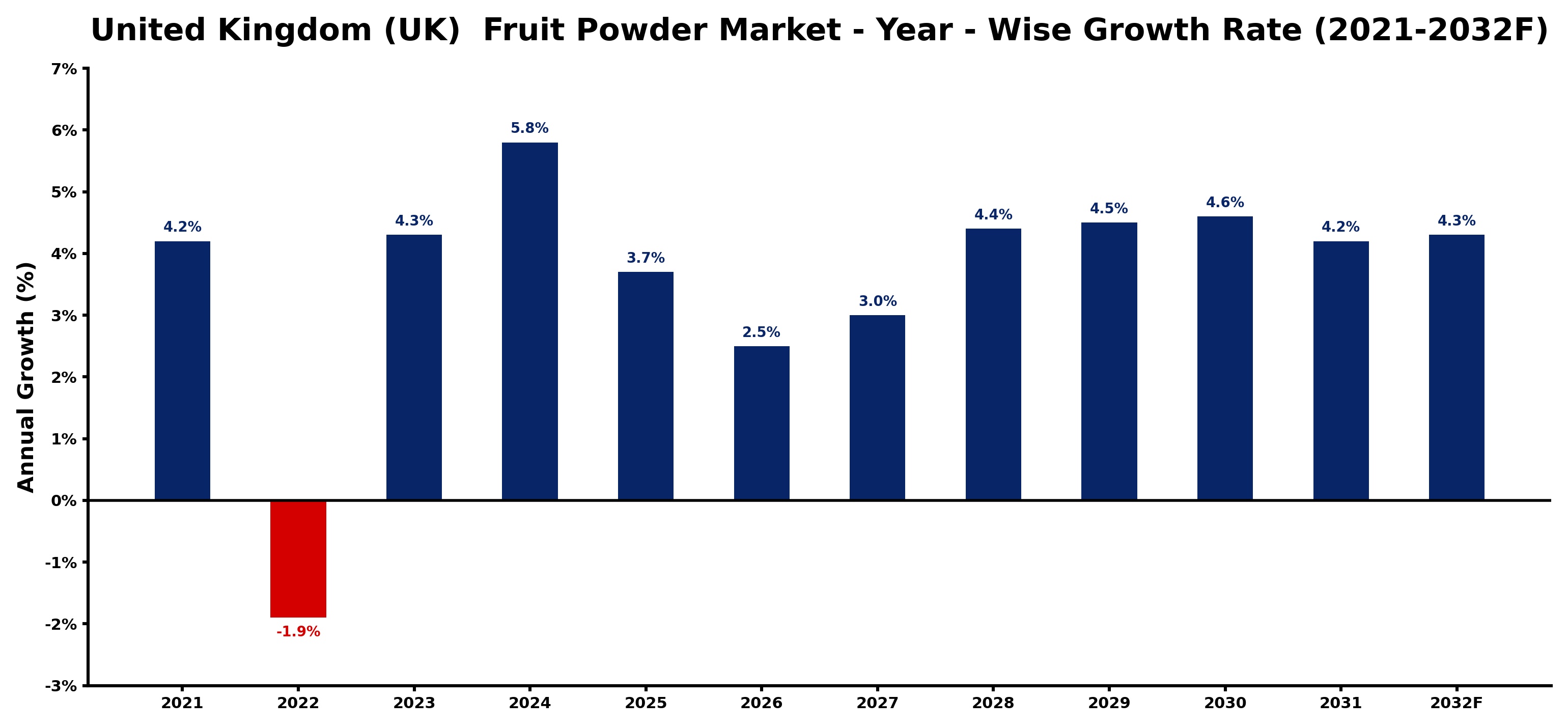
The table below presents the year‑wise growth rates along with the key drivers influencing the market
| Year | Growth Rate | Major Drivers |
| 2021 | 4.2% | New fruit drying technologies boosted domestic powder production capacity |
| 2022 | -1.9% | Supply chain disruptions hinder fruit powder production efficiency |
| 2023 | 4.3% | Export demand for fruit powder spurred manufacturing facility investments |
| 2024 | 5.8% | Fruit processing plants adopt advanced drying technology for powder quality |
| 2025 | 3.7% | Technology integration streamlined fruit powder production and enhanced efficiency |
| 2026 | 2.5% | Domestic beverage manufacturers boost fruit powder procurement for product lines |
| 2027 | 3.0% | Accelerated investments in spray drying technology enhanced fruit powder yields |
| 2028 | 4.4% | Investment in dehydration technology boosts fruit powder production efficiency |
| 2029 | 4.5% | Improved supply chain resilience boosted fruit powder export capabilities |
| 2030 | 4.6% | Fruit processing facilities expanded production capacity through modernized equipment investments |
| 2031 | 4.2% | Modernized fruit powder manufacturing lines boost operational efficiency and output |
| 2032 | 4.3% | Fruit powder manufacturers expand capacity to meet export demands |
Note - Market size estimations and growth projections presented in this report are based on 6Wresearch's advanced forecasting approach, validated with industry datasets as of June 2026.
United Kingdom (UK) Fruit Powder Market Synopsis
The UK Fruit Powder Market is seeing a marked shift towards clean-label and organic fruit powders, reflecting a growing consumer interest in healthy eating and sustainability. Retailers are responding by expanding their product lines to include innovative flavors and blends, catering to a diverse range of culinary applications, from smoothies to baked goods.
Moreover, exotic fruit powders like acai and pomegranate are gaining traction due to their perceived health benefits and versatility. This is not only enhancing consumer choice but also encouraging manufacturers to develop unique formulations that meet the evolving tastes and preferences of the market.
United Kingdom (UK) Fruit Powder Market Key Takeaways
- Growing consumer demand for convenient and nutritious food options is driving the fruit powder market.
- Increased popularity of organic and clean-label products is reshaping market dynamics.
- Exotic and superfruit powders are emerging as key product segments, tapping into health-conscious consumer trends.
- Sustainable packaging initiatives are influencing purchasing decisions among environmentally aware consumers.
- Investment in product innovation is crucial for market players to stay competitive in a rapidly evolving landscape.
Evaluation of Restraints in United Kingdom (UK) Fruit Powder Market
Despite the growth potential, the UK Fruit Powder Market faces several restraints that may hinder progress. One prominent concern is the seasonality of fruit sourcing, leading to unpredictable supply and price fluctuations. This variability can complicate inventory management for manufacturers aiming to provide consistent products year-round. Furthermore, meeting the rising consumer demand for natural and organic options requires substantial investment in production technologies and quality assurance processes, which can strain resources. Ensuring safety and nutritional integrity in fruit powders is paramount, as any lapses can diminish consumer trust and affect market growth.
United Kingdom (UK) Fruit Powder Market Trends
The UK Fruit Powder Market is currently characterized by several noteworthy trends. Consumers are increasingly gravitating toward natural and organic fruit powders, leading to a decline in artificial flavorings. Additionally, there is a growing fascination with superfruit powders due to their rich nutritional profiles and antioxidant properties. Another trend is the shift towards eco-friendly packaging solutions, reflecting a heightened awareness of environmental impacts among consumers. The integration of fruit powders across diverse applications—from nutritional supplements to cosmetics—is further enhancing market appeal and driving demand.
United Kingdom (UK) Fruit Powder Market Opportunities
The UK Fruit Powder Market is ripe with investment opportunities, particularly in the realm of health-oriented products. As consumers increasingly seek natural flavors and cleaner ingredient labels, companies that invest in innovative fruit powder formulations stand to benefit significantly. The expansion of distribution channels in both retail and online platforms also presents a lucrative avenue for growth. There is a burgeoning demand for organic products, and those brands that can authentically align with this trend are likely to capture a substantial share of the market.
Government Initiatives in the United Kingdom (UK) Fruit Powder Market
Government policies in the UK significantly influence the Fruit Powder Market, particularly concerning food safety, labeling regulations, and trade practices. The Food Standards Agency (FSA) implements stringent guidelines to ensure consumer safety, requiring manufacturers to adhere to high quality and transparency standards. As part of the commitment to public health, there are also efforts to promote healthy eating, which align with the increasing interest in natural and nutritious food alternatives. The ramifications of Brexit on trade policies continue to evolve, which could impact the import and export dynamics within this market.
Future Insights of the United Kingdom (UK) Fruit Powder Market
Looking ahead to the period from 2026 to 2032, the UK Fruit Powder Market is poised for sustained growth. The increasing inclination toward healthy lifestyles and the convenience of powdered fruit products will further catalyze market expansion. As trends in diet shift towards plant-based and functional foods, the demand for fruit powders will likely accelerate. Manufacturers focusing on innovative blends and flavors that offer health benefits are expected to lead the market as consumer preferences continue to evolve.
United Kingdom (UK) Fruit Powder Market Latest Developments (May 2025 - June 2026)
Recent developments in the UK Fruit Powder Market indicate a strong focus on product innovation and sustainability. Companies are actively engaging in research to develop novel fruit powder formulations that appeal to health-conscious consumers. There is also a noticeable uptick in collaborations aimed at enhancing distribution channels, ensuring that these products reach a wider audience. The trend towards eco-friendly packaging is being embraced by many manufacturers as they look to align their brands with consumer values on sustainability.
United Kingdom (UK) Fruit Powder Market - Key Attractiveness of the Report
- 10 Years of Market Numbers
- Historical Data Starting from 2022 to 2025
- Base Year: 2025
- Forecast Data until 2032
- Key Performance Indicators Impacting the Market
- Major Upcoming Developments and Projects
Key Highlights of the Report:
- United Kingdom (UK) Fruit Powder Market Outlook
- Market Size of United Kingdom (UK) Fruit Powder Market, 2025
- Forecast of United Kingdom (UK) Fruit Powder Market, 2032
- Historical Data and Forecast of United Kingdom (UK) Fruit Powder Revenues & Volume for the Period 2022-2032F
- United Kingdom (UK) Fruit Powder Market Trend Evolution
- United Kingdom (UK) Fruit Powder Market Drivers and Challenges
- United Kingdom (UK) Fruit Powder Price Trends
- United Kingdom (UK) Fruit Powder Porter's Five Forces
- United Kingdom (UK) Fruit Powder Industry Life Cycle
- Historical Data and Forecast of United Kingdom (UK) Fruit Powder Market Revenues & Volume By Type for the Period 2022-2032F
- Historical Data and Forecast of United Kingdom (UK) Fruit Powder Market Revenues & Volume By Banana for the Period 2022-2032F
- Historical Data and Forecast of United Kingdom (UK) Fruit Powder Market Revenues & Volume By Grapes for the Period 2022-2032F
- Historical Data and Forecast of United Kingdom (UK) Fruit Powder Market Revenues & Volume By Blueberry for the Period 2022-2032F
- Historical Data and Forecast of United Kingdom (UK) Fruit Powder Market Revenues & Volume By Mango for the Period 2022-2032F
- Historical Data and Forecast of United Kingdom (UK) Fruit Powder Market Revenues & Volume By others for the Period 2022-2032F
- Historical Data and Forecast of United Kingdom (UK) Fruit Powder Market Revenues & Volume By Application for the Period 2022-2032F
- Historical Data and Forecast of United Kingdom (UK) Fruit Powder Market Revenues & Volume By Bakery & Confectionery for the Period 2022-2032F
- Historical Data and Forecast of United Kingdom (UK) Fruit Powder Market Revenues & Volume By Dairy & Frozen Desserts for the Period 2022-2032F
- Historical Data and Forecast of United Kingdom (UK) Fruit Powder Market Revenues & Volume By Beverages for the Period 2022-2032F
- Historical Data and Forecast of United Kingdom (UK) Fruit Powder Market Revenues & Volume By Food Supplements for the Period 2022-2032F
- Historical Data and Forecast of United Kingdom (UK) Fruit Powder Market Revenues & Volume By others for the Period 2022-2032F
- United Kingdom (UK) Fruit Powder Import Export Trade Statistics
- Market Opportunity Assessment By Type
- Market Opportunity Assessment By Application
- United Kingdom (UK) Fruit Powder Top Companies Market Share
- United Kingdom (UK) Fruit Powder Competitive Benchmarking By Technical and Operational Parameters
- United Kingdom (UK) Fruit Powder Company Profiles
- United Kingdom (UK) Fruit Powder Key Strategic Recommendations






































