United Kingdom (UK) Gamification Market Size, Share & Growth Rate
The United Kingdom (UK) Gamification Market was estimated at USD 155 Million in 2025 and is projected to reach USD 191 Million by 2032, growing at a CAGR of 3.0% from 2026 to 2032. This growth trajectory is primarily fueled by the burgeoning adoption of gamification techniques across diverse sectors, including education and healthcare. The quest for enhanced customer engagement and the integration of innovative technology solutions are key factors propelling this market forward.
United Kingdom (UK) Gamification Market Year-wise Growth Rate and Key Drivers
This graph highlights how the United Kingdom (UK) Gamification Market has steadily grown over the years, supported by major growth factors.
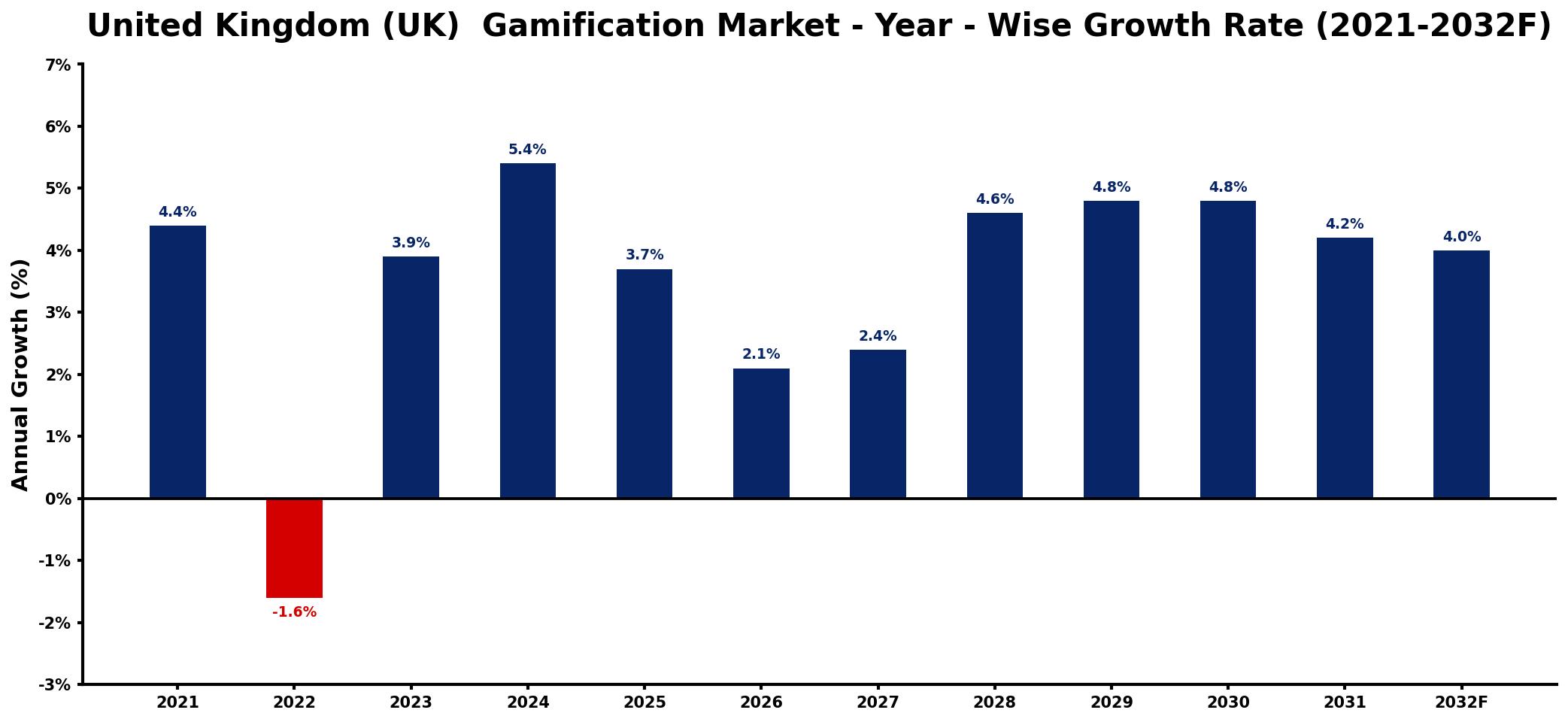
The table below presents the year‑wise growth rates along with the key drivers influencing the market
| Year | Growth Rate | Major Drivers |
| 2021 | 4.4% | Increased interest in engagement strategies |
| 2022 | -1.6% | Diminished corporate training budgets |
| 2023 | 3.9% | Rising adoption of digital platforms |
| 2024 | 5.4% | Expansion of remote work solutions |
| 2025 | 3.7% | Growing focus on employee motivation |
| 2026 | 2.1% | Increased investment in interactive tools |
| 2027 | 2.4% | Strengthening demand for learning technologies |
| 2028 | 4.6% | Surge in user-generated content |
| 2029 | 4.8% | Rising popularity of mobile applications |
| 2030 | 4.8% | Enhanced focus on customer loyalty |
| 2031 | 4.2% | Growing integration of analytics tools |
| 2032 | 4.0% | Increased emphasis on behavioral insights |
Note: Market size estimations and growth projections presented in this report are based on 6Wresearch's proprietary forecasting methodology, utilizing the latest available industry data, government publications, and primary research inputs.
United Kingdom (UK) Gamification Market Synopsis
Recent momentum in the UK gamification market has set the stage for a dynamic evolution. As industries recognize the power of gamification in driving engagement and behavior, the sector is on the cusp of substantial growth driven by technological advancements and innovative applications.
Looking ahead, the market is poised for an even greater expansion, with increasing investments in personalized solutions and emerging technologies such as augmented and virtual reality. The focus on enhancing user experiences and measurable outcomes will likely dominate the competitive landscape.
United Kingdom (UK) Gamification Market Key Takeaways
- The UK gamification market is witnessing steady growth across various sectors, with education and healthcare leading the charge.
- Technological innovations, particularly in mobile platforms, are enhancing user engagement and experience.
- Companies are increasingly seeking gamified solutions to improve employee training and customer loyalty initiatives.
- Personalized gamification strategies are becoming essential for businesses aiming to connect effectively with their audiences.
- The supportive regulatory environment in the UK is facilitating the growth of gamification initiatives.
Evaluation of Restraints in United Kingdom (UK) Gamification Market
Despite the optimistic growth outlook, the UK gamification market does face challenges that could impede its progress. One of the main concerns is the heightened competition among established players and emerging startups, which can lead to market saturation. Furthermore, a lack of comprehensive understanding of gamification among businesses can hinder adoption rates, necessitating extensive education and training efforts. Regulatory constraints related to data privacy, especially following the implementation of the GDPR, remain a significant concern for businesses looking to engage users in gamified environments. Additionally, maintaining long-term user engagement in gamification programs is crucial for sustainability but can prove to be challenging, requiring continuous innovation.
United Kingdom (UK) Gamification Market Trends
The gamification landscape in the UK is rapidly evolving, driven by trends that prioritize interactive and immersive experiences. There is a noticeable shift towards personalized gamification solutions, enabling businesses to tailor experiences to individual user preferences. The integration of artificial intelligence and data analytics is empowering companies to craft more impactful, data-driven gamified experiences. Additionally, the rising popularity of social media and mobile gaming is spurring demand for gamified marketing strategies, allowing brands to foster deeper connections with their audiences. Augmented and virtual reality applications are also gaining traction, enhancing the interactivity of gamified solutions.
United Kingdom (UK) Gamification Market Opportunities
Investment opportunities in the UK gamification market are plentiful, particularly in sectors such as education, healthcare, and employee engagement. The demand for innovative gamified solutions is on the rise, offering potential for businesses that specialize in gamification platforms, consultancy services, and customized solutions. Startups that focus on developing cutting-edge gamification technologies and established companies enhancing their operations with gamified strategies are well-positioned for growth. Moreover, with an increasing emphasis on training programs, customer loyalty initiatives, and wellness programs, there exists a burgeoning need for tailored gamified solutions, creating numerous pathways for investment.
Government Initiatives in the United Kingdom (UK) Gamification Market
The UK government is playing an active role in fostering the growth of the gamification market through various supportive policies and initiatives. Investment in research and development, combined with tax incentives aimed at businesses operating in this sector, has created a conducive environment for innovation. Collaborative efforts between academia and industry are being encouraged to stimulate advancements in gamification technologies. Additionally, regulatory bodies have established guidelines to ensure data protection and privacy within gamified products, helping to build trust and security in the evolving marketplace.
Future Insights of the United Kingdom (UK) Gamification Market
Looking ahead to 2026-2032, the UK gamification market is expected to experience substantial growth fueled by its broad adoption across diverse industries. The proliferation of smartphones and improved internet connectivity is driving the demand for engaging and interactive experiences. With a strong focus on enhancing user experience, productivity, and customer loyalty, the gamification sector is anticipated to flourish. Furthermore, ongoing governmental support for digital innovation will likely catalyze further growth, positioning the UK as a leading market for gamification solutions.
United Kingdom (UK) Gamification Market Latest Developments (2025 - 2026)
In recent months, the UK gamification market has witnessed notable developments. There has been an uptick in companies launching new gamified products aimed at enhancing user experience in educational settings. Concurrently, healthcare providers are increasingly incorporating gamification strategies into patient engagement initiatives, demonstrating the versatility of these solutions. Additionally, advancements in technology, such as improved analytics tools, are enabling businesses to create more tailored gamified experiences that resonate with users. Overall, the market is characterized by a growing commitment to innovative approaches that integrate gamification into everyday business practices.
United Kingdom (UK) Gamification Market - Key Attractiveness of the Report
- 10 Years of Market Numbers
- Historical Data Starting from 2022 to 2025
- Base Year: 2025
- Forecast Data until 2032
- Key Performance Indicators Impacting the Market
- Major Upcoming Developments and Projects
Key Highlights of the Report:
- United Kingdom (UK) Gamification Market Outlook
- Market Size of United Kingdom (UK) Gamification Market, 2025
- Forecast of United Kingdom (UK) Gamification Market, 2032
- Historical Data and Forecast of United Kingdom (UK) Gamification Revenues & Volume for the Period 2022-2032F
- United Kingdom (UK) Gamification Market Trend Evolution
- United Kingdom (UK) Gamification Market Drivers and Challenges
- United Kingdom (UK) Gamification Price Trends
- United Kingdom (UK) Gamification Porter's Five Forces
- United Kingdom (UK) Gamification Industry Life Cycle
- Historical Data and Forecast of United Kingdom (UK) Gamification Market Revenues & Volume By Component for the Period 2022-2032F
- Historical Data and Forecast of United Kingdom (UK) Gamification Market Revenues & Volume By Solution for the Period 2022-2032F
- Historical Data and Forecast of United Kingdom (UK) Gamification Market Revenues & Volume By Services for the Period 2022-2032F
- Historical Data and Forecast of United Kingdom (UK) Gamification Market Revenues & Volume By Deployment for the Period 2022-2032F
- Historical Data and Forecast of United Kingdom (UK) Gamification Market Revenues & Volume By Cloud for the Period 2022-2032F
- Historical Data and Forecast of United Kingdom (UK) Gamification Market Revenues & Volume By On-premises for the Period 2022-2032F
- Historical Data and Forecast of United Kingdom (UK) Gamification Market Revenues & Volume By Organization Size for the Period 2022-2032F
- Historical Data and Forecast of United Kingdom (UK) Gamification Market Revenues & Volume By SMEs for the Period 2022-2032F
- Historical Data and Forecast of United Kingdom (UK) Gamification Market Revenues & Volume By Large Enterprises for the Period 2022-2032F
- Historical Data and Forecast of United Kingdom (UK) Gamification Market Revenues & Volume By End-User for the Period 2022-2032F
- Historical Data and Forecast of United Kingdom (UK) Gamification Market Revenues & Volume By Enterprise-Driven for the Period 2022-2032F
- Historical Data and Forecast of United Kingdom (UK) Gamification Market Revenues & Volume By Consumer-Driven for the Period 2022-2032F
- United Kingdom (UK) Gamification Import Export Trade Statistics
- Market Opportunity Assessment By Component
- Market Opportunity Assessment By Deployment
- Market Opportunity Assessment By Organization Size
- Market Opportunity Assessment By End-User
- United Kingdom (UK) Gamification Top Companies Market Share
- United Kingdom (UK) Gamification Competitive Benchmarking By Technical and Operational Parameters
- United Kingdom (UK) Gamification Company Profiles
- United Kingdom (UK) Gamification Key Strategic Recommendations






































